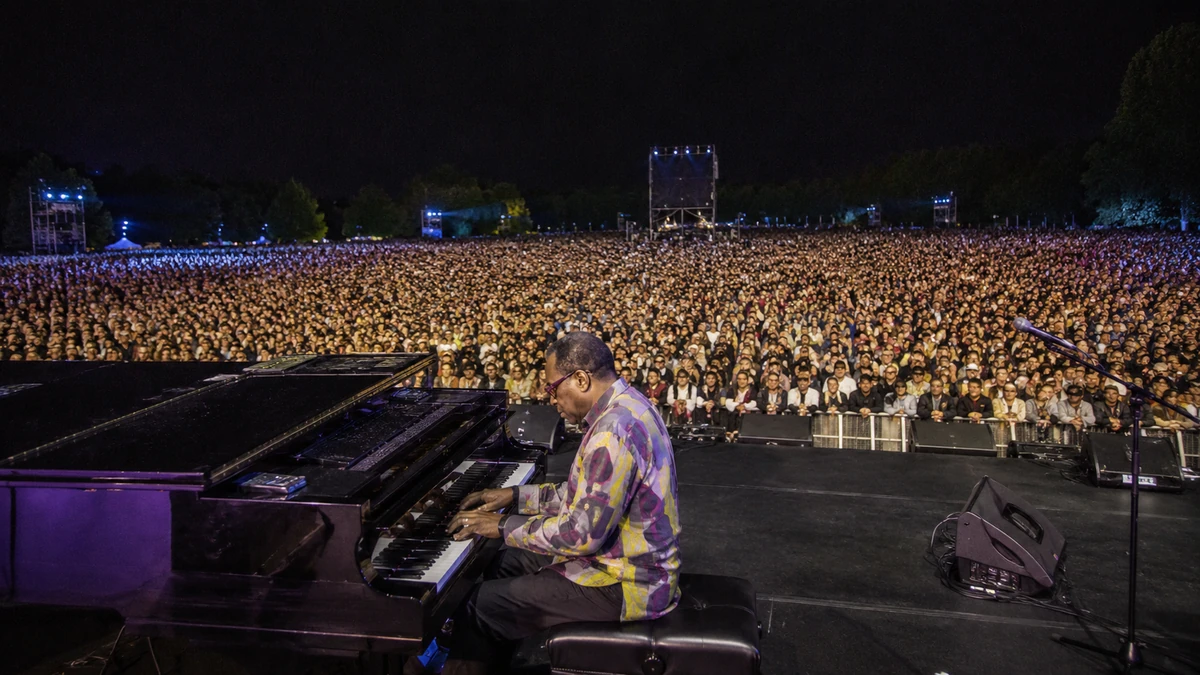
A legend in motion on a spring night in Seoul
SEOUL — For many American music fans, the image of a jazz elder can still carry a certain stereotype: a revered figure seated at the piano, delivering a dignified set heavy on memory, prestige and carefully preserved history. Herbie Hancock’s appearance Saturday night at the Seoul Jazz Festival offered something very different. The 86-year-old pianist and keyboard pioneer did not arrive in South Korea as a museum piece or a ceremonial guest star. He took the stage as the festival’s final-day headliner and, by all accounts, as a fully present, physically engaged performer who still treats live music as a living conversation rather than a tribute to his own past.
That distinction matters. Hancock’s concert at the 88 Lawn Field in Seoul’s Olympic Park was not simply another overseas stop by a famous American artist. In the context of South Korea’s contemporary live music scene, it became a demonstration of what musical longevity can look like when it is rooted not in nostalgia, but in continued risk, technical command and emotional connection with an audience. For a country better known abroad these days for K-pop, K-dramas and Oscar-winning or Emmy-winning screen storytelling, the sight of thousands gathering for a jazz headliner on a spring evening also said something else: South Korea’s cultural appetite is broader, more layered and more globally conversant than many outsiders assume.
According to Korean reporting on the performance, Hancock filled the night with energy and precision that made his age seem beside the point. That is not to say the moment carried no awareness of time. Quite the opposite. The power of the set lay partly in the visible contrast between age and vitality, between the lines on Hancock’s hands and the speed with which those hands moved across the keys, between a six-decade career and the unmistakable sense that this was not an exercise in replaying old triumphs. In a music industry that often treats youth as the primary currency of relevance, Hancock’s Seoul performance underscored a different truth: mastery can remain contemporary when it is activated in the present tense.
For American readers, there is a familiar analogy here. Think less of a legacy act dutifully running through the hits and more of a veteran athlete who, well past the age when most peers have stepped away, still changes the pace of a game in real time. Hancock’s presence in Seoul carried that kind of force. He was not simply honored for what he had done with Miles Davis in the 1960s or for landmark recordings such as “Head Hunters” and “Future Shock.” He was being received as a current artist, and the crowd responded accordingly.
Why this mattered beyond one concert
In the United States, jazz festivals often occupy a somewhat specialized place in the music calendar, serving dedicated audiences alongside tourists, arts patrons and local devotees. South Korea’s Seoul Jazz Festival has evolved into something closer to a major seasonal event, one that marks late spring in the capital with a broad, upscale and highly social audience. That matters because Hancock’s headlining slot was not tucked away in a niche cultural corner. It was positioned as a centerpiece of a prominent festival with mainstream visibility.
The symbolism of that final-night placement is hard to miss. Festivals reveal their identities through who gets the closing spotlight. To end with Hancock was to make a statement that jazz, even in a media environment dominated by short-form trends and algorithm-driven virality, still has enough weight to define the emotional and artistic tone of a large public event. It also suggested that South Korean audiences are willing — eager, even — to treat jazz not as heritage programming, but as a central live experience.
That may surprise some Americans whose picture of Korean popular culture begins and ends with stadium K-pop, beauty brands and streaming dramas. But Seoul, like New York, Los Angeles or London, contains overlapping cultural ecosystems. The same city that produces carefully choreographed idol groups also sustains indie rock venues, classical audiences, experimental art spaces and major international festivals. Hancock’s set became meaningful in part because it took place inside that wider ecology. He was not an exception to the rule so much as proof of the range within it.
The venue added another layer. Olympic Park’s wide outdoor grounds create a different kind of listening environment than a formal concert hall or seated theater. An open-air spring festival invites a blend of focus and looseness, seriousness and celebration. As daylight fades and the city’s energy shifts into nighttime, the music can feel less like a recital and more like a communal atmosphere. Korean coverage emphasized that the night itself — the season, the darkness settling in, the sense of a festival reaching its climax — became part of the performance. That is easy for American audiences to recognize if they have ever experienced the particular electricity of a summer set at Newport, New Orleans Jazz & Heritage Festival or an outdoor amphitheater where weather, mood and music fuse into one memory.
The real headline was connection, not just technique
One of the most revealing details from the concert had nothing to do with speed, virtuosity or career milestones. It was a brief greeting. Hancock reportedly told the audience he was very happy to see them because they were like part of his family, and he thanked them for coming. On paper, that may read like standard stage banter. In practice, it appears to have set the emotional terms for the entire performance.
Jazz, more than many forms of popular music, depends on reciprocity. A jazz performance is not only a delivery of arranged material but a process of real-time decision-making shaped by mood, risk, listening and reaction. Audience energy matters because it changes the room, and the room changes what the musicians choose to do inside it. Hancock’s remark effectively framed the audience not as passive consumers but as participants in the event’s creation.
That point is worth underlining for readers who may not follow jazz closely. In pop concerts, the crowd’s role is often easy to identify: singing along, cheering familiar hooks, responding to visual spectacle. In jazz, the interaction can be subtler but no less essential. A hush at the right moment, a burst of applause after a solo phrase, a wave of excitement when the ensemble shifts direction — all of that feeds the musicians. The Korean account of Hancock’s set described exactly this kind of feedback loop. As he deepened his immersion in the performance and accelerated the energy, the drummer broke the beat into finer fragments, the band tightened around him, and the overall sound surged toward the crowd with increasing density.
That description matters because it resists the simplistic story line of the solitary genius overwhelming everyone else. Hancock may be the marquee name, but what made the set compelling was the band’s collective responsiveness. The concert’s intensity came from interaction — between leader and ensemble, between stage and audience, between decades of experience and the unpredictability of the moment. In that sense, the family metaphor was not sentimental fluff. It was a concise way of saying that everyone present had a role in bringing the music to life.
For American readers, there is a useful cultural translation here. If K-pop concerts are often discussed in terms of fandom, synchronized participation and tightly organized spectacle, a night like this shows a different but equally powerful mode of communion in Korean live culture. The bond is less about fan chants and more about mutual listening. Yet the core idea is similar: a performance becomes memorable when the line between artist and audience starts to feel charged rather than fixed.
Age onstage, and the refusal to become static
Perhaps the most striking image from the Seoul performance was not simply Hancock at the keyboard, but Hancock reportedly coming forward with a wearable keyboard and moving his body with enough force to puncture any assumption that jazz is inherently still or decorous. Korean coverage described him effectively springing forward, channeling bursts of energy that animated the crowd further. It is the kind of detail that challenges old clichés about the genre as seated, cerebral and physically restrained.
This is where the concert becomes larger than a flattering profile of endurance. In the arts, older performers are often praised in terms that can be unintentionally limiting. Reviewers reach for words like “grace,” “dignity” and “still capable,” as if the main accomplishment were simply remaining upright in public. What made Hancock’s Seoul appearance notable is that such language seems insufficient. He was not merely preserving standards. He was projecting force.
The close-up image described in Korean reports — his wrinkled hands enlarged on a giant LED screen, moving rapidly and continuously over the keyboard — lands with particular emotional power because it captures time in two directions at once. The physical traces of age are visible. So is the refusal of those traces to dictate the meaning of the body onstage. The hands tell one story about years passed; the music tells another story about years transformed into instinct, reflex and authority.
That image resonates well beyond music. American culture, like many others, often swings between two simplistic attitudes toward aging: decline on one side, inspiration porn on the other. Hancock’s performance suggests something more complex and more honest. Age does not vanish. It becomes part of the performance’s texture. But it does not automatically reduce artistic power. In some cases, it deepens it by adding layers of timing, restraint, daring and perspective that younger players are still learning to access.
There is also a subtle rebuke here to the speed of the contemporary entertainment economy. Much of pop culture now rewards immediate novelty, social-media circulation and constant replacement. Hancock’s set in Seoul offered a counterargument: audiences still respond intensely to artists whose authority has been built over time, especially when that authority is not used as a shield against experimentation. Longevity means little if it hardens into repetition. Hancock’s career remains compelling because he has spent it moving across boundaries rather than policing them.
From Miles Davis to Seoul: the long arc of a restless career
Any attempt to explain Hancock to a broad American audience has to start with the sheer scale of his biography. He emerged in the early 1960s, became a key member of Miles Davis’ second great quintet and then went on to build one of the most adventurous solo careers in modern music. He did not just excel within jazz convention; he helped expand the definition of jazz by folding in funk, rock and electronic elements, pushing the music toward new textures and futures.
That history gave the Seoul performance its particular weight. This was not a case of a veteran artist visiting Asia to relive a fixed canon before polite admirers. It was the arrival of a musician whose entire significance comes from refusing to stand still. Hancock’s body of work has always argued that jazz is not a sealed-off heritage form but a porous language capable of absorbing new sounds, technologies and social rhythms. To see him headline a major spring festival in Seoul, decades after his debut, is to see that argument still playing out in public.
For readers who know Hancock primarily through a few signature reference points — perhaps “Cantaloupe Island,” the Headhunters era, or the MTV-era breakthrough of “Rockit” — the Seoul concert serves as a reminder that his career is best understood as a continuum of reinvention. That matters because South Korean audiences were not simply honoring his role in music history. They were encountering the present-day expression of a musician who has spent 64 years making change itself part of his method.
There is a fitting trans-Pacific quality to that. South Korea’s own rise as a cultural power has also been built on adaptation, hybridity and technical ambition. K-pop, after all, is fundamentally a genre of synthesis, drawing from American R&B, hip-hop, dance music and European electronic sounds while reworking them through Korean production systems and performance aesthetics. Hancock is not part of that world directly, but his career embodies a related principle: genres survive by evolving, not by sealing themselves off from contact.
That helps explain why his presence in Seoul carried more than ceremonial prestige. He represented a lineage of musical openness that remains legible in a city obsessed with what comes next. In that setting, his age did not place him outside the moment. It gave him a different authority within it.
What Seoul’s response says about South Korea now
For international readers, perhaps the broader significance of the concert lies in what it reveals about South Korea’s place in the global cultural landscape. The country is often described, understandably, through its export successes. K-pop tops charts, Korean television dominates streaming queues and Korean directors, actors and writers hold a higher profile in the West than at any point in history. But export is only one side of cultural power. The other is the ability to host, interpret and recontextualize global art on local terms.
That is what events like the Seoul Jazz Festival do. They turn South Korea not just into a producer of world-facing culture but into a site where world culture is actively consumed, debated and experienced in the present. Hancock’s performance illustrated that South Korean audiences are not only sending their own music and stories abroad. They are also participating in the preservation and renewal of international musical traditions through live performance.
This is important because it complicates simplistic East-West narratives. Too often, Asian audiences are portrayed in Western media as either markets to be tapped or superfans to be mobilized. The Seoul response to Hancock suggested something more sophisticated: a crowd that understands the stakes of a jazz performance, responds to improvisation in real time and helps generate the atmosphere in which the music can thrive. In other words, not consumers of prestige, but co-creators of the event.
There is also a social dimension to this. Outdoor festivals in Seoul have become markers of urban identity, especially in spring and fall when the weather draws residents into parks and public spaces. Much like music festivals in Chicago, Austin or Southern California, these gatherings are about more than who is onstage. They are rituals of season, lifestyle and city belonging. Hancock’s set became part of that civic texture. It was a global music story, but also a Seoul story — about how the city wants to hear itself at night, at the end of May, in one of its most recognizable public spaces.
Seen this way, the concert was not a detour from the Korean Wave. It was another expression of it, though not in the most obvious form. Hallyu, or the Korean Wave, usually refers to the spread of Korean entertainment abroad. But there is a quieter counterpart: the confidence of Korean cultural institutions and audiences in placing themselves at the center of global artistic exchange. A festival that can close with Herbie Hancock and make that moment feel immediate rather than retro is displaying exactly that confidence.
A night that argued for live music in the present tense
In the end, the most interesting question raised by Hancock’s Seoul performance may be the simplest one: Why does a live set by an 86-year-old jazz icon still command such attention in an era ruled by endless new releases, social-media trends and short attention spans? The answer, judging by the Korean reporting, is that great live performance still does something no archive, playlist or historical reputation can do on its own. It proves itself again, in front of people, under changing conditions, with the possibility of failure always nearby.
That is especially true in jazz, where the difference between competent execution and transformative performance often comes down to risk, responsiveness and presence. Hancock’s concert appears to have delivered all three. The crowd did not simply witness a famous man being famous. It witnessed an artist testing and renewing his connection with an audience in real time.
That distinction is crucial for understanding why the show resonated so strongly. Numbers help tell the story — 86 years old, a debut in 1962, more than six decades of work. But numbers do not produce electricity. Movement does. Listening does. The visible joy of a musician stepping forward rather than leaning back does. So does the willingness of an audience to meet that energy and send it back.
For American readers, there is something quietly hopeful in that picture. At a time when conversations about music can feel dominated by branding, metrics and the shrinking shelf life of attention, a spring night in Seoul offered a reminder that artistry still has a more elemental measure. It lives or dies in the room. Herbie Hancock, if the reports are any guide, did not come to South Korea to be commemorated. He came to play. And in doing so, he turned a festival-closing appearance into a broader statement about endurance, exchange and the stubborn present-tense power of jazz.
That is why this was more than a celebrity sighting or an imported prestige event. It was a live demonstration that the old categories — veteran versus current, heritage versus innovation, American jazz versus Korean audience, past achievement versus present relevance — do not hold up very well when the music is actually working. On Saturday night in Seoul, they appear to have collapsed into one scene: a master artist in motion, a crowd fully engaged, and a genre too often described in the past tense sounding very much alive.
Comments
Post a Comment