At Asia’s Premier Security Summit, South Korea Emerges as More Than a U.S. Ally — It Is Becoming a Security Stakeholder
A notable shift in how Washington talks about Seoul
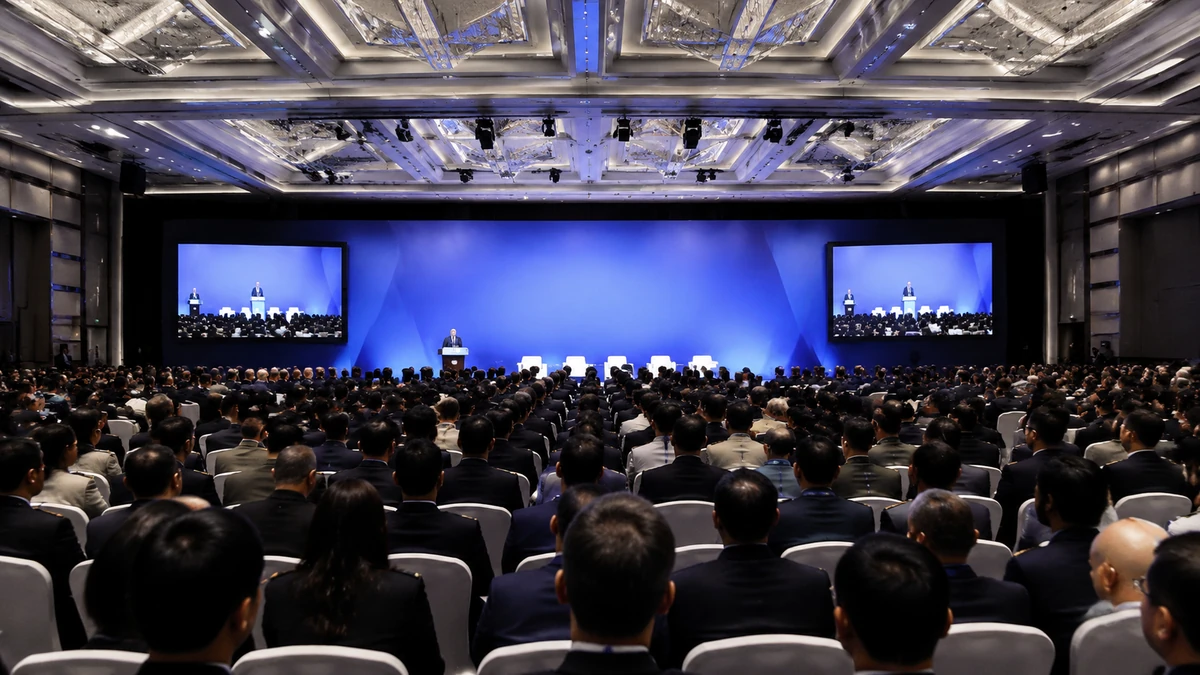
At a major security conference in Singapore this week, South Korea found itself cast in a role that would have been less common in earlier years: not simply as a frontline ally under threat, but as an increasingly capable partner expected to help shape the regional balance of power.
The occasion was the Shangri-La Dialogue, the annual gathering of defense officials, military leaders and security experts that has become one of Asia’s most important stages for strategic messaging. For American audiences, the conference can be thought of as something like a cross between the Munich Security Conference and a high-stakes Pentagon policy forum, but focused on the Indo-Pacific. What gets said there is rarely accidental.
That is why the remarks by U.S. Defense Secretary Pete Hegseth drew attention beyond the usual day’s headlines. Speaking Friday in Singapore, Hegseth said it was “encouraging” that South Korea had pledged to increase defense spending and was discussing a faster move toward greater leadership in wartime operational control. On the surface, that could sound like routine alliance praise. In context, it looked more consequential.
Hegseth paired his comments with a broader warning that the era of the United States effectively subsidizing the defense of wealthy allies is over. He also framed the U.S. position in stark terms, saying Washington needs partners, not protectorates, as it pushes back against what it sees as Chinese efforts to dominate the Asia-Pacific.
That combination matters. When an American defense secretary publicly singles out South Korea at the same moment he is demanding more responsibility from allies across the board, it signals that Washington increasingly sees Seoul as a model of the kind of ally it wants: affluent, technologically advanced, militarily serious and more willing to shoulder a larger share of the burden.
For many Americans, South Korea is still most familiar as the home of Samsung, Hyundai, Oscar-winning director Bong Joon Ho, and the global wave of K-pop and Korean dramas. It is also often viewed through the narrow lens of North Korea’s nuclear threat. But this latest moment in Singapore points to a broader reality. South Korea’s rise is no longer only cultural or economic. It is also strategic.
Why the Shangri-La Dialogue matters
The Shangri-La Dialogue does not produce treaties the way a formal summit might. It is better understood as a place where governments test language, send signals to adversaries and reassure or pressure allies in full public view. In diplomacy, especially on security issues, those signals can matter nearly as much as signed documents.
That is particularly true in Asia, where the regional order is being reshaped by intensifying competition between the United States and China. Countries across the Indo-Pacific are trying to strengthen deterrence without tipping into open conflict. In that environment, speeches are not just speeches. They are a way of defining who is in, who is reliable and who is expected to do more.
South Korea’s inclusion in Hegseth’s remarks is significant because it came in the middle of a larger argument about how the United States plans to maintain its position in the region. Hegseth emphasized that no country, including China, should be allowed to intimidate the United States or its allies into accepting a new regional hierarchy. But he also made clear that maintaining deterrence will require more than American military might alone.
The message, in effect, was that U.S. alliances are being updated. Washington still offers strategic protection and remains the central military power in the network. But it now expects allies to move beyond dependence and into something closer to co-management. That is the deeper meaning behind language about “partners” rather than “protectorates.”
For American readers, there is a familiar analogy here. In Europe, Washington has spent years pressing NATO allies to spend more on defense and develop greater capacity of their own. In Asia, the conversation is more complicated because the alliance architecture is different, more bilateral and shaped by distinct historical tensions. But the logic is similar: the U.S. wants capable allies who can act faster, invest more and contribute more directly to deterrence.
Against that backdrop, South Korea was not mentioned merely as a country under U.S. protection. It was presented as a country moving in the right direction — one that is beginning to fit Washington’s updated definition of a strong ally.
What wartime operational control means — and why it is such a big deal
One of the most important parts of Hegseth’s remarks involved a phrase unfamiliar to many outside Korea policy circles: wartime operational control, often shortened to OPCON.
For readers in the United States, this concept needs some unpacking. Operational control refers to who would command combined military forces in wartime. Because of the history of the Korean Peninsula — from the Korean War to the decades-long threat posed by North Korea — the U.S.-South Korea alliance developed a command structure unlike most other U.S. alliances. In practical terms, wartime command arrangements have long symbolized both the depth of the alliance and the unusual degree of American leadership embedded within it.
That is why debates over transferring wartime operational control have always been larger than military bureaucracy. They touch on questions of sovereignty, readiness, trust and political identity. Supporters of a greater South Korean role argue that a prosperous democracy with one of the world’s most advanced militaries should have a stronger hand in directing its own defense in wartime. Skeptics caution that command structures must match the realities of deterrence on a peninsula still technically at war and facing a nuclear-armed North Korea.
So when a U.S. defense secretary publicly describes movement toward South Korea taking faster leadership in this area as “encouraging,” it carries symbolic weight. This is not the kind of issue officials casually highlight unless they want their words noticed in allied capitals, adversary capitals and financial markets alike.
It does not mean an immediate change has been finalized. There was no indication in the available summary of a signed timeline or definitive agreement. But in alliance politics, a favorable public description from a senior U.S. official can serve as a marker. It tells the world that Washington is comfortable with the direction of travel, even if the technical details remain unsettled.
For South Korea, that matters because OPCON has long been one of the clearest tests of how autonomous the country is prepared to become while remaining tightly anchored to the United States. For the broader region, it matters because a South Korea that takes more responsibility in command decisions is a South Korea that looks less like a security dependent and more like an active strategic player.
South Korea’s image is changing, abroad and at home
This shift in language also reflects a larger transformation in South Korea’s international profile. For decades, South Korea was often discussed abroad in defensive terms: a divided nation, a vulnerable democracy, a place whose fate could be shaped by larger powers around it. That framing was not wrong, but it was incomplete.
Today’s South Korea is the world’s 10th- or 12th-largest economy depending on the measure, a manufacturing powerhouse, a leading semiconductor producer and a major exporter of cars, batteries, ships and increasingly defense equipment. Its democratic institutions have weathered intense domestic pressures. Its cultural reach, through music, film, streaming dramas and beauty products, has made it one of the most recognizable countries in the world far beyond its size.
Yet that cultural visibility has often outpaced international awareness of South Korea’s growing security role. American audiences can likely name BTS more quickly than they can describe the structure of the U.S.-South Korea alliance. They may know “Parasite” or “Squid Game,” but not realize that South Korea fields one of the world’s most capable militaries and sits at the center of nearly every major strategic calculation in Northeast Asia.
The remarks in Singapore suggest that this gap is narrowing. South Korea is being described in more multidimensional terms: not just as a consumer of security, but as a contributor to it; not just as a country that reacts to regional danger, but as one that helps organize the response.
That distinction has practical consequences. In international politics, being praised as a responsible stakeholder can bring prestige, but it also brings expectations. A country treated as a serious security partner will face more scrutiny over how much it spends, how it structures command, what capabilities it acquires and how clearly it aligns itself in strategic competition.
In other words, recognition can feel a lot like pressure. When Washington holds South Korea up as a positive example, it is not simply complimenting Seoul. It is also placing it under a brighter spotlight.
The China factor is impossible to ignore
None of this can be separated from the broader U.S.-China rivalry that now shapes much of Indo-Pacific strategy. Hegseth’s speech reportedly included a forceful message that no country should be able to use regional dominance to shake the security of the United States and its allies. That line was aimed above all at China, whose military modernization, maritime assertiveness and growing pressure on Taiwan and in the South China Sea have alarmed Washington and many of its partners.
South Korea occupies an especially complicated position in that landscape. It is a treaty ally of the United States and home to a substantial American military presence. At the same time, China is a major economic partner, and South Korea has often tried to avoid being boxed into stark either-or choices. That balancing act has become harder as U.S.-China competition intensifies.
From Washington’s perspective, South Korea’s value extends well beyond the Korean Peninsula. It is a linchpin state in a region that connects Japan, Taiwan, Southeast Asia and the wider Pacific. It sits in a geopolitically sensitive location, possesses advanced defense-industrial capacity and has the economic depth to support a more robust military posture if it chooses.
That helps explain why South Korea’s mention at Shangri-La carried diplomatic significance. It suggested that the United States increasingly sees Seoul not merely through the narrow prism of deterring North Korea, but as part of a larger network meant to preserve the regional balance against Chinese coercion or hegemony.
For South Korea, however, that elevated role comes with difficult choices. The more it is praised as a central U.S. partner in the Indo-Pacific, the harder it may be to maintain ambiguity in moments of regional crisis. Whether the issue is Taiwan contingencies, supply-chain security or military coordination with Japan and other U.S. partners, expectations on Seoul are likely to grow.
That does not necessarily mean South Korea will abandon its caution. Korean governments, regardless of ideology, have often tried to keep room for diplomatic maneuver. But the political space for sitting comfortably in the middle appears to be shrinking.
Defense spending is about more than the numbers
Hegseth’s comments also underscored a broader point: in the current American view, the issue is not only how much allies spend, but what that spending says about their political will and strategic seriousness.
The United States has committed itself to enormous military investment of its own, with Hegseth citing a figure of $1.5 trillion. At the same time, Washington has repeated calls for allies and partners to raise defense spending to 3.5% of gross domestic product. Those are eye-catching numbers, but the more revealing part of the message may be the political language attached to them.
When U.S. officials say they want partners rather than protectorates, they are talking about a mindset as much as a budget line. They want allies that can make difficult decisions, invest in capabilities, take on more command responsibility and act with speed in a crisis. Spending becomes a visible measure of commitment, but not the only one.
That is why South Korea’s mention was important. It was cited not just for increasing defense spending, but for moving toward a posture in which it leads more quickly and more decisively in military operations. In Washington’s terms, that is what a mature alliance looks like.
There is also an industrial dimension here that American readers should not overlook. South Korea is not simply capable of buying more weapons. It is increasingly capable of making them, exporting them and integrating high-end technology into defense production. In an era when supply chains, munitions stockpiles and industrial resilience have become central strategic issues — lessons sharpened by the war in Ukraine — that makes South Korea more valuable to the United States and its partners.
Its identity as a “rich country” matters in this conversation, too. The U.S. argument is straightforward: wealthy democracies facing serious threats should not rely on Washington to carry a disproportionate share of the burden. South Korea, with its strong economy and advanced military base, is exactly the kind of country that argument targets — and the kind Washington now wants to showcase when the response is positive.
What this means for how the world sees South Korea
There is an important media angle to this story as well. International coverage of South Korea often falls into one of three categories: North Korea tensions, export-driven economics or globally popular entertainment. All are real, but each can flatten the country into a single narrative.
The significance of the Singapore remarks is that they point toward a fourth narrative, one likely to become more prominent in the years ahead: South Korea as a strategic actor in its own right.
That does not mean South Korea has suddenly become a military great power on the level of the United States or China. It does mean that its choices now carry more regional consequence. When Seoul adjusts defense spending, debates command authority or refines its posture toward Washington, Beijing and Tokyo, those decisions increasingly reverberate well beyond the peninsula.
For American readers, this may require a subtle but important update in perspective. South Korea is not just a place where the United States stations troops to deter North Korea. It is also a country whose leaders are being asked to help define how deterrence works in Asia, how alliance networks evolve and how democracies respond to strategic pressure from larger authoritarian neighbors.
Seen that way, Hegseth’s praise was less about diplomatic courtesy than about strategic categorization. South Korea was being placed in a new frame: not simply as vulnerable, but as capable; not only as exposed, but as responsible; not just as an ally to defend, but as an ally expected to defend alongside the United States.
That reframing matters because language often precedes policy. Before governments revise doctrine or announce major new initiatives, they often begin by changing how they describe one another. In Singapore, the language surrounding South Korea suggested that the country’s role in the U.S.-led regional order is widening.
A bigger role, and bigger expectations
If there is a central takeaway from this episode, it is that South Korea’s global standing is broadening from cultural influence and economic power into the realm of hard security. The same country that exports chart-topping music, acclaimed films, memory chips and electric vehicles is also being recognized as a more assertive player in the architecture of Asian deterrence.
That is a meaningful evolution. It reflects South Korea’s material capabilities, but also a changing U.S. approach to alliances. Washington no longer wants relationships defined mainly by protection. It wants partnerships defined by contribution, capacity and initiative. In that framework, South Korea is being presented not as a passive beneficiary of American power, but as one of the allies helping sustain it.
There are obvious risks to that shift. Greater responsibility can sharpen tensions with China, intensify domestic debates in South Korea and raise the stakes of every budget decision or command adjustment. Public praise from Washington can be politically useful, but it can also lock a country into expectations that become difficult to navigate later.
Still, the symbolism of the moment is hard to miss. At one of Asia’s highest-profile security forums, a senior American official chose to highlight South Korea as an encouraging example at a time when the United States is openly demanding more from allies. That says something about where Seoul now stands.
For years, South Korea’s global story has been told through its transformation from war-torn state to democratic success story, from manufacturing hub to cultural powerhouse. Those chapters remain true. But another chapter is now being written — one in which South Korea is increasingly seen not only as a country shaped by the regional order, but as one helping shape that order itself.
For the United States and other English-speaking audiences, that is the deeper meaning of the news from Singapore. South Korea is not just in the room anymore. It is being called on, publicly, to help lead.
Comments
Post a Comment