Ozone Alert Across Gyeonggi Puts Millions Near Seoul on Notice as South Korea Confronts a Familiar Warm-Weather Air Threat
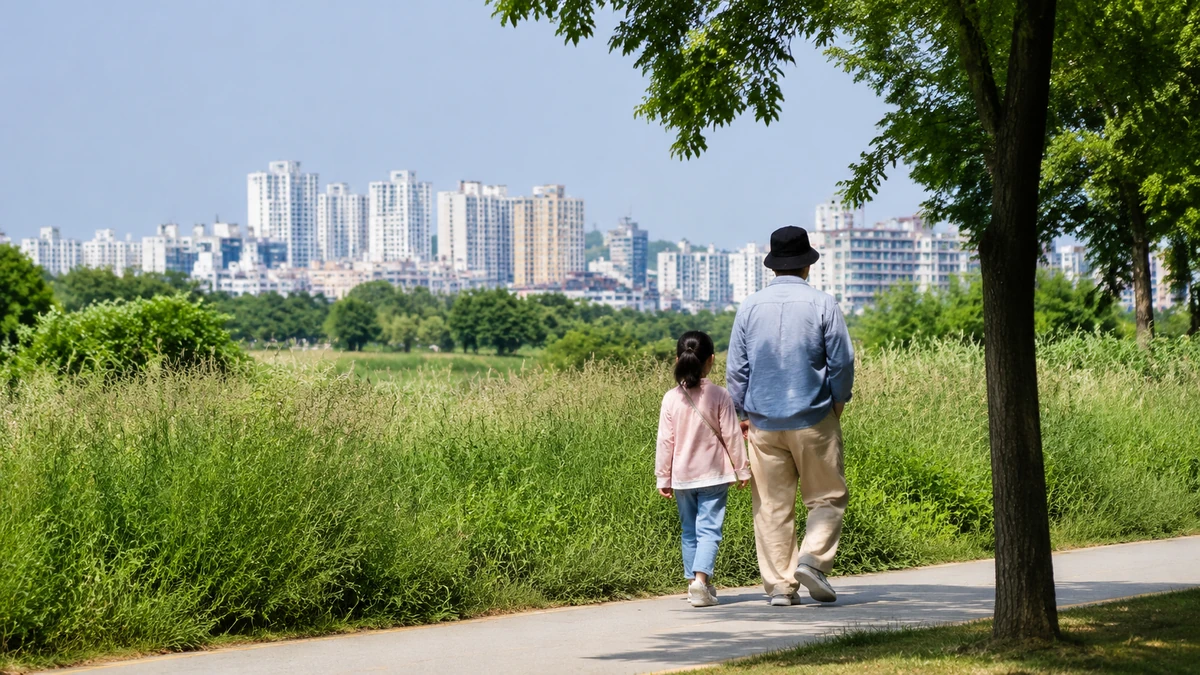
A midday air-quality warning with immediate consequences
South Korean authorities issued an ozone advisory Friday afternoon for 18 cities and counties in central and eastern Gyeonggi Province, a densely populated region that wraps around Seoul and functions much like the suburban and exurban belt around a major American metropolis. The advisory, announced at 1 p.m., covered a broad swath of communities including Suwon, Seongnam, Anyang, Bucheon, Ansan and Hanam — places tied together by heavy commuting, industrial activity, school schedules and family routines. In practical terms, the warning was not just a weather note. It was a public-health directive affecting how millions of people should move through the day.
The alert was based on hourly average ozone concentrations measured by the Korea Environment Corp., a government-linked agency that tracks air quality nationwide. Officials reported ozone levels of 0.1309 parts per million in the central zone and 0.1254 parts per million in the eastern zone, both above South Korea’s threshold of 0.12 parts per million for issuing an ozone advisory. Earlier the same day, authorities also issued a similar alert for eight northern Gyeonggi jurisdictions, indicating that the problem was not confined to one corner of the province but spread across much of the broader Seoul metropolitan sphere.
For American readers, an ozone advisory is closest to the kind of air-quality alert issued during a smoggy summer day in Los Angeles, Houston or Atlanta, when hot weather and emissions combine to create unhealthy breathing conditions. Ozone high in the atmosphere helps shield the Earth from ultraviolet radiation, but at ground level it becomes a pollutant that can irritate the lungs, worsen asthma and make outdoor exercise risky, especially for children, older adults and people with heart or respiratory disease. South Korean officials emphasized those same groups Friday, urging them to avoid outdoor activity and advising the general public to skip strenuous exercise outside.
That distinction matters because the story here is not only about numbers on a monitoring chart. It is about what happens when an invisible hazard interrupts ordinary urban life. Parents may reconsider playground outings. Older residents may cut short afternoon walks. Schools, outdoor workers and commuters may need to adjust plans. In a region as interconnected as Gyeonggi, where city boundaries blur into one another and daily life often involves crossing multiple jurisdictions, an ozone advisory becomes a broad warning to an entire living network, not simply a single-city announcement.
Why Gyeonggi matters far beyond one province
To understand why this warning carries weight, it helps to understand Gyeonggi Province’s place in South Korea. Gyeonggi surrounds Seoul, the capital, in much the same way that Northern Virginia and Maryland ring Washington, or the counties surrounding New York and New Jersey feed into the New York metropolitan economy. It is South Korea’s largest provincial population center and home to a patchwork of bedroom communities, industrial hubs, logistics corridors and leisure destinations. Residents may live in one city, work in another and spend weekends in yet another, all within the same highly integrated metropolitan orbit.
The list of affected communities underscores that point. Suwon is a major urban center south of Seoul. Seongnam is a large city known for both residential density and business districts. Bucheon and Anyang are part of the tightly packed urban belt west and south of the capital. Ansan and Hwaseong have significant industrial and manufacturing activity, while Namyangju, Guri and Hanam are closely tied to the capital region’s housing and commuter patterns. Farther out, Yangpyeong and Gapyeong are better known to many Koreans as getaway areas, places where city residents might travel for outdoor breaks or family outings. When all of them fall under the same ozone advisory umbrella, the warning stretches across very different kinds of daily life at once.
That breadth is part of what makes the advisory newsworthy. The issue is not merely environmental in an abstract sense. It touches transportation, family care, labor, education and recreation all at once. A parent deciding whether to take a toddler outdoors, a delivery worker spending hours on the road, a retiree planning an afternoon walk and a student athlete hoping to practice after lunch all encounter the same question: Is it safe to stay outside for long? In that sense, the advisory acts as a public signal telling a whole region to slow down its daytime outdoor rhythm.
For an American audience, that may sound familiar in a different form. In many U.S. cities, summer air alerts are often folded into weather coverage and public-service messaging, sometimes competing with heat advisories, wildfire smoke warnings or thunderstorm forecasts. South Korea’s system works in a comparably structured way, but in a more geographically compressed environment where millions of people live close together and rely on shared transportation and public spaces. That density can make even a moderate-seeming advisory carry outsized social impact.
What the numbers mean, and why they are taken seriously
The measurements behind Friday’s alert are important because they were not barely at the threshold. The reported hourly average ozone concentration in central Gyeonggi, 0.1309 parts per million, exceeded the advisory benchmark of 0.12 parts per million by a meaningful margin. The eastern zone reading, 0.1254 parts per million, was also above the trigger level. In other words, this was not a case of authorities acting out of excessive caution over a borderline reading. The values clearly crossed the standard used to launch public warnings.
South Korea’s ozone warning system is tiered. An advisory is issued when the one-hour average reaches at least 0.12 parts per million. A stronger warning is triggered at 0.30 parts per million, and a severe warning at 0.50 parts per million. Friday’s readings were nowhere near the highest emergency categories, but they were solidly inside the first stage at which people are expected to change behavior. That is a crucial distinction. Public-health systems are not only built for catastrophic moments; they are also designed to intervene early enough to reduce harm before conditions become dramatically worse.
Ground-level ozone is especially tricky because it cannot be seen directly in the way smoke or haze often can. People may not realize the air has become more dangerous at the very moment when sunny, warm weather seems to invite outdoor activity. Ozone tends to rise on hot, bright days when sunlight reacts with pollutants such as nitrogen oxides and volatile organic compounds, many of them linked to vehicle exhaust, industrial emissions and other urban sources. That makes the advisory system particularly important: it translates complex monitoring data into simple advice people can use in real time.
In public communication, those thresholds serve much the same role that hurricane categories, pollen counts or UV indexes do elsewhere. They convert environmental measurement into an actionable scale. Yet ozone may be harder for the public to intuit because the danger is less obvious and often feels less dramatic than a storm warning. There are no toppled trees or flooded intersections to signal urgency. Instead, the risk is dispersed and physiological — a scratchy throat, tighter chest, shortness of breath during exercise, worsened asthma symptoms or added strain on vulnerable hearts and lungs. That subtlety is exactly why clear alerts matter.
The most important part of the story is the behavior guidance
South Korean authorities and news outlets made the central public message explicit: older adults, children, and people with respiratory or heart disease should refrain from outdoor activity, while the broader public should also avoid strenuous exercise outside. That wording may sound routine, but it is in fact the heart of the story. An ozone advisory is not primarily about atmospheric science for its own sake. It is a request — backed by data — for residents to immediately reconsider how they spend the day.
That guidance lands differently across households. Families with young children may swap outdoor plans for indoor ones. Schools or day care centers may need to rethink recess or field activities. Fitness enthusiasts may postpone runs, bike rides or soccer sessions. Outdoor laborers, from construction crews to street-level service workers, face a harder reality: they often have less flexibility in avoiding exposure, even when public-health guidance says they should limit exertion. In that respect, ozone alerts also expose an inequality common to environmental hazards worldwide — some people can simply go inside, while others have jobs or obligations that keep them outdoors.
Older adults may feel the effects quickly. In South Korea, as in the United States, many retirees maintain regular walking routines for exercise and social connection. Children are another concern because their lungs are still developing and they tend to be active outdoors when weather turns warm. People with asthma, chronic obstructive pulmonary disease or cardiovascular conditions can be particularly vulnerable even when they appear otherwise healthy. Public-health messaging often singles out those groups not to cause alarm, but because the physiological evidence is clear: ozone exposure can aggravate underlying conditions and increase discomfort or medical risk.
Even healthy adults are not exempt from concern. Officials advised the general public to avoid heavy outdoor exertion, a reminder that ozone’s effects are not limited to a narrow high-risk group. Anyone doing intense activity outside breathes more deeply and takes in more air, which can increase exposure and irritation. That is why alerts often focus not only on whether people should go outside, but on what kinds of activity they should avoid once outside.
This is one reason stories like this belong on the public-safety and society beat, not tucked away as a narrow environmental brief. The consequences are immediate and practical. A warning like Friday’s reaches into care work, public recreation, schooling, fitness culture, commuting and workplace safety all at once. It changes behavior because it has to.
A warning spread across linked urban, industrial and leisure zones
The geographic spread of Friday’s advisory is striking. This was not a single industrial district posting a bad reading, nor a one-off spike in a rural pocket. It included major residential cities, areas with significant factory and logistics activity, and communities that connect directly to Seoul’s suburban commuter web. In addition, places better known as recreational escapes for urban residents were also under the same warning framework. That combination makes the advisory feel less like a localized pollution issue and more like a metropolitan event.
The same day’s earlier alert for eight northern Gyeonggi jurisdictions reinforced that point. According to officials, the northern zone’s hourly average ozone concentration reached 0.1274 parts per million, also above the advisory threshold. Taken together, the northern and the central-eastern alerts meant that large sections of the province were placed under ozone management protocols within hours of one another. It was, effectively, a day when much of the greater Seoul periphery had to respond to the same air-quality problem in staggered sequence.
That matters in a region where movement across city lines is routine. A resident may leave home in Seongnam, work in Seoul, meet family in Suwon and head to a park in Hanam or farther east on the weekend. In American terms, imagine a summer air alert stretching across multiple counties surrounding Chicago or the Washington region, affecting not one city’s downtown but an entire shared corridor of homes, schools, industrial sites and green spaces. The social meaning of the warning expands as soon as residents realize it travels with them, crossing the invisible borders that normally separate one jurisdiction from another.
It also highlights a deeper reality about air pollution: it does not respect administrative lines. Governments may issue alerts by city, county or zone because that is how public systems are organized, but the atmosphere works on a larger scale. Friday’s readings effectively reminded residents that the capital region’s air is a shared environment, shaped by traffic, industry, weather and geography across a wide area. That makes coordinated monitoring and fast communication essential.
Why this kind of automated public information still carries real weight
The underlying Korean report noted that the alert story was automatically generated from official air-quality data and then reviewed by editors. In some media settings, the phrase “automatically generated” can make a story sound minor or mechanical. In this case, it should be understood almost the opposite way. Standardized, rapidly published public-service information can be one of the most important functions a newsroom performs, especially when the subject is a time-sensitive health advisory rather than a political argument or feature profile.
There is a reason these stories rely on formula, thresholds and direct instructions. When ozone concentrations rise, the goal is not literary flair. It is speed, clarity and consistency. What time was the advisory issued? Which places are covered? What were the measured concentrations? What does the warning level mean? Who should limit activity? Those are the essential questions, and a tightly structured system can answer them faster than a conventional reported narrative built from phone calls and scene-setting.
That does not reduce the significance of the information. If anything, it underscores how modern public safety increasingly depends on the handoff between sensor networks, government agencies and news distribution. Air pollution is an invisible risk. If data collection is delayed, or if alerts fail to reach people promptly, the advisory loses practical value. The combination of automated drafting and editorial oversight reflects an effort to make that chain faster without discarding accountability.
American readers have seen similar shifts in weather alerts, earthquake notices, transit disruptions and election returns, where machine-assisted publishing plays a larger role. The journalism value lies not in pretending a data-driven bulletin is a hand-crafted feature, but in presenting it accurately, quickly and in a form readers can use. Friday’s ozone advisory is a reminder that some of the most useful reporting is also the most straightforward: conditions have crossed a threshold, and here is what the public should do next.
What this says about everyday risk in a highly connected Korea
There is a temptation to think of major news only in terms of dramatic crises — storms, crashes, political upheavals or celebrity scandals. But many of the pressures that shape modern urban life arrive more quietly. An ozone advisory does not produce the visual shock of a natural disaster. It does something subtler: it asks a whole region to adjust itself because the air has become less safe, even if the sky still looks ordinary.
That is part of what makes this a meaningful story for readers outside South Korea. It offers a window into how a technologically advanced, densely populated society manages routine risk. The process is structured: measurements are gathered, thresholds are defined, alerts are issued, and citizens are expected to modify behavior. It is a bureaucratic system, but also an intimate one, because it reaches directly into the choices people make about children, health, work and movement. It is the infrastructure of daily safety operating in real time.
Gyeonggi’s role amplifies that lesson. Because the province is so deeply tied to Seoul and to South Korea’s broader economic engine, changes there reverberate widely. When a warning covers communities with heavy population density, strong industrial links and constant mobility, it becomes more than a local environmental item. It becomes a marker of how metropolitan life depends on invisible but carefully monitored systems — air, transit, power, data and public communication.
There is also a broader climate-era context. Hotter weather and more volatile environmental conditions in many parts of the world have made air-quality issues increasingly central to everyday public life, whether from ozone, wildfire smoke, dust or urban pollution. South Korea is hardly alone in confronting that challenge. But Friday’s advisory shows how those pressures play out in a place where land is limited, cities are compressed and millions share the same atmospheric basin around the national capital.
In the end, the significance of the alert lies less in whether it reached the most severe category and more in how seriously the first warning stage is treated. Once the threshold is crossed, the message is simple: daily life should change. That is the real story behind the numbers. In a broad region surrounding one of Asia’s most dynamic capitals, an invisible pollutant became important enough to reshape the afternoon for millions of people — a reminder that public safety in the modern city often begins with hazards no one can see.
Comments
Post a Comment