A Korean film’s big Cannes moment came with an uncomfortable reminder
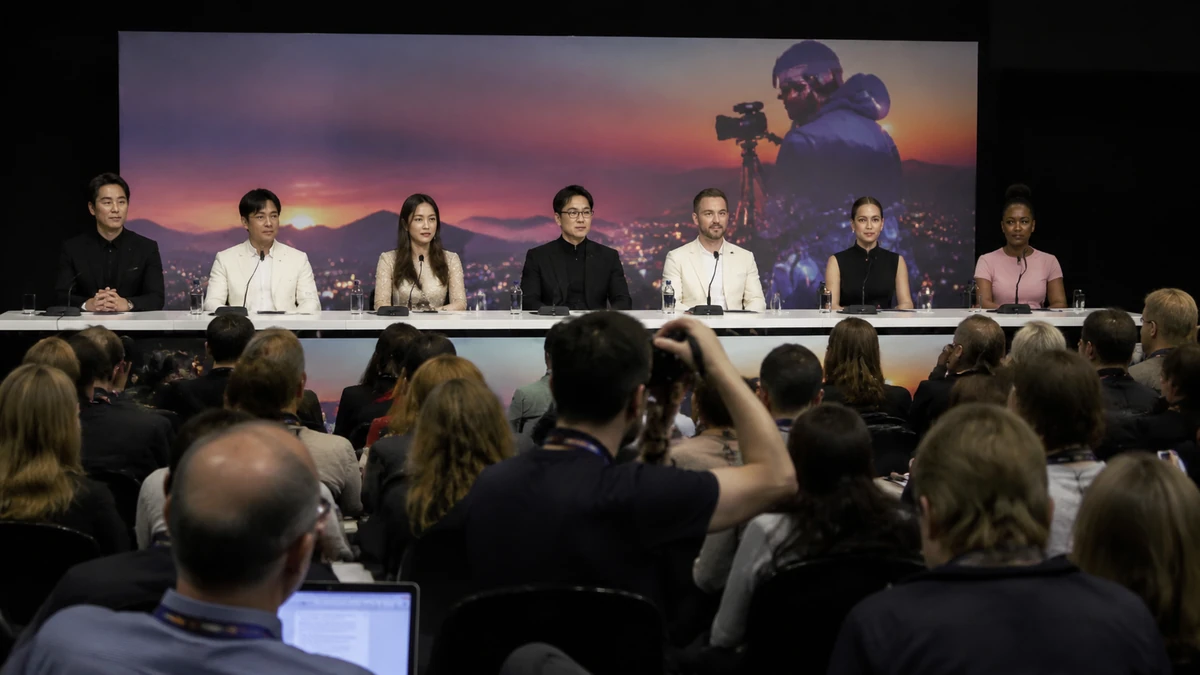
For South Korean cinema, the image itself was powerful enough to tell a larger story. At the Cannes Film Festival, one of the most prestigious stages in global filmmaking, director Na Hong-jin appeared before the press for his competition entry “Hope,” joined by a cast that reflected the increasingly borderless nature of contemporary moviemaking. On one side were major Korean stars including Hwang Jung-min, Zo In-sung and Jung Ho-yeon. On the other were internationally known actors Michael Fassbender, Alicia Vikander and Taylor Russell. Together, they represented a reality that would have seemed far less common even a decade ago: a Korean director unveiling a film at the center of world cinema with Korean and Western actors sharing the same marquee.
Then came the question that shifted attention away from the film itself.
According to South Korean media reports and accounts circulating online, an English-speaking reporter at the official Cannes press conference sparked controversy by failing to identify his name and media outlet before asking a question, then effectively singling out Fassbender and Vikander while dismissing the rest of the people onstage. The reporter reportedly said, in substance, that he did not really know the others, greeted the married couple specifically, and asked the director why he had cast them. The question then reportedly turned cruder, suggesting a kind of “package deal” because Fassbender and Vikander are married.
At one level, it was a case of bad manners in a room that runs on protocol. At another, it landed as something more revealing: a snapshot of how quickly a major international event can slide back into familiar hierarchies, where globally recognizable Western names become the focal point and everyone else, including the filmmaker whose movie is being discussed, is treated as secondary.
That is why the moment resonated beyond one awkward exchange. For many Korean observers and global fans of Korean entertainment, the controversy was not just about rudeness. It was about whether the international conversation around Korean culture has truly caught up to the reality of Korean cultural influence.
Why Cannes matters so much in the first place
To American readers who follow the Oscars more closely than Cannes, it helps to understand the symbolic weight of the festival. If the Academy Awards are Hollywood’s biggest annual prize ceremony, Cannes is something closer to the world’s most influential artistic showcase for film. Being invited to compete there signals more than commercial viability or celebrity draw. It means a movie is entering a global conversation about cinema as art, culture and industry all at once.
For South Korea, Cannes has long been part of a larger story about cultural ascent. Korean directors including Park Chan-wook, Bong Joon Ho, Lee Chang-dong and Hong Sang-soo have all become familiar names on the festival circuit, helping redefine what international audiences expect from Korean filmmaking. That trajectory culminated in new ways when Bong’s “Parasite” won the Palme d’Or at Cannes in 2019 and then became the first non-English-language film to win the Oscar for best picture in 2020. For American audiences, that victory was a watershed moment, one that made subtitles less of a barrier and Korean storytelling far less niche.
But the so-called Korean Wave, or “Hallyu,” extends beyond film. Over the last two decades, Korean pop music, TV dramas, fashion, beauty brands and streaming-era celebrity culture have built a global audience that now includes millions of Americans. BTS sold out stadiums in the United States. Netflix’s “Squid Game” became a worldwide phenomenon. Korean actors who might once have been introduced to Western audiences as discoveries are now, in many cases, already stars to viewers around the world.
That is part of what made the incident at Cannes feel out of step. A reporter treating Korean talent at a major Korean film’s press conference as unfamiliar background figures was not just exposing personal ignorance. To many viewers, it suggested that some corners of international media still operate with an outdated mental map, one that has not fully registered how much the center of gravity has shifted.
The problem was not only the question, but the frame
Film festival press conferences are not casual fan events. They are part publicity, part criticism, part public record. They are spaces where directors explain their intentions, actors describe their approach to character, and journalists try to draw out themes that help audiences and critics understand what a film is trying to do. The etiquette can vary by country and event, but some basics are widely understood: identify yourself, be concise, and ask a question that respects the room and the work under discussion.
What appears to have upset so many people was not only the reporter’s tone, but the structure of the question itself. In a setting meant to discuss “Hope” as a film, the exchange reportedly reduced attention to the celebrity status and marital relationship of two cast members. That framing can feel familiar to American readers who have watched junket culture turn interviews into gossip, or who have seen women actors asked about dresses while men are asked about craft. It is not difficult to imagine the backlash if a reporter at a major U.S. festival dismissed most of a cast and asked whether a married Hollywood couple had been hired as a convenient bundle.
Words such as “package” are especially loaded in that context. They suggest not artistic collaboration, but transactional convenience. The implication is that the creative rationale behind casting matters less than a marketable hook. That can be diminishing to the actors involved, but it also sidelines the filmmaker’s larger vision and the contributions of everyone else onstage. In this case, that included Korean actors with major bodies of work, as well as Na himself, a director with a significant reputation in genre cinema.
There is also a subtler issue here, one that is familiar in cross-cultural coverage. When journalists default to the faces they already recognize, they risk rewriting the event around their own limits rather than the reality in front of them. In other words, “I don’t know these people” becomes a lens through which the audience is encouraged not to know them either. That is precisely the opposite of what international reporting should do. The point is not merely to reflect existing fame hierarchies, but to help readers understand why people matter in contexts outside their own.
Who Na Hong-jin and his cast are, and why that matters
For readers in the United States who may know Fassbender and Vikander more readily than the Korean stars on the stage, a little context is essential. Na Hong-jin is one of the most distinctive filmmakers to emerge from South Korea’s modern cinema boom. He is best known for dark, intense and often unsettling films such as “The Chaser,” “The Yellow Sea” and “The Wailing.” His work tends to mix genre suspense with psychological dread and social unease, the kind of filmmaking that has earned admiration from cinephiles well beyond Korea.
Hwang Jung-min is one of South Korea’s most respected and recognizable actors, known for a range that stretches from action and crime films to emotional dramas. Zo In-sung has long been a major star in both film and television, while Jung Ho-yeon became instantly familiar to many American viewers through “Squid Game,” then expanded her profile into global fashion and international screen work. In other words, the Korean side of the “Hope” cast is not an anonymous supporting presence orbiting Hollywood names. It is a group of established figures who carry enormous cultural weight in their own industry and increasingly abroad.
The inclusion of Fassbender, Vikander and Russell points to something else: Korean projects are no longer simply being exported after the fact. They are increasingly being built from the ground up as international collaborations, with financing, casting, marketing and critical reception all unfolding across borders. That is an important distinction. In an earlier era, a Korean film might play festivals overseas and gradually find an audience through critics and art-house theaters. Now Korean directors can assemble multinational casts and still remain the creative center of the project.
That shift matters because it challenges a long-standing assumption in Western entertainment coverage: that legitimacy still mostly flows from Hollywood outward. The reality looks different now. Korean film and television do not need Western actors to become real, but Western actors increasingly see value in participating in Korean-led projects because that is where some of the most exciting storytelling is happening. When a Cannes press conference fails to reflect that balance, the misstep stands out more starkly.
What the backlash says about the new sensitivity around K-culture
The response to the Cannes moment also reveals something important about the audience that now surrounds Korean culture. Ten or 15 years ago, a slight at a Korean film press event might have remained a local irritation. Today, such moments can ricochet across social media in multiple languages within hours, interpreted not only by Korean outlets and domestic viewers, but by international fans who follow Korean entertainment with the fluency once reserved for local industries.
This global fan ecosystem can be a double-edged sword. It sometimes amplifies outrage faster than facts can be fully established. But it also means that dismissive or imbalanced treatment no longer passes unnoticed. International fans of Korean cinema and television are often keenly aware of how Western institutions frame Asian artists. They have watched years of reductive coverage, from treating subtitled work as exotic to asking East Asian performers the same stale questions about cultural difference instead of artistic choices.
In that sense, the reaction to Cannes was about standards, not hypersensitivity. There is a growing expectation that if media organizations want access to global culture, they should do the homework that global culture requires. That means knowing who is in the room, understanding why they matter, and resisting the lazy instinct to organize every conversation around the most familiar Western reference point.
American readers can understand this through a parallel in U.S. sports or music. Imagine covering an international basketball tournament and asking only about the one NBA player while brushing aside the local stars who define the event for everyone else. Or imagine attending a Latin music awards press conference and directing all serious attention to the most recognizable crossover act while ignoring the artists central to the genre. The issue is not simply ignorance. It is that the ignorance gets built into the public conversation, flattening the culture it is supposed to illuminate.
A broader pressure point in South Korea’s entertainment industry
The controversy also arrived amid a broader climate of scrutiny around South Korean entertainment, where success increasingly brings heightened accountability at every stage of production and promotion. On the same day that coverage of the “Hope” press conference circulated, South Korean media also reported on a separate cultural dispute involving a drama accused of historical distortion. According to those reports, the broadcaster moved to delete a controversial ending scene from one episode and to close a related pop-up event earlier than planned.
The two incidents are not the same. One concerns media etiquette on an international stage. The other concerns domestic criticism over how history is represented in a TV drama. But together they illustrate the pressure now surrounding Korean content. As Korean entertainment has become more global, every aspect of it, from storytelling choices to promotional messaging to media interpretation, faces more intense examination.
This is, in some ways, the cost of cultural power. South Korea is no longer operating as a peripheral exporter grateful simply to be noticed. It is a major producer of global entertainment, and that means its works are judged more closely, debated more fiercely and consumed in a more politically and culturally charged environment. Questions of representation, respect, historical awareness and critical framing all become more visible.
That larger reality helps explain why the Cannes exchange felt significant. The issue was not only that a reporter behaved poorly. It was that the moment seemed to dramatize a larger tension in real time: Korean culture has reached the center of global attention, but some of the habits of the global attention economy have not evolved at the same speed.
What respectful international coverage should look like
There is a simple lesson here for journalists, critics and festival institutions alike. Global coverage requires more than access and enthusiasm. It requires literacy. That means learning names, understanding context, and approaching artists from outside one’s own cultural sphere with the same seriousness routinely extended to Western celebrities and auteurs.
It also means recognizing that respect is not the same thing as deference. Tough questions are part of journalism. So are skeptical questions. If there are artistic, ethical or industrial issues worth pressing a filmmaker on, press them. But ask them in ways that illuminate the work rather than collapse it into spectacle. A question about why Na cast certain actors could have been entirely valid if framed around creative chemistry, linguistic collaboration, transnational production or the evolving role of Korean cinema in global casting. Instead, by centering celebrity marriage and implying a bargain-bin logic to the casting, the reported question drew attention to the reporter more than to the film.
Festival organizers also have a role to play. Cannes is famous for glamour, but it is also a professional arena that helps shape film culture worldwide. The standards set in those rooms matter because they ripple outward, influencing reviews, headlines and public understanding. If international festivals want to reflect a genuinely international industry, they should make sure their press spaces do not reproduce the same narrow hierarchies that many artists have spent years trying to move beyond.
For American media, there is an especially relevant takeaway. Newsrooms in the United States have spent the past decade expanding their coverage of Korean entertainment because the audience is there and the cultural importance is undeniable. But growth in coverage should be matched by growth in expertise. K-pop, K-drama and Korean film cannot be treated as trend pieces forever. They are part of the mainstream cultural landscape now, and coverage should reflect that maturity.
The real story is bigger than one awkward exchange
In the end, the most revealing thing about the Cannes controversy may be the contradiction it exposed. The very existence of “Hope” as a Korean competition title with a multinational cast shows how far South Korean cinema has come. A Korean director can bring together prominent performers from Korea, Europe and North America and stand before the world’s most influential film press on equal footing. That would have been enough, on its own, to mark a significant chapter in the ongoing rise of Korean cultural influence.
And yet, in that same room, an apparently small interaction made clear that old assumptions still linger. Who is presumed to matter? Whose names are worth learning? Which faces are treated as central and which are treated as context? Those questions hover over more than one press conference. They shape how global audiences come to understand art from outside the traditional Western center.
For Korean cinema, this is both frustrating and affirming. Frustrating, because artists who have already proven their importance continue to confront versions of the same narrowing gaze. Affirming, because the backlash itself shows that the old framing no longer goes uncontested. Fans notice. Industry observers notice. Journalists notice. The conversation has changed enough that treating Korean creators as peripheral at their own major moment now looks not normal, but embarrassingly dated.
If there is a broader message for English-speaking audiences, it is this: Korean culture is not arriving. It arrived years ago. The more interesting question now is whether international institutions, including the media, are prepared to engage with it on its own terms. Cannes offered one answer in the form of a Korean film commanding world attention. The controversy around its press conference offered another, less flattering answer: some people in the room are still catching up.
That tension is likely to persist as Korean filmmakers, actors and musicians continue expanding their presence across the global market. But each time it surfaces, the standard becomes a little clearer. Curiosity is welcome. Cross-cultural exchange is valuable. Star power is part of the business. But none of that excuses shrinking a work of art to the most convenient celebrity angle or treating non-Western artists as supporting players in their own story.
At a festival built on the idea that cinema can cross borders, that should be the easiest lesson of all.
Comments
Post a Comment