At a Korean Baseball Game, Two Off-Duty Firefighters Turned a Scary Moment Into a Lesson on Public Safety
A routine night at the ballpark changed in seconds
For most fans, a summer baseball game is one of the most ordinary pleasures in public life: a seat in the stands, food in hand, a few hours of release from work and worry. That was the setting Tuesday at Suwon KT Wiz Park, home of the KT Wiz, one of the clubs in South Korea’s top professional baseball league. Families and fans had gathered to watch a game between the Lotte Giants and the KT Wiz when something unusual began to intrude on the familiar rhythm of the evening. Smoke drifted toward the stadium.
According to South Korea’s Yonhap News Agency, the source was a fire near the ballpark’s recycling area. In another context, that might sound like a small facilities problem. But in and around a crowded sports venue, even a seemingly limited fire can become something more serious very quickly. Smoke can spread faster than the flames themselves. It can trigger confusion before people know exactly what is happening. In a space built for entertainment rather than emergency response, sightlines, crowd movement and communication all matter.
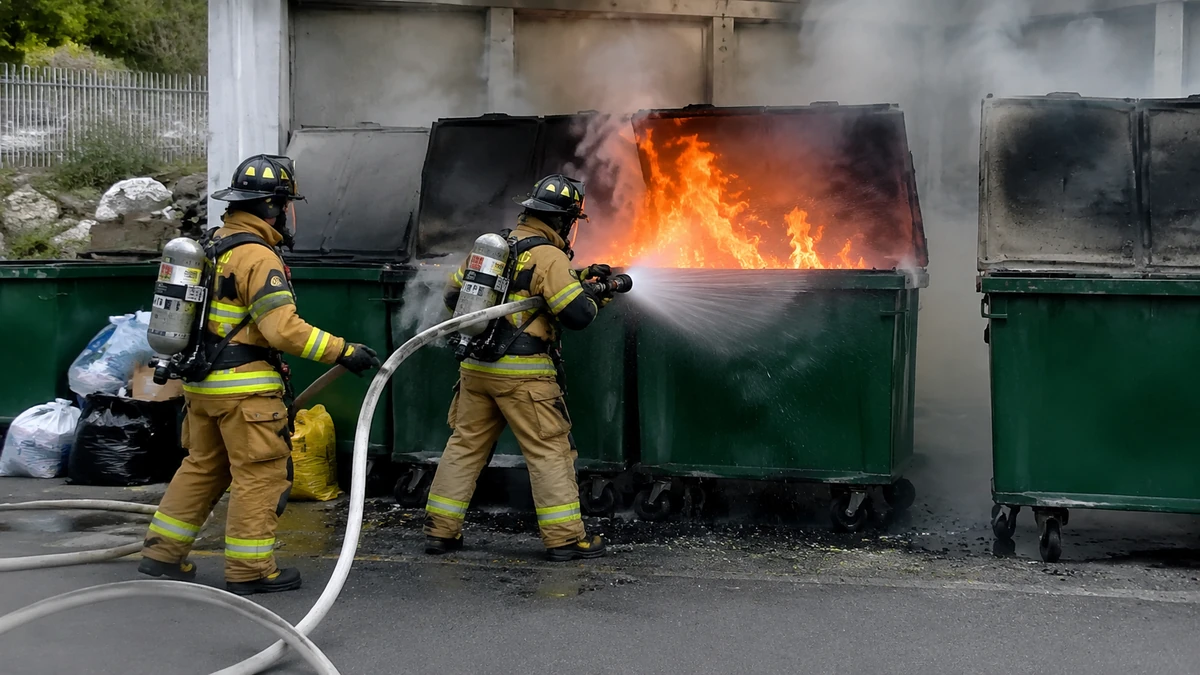
Before the situation could spiral, two off-duty firefighters who had come to the game as spectators recognized the danger and moved toward it. The firefighters, identified in Korean reports as Kim Hyun-seung of the Uiwang Fire Station’s field command unit and Park Young-soo of the Baegun 119 Safety Center, did not remain bystanders. They reportedly alerted those nearby that they were firefighters, took hold of a fire hose and worked alongside KT staff members to bring the flames under control.
The result, by all available accounts, was that a potentially larger incident was stopped before it spread. There were no reports of a major evacuation, mass panic or serious injuries tied to the fire. On one level, that makes this a straightforward story about quick thinking and competence. On another, it says something larger about public safety in modern urban life: how much depends not only on systems and equipment, but on trained people recognizing a threat in its earliest moments and acting before most others even understand what they are seeing.
For American readers, the broad outlines are familiar. It is easy to imagine a similar scene at a minor league game in Ohio, a college football stadium in Texas or a Major League Baseball park on a packed weekend night. Public venues are designed around comfort and spectacle, not around the expectation that a nearby fire will interrupt the evening. That is why this episode in Suwon, a city just south of Seoul, resonates beyond South Korea’s borders. It is a local story with universal stakes.
Why a small fire near a stadium can become a major problem
Sports facilities are highly managed environments, but they are also vulnerable ones. Thousands of people arrive at once. Many are focused on the field, not their surroundings. Food vendors, maintenance areas, storage rooms and waste collection points all create the kinds of routine operational zones that most fans never think about. In ordinary circumstances, that is exactly how it should be. But when smoke enters a spectator space, the psychology changes immediately.
The danger is not only the fire itself. It is the uncertainty. Fans may smell smoke before they see flames. They may mistake it for food smoke, fireworks residue or an outside source. Some will ignore it. Others may stand up, turn around and start moving before any official instruction is given. In dense seating areas, that ambiguity can create a ripple effect. A few people reacting without clear information can lead to more widespread anxiety, especially in a setting where children, older spectators and large family groups are common.
That is one reason the Suwon incident drew attention in South Korea even though it did not become a mass-casualty event. The smoke reportedly flowed into the stadium interior, meaning the fire was not entirely isolated from the crowd experience. Had the response been slower, stadium officials might have had to shift from routine game operations to emergency crowd management. Anyone who remembers frightening crowd scenes at concerts, sporting events or transit hubs understands how quickly a manageable problem can become a broader safety challenge.
American audiences have seen versions of this dynamic before. Not every public-safety story begins with a dramatic explosion or a major structural collapse. Many begin with a smaller disruption at the edge of a venue: smoke in a concourse, an electrical issue in a service area, a kitchen fire at an arena, a suspicious odor at a transit station. The early minutes matter because that is when the event is still containable. Once fear spreads through a crowd, control becomes much harder.
That is why the speed of the initial response in Suwon matters so much. What stands out is not just that trained firefighters happened to be present. It is that they identified the change in conditions quickly, declared who they were and entered a cooperative response with on-site staff. Those are the mechanics of prevention, and prevention is often invisible. The public tends to remember disasters. It rarely notices the moments when one was quietly avoided.
The Korean baseball setting matters, too
To understand why this story resonated in South Korea, it helps to understand what a Korean baseball stadium represents. Professional baseball in South Korea is not a niche pastime. It is one of the country’s most popular mass leisure activities, a place where corporate identity, regional pride, family recreation and highly organized fan culture come together. Korean baseball games are lively, loud and deeply social. Cheer songs are a central feature. Fans often sing in unison, wave team gear and engage with the game as a shared performance rather than a silent viewing experience.
For Americans, the closest comparison might be a blend of a Major League Baseball game, a college sports atmosphere and the choreographed fan participation often associated with soccer abroad. The ballpark is not just a place to watch pitches and outs. It is a public gathering space where people eat, sing, chat and settle in for an evening that feels communal. That makes any interruption involving smoke especially jarring. A stadium that normally symbolizes relaxation and collective fun suddenly becomes a site of uncertainty.
KT Wiz Park, like many stadiums in South Korea, sits within a dense urban environment where transportation links, commercial areas and residential life intersect. The modern Korean city is built around efficiency and concentration. That has many advantages, but it also means an emergency in one area can have immediate consequences for many people nearby. A fire in a recycling area outside a stadium does not stay psychologically “outside” once smoke begins moving indoors.
The setting also matters because baseball in South Korea is a family-centered outing. Parents bring children. Couples go on dates. Coworkers attend after work. In that sense, the Suwon game was not simply an athletic contest; it was part of everyday civilian life. The firefighters involved were there on their day off, accompanied by family members. That detail deepens the story because it underscores the overlap between private time and public responsibility. They were not at a training exercise. They were doing what thousands of Koreans do during baseball season: taking in a game.
That crossover between ordinary leisure and emergency response is one reason the incident has emotional weight. It reminds people that public safety is never fully separate from daily life. Even in a setting built for fun, the infrastructure of protection has to be close at hand, whether in the form of alarms, staff coordination, clear exits or, in this case, trained professionals who happen to notice that something is wrong.
What the firefighters’ response says about training and public duty
Korean reports emphasized that the two men were off duty, and that detail has shaped much of the public reaction. In South Korea, firefighters are widely regarded as frontline public servants whose work carries both danger and moral authority. That is not unique to Korea, of course. Americans also tend to hold firefighters in especially high regard, often above many other institutions, because the job is associated with immediate physical risk and direct service to others. But in South Korea, where collective responsibility is often strongly emphasized in public discourse, stories like this can take on added symbolic meaning.
There is a temptation in stories like these to reduce everything to heroism, and there is no question that the two firefighters’ actions were brave and decisive. But the deeper lesson may be less about individual valor than about professional reflex. They reportedly recognized smoke as a warning sign before many others might have. They identified themselves clearly. They coordinated with stadium personnel rather than acting in isolation. In other words, they did what good emergency training is meant to produce: fast assessment, role clarity and teamwork under pressure.
That distinction matters because public safety cannot rest on hero narratives alone. If a society expects every off-duty firefighter, nurse, police officer or paramedic to remain perpetually available, it risks romanticizing a structural burden that should be shared by institutions. Off-duty intervention can be lifesaving, but it should not become an excuse to neglect staffing, planning, equipment or safety drills. The fact that these firefighters helped prevent a bigger problem is admirable. It is also a reminder that the best outcomes usually come when individual expertise meets functioning on-site systems.
Still, there is something undeniably powerful about the image described in Korean coverage: two men at a baseball game seeing smoke and moving toward it while others were still processing what was happening. It is a classic first-responder story not because it is cinematic, but because it reveals a mindset shaped by repetition and duty. People with that kind of training do not just know how to use equipment. They are taught to read the atmosphere of a scene, to notice what is out of place and to act within seconds.
In that sense, the Suwon incident offers a useful corrective to the way public safety is often discussed. We tend to focus on visible hardware — trucks, hoses, exits, extinguishers, barricades, surveillance cameras. All of those matter. But human judgment is often the first and most irreplaceable line of defense. Technology can support a response. It cannot substitute for the moment when a trained person understands, ahead of the crowd, that a manageable anomaly is about to become a dangerous event.
The role of stadium workers and shared responsibility
One of the most important details in the Korean reports is that the firefighters did not put out the flames alone. They worked with KT staff members at the scene. That may sound like a secondary point, but in practical terms it could be the most instructive part of the entire episode. Safety in large public venues is almost never the product of a single institution. It depends on layers of responsibility, and on whether those layers can mesh quickly under stress.
In an American context, this is easy to recognize. A stadium’s security team, operations staff, janitorial crews, concessions workers, local fire department, private contractors and local police may all have roles in different types of incidents. Even a relatively small emergency can require coordination across people with different chains of command and very different levels of technical expertise. The best response is not the one with the most dramatic individual actor; it is the one where people know how to cooperate.
That seems to be what happened in Suwon. The firefighters reportedly identified themselves and joined forces with those already on site. That matters because even the most skilled responder needs local support: access to hoses or extinguishing equipment, knowledge of the facility layout, help managing nearby areas and communication with venue officials. A stadium employee may not have the same training as a firefighter, but that employee may know exactly how to open a utility access point, direct foot traffic or relay information to supervisors.
When officials with the KT Wiz later expressed gratitude and said the club would formally thank the firefighters, they were acknowledging more than a good deed. They were recognizing that the intervention likely changed the scale of the event. Yet the episode also sends a message back to sports organizations themselves. Safety planning cannot be a box-checking exercise that sits in a manual until an inspector arrives. It has to be operational. Staff need to know where equipment is, how to communicate, when to escalate and how to support professionals when something goes wrong.
That principle is especially important as sports venues around the world become more immersive and commercially complex. Modern stadiums are no longer just bowls of seats surrounding a field. They are entertainment districts, food halls, family spaces and event platforms. The more functions a venue serves, the more potential points of failure it contains. Fire safety in that environment is not simply a matter for emergency agencies. It is part of the core business of running a public venue responsibly.
Families were there, too, which changes the emotional texture
The presence of family members added another layer to how the story has been understood in South Korea. Yonhap cited remarks from relatives describing how quickly the firefighters moved after spotting the smoke. Those accounts do more than add color. They place the event in a distinctly human frame. This was supposed to be time off — a day at the ballpark, the kind of break that public servants and their families rarely get enough of.
That detail can be especially resonant in South Korea, where demanding work cultures and long hours have long shaped public conversation about quality of life. Leisure time matters. Family time matters. So when an off-duty firefighter is called, in effect, back into professional action while sitting in the stands, the story becomes not just about bravery but about the difficulty of fully separating public duty from private life in certain professions.
One report also noted that another firefighter’s wife, herself a firefighter and pregnant, helped near the scene. Even if her role was not identical to those directly handling the hose and flames, the detail broadens the meaning of emergency response. Crisis scenes are not neatly divided between central figures and bystanders. There are people managing space, supporting communication, steadying others and helping preserve order. Those contributions can be harder to dramatize, but they matter.
For readers in the United States, this may evoke familiar stories of military families, emergency-room families or firefighting families in which the profession extends beyond the individual who wears the uniform. The burdens and instincts of public service can shape entire households. Loved ones know plans may be interrupted. They know that danger can intrude without warning. In that sense, the Suwon episode is not just a public-safety story; it is also a story about what it means to live close to a profession built around emergencies.
That emotional dimension helps explain why stories like this travel widely. They are not merely about competence. They are about character, obligation and the uneasy truth that some people never really clock out. That can inspire admiration, but it should also prompt reflection about how societies support those workers, compensate them and avoid taking their extra labor for granted.
How South Korea reads stories like this
In South Korea, incidents involving firefighters often carry a strong civic undertone. The country has spent years grappling with questions of disaster preparedness, state accountability and institutional trust, especially after a series of national traumas in recent decades sharpened public sensitivity to how emergencies are handled. Against that backdrop, even a relatively contained event can become meaningful if it illustrates competence, cooperation and the prevention of greater harm.
That helps explain why this story was not treated simply as a feel-good human-interest brief. Korean coverage framed it as evidence that public safety lives in everyday spaces and depends on quick recognition of risk. The fire itself may not have been large by the time it was controlled, but the setting — a crowded professional baseball stadium — gave it wider significance. The incident became a case study in what happens when warning signs are caught early and the right people act without hesitation.
There is also a cultural layer involving the term “119,” which appears in the affiliation of one of the firefighters. In South Korea, “119” is the emergency number used to contact fire and ambulance services, roughly equivalent to 911 in the United States for those functions. So when Korean readers see a reference to a “119 Safety Center,” they immediately understand it as part of the country’s emergency-response infrastructure. For American readers, it may be helpful to think of it as the local fire and rescue apparatus embedded in daily civic life.
What South Koreans may also see in this episode is an affirmation of a social expectation: that expertise should be mobilized in the public interest when circumstances demand it. But there is a tension here. Admiration for individual sacrifice can coexist with concern that institutions rely too heavily on it. The healthier reading of this event is not that society can count on off-duty heroes to fill every gap, but that well-trained people, supported by functioning venue staff, can prevent small emergencies from becoming larger ones.
That nuanced interpretation matters because South Korea, like the United States, regularly debates the balance between individual responsibility and systemic readiness. The Suwon fire offers a rare story in which both appear to have worked together. The individuals were excellent. The venue staff were cooperative. The result was calm rather than catastrophe.
A local incident with a broader message
It would be easy to file this away as a heartening one-day story from the sports pages: two firefighters on their day off happened to be in the right place at the right time and did the right thing. That version is true as far as it goes. But it understates the broader civic lesson.
What happened in Suwon is a reminder of how fragile normalcy can be in crowded public spaces, and how much depends on the people who are trained to recognize danger before it becomes obvious to everyone else. It is also a reminder that safety is collaborative. The firefighters mattered. The stadium workers mattered. The existence of equipment and access mattered. The quick shift from spectator mode to response mode mattered.
For American readers, the story offers a useful lens on South Korea beyond the more familiar export images of K-pop, hit television dramas and beauty brands. The Korean Wave has made South Korea culturally visible around the world, but stories like this reveal another side of the country: the everyday systems, habits and public expectations that structure ordinary life. This was not a glamorous moment. It was a practical one. And in some ways, that makes it more revealing.
At a time when many societies feel anxious about whether public institutions can still function effectively under stress, a contained success story has its own value. Nobody wants a fire at a ballpark. Nobody wants smoke entering a stadium during a game. But when something does go wrong, the public learns a great deal from what happens next. In Suwon, what happened next was fast recognition, calm action and cooperation — the unflashy ingredients of a disaster that never fully materialized.
That may be why this incident has lingered in Korean news coverage longer than the flames themselves did. People are not only responding to a dramatic anecdote. They are responding to a reassuring possibility: that when an emergency suddenly collides with ordinary life, trained professionals and prepared workers can still keep the worst from happening. In a baseball stadium in South Korea, on what should have been an uneventful night, that possibility was put to the test — and, at least this time, it held.
Comments
Post a Comment