At a Major South Korean Film Festival, Greta Lee Reframes What It Means for a Korean American Actor to Play a ‘Western’ Role
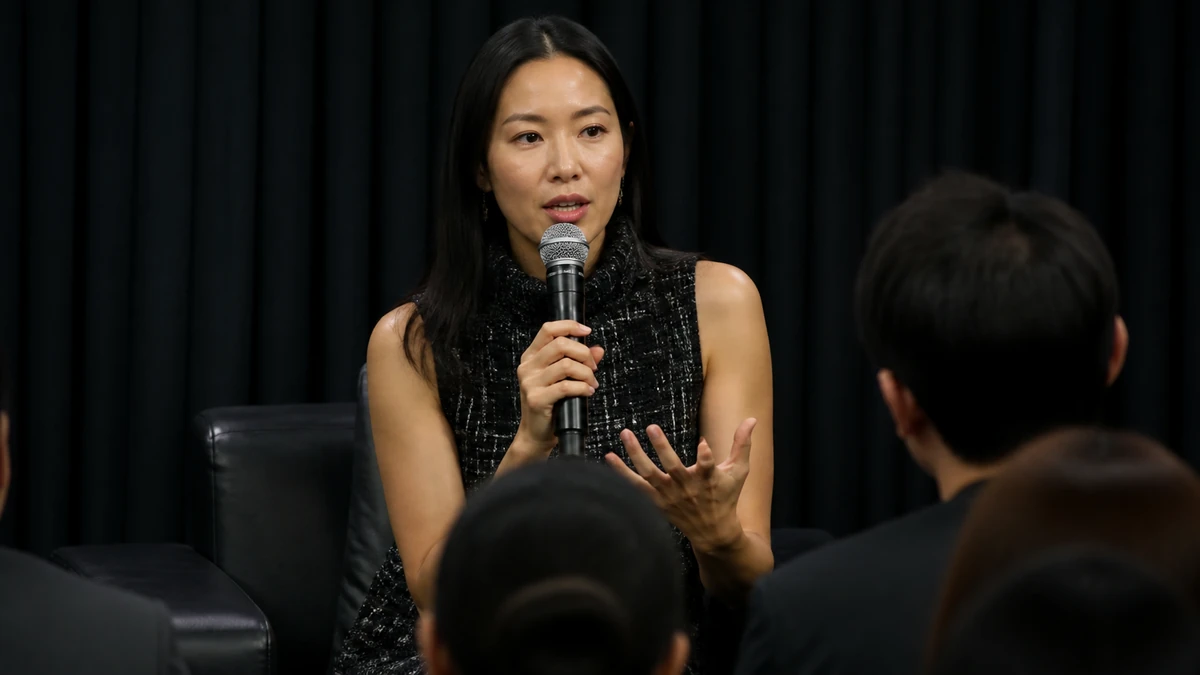
A spotlight moment in Jeonju
JEONJU, South Korea — Greta Lee, the Korean American actor whose career has steadily moved from sharp-edged comedy and indie film to the center of global conversations about identity and performance, used a high-profile appearance in South Korea this week to articulate something larger than a casting anecdote. Speaking at the 27th Jeonju International Film Festival, one of South Korea’s most respected showcases for art-house and independent cinema, Lee said her role as Gloria in the festival’s opening film felt especially meaningful because it was built around what she described as a distinctly Western cinematic device — and because she was performing it as a Korean person.
That comment, delivered Wednesday at a press event in Jeonju, a city about three hours south of Seoul that is often associated in Korea with tradition, food and a thriving cultural scene, resonated beyond the usual festival buzz. In the American film conversation, it would be somewhat akin to an actor appearing at Telluride, Sundance or the New York Film Festival and using the occasion not simply to promote a film, but to explain how race, screen history and performance conventions are being renegotiated in real time.
For audiences in South Korea, Lee’s appearance carried an added layer. She is not merely an American actor of Korean descent visiting an ancestral homeland. She has become, for many Korean viewers and industry observers, a visible example of what the global success of Korean and Korean diaspora talent now looks like in practice: not only appearing in stories explicitly about ethnicity, immigration or cultural trauma, but inhabiting roles that draw from the deepest well of Western film language itself.
That distinction matters. For years, Asian actors in Hollywood were often confined to parts that existed to mark them as foreign, exotic, peripheral or instructively “ethnic.” Even as those boundaries have loosened, many of the most celebrated roles for Asian and Asian American performers still arrive carrying identity in neon lights. Lee’s comments in Jeonju pointed to a different threshold. The significance, she suggested, was not that a Korean-descended actor had found success abroad — that narrative is now familiar. It was that she had stepped into a role constructed from classic Western performance codes and made it her own without having to erase who she is.
That is one reason her remarks attracted attention in Korea’s film world. The story here is not simply that Greta Lee showed up at a major festival. It is that, at a formal public event inside one of South Korea’s leading cinema institutions, a Korean diaspora actor plainly described how identity can enrich a performance style once assumed to belong to someone else.
Why Jeonju matters in Korean cinema
To understand why this landed so strongly, it helps to understand Jeonju’s place in South Korean culture. While the Busan International Film Festival is often the country’s best-known global cinema event, Jeonju has built a reputation as a more adventurous, filmmaker-centered space — a place where critics, students, programmers and serious moviegoers gather to take the temperature of where film is going next. If Busan can sometimes feel like the Korean equivalent of a large international market and red-carpet hub, Jeonju often plays the role of a tastemaker.
The festival’s opening film, then, is not just a ceremonial first screening. It is a statement. It tells viewers, journalists and international guests something about the questions the festival wants to foreground that year. In this case, the opening title, “My Artist,” arrives carrying themes of artifice, reinvention, aging, desire and artistic self-creation. According to the Korean summary presented at the festival, the film follows Ed Saxberger, an elderly New Yorker working at a post office whose poems from his youth suddenly draw attention from a younger group of aspiring artists. Gloria, Lee’s character, enters as a magnetic figure who captures his eye.
There is something knowingly theatrical in that setup. An ordinary older man, a revival of youthful creative identity, ambitious younger artists and a glamorous, stylized woman who seems to live as though she is always half-performing — these are ingredients that belong as much to cinema’s memory as to ordinary realism. That is part of what makes Lee’s role so notable. Gloria is not framed as a naturalistic everyday person in the current prestige-TV sense. She is closer to a cinematic apparition, a woman shaped by references, attitude, gesture and self-conscious image-making.
For a festival like Jeonju, that matters. South Korean audiences have spent the last two decades watching their film industry become increasingly global, from the Oscar triumph of “Parasite” to the worldwide reach of streaming-era Korean series. But Korean festivals are not only celebrating export power. They are also asking what happens when Korean cinema, and artists connected to Korea, participate in the full historical vocabulary of world cinema. Jeonju’s decision to spotlight this film suggests that the current moment is not just about Korean content traveling well. It is also about Korean and Korean diaspora artists reshaping the forms and traditions that once seemed to come from elsewhere.
A role built from old Hollywood memory
Lee’s explanation of Gloria helps clarify why she called the experience special. The character, as described in Korean reporting from the festival, is a woman who dreams of being a star and seems to treat even ordinary life as a performance. Her speech patterns, body language and outward appearance are heightened. Smoky eye makeup and stylized gestures are not incidental flourishes; they are part of the design. Gloria is presented less as a straightforward realist character than as someone wearing film history on her body.
That kind of role can be difficult to pull off. Contemporary screen acting, especially in English-language prestige film and television, often prizes understatement, spontaneity and emotional transparency. Performances are expected to feel stripped down, psychologically grounded and free of overt theatricality. Gloria, by contrast, seems to intentionally revive a more mannered and iconographic style, one rooted in star image as much as character psychology.
The Korean summary notes that the role draws from classic screen references including Marlene Dietrich in “Shanghai Express” and Liza Minnelli in “Cabaret.” For American readers, those are not small name-drops. Dietrich represents one of the foundational embodiments of modern screen glamour: cool, erotic, enigmatic and visibly crafted. Minnelli in “Cabaret” is all deliberate performance, all kohl-lined eyes and emotional danger, a figure who turns stylization into revelation. To invoke those names is to signal that Gloria is operating in a lineage of women who are not merely “characters” but cinematic constructions — personas that expose how desire, fantasy and performance overlap.
When Lee called that a Western device, she was naming the way film history is embedded in the role. She did not appear to mean “Western” in a simple geographic sense, as if the character were merely American or European. She meant, more precisely, that the part was built out of a particular tradition of screen mythology — one shaped by old Hollywood and its adjacent cultural afterlives. In another era, such a role may have automatically gone to a white actor whose image was assumed to fit the template without comment.
What changes when a Korean American actor steps into that frame? The answer is not that the role suddenly stops being Western. Rather, the category itself becomes less sealed. The performance gains productive tension. The audience still sees the Dietrich or Minnelli echoes, but it also sees a performer whose body and biography complicate the inheritance. The result is not a rejection of the tradition but a widening of it.
Why her comments struck a nerve in Korea
In the United States, conversations about representation often focus on access: Who gets to audition? Who gets cast? Who gets a leading role? Those questions remain crucial. But the response in South Korea to Lee’s remarks suggests a somewhat different emphasis as well: not only whether a Korean-descended actor is visible on the world stage, but what kinds of performance traditions that actor is now trusted to carry.
That may sound abstract, but it reflects a real shift. For many years, Korean audiences watching Korean or Korean diaspora talent abroad often encountered a familiar pattern. Actors of Korean descent were praised as symbols of progress, yet the roles that brought them recognition were frequently tethered to Koreanness itself. They were children of immigrants, culture brokers, war survivors, dutiful daughters, estranged sons or embodiments of trauma and displacement. There is tremendous value in those stories; many are overdue and deeply human. But they can also create a narrow expectation that the Asian actor’s primary dramatic purpose is to explain identity.
Lee’s role in Jeonju points somewhere else. The excitement comes from seeing a Korean-descended performer not confined to a “Korean role,” but instead entrusted with a role defined by performance style, cinematic memory and old-school star architecture. That does not mean ethnicity disappears. In fact, Lee’s own point was almost the opposite. Her identity does not vanish when she plays Gloria. It changes the texture of the role. The performance becomes more layered precisely because she is bringing herself — including her cultural position — into a framework that might once have excluded her.
This helps explain why her remarks were read in Korea as a marker of evolution within the broader Korean Wave, or Hallyu, the term used to describe the global spread of South Korean popular culture. Americans often associate Hallyu with K-pop groups, bingeable Netflix dramas or Oscar-winning directors. But another part of that story is the gradual expansion of what “Korean talent” can mean outside Korea. It no longer refers only to artists working in Korean-language productions or to exportable “Korean” aesthetics. It also includes diaspora performers who can move through multiple traditions at once.
For South Korean audiences, that can feel both familiar and new. Familiar, because Korean and Korean diaspora artists are now expected to be globally present. New, because their global presence is increasingly detached from the requirement that every role be legibly Korean. That is a subtler change than a chart-topping single or a box-office headline, but in some ways it may be more lasting.
Greta Lee’s career and the widening lane for diaspora talent
Lee’s own career makes her especially suited to articulate this shift. American audiences know her from a range of work that has demonstrated both comic precision and emotional intelligence, culminating in the critical success of “Past Lives,” the Celine Song film that turned her into a major awards-season presence and introduced many viewers to her ability to hold intimacy, reserve and longing in a single close-up. That movie, notably, was deeply connected to Korean identity, language and migration, even as it spoke to universal themes of roads not taken.
But one reason Lee remains such a compelling figure is that she has never fit neatly into a single lane. She can play acerbic, contemporary, sharply observed characters; she can handle irony; and she can anchor meditative material without collapsing into self-seriousness. In that sense, her move into a role like Gloria feels like a logical next step. It allows her to draw not only on biography or realism, but on shape, surface, stylization and all the old-fashioned tools of screen presence that make movie acting something distinct from simply being believable.
For American readers, there is a useful analogy in the way Black actors in Hollywood have often spoken about the importance of being able to play not only roles explicitly about race, but also characters whose race informs the performance without wholly defining the narrative. The issue is not to pretend identity does not matter. It is to insist that identity does not have to function as a cage. Lee’s comments in Jeonju fit that broader creative struggle.
There is also a generational dimension here. Earlier waves of Asian American performers often had to argue for basic recognition in industries that treated them as exceptions. Today’s generation is still confronting exclusion, but it is also engaged in a more nuanced fight: the fight to inherit and reinterpret mainstream screen language itself. Who gets to be glamorous in a way that references Dietrich? Who gets to embody the knowingly artificial, intensely cinematic femininity associated with old Hollywood and European cabaret iconography? Lee’s answer, at least through this role, is simple: there is no reason the answer should not include a Korean American actor.
The film industry’s renewed focus on human performance
Lee’s remarks also arrive at a moment when global film culture is newly preoccupied with what, exactly, counts as human performance. The Korean summary connecting her appearance to broader industry debates cited new guidance from the Academy of Motion Picture Arts and Sciences, the organization behind the Oscars, emphasizing that human creative authorship and human acting remain central to awards consideration even as artificial intelligence becomes a growing factor in filmmaking.
That larger debate might seem far removed from a character with smoky makeup and old-Hollywood references, but the connection is real. A role like Gloria depends on finely calibrated choices that cannot be reduced to plot function. The cadence of a line. The fraction of a pause. The difference between a gesture that reads as homage and one that slips into parody. The way makeup, posture, gaze and vocal texture combine to create someone who feels intentionally larger than life without ceasing to be alive.
In the streaming era, when content is often discussed in terms of algorithms, audience segmentation and “IP,” roles like this can feel almost rebellious. They remind viewers that cinema still depends on bodies in space and on performers who can summon references from the past while making them present. The more stylized the role, the more obvious the need for intelligence and control. It takes real technique to make artifice feel meaningful.
That is part of what made Lee’s phrasing so striking. By calling the experience special, she was not just saying she enjoyed the part. She was identifying the role as a site where performance, identity and film history met in a visible way. In an age increasingly fascinated by technology’s capacity to mimic, that kind of statement lands as a defense of acting as interpretation — as something irreducibly human.
What American audiences should take from Jeonju
It would be easy for American readers to dismiss this as a niche festival story, the sort of item that circulates among cinephiles and then disappears. That would miss the broader point. What happened in Jeonju this week is part of a larger cultural realignment that Americans are already living through, whether they realize it or not. The global circulation of Korean culture has changed not only what Americans watch, but also how categories of belonging and screen identity are being reorganized.
A decade ago, much American coverage of Korean entertainment still treated it as a specialty interest, something for festivalgoers, K-pop stans or streaming scavengers. Today, Korean cultural production is mainstream enough that viewers who have never set foot in Seoul can recognize the grammar of a K-drama cliffhanger or the industrial power of a BTS release. But as familiarity grows, the most interesting developments are no longer just about popularity. They are about form, authorship and permission.
Lee’s Jeonju appearance underscores that the next phase of this story may be less about whether Korean or Korean-linked artists can “break through” and more about how fully they can inhabit the canon — and remake it from within. That process is not limited to directors or screenwriters. Actors are central to it because they are the visible surface of the industry’s imagination. When a Korean American performer can convincingly embody a character built from old Western star mythology, and when that fact becomes a point of thoughtful public discussion at a major Korean film festival, it signals a shift in what audiences on both sides of the Pacific now consider possible.
There is also a quieter lesson in the setting itself. Jeonju is not Hollywood. It is not Cannes. It is not New York. Yet it has become one of the places where these transnational questions can be named with unusual clarity. That, too, reflects the current media landscape. Cultural authority is no longer monopolized by a few Western capitals. Conversations about the future of cinema now emerge from places like Jeonju, where local institutions are increasingly global in reach and ambition.
For American audiences, the takeaway is straightforward. Greta Lee’s comments were not just about one part in one film. They were about who gets to carry inherited screen myths, who gets to look iconic, and who gets to stand inside a supposedly Western performance tradition without asking permission to belong there. In that sense, the moment in Jeonju was about much more than festival glamour. It was about the widening of the frame.
Comments
Post a Comment