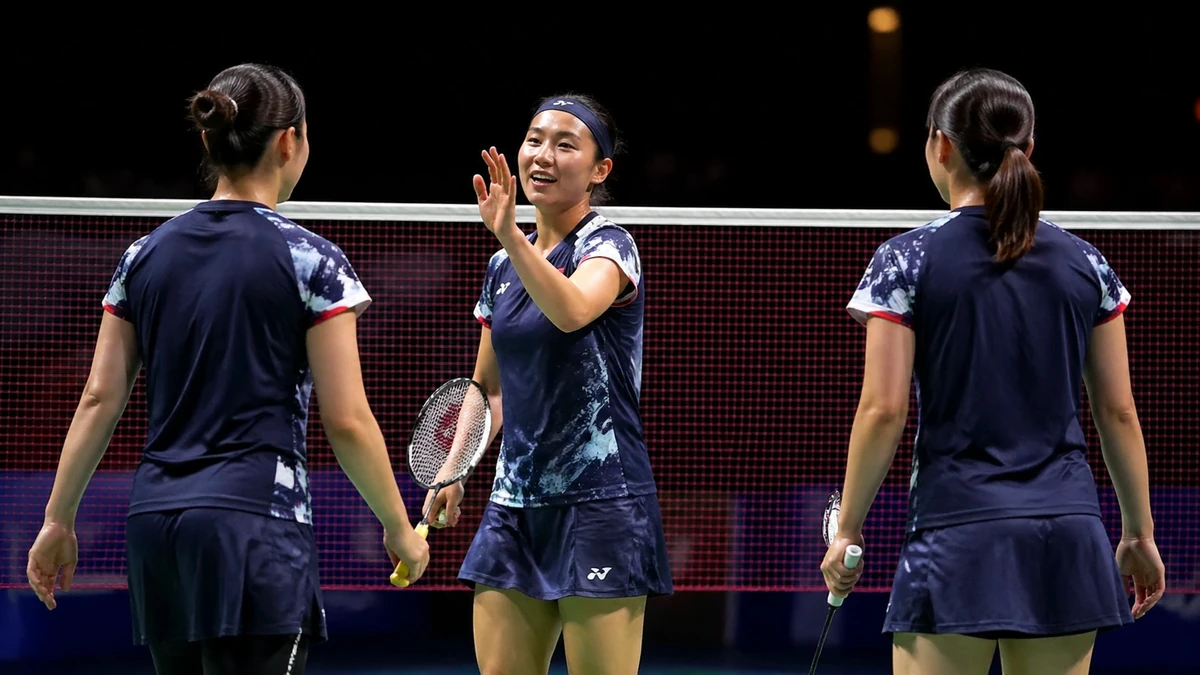
South Korea advances, and the score tells only part of the story
South Korea’s women’s badminton team has moved into the semifinals of the Uber Cup, beating Taiwan 3-1 in the quarterfinals in Horsens, Denmark, in a result that says something larger about where the country stands in world sports. On the surface, the facts are straightforward: South Korea won the tie, secured the three match victories it needed and kept its bid for one of the sport’s biggest team prizes alive. But for anyone trying to understand why this mattered beyond a single day’s scoreboard, the quarterfinal offered a clear picture of how South Korea has built itself into something more durable than a team dependent on one famous name.
The Uber Cup, held every two years, is badminton’s premier women’s team championship, the counterpart to the men’s Thomas Cup. In the United States, badminton is often seen as a backyard game played at family cookouts or summer camp, but globally it occupies a very different place. In much of Asia and parts of Europe, it is a major professional sport with deep national investment, intense fan interest and athletes who are household names. Events like the Uber Cup function less like a niche tournament and more like a World Cup-style test of a nation’s depth, planning and composure under pressure.
That is what makes South Korea’s 3-1 win over Taiwan notable. In this format, nations compete across five matches — three singles and two doubles — and the first team to win three claims the tie. That structure matters because it asks for more than brilliance from one star. It rewards roster balance, coaching decisions, matchup strategy and the ability to keep momentum after the emotional swings that come with team competition. A country can produce a world No. 1 and still fall short if the rest of the lineup cannot carry its share. South Korea, at least on this day, looked like a team that understands exactly how to turn individual excellence into collective control.
For American readers, there is a familiar sports question at work here: What is more dangerous in a tournament setting, a team with the single best player or a team with enough structure to survive the inevitable stress points? Think of March Madness, the Davis Cup, the Ryder Cup or even an MLB postseason series in which one ace can set the tone but cannot win every game. South Korea entered this tie with the sport’s top-ranked women’s singles player, but its quarterfinal victory mattered because it also suggested something about the group around her. The result reinforced a broader point that has become increasingly true of South Korean sports over the past generation: The country is no longer simply producing isolated stars. It is building systems that keep it near the top.
An Se-young opens the door the way an ace is supposed to
The most recognizable name in the lineup was An Se-young, the world No. 1 in women’s singles and the player who once again took the court first for South Korea. In team competition, that assignment is not just ceremonial. The opening match can reset the emotional temperature of an entire tie. A dominant win forces the opponent to chase, makes the remaining lineup decisions feel heavier and allows the stronger team to dictate the flow. Coaches in every sport understand the value of a fast start. In the Uber Cup, it can be decisive.
An delivered exactly that kind of start. She defeated Taiwan’s Chiu Pin-chian, ranked No. 14 in the world, in straight games, 21-7, 21-8. The lopsided score is the kind that needs little embellishment. It was not a grinding comeback or a narrow escape in high-pressure points. It was the sort of clean, clinical performance that announces superiority from the opening exchanges and leaves very little room for suspense. Against a top-15 opponent on a major stage, An did not merely win; she simplified the tie for everyone who came after her.
That kind of performance also helps explain why An has become one of the defining figures in women’s badminton. Rankings can sometimes feel abstract to casual readers, but scores like this one make the hierarchy easier to understand. A world No. 1 is expected to win. A true standard-setter wins in a way that shapes the larger contest. That was An’s contribution here. She gave South Korea a 1-0 lead, but just as importantly, she put Taiwan in immediate catch-up mode.
There is also a cultural dimension to the way South Korea uses a player like An in team competition. In many Korean sports settings, whether in volleyball, archery, baseball or short-track speedskating, there is a strong premium on role clarity inside the group. Star players are expected to perform as stars, but within a broader system that emphasizes discipline, order and responsibility to the team. That does not mean Korean sports culture is uniquely collectivist in some simplistic way; American teams value structure too. But South Korea’s success in international competition often reflects a distinctive ability to integrate individual standout performers into highly organized national programs. An’s place as the opening player fits that pattern. She is the headline name, but she is also a tactical instrument in a carefully managed team design.
Why the Uber Cup means more than casual fans might realize
To understand the significance of a semifinal berth, it helps to understand the prestige of the event itself. The Uber Cup is not just another stop on the badminton calendar. It is one of the sport’s most symbolic titles because it measures national strength rather than individual form alone. A player can have a brilliant two weeks in a singles tournament and leave with a title. Winning deep rounds in the Uber Cup demands something broader: a functioning team architecture.
That is part of what separates team badminton from the more familiar week-to-week rhythm of individual professional tournaments. In a regular singles draw, a player’s path is mostly about her own fitness, tactics and mental sharpness. In the Uber Cup, every result affects the collective. One player’s dominant win changes the pressure on the next court. A doubles pairing can rescue a tie or expose a weak link. Coaches are not just preparing athletes; they are sequencing a story over multiple matches, trying to reach three wins before the other side does.
In American terms, the closest comparison may be the way Olympic team gymnastics differs from an all-around final, or how college tennis and wrestling team meets carry a different kind of tension from standalone championships. Every individual result has a scoreboard consequence beyond the athlete. That creates a particular kind of national drama, especially in countries where badminton is followed closely. South Korea, China, Japan, Indonesia, Malaysia, India, Thailand, Denmark and Taiwan all operate in badminton cultures where these ties are watched not just as athletic contests, but as statements about national sporting credibility.
For South Korea, that credibility has been growing across sports for years. The country already carries global recognition in soccer, baseball, archery, fencing and e-sports, and it continues to produce Olympic contenders in events that do not always get sustained attention in the American press. What the Uber Cup offers is another lens on the same story: South Korea’s international footprint is not confined to the entertainment exports that most American audiences know best, such as K-pop and Korean television dramas. Sports remain one of the clearest ways nations project consistency, discipline and excellence to a global audience, and badminton is one of the arenas where South Korea keeps doing exactly that.
A team result, not just a star turn
One reason the 3-1 scoreline stands out is that it suggests control without demanding perfection. Team ties can turn quickly when momentum shifts. A single upset can create nerves, alter lineup pressure and force a favorite into a much more dangerous position. South Korea avoided that spiral. By closing the tie at 3-1, it limited the window for Taiwan to build a comeback and showed the kind of steadiness that stronger teams often display in elimination rounds.
That matters because one of the recurring challenges in talking about South Korean sports internationally is avoiding the temptation to reduce every achievement to a single emblematic figure. That happens with countries all the time. One athlete becomes the face of a national program, and the rest of the structure disappears from view. An is unquestionably the central figure in South Korean women’s badminton right now, but the Uber Cup format does not allow a nation to hide behind branding. Three match wins are required. Someone else has to finish what the ace begins.
That is why the quarterfinal can be read as evidence of competitive depth. South Korea did not win because a superstar collected an individual trophy. It won because a superstar’s opening statement was supported by the rest of the tie, enough to reach the required three victories. For a national federation, that is a far healthier sign than any isolated result. It suggests player development is working, doubles combinations are reliable enough and the coaching staff understands how to distribute pressure across the roster.
It also underscores an important distinction in modern international sport: the difference between having a world-class athlete and having a world-class program. The first is exciting and marketable. The second is sustainable. South Korea’s badminton tradition has long included major names and big moments, but this result in Denmark points to a program that can still operate at elite level in the current era, against opponents who are every bit as sophisticated and prepared.
That is not a small thing in badminton, where margins at the highest level are thin and the sport’s competitive geography is wide. Taiwan, like several of South Korea’s regional rivals, has produced players capable of beating top opponents. There are no easy quarterfinals at this level. A 3-1 victory in the last eight of the Uber Cup is meaningful precisely because the event is designed to expose weakness. South Korea passed that test.
What this says about South Korea’s image in world sports
For international audiences, especially those encountering South Korea mostly through headlines on technology, North Korea, trade or pop culture, sports results like this add another layer to the country’s global profile. They show a nation that keeps appearing in high-performance settings across very different fields. In the same way Americans might think of countries like the Netherlands punching above their population size in soccer and speedskating, or Australia consistently surfacing in swimming, rugby and tennis, South Korea has become the kind of country that repeatedly turns up in medal races and championship brackets across a striking range of sports.
Badminton is an especially revealing case because it bridges Asia and Europe in ways some other sports do not. This quarterfinal took place in Denmark, one of badminton’s historic European strongholds, against a Taiwanese team from one of the sport’s deepest Asian talent pools. That setting matters. It means South Korea’s success was not confined to a regional event or a familiar home environment. It was produced on a genuinely international stage, in front of a global badminton audience that understands exactly how demanding this competition is.
For Americans less familiar with Korean sporting culture, it is also worth noting how national team performance often carries a particularly strong resonance in South Korea. International tournaments can become moments of concentrated national attention, not unlike the way Olympic basketball, the Women’s World Cup or the World Baseball Classic can briefly pull broader U.S. audiences into sports they do not follow every day. In South Korea, those windows often produce intense investment, especially when the country is seen as contending near the top. A semifinal berth in the Uber Cup fits that pattern because it is not just a statistic; it is a visible reminder that South Korea remains a serious player in a sport where the competition is relentless.
There is an economic and cultural logic to that visibility as well. Nations increasingly compete for prestige not only through diplomacy and business, but through the symbols that circulate most widely across borders: music, film, technology, cuisine and sports. South Korea has been extraordinarily successful in several of those arenas. A strong showing in a major badminton team championship may not command the same immediate attention in the United States as a blockbuster TV series or a K-pop stadium tour, but within the ecosystem of global sports, it contributes to the same broader narrative of Korean excellence and international reach.
The meaning that lasts longer than the score
The most enduring sports stories are rarely about numbers alone. The box score from South Korea’s quarterfinal win will record the essentials: Horsens, Denmark; Uber Cup quarterfinal; South Korea 3, Taiwan 1; An Se-young opening with a 21-7, 21-8 victory. Those are the facts. What lingers is the shape of the performance. South Korea took command early, used its biggest star exactly as a contender should and then translated that advantage into a team result that carried it into the final four.
In that sense, the match served as a compact expression of what makes South Korea such an intriguing sporting nation right now. It can still produce individual dominance. It can still rely on a world No. 1 to set the emotional and tactical tone. But it is not trapped in a one-player story. The structure around the star is strong enough to matter, and in team championships that distinction is everything.
There is also a lesson here for readers who may only occasionally encounter badminton on the global sports calendar. The sport’s biggest team events offer some of the clearest evidence of how countries build excellence. They expose whether a program has real depth, whether its top players can handle responsibility, whether its coaches can manage pressure and whether its supporting cast can convert opportunity into results. South Korea’s quarterfinal answered those questions persuasively.
Now the stakes rise again in the semifinals, where the margin for error will narrow and the quality of opposition will only increase. That is the nature of championships built on national depth rather than star billing alone. South Korea will still need An Se-young, and it will still need the rest of the roster to carry their portions of the load. But by reaching the semifinals with a 3-1 win over Taiwan, the team has already made one thing clear: South Korean badminton is not just represented by one brilliant player. It is backed by a team structure capable of carrying the country deep into one of the sport’s most important events.
For a global audience, that is the real significance of this result. It is not simply that South Korea won another match. It is that, on one of badminton’s most prestigious stages, the country again looked like what the world increasingly recognizes it to be in sport as in other fields: organized, ambitious, resilient and fully comfortable competing near the top.
Comments
Post a Comment