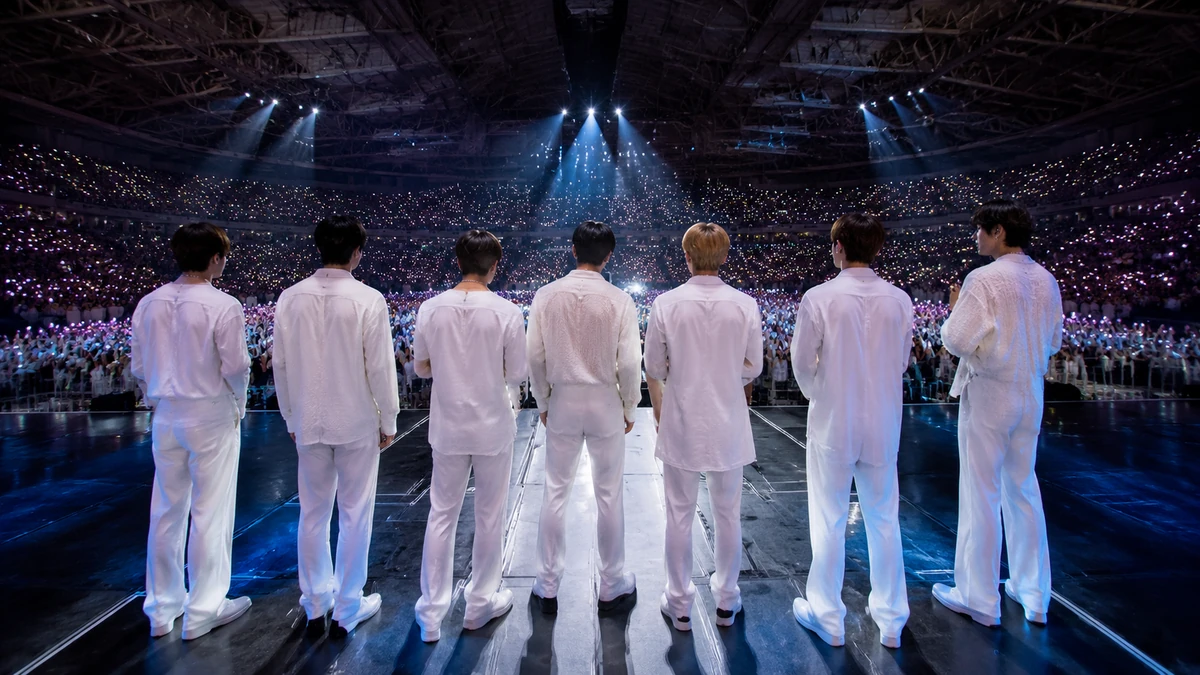
A Familiar Stage, a Different Moment
BTS is heading back to one of the biggest stages in American pop music, and this time the group arrives not as a curiosity from overseas but as a central part of the show’s story. According to reports cited by the entertainment outlet Deadline, the South Korean supergroup will make a special appearance at the 2026 American Music Awards on May 25 local time. The ceremony is set for the MGM Grand Garden Arena in Las Vegas and will be broadcast live on CBS and streamed on Paramount+.
On its face, that might sound like a routine awards-show booking. Major ceremonies rely on star power, and BTS remains one of the most recognizable names in global pop. But this appearance carries extra weight because the group is not just showing up to wave at cameras or present an award. BTS is also part of the competition, earning nominations for artist of the year, best male K-pop artist and song of the summer for its title track, “Swim.” In the language of awards season, that means BTS is not being treated as a side attraction. It is being treated as a serious contender.
For American viewers who have watched K-pop move from niche fandoms to arena tours, chart dominance and major festival bookings, that distinction matters. It reflects a larger shift in how Korean pop acts are positioned in the United States. A decade ago, appearances by K-pop stars on major American broadcasts were often framed as novelty or crossover experiments. Today, BTS returns to the AMA stage as part of the mainstream machinery of pop itself, occupying the same space as the industry’s biggest names and most closely watched races.
The announcement also arrives with a strong sense of symbolism. Awards shows are not just about trophies; they are about narrative. They package music into moments that are meant to feel historic, emotional and culturally revealing. BTS and the AMAs already share one of those moments, and this year’s ceremony is shaping up as another chapter in a longer relationship that has helped define K-pop’s rise in America.
Why This AMA Appearance Matters
The most notable thing about this year’s appearance is the combination of visibility and validation. BTS is up for awards in three different categories, and each nomination says something different about the group’s standing.
Artist of the year is the broadest and most prestigious of the three. It is the kind of category that measures overall impact rather than success within a single lane. Being nominated there suggests the group’s presence extends beyond a dedicated fandom and into the wider conversation about who shaped the year in popular music. In practical terms, it places BTS in a top-tier awards category usually reserved for the artists who most clearly define the pop landscape.
The best male K-pop artist nomination speaks to something more specific: BTS’ continuing role inside a now-crowded Korean pop market that has become increasingly global. K-pop, shorthand for South Korean popular music, is not a genre in the narrow musical sense so much as an industry system. It blends pop, hip-hop, dance, R&B and tightly choreographed performance into a highly structured entertainment model built around intensive training, fan engagement and cross-platform marketing. Within that system, BTS has long been the act most associated with K-pop’s breakthrough in the United States.
Then there is song of the summer for “Swim,” a category that captures something different altogether. These nominations are often about cultural stickiness: the songs that travel from playlists to social media clips to car radios to vacation soundtracks. For an act with one of the most organized fan bases in the world, the nomination suggests that “Swim” is being recognized not simply as a fan favorite but as part of the broader seasonal pop conversation. That matters because one of the oldest questions about K-pop in the United States has been whether its reach can extend beyond fandom into general public recognition. A nomination like this implies that it can.
Taken together, the nominations present BTS as a group competing on several fronts at once: overall influence, genre leadership and song-level popularity. Add in a special appearance, and the result is a kind of double presence that few acts achieve at major awards shows. BTS is both nominee and event. That combination almost guarantees the group will be one of the night’s focal points, regardless of whether it ultimately leaves with trophies.
The Shadow of 2017
To understand why many fans and industry watchers see this AMA return as especially meaningful, it helps to go back to 2017. That year, BTS performed “DNA” at the American Music Awards, marking the group’s first appearance on U.S. television. For many Americans, it was the first time they saw a Korean boy band command a major domestic broadcast stage not as background color but as the main act.
That performance quickly took on outsized meaning. In industry terms, it was a milestone: BTS became the first Korean group to perform in the history of the AMAs, an awards show that dates back to 1974. In cultural terms, it served as a visible entry point for K-pop into the American mainstream. While Korean music had already built substantial online fandoms in the United States, the AMA stage represented something different. It was one of those legacy American institutions that still carries the power to signal who is inside the tent.
For American readers, a useful comparison might be the way certain moments at the Grammys, MTV Video Music Awards or the Super Bowl halftime show become shorthand for broader changes in pop culture. The performance itself lasts only a few minutes, but the symbolism can stretch for years. That 2017 BTS stage now looks like one of those moments. It did not create K-pop’s global rise on its own, but it crystallized it for a U.S. audience in a way few events had before.
This is why the 2026 return feels more layered than a standard guest spot. It invites a look backward as much as forward. If 2017 was about a first breakthrough, 2026 is about durability. The question is no longer whether BTS can get on the stage. The question is what it means that the group keeps returning to it as a major player. In the entertainment business, longevity is often a harsher test than novelty. Plenty of artists can generate a splash; far fewer can remain central to the conversation over time.
For BTS fans, known collectively as ARMY, the significance is even more personal. ARMY is not simply a fan club in the casual American sense of the term. It is a globally organized, digitally sophisticated fandom known for coordinated streaming, voting and social media activism, as well as intense emotional investment in the group’s career milestones. To that audience, the AMAs are not just another stop on the publicity circuit. They are part of the mythology.
What BTS and ARMY Mean in American Pop Culture Now
Any article for an American audience about BTS has to explain that the group’s influence has never been limited to music sales alone. BTS helped introduce millions of U.S. listeners to a different model of pop stardom, one in which music, visual storytelling, online community and fan participation operate as one ecosystem. That model is common in South Korea’s idol industry, where groups are often built through years of training and where fans are encouraged to engage through livestreams, variety content, voting and meticulously produced social media updates.
In the United States, fan culture has always been a powerful force, from Beatlemania to boy-band wars between Backstreet Boys and NSYNC to the online armies surrounding artists like Taylor Swift and Beyoncé. What BTS did was fuse that familiar intensity with the scale and discipline of a modern, always-online global fandom. ARMY helped demonstrate that language barriers were becoming less important in an era where music discovery happens on YouTube, TikTok, streaming services and fan translation accounts.
That has changed how the American industry thinks about international acts. Not long ago, executives often assumed that non-English-language pop could succeed in the United States only if it was reshaped to fit domestic tastes. BTS helped challenge that assumption. The group’s rise suggested that American audiences, especially younger ones, were increasingly comfortable meeting artists on their own terms, whether that meant reading subtitles, learning Korean phrases or understanding cultural references from outside the United States.
This broader context helps explain why a return to the AMAs resonates beyond fan circles. BTS has become one of the key case studies in what global pop looks like after the old gatekeepers lose some of their power. The group’s success did not depend solely on one radio programmer or one television booking. But appearances on stages like the AMAs still matter because they show how legacy institutions adapt once the audience has already moved. In other words, the American awards show is no longer introducing BTS to the public. It is catching up to where the public already is.
That dynamic also helps explain the language often used around K-pop in U.S. media. The term can flatten major differences among artists and styles, but it remains useful as shorthand for a broader cultural wave that includes music, television, film, beauty and fashion coming out of South Korea. BTS is one of the clearest examples of that wave’s impact. Its return to a major American ceremony says as much about the U.S. entertainment landscape as it does about the group itself.
Las Vegas, Network TV and the Global Awards Economy
The location and broadcast setup add another layer to the story. This year’s American Music Awards will take place in Las Vegas at the MGM Grand Garden Arena, a venue associated with spectacle, high-production concerts and marquee entertainment events. Las Vegas, of course, has long marketed itself as a city built for scale and visibility. It is where residencies, championship fights and televised ceremonies are staged to look larger than life. In that setting, BTS is entering an environment designed for maximum impact.
That matters because performance in K-pop is never incidental. Choreography, styling, stage design and camera work are often treated as core parts of the musical experience rather than extras added after the fact. For BTS, a special appearance on a stage like this is likely to invite not only interest in the songs themselves but also close scrutiny of how the performance is conceived visually. Fans will watch for symbolism, for references to earlier eras in the group’s career and for clues about what the group wants this return to represent.
The broadcast arrangement is just as telling. CBS will air the show live, while Paramount+ will stream it, reflecting the hybrid media environment in which modern pop culture now lives. For older American viewers, network television still carries a sense of officialness. For younger viewers, streaming and social media clips often matter more than the linear broadcast. The AMAs now operate across both worlds, and that distribution model makes a performance by a globally networked act like BTS especially potent.
Within minutes, clips from the stage are likely to circulate across platforms, subtitled and recirculated by fans from Seoul to São Paulo to Los Angeles. That rapid, borderless feedback loop is part of what makes K-pop’s global footprint so distinct. A major American awards show no longer belongs only to American viewers. It becomes a worldwide event in real time, with reaction videos, fan edits, trend charts and translated commentary extending its reach well beyond the original telecast.
In that sense, BTS’ appearance is about more than prestige. It is about placement inside a global distribution system. When a K-pop group performs on an American awards show carried by both traditional television and streaming, it reinforces the idea that Korean pop is no longer a regional export trying to break in. It is an established part of the international entertainment economy.
What This Says About K-pop’s Place in the Mainstream
The simplest reading of the news is that BTS will be at a major awards show on May 25. The fuller reading is that the group’s presence there captures where K-pop stands in 2026. American pop institutions are no longer asking whether Korean artists can attract attention. They are increasingly building their biggest nights around them.
That does not mean every barrier has vanished. K-pop still faces familiar American industry limitations, including uneven radio support, occasional exoticizing coverage and a tendency to treat non-English-language acts as separate from the main field even when their commercial impact is enormous. But the symbolism of this year’s AMA lineup points in a clear direction. BTS is being recognized not only in a K-pop category but also in a top all-genre race, while one of its songs is competing in a season-defining pop category. That is the kind of multidimensional visibility that suggests staying power.
It also reflects a broader change in what Americans think of as mainstream. In the past, the term often implied a mostly English-language, U.S.- and U.K.-centered pop universe. Streaming has steadily dismantled that hierarchy, making it easier for audiences to move across languages and national markets without much friction. Latin music’s rise in U.S. charts, the global success of Afrobeats and the continued popularity of Korean film and television all point to the same reality: American entertainment consumers are increasingly global in their habits, even if industry structures are slower to adapt.
BTS has been one of the most visible beneficiaries of that shift, but it has also been one of the forces driving it. The group helped normalize the idea that an act could be unmistakably Korean and still dominate a conversation in America. That may be its most lasting cultural contribution. It is not simply that BTS found success here; it is that the group changed expectations about who gets to belong at the center of U.S. pop culture.
Seen through that lens, the upcoming AMA appearance is less about a return than a reaffirmation. It ties together several facts that, on their own, might seem like isolated milestones: the group’s historic 2017 “DNA” stage, its status as the first Korean group to perform in AMA history, its current nominations and its continued ability to draw attention as both performers and contenders. Put together, those facts tell a story about continuity. BTS is not revisiting old glory. It is extending a run.
The Night Ahead
For now, the confirmed news is straightforward: BTS will make a special appearance at the American Music Awards, and the group will go into the ceremony with nominations in major categories. Anything beyond that, including how the performance will unfold or whether the group will add to its awards tally, remains to be seen.
But even before a single note is sung onstage, the meaning of the moment is already clear. For ARMY, it is likely to feel like a reunion with a place that holds deep emotional memory. For the music industry, it is another reminder that K-pop has long since graduated from novelty status. And for American viewers who may only dip into this world when a major event places it squarely in front of them, it is a chance to see how much the cultural map has changed.
There was a time when a Korean group appearing on a major U.S. awards show felt like a breakthrough headline in itself. In 2026, the bigger story may be that BTS is arriving with the kind of nominations, history and audience pull that make its presence seem almost inevitable. That is what real mainstream acceptance looks like. Not a single surprise performance, but the expectation that when the biggest nights in pop are assembled, BTS belongs in the room and often near the center of the stage.
On May 25 in Las Vegas, that stage will again belong, at least in part, to the group that helped redraw the boundaries of American pop culture. Whether the night ends with trophies, viral moments or both, the message is already landing: BTS is not just returning to the AMAs. It is returning as proof of how far K-pop has come and how fully it has embedded itself in the story of global music.
Comments
Post a Comment