Factory Fire in South Korea’s Seosan Sends Workers to Hospital and Raises Fresh Questions About Industrial Safety
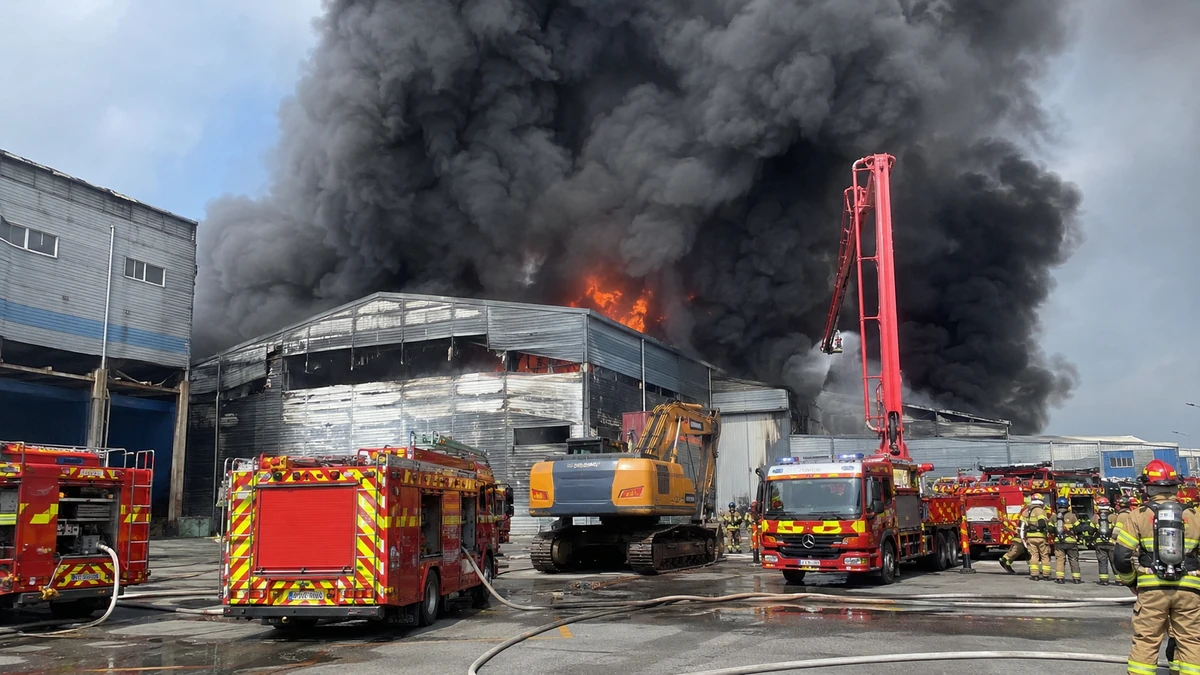
A factory fire with consequences beyond the factory gate
A fire at an auto bumper painting factory in Seosan, a manufacturing city on South Korea’s west coast, forced six workers to evacuate Tuesday morning, with two later taken to a hospital after suffering smoke inhalation, according to South Korean authorities and local media reports citing Yonhap News Agency.
The blaze broke out at about 8:54 a.m. in Eumam-myeon, an outlying area of Seosan in South Chungcheong province. While the number of confirmed injuries remained limited in the initial reports, the scale of the response told a larger story. Fire officials mobilized 326 personnel and 53 pieces of equipment, including heavy machinery such as excavators and demolition vehicles, as crews battled the fire for at least six hours. By the afternoon, the blaze had not been fully extinguished.
For American readers, the basic facts may sound familiar: an industrial fire, workers rushing out, neighbors calling 911 equivalents after seeing thick black smoke, and firefighters settling into what becomes a long, physically punishing operation rather than a quick knockdown. But in South Korea, where dense development often places industrial facilities close to homes, small businesses and farmland, such incidents can rapidly become communitywide emergencies rather than isolated workplace accidents.
That appears to be what happened in Seosan. Residents living near the factory reportedly made multiple calls to authorities saying heavy black smoke was pouring into the area. That detail matters. It means the event was not only a crisis for those inside the building, but a visible and immediate threat to people outside it — the kind of scene that transforms a workplace fire into a public safety event for an entire neighborhood.
At this stage, officials have not publicly identified the cause of the fire, and there is no confirmed report of deaths or life-threatening injuries from the initial response. Still, the combination of prolonged firefighting, hazardous smoke and the type of factory involved has already turned the Seosan blaze into something larger than a routine local incident. It has become another reminder of how industrial safety, emergency response and community exposure intersect in one of Asia’s most industrialized democracies.
Why this type of fire is especially difficult to control
One of the most important details in the Korean reporting was not just that the fire happened, but where it happened: an automobile bumper painting factory. That may sound highly specific, but it helps explain why firefighters expected a long battle.
Factories that handle auto parts, especially painted plastic components, can present unique firefighting challenges. Bumpers are typically made from plastic or plastic-based composites, materials that can burn intensely and produce thick, dark smoke. In a painting operation, those plastics may be stored alongside coatings, solvents and other combustible materials commonly used in finishing work. Even when those substances are handled according to safety rules, they can complicate suppression efforts once a fire starts.
Authorities said the building contained large amounts of combustible plastic, which was expected to slow complete extinguishment. That is a crucial point. In many industrial fires, the headline number of injuries does not fully capture the seriousness of the situation. A blaze can still be considered major if it ties up hundreds of emergency personnel, produces potentially hazardous smoke and resists containment for hours because of the materials burning inside.
American readers may think of warehouse fires, chemical plant incidents along the Gulf Coast or blazes at recycling facilities where certain materials continue to smolder long after the visible flames appear reduced. The Seosan fire belongs to that broader category of industrial emergencies where the hazard is not only the initial flames, but the combination of fuel load, smoke, access difficulties and the possibility of reignition.
The use of demolition equipment and excavators suggests firefighters may have needed to break apart parts of the structure or move materials to reach hot spots. That is often a sign that the fire is embedded deep within a facility or complicated by a building layout and contents that prevent straightforward hose-line access. It also indicates that crews were not simply surrounding the building and waiting. They were engaged in a labor-intensive effort to dismantle and expose burning material while controlling the spread.
In other words, the Seosan fire appears to have been driven as much by the nature of the workplace as by the fire itself. That distinction is central to any serious discussion of industrial safety. What a factory makes, how it stores raw materials, how it ventilates work areas and how easy it is for firefighters to enter all influence what happens after the first spark.
Fast evacuation limited injuries, but smoke remained a serious threat
By one measure, the outcome in Seosan could have been far worse. Six workers inside the factory were able to evacuate, and only two were reported hospitalized with smoke inhalation. Given the scale of the fire and the hourslong suppression effort, that suggests the initial escape from the building happened quickly enough to prevent a mass-casualty scenario.
That should not be mistaken for a minor event. Smoke inhalation is one of the most common and dangerous forms of injury in industrial fires. Victims do not need to be trapped by flames to face serious medical risk. Dense smoke from burning plastics and industrial materials can contain toxic compounds, reduce oxygen levels and impair judgment within minutes. In some cases, the most dangerous exposure happens before workers or residents realize how quickly conditions are changing.
That is especially true in facilities where routine work is underway at the time of the fire. The blaze began just before 9 a.m., during what would normally be an active production period. In any manufacturing environment, that timing matters. A fire that breaks out during operating hours can immediately involve workers spread across different sections of a plant, equipment that may still be running and materials that are already in use or in transit.
The fact that all six workers got out is therefore not a trivial detail. It points to the life-or-death importance of evacuation procedures, alarm systems and the ability of employees to recognize danger fast. In the United States, after major plant fires, investigators often look at whether exits were accessible, whether drills had been conducted and whether workers had enough time to flee before smoke conditions became overwhelming. Those same questions are likely to matter in South Korea once authorities turn from suppression to investigation.
For now, the known injuries appear limited. But the hospital transport of two workers is still significant. It indicates the air inside or near the facility was dangerous enough to cause physical harm even without reported burns or structural collapse injuries. And because fires involving plastic and paint-related materials can produce heavy, acrid smoke, the health concern extends beyond the people nearest the flames.
That helps explain why neighbors’ reports of thick black smoke carry so much weight. In industrial fires, the visual drama of smoke is not only alarming; it can also be a rough public signal that combustion is involving synthetic materials rather than ordinary wood or paper alone. Residents do not need to know the exact chemical composition of the plume to understand that something is wrong and potentially hazardous.
Seosan’s industrial landscape helps explain the wider concern
To understand why this fire resonated beyond one factory, it helps to understand Seosan itself. The city is part of South Korea’s industrial west coast, a region tied to shipping, petrochemicals, automotive supply chains and other export-driven manufacturing. In American terms, it is the kind of place where industry is not tucked far from daily life but woven into the local economy and geography. Factories, warehouses, rural roads and residential areas often exist in close proximity.
South Korea’s rapid industrial development compressed decades of growth into a relatively short period. As a result, many cities developed with an intensity that can be hard for Americans outside large metro corridors to picture. Even in smaller cities or county-level areas, industrial sites may sit close enough to homes that a plume of smoke is immediately visible from neighborhood streets, apartment blocks or nearby fields.
That proximity shapes the meaning of a fire like this one. It is not simply a business interruption or a workplace accident. It is also a community event. Parents may worry about air quality. Drivers may face road closures or traffic disruptions. Nearby businesses may suspend operations. Residents who see black smoke rising above rooftops may have little information in the first minutes except that something dangerous is happening close to home.
In South Korea, that dynamic often gives local industrial accidents an unusually broad social footprint. They are covered not just as business or labor stories, but as public safety stories. The Seosan blaze fits that pattern. Multiple reports from nearby residents suggest the incident was immediately felt outside the plant perimeter, not just by employees or emergency crews.
That broader exposure is also why the size of the firefighting response matters. Authorities issued what South Korea calls a “response stage 1,” a mobilization level that typically brings in the full personnel of the jurisdictional fire station and coordinates substantial resources. The terminology may differ from the incident command language Americans hear at major structure fires, but the principle is similar: the emergency was large enough to require a formal escalation and concentrated public resources.
Those resources do not come cheaply. When more than 300 personnel are committed to a single blaze for much of a day, there is an obvious financial cost, but also an operational one. Firefighters and apparatus tied up at one incident are less available for others. That does not mean response elsewhere stops, but it underscores why long-burning industrial fires are a concern even when casualty counts remain low. They consume attention, manpower and equipment at a scale that affects the wider public system.
An old question in a modern economy: How safe are industrial workplaces?
Before investigators determine how the Seosan fire started, there are limits to what can responsibly be said about fault. It would be premature to assign blame to a worker, a company, a machine failure or a violation of safety rules without evidence. But the incident already revives a recurring question in South Korea: whether industrial safety practices are keeping pace with the country’s highly competitive manufacturing economy.
South Korea is a global industrial powerhouse, home to world-famous brands in automobiles, electronics, shipbuilding and batteries. That success, however, has long come with public concern about labor conditions and workplace accidents, particularly in subcontracting and small-to-midsize industrial settings that receive less international attention than major conglomerates. When something goes wrong at a local plant, it often highlights the less glamorous but essential layers of the supply chain where everyday manufacturing happens.
In the United States, similar debates follow accidents at warehouses, refineries, food processing plants or distribution centers. Was there adequate training? Were dangerous materials stored properly? Did the company invest in suppression systems and ventilation? Were workers empowered to stop operations if conditions became unsafe? Those are not abstract regulatory questions. They are the practical details that determine whether a fire becomes a contained emergency or a catastrophe.
The Korean summary of the incident strongly emphasizes the role of combustible plastic inside the facility. That alone does not prove wrongdoing. Some industries, by their nature, must handle materials that burn readily. But it does highlight what safety experts in many countries already know: industrial fire risk is often structural, not accidental in the everyday sense. It is shaped by the materials present, the design of the workspace, the separation of hazardous processes, the ease of evacuation and the ability of firefighters to gain access once a blaze begins.
That is why the Seosan case matters even before the cause is known. The fire asks a broader systems question: in a factory dealing with painted plastic auto parts, were the conditions such that workers could get out quickly and responders could get in efficiently? The answer appears mixed. On one hand, all six workers escaped. On the other, the blaze still demanded hundreds of responders and remained active for hours.
Those dual realities can both be true. A workplace can succeed in preventing mass casualties while still exposing serious vulnerabilities in fire prevention, building design or hazard control. That nuance is often lost in early coverage focused only on whether anyone died. In industrial safety, “no fatalities” is important, but it is not the only measure that matters.
What neighbors saw turned an industrial accident into a civic event
One of the more revealing details in the initial reports was the number of calls from residents who said they saw heavy black smoke coming from the area. In many ways, that is the moment when the story moved from factory floor to community consciousness.
Modern industrial societies rely on a tacit bargain. Residents accept living near the infrastructure that powers jobs and economic growth, while companies and governments are expected to minimize risk and respond quickly when something goes wrong. A towering column of smoke is the visual sign that the bargain has been broken, at least temporarily. It does not necessarily mean there is long-term contamination or lasting public harm, but it does mean the danger can no longer be contained from view.
In South Korea, where local news alerts travel fast through mobile platforms and neighborhood chat groups, the public experience of an emergency can unfold almost in real time. Smoke seen from nearby homes becomes an instant warning. Families begin checking whether schools, roads or workplaces nearby are affected. The emotional geography of the event expands quickly, often faster than official explanations can keep up.
That social dimension is easy to underestimate from outside Korea. To Americans, an industrial fire in a provincial city might sound distant or narrowly local. But in South Korea, regional incidents often carry national resonance because they speak to common anxieties about safety, urban density and the pace of industrial life. The Seosan fire is not a celebrity scandal or a geopolitical flashpoint, yet it fits squarely into a category of news that many Koreans read as a barometer of how well the state and industry are managing everyday risk.
The public response also matters because it can shape what happens next. Strong community concern often leads to closer scrutiny of fire inspections, emergency preparedness and environmental monitoring. It can also pressure local governments to communicate more transparently about what burned, how long smoke affected nearby areas and whether additional safety reviews will follow.
For now, what residents knew first was simple and visceral: there was thick black smoke in the air, and something big was burning close enough to worry them. That may be the most basic measure of the fire’s civic impact.
What comes next after the flames are out
Once firefighters fully extinguish the blaze, the story will enter a different phase. Investigators will likely focus on origin and cause, the layout of the building, the materials stored inside and whether fire protection systems functioned as intended. Officials may also assess the full extent of property damage and whether production at the site can resume.
Those findings will matter not only to the company involved, but to a broader conversation in South Korea about industrial resilience. The country depends heavily on manufacturing, and even seemingly small facilities can sit inside larger domestic and global supply chains. An auto bumper painting factory may not be a household name, but it is part of the industrial ecosystem that supports the automotive sector, one of South Korea’s signature export industries.
There is also the question of what lessons the emergency response itself may yield. The large deployment suggests authorities treated the incident with urgency and scale. The successful evacuation of all six workers suggests at least some critical safety measures worked in the opening minutes. Yet the hours required to contain the fire point to the stubborn reality that once combustible industrial materials are fully involved, even a strong response can turn into a marathon.
That is the underlying lesson of Seosan. Industrial fires are rarely one-dimensional. They are labor stories, because workers are the first people at risk. They are community stories, because smoke and fear cross factory boundaries. They are governance stories, because public agencies must decide how to allocate resources and communicate danger. And they are economic stories, because the same facilities that generate jobs can also expose the vulnerabilities of a manufacturing-heavy region.
For now, the confirmed toll remains two hospitalized for smoke inhalation and six workers safely evacuated. That is the immediate human outcome, and it is fortunate compared with what might have happened. But the longer image left by the fire is not simply one of escape. It is the image reported by nearby residents: black smoke rising over a city where industrial production and ordinary life stand side by side, close enough that when a factory burns, the whole community feels it.
Comments
Post a Comment