A Child Fell Into the Sea During a Korean Campaign Rally. The First Responders Were Passing Election Workers.
An Ordinary Campaign Stop Turned Into an Emergency on Korea’s Coast
On a spring afternoon in the South Korean industrial city of Ulsan, a local election campaign was moving through a coastal neighborhood much the way it does every election season in Korea: loudspeakers mounted on a truck, campaign workers waving to pedestrians, and staff members traveling between stops along the shoreline roads. Then, suddenly, the routine was interrupted by a cry for help coming from the water.
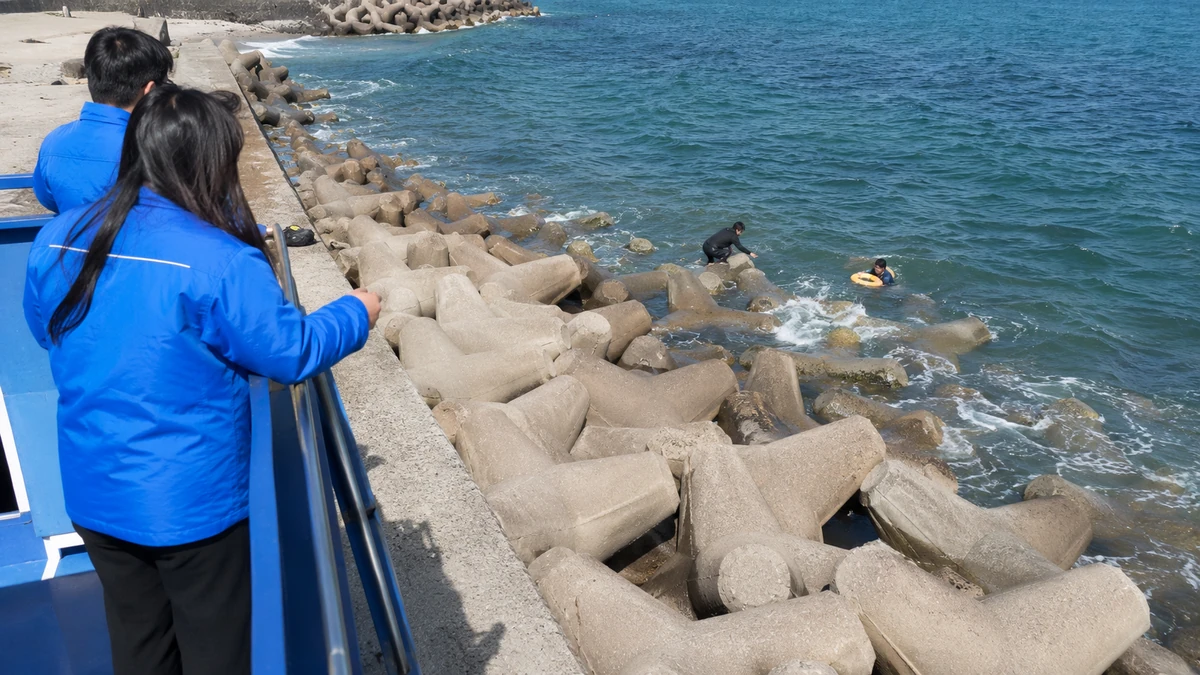
According to the campaign team of Cho Yong-sik, a candidate for Ulsan superintendent of education, election workers traveling in a campaign vehicle on May 23 spotted a child who had fallen into the sea near the Jujeon-dong waterfront in Dong District, Ulsan. The workers reportedly stopped to assist after noticing the child’s father struggling to rescue the child near a set of tetrapods — the massive concrete wave breakers commonly installed along Korean coastlines.
The incident may sound small compared to the dramatic disasters that often dominate international headlines, but in many ways it captures something deeply revealing about everyday life in South Korea. It was not a planned rescue operation. There were no professional lifeguards already on scene. Instead, the emergency unfolded in the middle of a routine political event, and the people who first reacted were ordinary civilians whose primary job that day had nothing to do with public safety.
For American readers unfamiliar with Korean local politics, campaign trucks are a familiar sight during election periods. Candidates frequently use brightly decorated vehicles equipped with speakers, music, and microphones to move through neighborhoods and markets while staff members greet residents. The vehicles function almost like rolling campaign stages. In this case, however, the campaign truck became something else entirely: an accidental first-response platform.
What makes the story notable is not simply that bystanders helped, but the specific conditions that made the rescue difficult. The child reportedly fell between tetrapods, turning what might otherwise have been a straightforward rescue into a highly dangerous situation. Those structures are designed to weaken waves and prevent coastal erosion, but they are also notorious safety hazards. Along South Korea’s coastlines, they have been linked to repeated accidents involving fishermen, tourists, and children.
The episode became a brief but striking example of how quickly ordinary public life can collide with emergency response in densely populated coastal societies.
The Hidden Danger of Korea’s Tetrapod Coastlines
To many international visitors, South Korea’s coastline can appear carefully engineered and highly modernized. Concrete sea walls, breakwaters, fishing harbors, and artificial coastal protections are common across the country’s eastern and southern shores. Tetrapods — giant four-legged concrete structures stacked along the water — are among the most recognizable features of these landscapes.
Americans who have visited ports in California, New England, or parts of the Gulf Coast may recognize similar wave-breaking structures, but South Korea’s coastlines often place them much closer to residential and recreational areas. Locals fish near them, children climb on them, and tourists sometimes take photographs from dangerous angles without fully understanding the risks.
The problem is structural. Tetrapods are intentionally uneven and unstable in shape because their purpose is to absorb and disperse wave energy. That same design creates deep gaps, slippery surfaces, sudden drops, and powerful currents between the blocks. Once someone falls between them, especially in rough water, extraction becomes extremely difficult even when rescuers are only a few feet away.
In the Ulsan incident, the child’s father reportedly threw a flotation ring into the water and attempted to pull the child out. But according to accounts released by the campaign team, rescuing the child from between the structures proved difficult without additional help. That detail is important because it shifts the story away from a simplistic “good Samaritan” narrative and toward a broader conversation about coastal safety.
South Korea has repeatedly confronted similar dangers. Warnings about tetrapod accidents appear regularly in Korean media, particularly during summer vacation season. In some coastal areas, local governments have installed warning signs and barriers, but access remains relatively open compared with heavily restricted waterfronts in some Western countries.
The danger is compounded by the speed at which accidents unfold. A child slipping on algae-covered concrete, a sudden wave surge, or a momentary lapse in supervision can rapidly escalate into a life-threatening emergency. In environments like tetrapod fields, even strong swimmers can become trapped or injured.
That reality helps explain why the arrival of additional bystanders in Ulsan may have mattered so much. The issue was not only that a child was in the water. It was that the physical environment sharply limited what one adult could accomplish alone.
Why the Role of Election Workers Resonated in South Korea
The story gained unusual attention in Korea not because election workers are expected to perform rescues, but precisely because they are not. The people who reportedly intervened were campaign staffers engaged in political outreach, not firefighters, police officers, or coast guard personnel.
In the United States, campaign volunteers are often associated with door-knocking, phone banking, or distributing yard signs. In South Korea, local election campaigns are considerably more visible in public spaces. Campaign workers commonly travel in groups, ride in trucks with amplified sound systems, and interact directly with pedestrians in markets, beaches, and residential neighborhoods.
That visibility meant the campaign staff happened to be present at exactly the moment the emergency unfolded.
The response resonated because it reflected a broader social dynamic often seen in Korean communities: the expectation that ordinary citizens may need to react immediately before official responders arrive. South Korea is highly urbanized and technologically advanced, but many emergency situations still rely heavily on rapid intervention by nearby civilians.
That pattern became especially visible after major national tragedies over the past decade prompted broader discussions about emergency preparedness, public responsibility, and institutional response systems. Since then, stories involving ordinary people stepping into unexpected crisis situations have often carried strong emotional and social significance.
Importantly, the available reports did not exaggerate the incident or present the campaign workers as heroic saviors. The publicly released account was relatively restrained. It stated that the workers witnessed the child in danger and assisted in the rescue while the father was already attempting to help. That moderation matters in a media environment where sensationalism can sometimes overshadow factual clarity.
There also remains limited publicly confirmed information about the child’s later medical condition or the final outcome beyond the rescue effort itself. Responsible reporting requires acknowledging those limits. What is verified is that a child fell into the sea, a parent attempted an immediate rescue, and nearby campaign workers joined the effort.
Even with those factual boundaries, the event carried symbolic weight because it highlighted how civic roles can suddenly overlap. For a brief moment, campaign staffers ceased being political operatives and became emergency responders simply because they were physically present.
Coastal Cities Like Ulsan Live With Everyday Maritime Risk
Ulsan is best known internationally as one of South Korea’s industrial powerhouses. Home to major shipbuilding yards, petrochemical facilities, and automotive manufacturing operations, the city has long been associated with heavy industry rather than tourism. Yet like many Korean cities, Ulsan’s identity is deeply tied to the sea.
Neighborhoods such as Jujeon-dong blend residential life, fishing culture, tourism, and industrial geography into the same physical space. Beaches, rocky coastlines, seafood restaurants, and fishing spots often sit close to roads, homes, and commercial districts. That proximity creates convenience and local character, but it also means maritime hazards are woven directly into daily life.
For Americans living in coastal communities, the dynamic may feel familiar. Residents of Florida beach towns, New England fishing communities, or California waterfront neighborhoods understand that water is both an economic asset and a constant safety concern. South Korea experiences a similar tension, but in a more densely compressed environment.
Korean coastal spaces are often heavily used throughout the year, not only during peak tourist seasons. Families walk along breakwaters, older residents fish from sea walls, and children play near harbors. In many cases, potentially dangerous infrastructure is integrated directly into ordinary public areas rather than isolated behind fences.
That helps explain why the Ulsan rescue story felt recognizable to many Korean readers. It was not viewed as a bizarre or once-in-a-generation event. Instead, it reflected a familiar anxiety: that everyday recreational spaces can become emergency zones within seconds.
The timing of the incident also contributed to its symbolic power. It occurred around 3 p.m., in broad daylight, during active public campaigning ahead of local elections. There was no storm, no large-scale disaster, and no extraordinary circumstance. The danger emerged during an otherwise ordinary afternoon.
That normality is precisely what made the story unsettling. It reinforced the idea that coastal accidents are not always dramatic cinematic events involving major shipwrecks or typhoons. Sometimes they begin quietly, in routine spaces, before nearby civilians even fully understand what they are seeing.
What the Story Reveals About Public Safety and Civic Responsibility
At its core, the Ulsan incident raises broader questions about how societies handle the first moments of emergencies. Who notices danger first? Who acts before professionals arrive? And how much does public safety depend on ordinary people reacting quickly in unplanned situations?
Those questions are hardly unique to South Korea. Around the world, many emergency responses begin not with trained personnel but with nearby civilians. Whether it is someone administering CPR in an airport, pulling a stranger from floodwater, or stopping traffic after a crash, the first critical minutes of a crisis often depend on whoever happens to be nearby.
In South Korea, however, these discussions carry additional resonance because of the country’s intense urban density and strong emphasis on communal awareness. Korean society often places significant social value on rapid collective response, particularly in public spaces. The expectation that people should not ignore unfolding danger remains culturally powerful.
The Ulsan rescue story also subtly challenged assumptions about political campaigning. Election coverage is frequently dominated by ideological conflict, polling numbers, scandals, and partisan strategy. This incident instead presented campaign workers as embedded members of the community who encountered the same unexpected risks as everyone else.
That does not turn the event into political messaging so much as a reminder of how intertwined civic life can become in tightly connected local communities. In Korean local elections, campaigns move physically through neighborhoods rather than remaining confined to television screens or online platforms. As a result, campaign staff often occupy the same everyday environments where emergencies, festivals, traffic accidents, and community events occur.
The overlap between public activity and public safety became especially visible in this case. A campaign vehicle traveling a coastal road unexpectedly became part of an emergency response network.
At the same time, the incident underscores a more uncomfortable truth: prevention remains more important than rescue. The most significant lesson may not be that bystanders helped successfully, but that the environment itself created such a dangerous scenario in the first place.
Parents, tourists, and local residents continue to encounter tetrapod-lined coastlines with varying levels of awareness about their risks. Public education campaigns exist, but accidents persist. The physical design of these spaces means that once someone falls in, even immediate rescue attempts can become dangerously complicated.
A Brief Local Story With Universal Meaning
In raw news terms, the Ulsan incident was relatively small. It did not involve mass casualties, international diplomacy, or national political upheaval. Yet stories like this often reveal more about a society than larger headline events.
The scene contained several overlapping layers of modern Korean life: a local election campaign, a working coastal neighborhood, a family emergency, dangerous maritime infrastructure, and ordinary citizens reacting in real time. Together, those elements formed a snapshot of how communities function under pressure.
For global readers, the story’s appeal lies partly in its familiarity. Similar scenes could unfold almost anywhere: a child in danger near the water, a parent struggling to help, strangers rushing over from unrelated activities. The details are distinctly Korean, but the underlying human dynamics are universal.
What distinguishes the incident is the way it exposed the thin line between routine life and crisis. One moment, campaign workers were traveling to another election stop. The next, they were participating in a rescue effort along a hazardous shoreline.
That transition happened without preparation, institutional planning, or formal assignment. It happened because ordinary people saw an emergency and moved toward it.
In an era when many political stories revolve around polarization, distrust, and spectacle, the Ulsan episode briefly shifted attention toward something more basic: the fragile dependence communities still have on immediate human response. Technology, infrastructure, and public systems matter enormously, but in the first moments of danger, societies often still rely on whoever happens to be close enough to help.
That reality — more than the campaign truck or the election backdrop — is what gave this short coastal rescue story its lasting significance.
Comments
Post a Comment