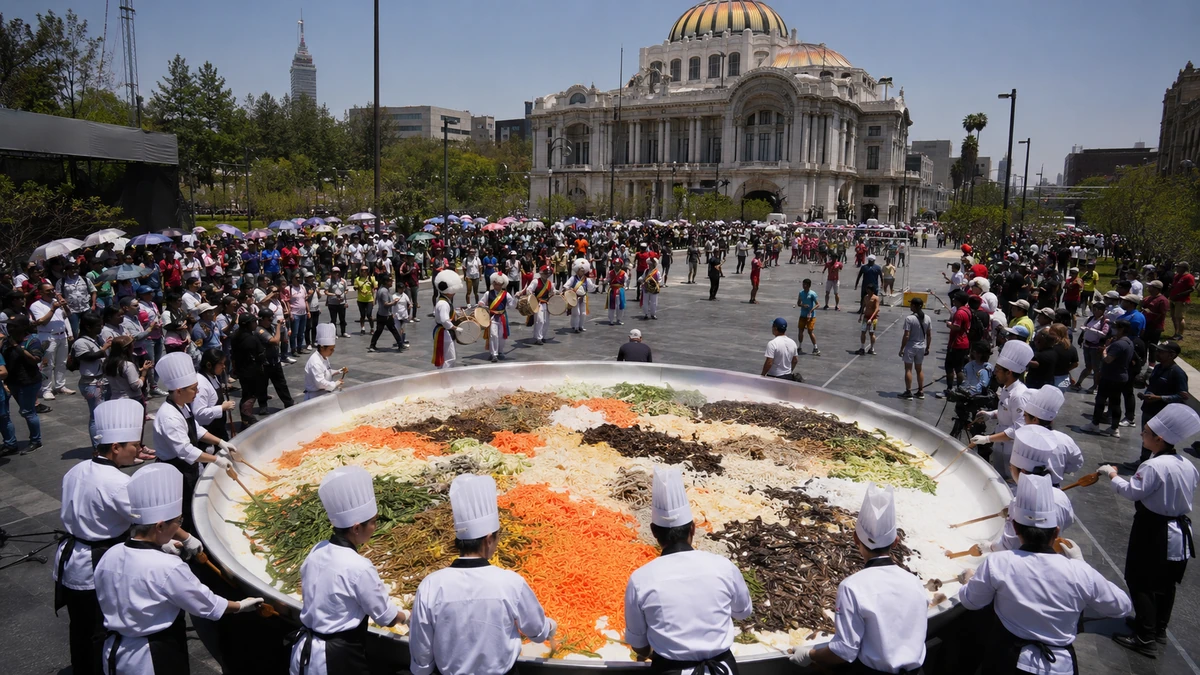
A Korean dish takes center stage in a Mexico City plaza
MEXICO CITY — In the middle of Lindbergh Plaza, under the kind of bright late-morning sun that makes public squares feel both festive and exposed, hundreds of people gathered around an unmistakably Korean symbol: an oversized bowl of bibimbap.
At first glance, it might have looked like the sort of international food festival scene familiar to Americans from street fairs in Los Angeles, Queens or Chicago — a crowd, music, children moving between activity tables and a national cuisine used as an invitation. But organizers said this event was meant to carry a broader message. Held ahead of the World Cup and framed as a gathering for peace and unity, the Mexico City program used one of Korea’s best-known dishes to argue for something larger than culinary curiosity: that people from different cultures can coexist, collaborate and even find harmony in their differences.
According to the South Korean news agency Yonhap, the event drew local residents and members of the Korean diaspora in Mexico. Its formal title tied together several ambitions at once — support for a successful World Cup, hopes for peace on the Korean Peninsula and the idea of peaceful coexistence across borders. That may sound like a lot to ask of a rice dish, but bibimbap has long carried symbolic weight in Korean culture. The name roughly translates to “mixed rice,” and the dish is built from contrast: vegetables, meat, egg, sauce and rice placed side by side, then stirred together into something unified.
For American readers, bibimbap can be understood as one of South Korea’s signature comfort foods, though calling it merely comfort food undersells its cultural reach. It is common in Korean homes and restaurants, visually striking enough for social media and flexible enough to adapt regionally or internationally. In the United States, it has become one of the gateway dishes through which non-Korean diners encounter Korean cuisine, much as sushi introduced many Americans to Japanese food or tacos expanded from a niche offering into a defining part of mainstream dining. In that sense, choosing bibimbap for a public diplomacy event was not random. It is Korean, recognizable and built around the idea that distinct ingredients do not lose themselves when combined; they create something new.
That metaphor was the organizing principle of the day in Mexico City. Rather than presenting Korean culture as a museum piece to be admired from a distance, the event tried to make it something people could join, taste, hear and physically move alongside. The giant bibimbap at the center of the plaza was not just a photo opportunity. It was a statement about mixture itself — about the possibility that a shared public space can hold many identities at once without flattening them.
Beyond spectacle, a lesson in participation
What stood out about the gathering was not simply the scale of the dish but the way the plaza was animated around it. There were Korean drummers in hanbok, the traditional Korean dress known for its vivid colors and flowing lines, performing to the rhythms of samulnori, a Korean percussion tradition built around four instruments. For Americans unfamiliar with the term, samulnori is not unlike a highly stylized public drum performance that blends ceremony, movement and musical intensity. It can feel at once communal and theatrical, and it often works even for audiences who do not know its history because rhythm crosses language barriers easily.
As performers moved through the square striking the kkwaenggwari, jing, janggu and buk — small gong, large gong, hourglass drum and barrel drum — local spectators did more than observe. They reacted, lingered, joined and folded the performance into the larger atmosphere of the event. Nearby, women took part in a jump-rope challenge. Men controlled soccer balls in the square. Children colored images tied to the East Asian zodiac, the cycle of 12 animal symbols that remains familiar across several Asian cultures and still appears in everyday references, especially around the Lunar New Year.
That mix matters. Public presentations of national culture abroad can sometimes feel one-directional: a country arrives, displays its “heritage,” receives polite applause and leaves. This event appeared to aim for something more porous. Traditional Korean symbols were present, but they were placed beside universally legible activities — games, sports, coloring stations, a communal food ritual. In practical terms, that made the event easier to enter for someone with no prior knowledge of Korea. In symbolic terms, it suggested a shift from showcasing culture to sharing it.
That distinction is especially important in the era of the Korean Wave, or hallyu, the broad global spread of South Korean popular culture through K-pop, television dramas, film, beauty products and food. In the United States, hallyu is often discussed through commercial success: BTS topping charts, “Parasite” winning the Oscar for best picture, “Squid Game” becoming a streaming sensation, Korean skin care filling retail shelves and Korean fried chicken turning up in suburban strip malls. But culture does not travel only through entertainment giants or export figures. It also travels through embodied experiences — something you taste at a neighborhood restaurant, hear in a public square or learn to imitate with your own hands.
The Mexico City gathering belonged to that second category. It showed how Korean cultural presence abroad increasingly depends not just on being seen, but on being done together.
Why bibimbap works as a global symbol
Among Korean foods, bibimbap is especially well suited to international messaging because its meaning is unusually easy to explain. You do not need to know Korean history in detail to grasp the idea. A bowl arrives with ingredients arranged separately; then they are mixed into one dish. The appeal is immediate, almost self-translating.
That intuitive symbolism helps explain why organizers used bibimbap to connect themes as large as World Cup unity, Korea-Mexico friendship and peace on the Korean Peninsula. In diplomacy, abstract ideals such as mutual respect, coexistence and solidarity can become stale from overuse. But when those ideals are attached to a sensory act — stirring a bowl, sharing a meal, eating from a common concept if not literally from a common plate — they become easier to remember.
American readers can think of this as a cousin to the way certain foods in the United States carry narratives larger than themselves. A Thanksgiving table, for example, is not just turkey and stuffing; it is also a ritualized story about family, belonging and national identity, however contested that story may be. A neighborhood cookout can mean more than grilled food; it can signal community, summertime and informal civic life. Bibimbap, in this setting, functioned similarly. It was food, but it was also an argument.
That argument was not that difference should disappear. Bibimbap only works because its ingredients remain distinct long enough to matter. The vegetables, rice, protein and sauce each bring their own texture and flavor before the mixing begins. For a multicultural audience, that is a useful metaphor: coexistence does not require sameness. It requires a structure in which difference contributes to the whole.
That is likely one reason the dish has become such a strong ambassador for Korean food abroad. Korean cuisine more broadly is increasingly familiar to American diners, but bibimbap offers a kind of built-in narrative clarity. Korean barbecue is interactive and convivial, but less metaphorically obvious. Kimchi is iconic and historically rich, but its pungency can still be a threshold for newcomers. Bibimbap is colorful, accessible and open-ended. It invites customization without losing its core identity. In a global public square, that makes it unusually effective.
In Mexico City, the dish also fit the democratic energy of the plaza itself. This was not a gala dinner or embassy banquet cut off from ordinary foot traffic. It was an event in a public space, where passersby could become participants. In that environment, a dish built on mix-and-match abundance could communicate something that a formal speech alone could not.
The World Cup backdrop and the language of sport
The timing of the event also mattered. Organizers tied the program to the World Cup, and the soccer-related activities in the square underscored why. Sports, especially soccer, offer one of the lowest barriers to entry in global public life. You do not need specialized knowledge to understand someone juggling a ball or a crowd rallying around a major tournament. The emotional grammar is shared almost everywhere.
For American audiences, there is an instructive parallel in how big sporting events become containers for identity and soft power. The Olympics, the World Cup and even major international friendlies are never only about results on the field. They are about branding cities, projecting values and giving national stories a stage that feels less formal than statecraft and more emotionally immediate than trade policy. That is true whether the host is Paris, Los Angeles, Doha or Seoul.
By linking bibimbap with the World Cup, organizers effectively placed Korean cultural symbolism onto a global timetable that millions already understand. Soccer broadened the audience. Bibimbap supplied the message. Traditional drumming anchored the event in Korean heritage. Local residents and Korean expatriates filled in the human bridge between them.
There is also a specific logic to staging such an event in Mexico City. Mexico is one of the world’s most soccer-passionate countries, where the sport shapes public life in a way Americans more often associate with the NFL in football-heavy states or college basketball in parts of the Midwest and South. A plaza event that includes ball control demonstrations and communal festivity is speaking the language of the setting. It is not simply importing Korean culture intact. It is meeting the host culture where it lives.
That is often the difference between successful cultural diplomacy and mere display. The strongest international cultural events do not insist on total translation into one side’s terms, but they do make space for recognition. In Mexico City, soccer supplied that recognition. So did the public-square format itself, which carries a civic feeling familiar from Latin American urban life. Korea’s contribution was not delivered as an isolated package. It was folded into a social rhythm already legible to local audiences.
Seen that way, the event was not just about Korea introducing itself. It was about Korea entering into a local conversation already structured by sport, public gathering and shared celebration.
What the ambassador’s remarks reveal about Korea’s message abroad
South Korea’s ambassador to Mexico, Lee Joo-il, said in remarks at the event that communities become richer when people of different cultures, traditions and backgrounds coexist with mutual respect, understanding and solidarity. He added that he hoped the gathering would bring the two communities closer and strengthen a shared commitment to peace.
Diplomatic speeches often flatten into predictable language, and phrases like “mutual respect” can wash past listeners if they are not attached to something tangible. But in this case, the remarks gained force from the setting. The ambassador was not speaking at a policy forum or a security conference. He was speaking in a plaza, amid drumming, games and a symbolic food ritual involving local residents and members of the Korean community.
That context matters because it locates diplomacy in everyday experience rather than elite negotiation. No one would seriously argue that a food event can transform international relations overnight or resolve the longstanding division of the Korean Peninsula. But public life does not run only on treaties and communiques. It also runs on memory, familiarity and repeated contact. When people come to associate another country not only with headlines about missiles, trade disputes or celebrity exports but with a lived sense of welcome, their baseline understanding changes.
For South Korea, that matters. The country’s global image has grown broader and more sophisticated over the past two decades, but it still often reaches foreign audiences in fragments — Samsung, K-pop, North Korea-related security news, award-winning cinema, high-speed internet, cosmetics, “Squid Game.” Events like the one in Mexico City help integrate those fragments into something more human-scaled. They present Korea not just as a producer of globally successful products and cultural phenomena, but as a society trying to make its values legible through participation.
The ambassador’s invocation of peace also carries a specifically Korean resonance. For South Koreans, public references to peace are rarely abstract. They exist in the shadow of the unresolved Korean War and the continuing division between North and South Korea. To American readers, that context may feel remote until it resurfaces in a missile test or diplomatic summit. But in Korean public culture, peace can appear in far more ordinary contexts, from commemorative events to civic campaigns and cultural programs abroad. That does not mean every such event is overtly political. It means the language of peace remains close to the surface of Korean national life in ways many Americans might not immediately recognize.
In Mexico City, the message was softened and broadened through food and festivity. That may be precisely why it worked.
From “showing” Korea to “doing” Korea together
If there is a larger trend visible in the event, it is this: Korean culture abroad is increasingly moving from presentation to participation. That shift can be seen well beyond Mexico. In American cities, Korean cultural festivals no longer revolve only around stage performances and booth displays. They often include kimchi-making workshops, K-pop dance tutorials, taekwondo demonstrations open to children, Korean calligraphy activities and tasting stations where food becomes a point of entry rather than a souvenir.
This reflects a broader change in how cultures travel in the digital age. Online fandom can generate attention quickly, but in-person participation gives that attention durability. A song can go viral; a shared physical experience can become memory. The same is true for cuisine. Watching a cooking video is one level of engagement. Mixing your own bowl, hearing the drums nearby and doing so in conversation with people from different backgrounds is another.
That may sound obvious, but it marks a meaningful evolution in hallyu. The early phases of Korea’s global cultural rise were often measured through exports and audience numbers — TV ratings, album sales, box office totals, streaming views. Those metrics still matter. But they do not fully capture how a country becomes familiar abroad. Familiarity often grows in slower, smaller ways: a grocery store aisle, a weekend festival, a school language program, a local restaurant, a public plaza event where children color zodiac animals while adults try a dish they have heard about but never tasted.
The Mexico City bibimbap gathering appears to have understood that. It did not treat local residents as passive spectators in front of Korean authenticity. It offered them ways in. The drumming could be watched, but the rhythms could also be felt. The food could be admired, but it also explained itself through its ingredients. The setting allowed Korean identity, Mexican public culture and globally shared interests like soccer to exist side by side.
That approach is one reason Korean culture has proven so adaptable internationally. At its best, it is not offered as a closed system demanding expert knowledge. It is offered through touchpoints — food, rhythm, style, story, ritual — that are specific enough to remain Korean and open enough to welcome newcomers. The result is not dilution. It is translation.
Why this story resonates beyond Korea and Mexico
For readers outside both countries, the Mexico City event is interesting because it illustrates a bigger truth about how nations build relationships in the 21st century. Not every consequential international story unfolds in a summit room, a military briefing or a trade negotiation. Sometimes it unfolds in a public square around a bowl of food.
That does not make the scene trivial. In some ways, it makes it more revealing. Official diplomacy tells us what governments want. Public cultural encounters tell us how those messages are likely to be felt, remembered or ignored. A speech about solidarity may be forgotten by evening. A plaza full of percussion, soccer tricks, children’s art and a giant communal bibimbap is easier to hold onto.
There is also something broadly American in the appeal of the scene. The United States, for all its internal divisions, remains deeply shaped by the idea that public culture can be built through shared spaces and hybrid traditions. Americans understand instinctively what it means for food to become a bridge among communities. They know what neighborhood festivals do for civic texture. They know that sports can create common ground among people who disagree about nearly everything else. In that sense, the Mexico City gathering is not just a Korean story or a Mexican story. It is a story about one of the oldest democratic instincts: inviting strangers into a space where participation matters more than familiarity.
The giant bibimbap in Lindbergh Plaza offered a version of that invitation. It suggested that culture is at its most persuasive not when it stands behind velvet ropes, but when it asks people to come closer. Before the World Cup, with soccer helping set the tone and Korean tradition supplying the symbols, organizers created a scene that was easy to understand even for people who had never heard of samulnori, never worn hanbok and never tasted gochujang, the fermented red chili paste that gives many Korean dishes their heat.
They did so with a message that traveled well: Different ingredients, mixed together, can make something richer than any one of them alone. That is a simple idea, almost disarmingly so. But in an era of hardening borders, cultural suspicion and political polarization, its simplicity may be part of its power.
In the end, the most memorable image from the event may not be the size of the bibimbap itself, though that certainly helped draw attention. It is the image of a plaza where Korean expatriates and local residents moved through the same space, responding not to a lecture about coexistence but to a lived version of it. Music, food, sport and play did the explanatory work. The diplomacy was still there, but it came wrapped in experience rather than protocol.
That is why the story matters. It captures the increasingly tactile, participatory way South Korea is meeting the world — not only through blockbuster entertainment or export prowess, but through the softer power of ordinary human connection. In Mexico City, that connection happened around a bowl of mixed rice big enough to be seen from a distance, but meaningful because it invited people to come near.
Comments
Post a Comment