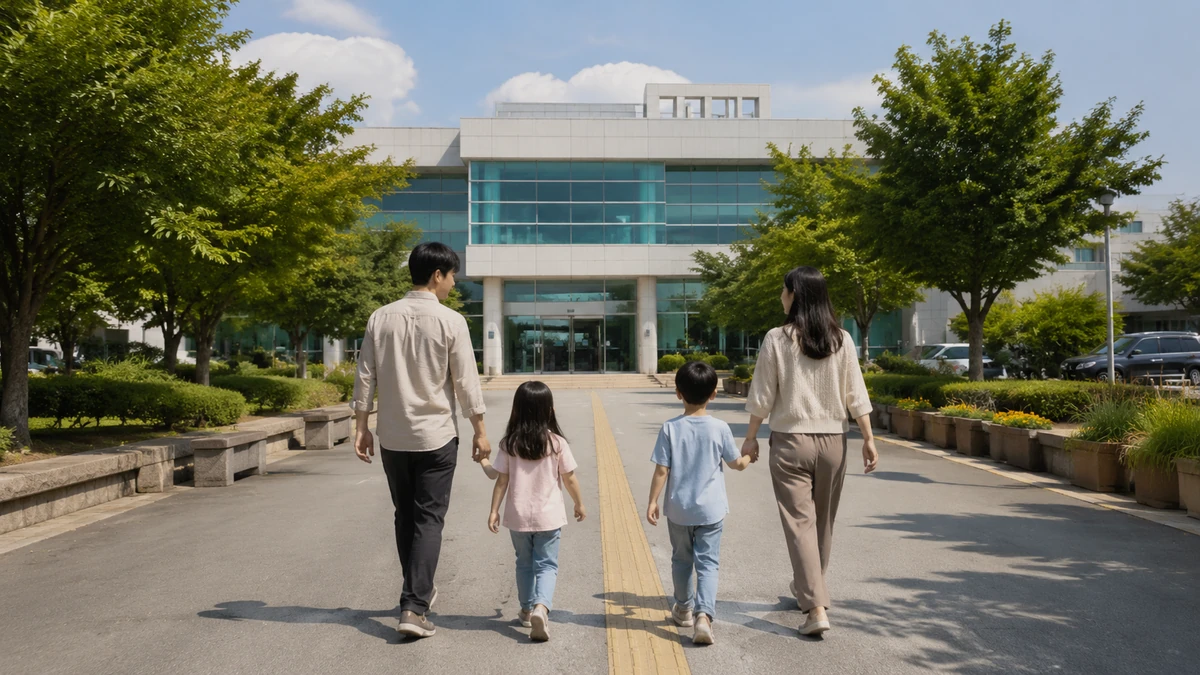
A small policy aimed at a familiar family problem
In the South Korean city of Yangju, just north of Seoul, local officials are rolling out a policy built around a simple but often overlooked reality of family life: For many parents, getting a sick child to the doctor is not only a medical question, but a transportation one.
Beginning next month, Yangju’s public health office will reimburse transportation costs for children 13 and younger who live in the city’s more rural townships and need to visit a pediatrics or adolescent medicine clinic. The support will apply to trips made on weekday evenings from 7 p.m. to 8 a.m. the next day, as well as on Saturdays and public holidays, times when parents are often juggling work, limited transit options and a shrinking number of clinics that are open.
On paper, the program may sound modest. It is not free health care in the broad sense, and it does not build a new hospital or add a fleet of ambulances. Instead, it reimburses actual round-trip transportation expenses, including taxis and private ambulances used for pediatric visits. But the policy has drawn notice because it targets a gap in access that many health systems, in South Korea and elsewhere, tend to treat as secondary: the cost and logistics of physically reaching care.
For American readers, the idea may sound somewhat analogous to the transportation benefits sometimes included in Medicaid managed care plans, nonemergency medical transportation programs, or hospital-backed rides for patients who otherwise might miss appointments. The difference is that Yangju’s plan is tailored with striking precision to a particular slice of daily life: children in less-connected areas, traveling at the hardest hours, for a type of care that often cannot wait until Monday morning.
That focus helps explain why a local administrative announcement in South Korea is resonating beyond the narrow world of municipal policy. It is really a story about how governments define access to care. Is access only about whether treatment exists? Or does it also include whether a parent can afford the ride across town at 9 p.m. when a child spikes a fever?
In Yangju, officials appear to be answering that question in practical terms. If the problem starts before a family reaches the clinic door, then the policy response should start there, too.
Why the transportation bill matters
In the United States, debates over health care usually center on insurance premiums, deductibles, drug prices and hospital bills. In South Korea, where national health insurance already covers most residents, the conversation often looks different. Costs still matter, but so do wait times, regional disparities and access outside major urban centers. A family may technically have coverage yet still face real barriers when the nearest appropriate clinic is not close, not open or not easy to reach on short notice.
That is the problem Yangju’s new program is trying to narrow. The beneficiaries are children living in areas designated as eup and myeon, Korean administrative units that broadly refer to towns and rural townships rather than denser urban neighborhoods. South Korea is highly urbanized, and its global image is often tied to ultramodern Seoul, high-speed internet and gleaming transit networks. But that image can obscure the uneven geography of everyday services. Even in the orbit of the capital region, some families live farther from specialized care and have fewer options during off-hours.
For children, those limitations can matter quickly. A 7-year-old with a worsening cough, a high fever or sudden stomach pain cannot independently decide to seek care, arrange a ride or compare nearby clinics online. Everything depends on an adult’s time, judgment and means. If the parent is working late, lacks a car, or faces a costly taxi trip because buses are infrequent or no longer running, the threshold for going to the doctor rises.
That is what makes transportation more than a side expense. In some cases, it can become the factor that determines whether care begins early or is delayed until symptoms become harder to manage. In health policy language, this is often discussed under the umbrella of “social determinants of health,” the idea that outcomes are shaped not only by medical treatment but also by income, housing, education and mobility. Yangju’s program may not use that jargon, but it operates on the same logic.
It also reflects a growing recognition that the most meaningful support programs are not always the biggest. Sometimes they are the ones designed around friction: the small, repeated obstacles that families encounter in ordinary life. A reimbursement for a taxi to a pediatric clinic will not transform a regional health system overnight. But for a parent standing outside with a sick child on a cold holiday evening, it can make the difference between going now and waiting until morning.
That is why this transportation policy belongs not only on the local government beat, but also in the broader conversation about inequality. If two children need the same medical attention but one can reach it easily while the other cannot because of where that child lives, the gap is not abstract. It is immediate, measurable and tied to place.
A local government response shaped by Korean realities
South Korea’s local governments often play a larger role in day-to-day family support than foreign audiences might expect. Alongside national programs, cities, counties and districts regularly introduce narrowly targeted assistance for child care, housing, fertility, elder care and education. In recent years, as the country grapples with a low birthrate, aging demographics and sharp regional imbalances, municipal governments have become increasingly active in trying to ease the practical burdens of raising children.
Yangju’s new measure fits squarely within that pattern, but it also stands out. Support for children’s medical care is common in one form or another. What is less common is a policy that bypasses the clinic bill itself and zeroes in on the trip to the clinic. That makes the measure socially significant even if its price tag is relatively small.
In Korean public administration, details matter. The city did not frame the initiative as general family assistance. It specified the eligible age group, children 13 and under. It specified geography, limiting the program to eup and myeon residents rather than the entire city. And it specified the time window: weekday nights from 7 p.m. to 8 a.m., plus Saturdays and public holidays.
That kind of design says a lot. It suggests the city is not simply trying to hand out benefits broadly, but trying to identify when families are most likely to face a real access barrier. In Korea, many pediatric clinics operate standard hours, and while larger hospitals may have emergency departments, not every family needs or wants to go straight to an emergency room for a child who needs prompt but not life-threatening evaluation. Parents often seek neighborhood pediatrics clinics for exactly the kind of cases that generate stress in the evening or on weekends: persistent fevers, ear infections, stomach viruses, breathing concerns or symptoms that worsen after school or after work.
By limiting reimbursements to those high-friction time periods, Yangju is acknowledging a fact many parents anywhere would recognize. Illness rarely arrives on schedule. A child is just as likely to become sick after bedtime, during dinner or on a holiday afternoon as during a convenient weekday slot. And when that happens, the burden on caregivers multiplies quickly.
The policy also reveals something about the current boundaries of local power. A city government cannot instantly create a fully even distribution of pediatric specialists. It cannot, by itself, remake the larger health infrastructure. But it can identify one barrier within its control and reduce it. In that sense, the program is a practical workaround, not a total solution. It aims to make the existing system more reachable for families who live on its edges.
That may sound unglamorous, but it is often how social policy actually evolves: not through one sweeping reform, but through a sequence of narrow fixes that target where institutions and daily life fail to line up.
The significance of nights, weekends and holidays
The most revealing part of Yangju’s plan may be its clock. The city is covering transportation not at all hours, but at the hours when parents are most likely to feel cornered.
Weekday evenings after 7 p.m. are a familiar pressure point in both Korean and American family life. Children are home from school. Parents may still be commuting, finishing work or managing dinner, homework and younger siblings. If a child suddenly needs care, the decision is no longer only about health. It becomes a logistics challenge layered on top of a work-life squeeze.
In South Korea, that pressure can be especially acute because work culture has long been demanding, even as reforms have tried to reduce working hours. Add to that a family living outside the city center, limited late-night bus service and the possibility that the nearest open pediatric clinic may not be close, and a doctor’s visit becomes a complicated operation. The policy’s time frame effectively acknowledges that what looks like a medical choice from the outside is often a transportation-and-time puzzle on the ground.
The inclusion of Saturdays and public holidays matters for similar reasons. In the United States, many parents know the scramble of finding urgent care on Thanksgiving weekend or during a Sunday afternoon when the pediatrician’s office is closed. South Korean families face their own version of that dilemma. On days when routine clinic hours are reduced and some facilities are closed altogether, the set of available options narrows, often requiring longer travel.
That means transportation costs can spike precisely when a family’s stress is already high. Taxis become more likely. Private ambulances, which in Korea can be used in certain medical transport situations outside the standard emergency response system, may also come into play. Reimbursing those expenses is not simply a gesture of sympathy. It is an attempt to stop transportation costs from becoming a reason to postpone care.
There is also a psychological dimension that should not be underestimated. Public policy often talks about “financial burden” in numeric terms, but family decisions are shaped by uncertainty as much as by hard costs. If parents know in advance that a late-night trip to a pediatric clinic could be reimbursed, they may feel more able to act quickly rather than hesitating, monitoring symptoms longer or hoping a child will improve by morning.
That kind of reassurance can be especially important in a country where many households are feeling economic pressure. South Korea has experienced the same broad anxieties familiar to families in the United States: housing costs, child care expenses, stagnant wage concerns and the general strain of raising children in a competitive environment. In that context, even a relatively small local subsidy can carry disproportionate emotional value because it tells parents that government sees a particular problem they face and is willing to help shoulder it.
How the program works, and where friction may remain
According to city officials, the reimbursement applies to pediatric and adolescent medicine visits taking place on or after the first day of next month. Families must apply within three months of the treatment date. To receive payment, they need to submit an application form along with a medical receipt, proof of transportation expenses, a resident registration document showing household information and a copy of a bank account.
Applications can be filed either at the local administrative welfare center in the family’s township area or through the pharmaceutical and medical management team at Yangju’s public health center. In administrative terms, that is a sensible structure. It gives residents a nearby access point while also linking the process to the office with health-related expertise.
Still, the application requirements point to a tension familiar in social policy everywhere: the balance between accountability and usability. Governments want documentation to prevent abuse and justify spending public money. Families, meanwhile, often need programs that are simple enough to use when they are tired, busy and already dealing with a child’s illness.
American readers will recognize the pattern. Many assistance programs, from child tax credits to school meal benefits to transportation reimbursement in health care systems, can look generous in principle while losing applicants in practice because paperwork becomes its own barrier. Receipts get misplaced. Deadlines are missed. Parents do not know a benefit exists until after the eligible window closes.
Yangju’s three-month filing period offers some breathing room, which could improve participation. But whether the policy succeeds may depend as much on outreach and ease of use as on the reimbursement itself. If local clinics, schools and township offices actively explain the program, more families are likely to take advantage of it. If the process remains too cumbersome, the measure could help fewer households than intended.
That does not diminish the importance of the policy. If anything, it underscores how the practical success of social programs is often determined less by lofty goals than by implementation details. A well-designed reimbursement with low public awareness can underperform. A modest one with clear guidance and easy submission can punch above its weight.
The structure of Yangju’s plan at least suggests officials have thought about usability. The target population is clearly defined. The time window is explicit. The eligible expenses are specific. And the filing locations are not restricted to one remote office. Those may sound like bureaucratic particulars, but in real life they are the difference between a policy that exists on paper and one that residents actually use.
What this says about inequality inside prosperous societies
To outsiders, South Korea can appear uniformly advanced: fast trains, dense cities, high educational attainment, sophisticated hospitals and one of the world’s most wired populations. All of that is true. But prosperous countries are not free of internal inequalities. In many cases, prosperity can mask them. The assumption that a rich, modern society has solved access issues can make the remaining gaps harder to see.
Yangju’s transportation program is, in effect, an official admission that even within a developed metropolitan region, not all families experience public services equally. Geography still matters. So does time of day. So does whether a household has the bandwidth to absorb one more unexpected expense.
That is not uniquely Korean. In the United States, a child in a suburb with multiple urgent care centers and a family car lives in a very different care environment from a child in a rural county where the nearest pediatric specialist is miles away. Even in cities with world-class hospitals, low-income families may struggle with transit, parking fees, missed wages and the complexity of navigating systems. The lesson is broadly transferable: access is never only about the existence of a service. It is about the pathway to it.
What makes Yangju’s move noteworthy is that it treats transportation as part of the health care equation rather than an unfortunate externality. That perspective is increasingly important in aging and low-birthrate societies, where governments are under pressure to make raising children less punishing and community life more sustainable. South Korea’s demographic crisis has pushed policymakers at every level to ask what kinds of support families actually need. Sometimes the answer is a housing subsidy or child care support. Sometimes, as in this case, it is help paying for the ride to a clinic on a weekend night.
There is also a deeper philosophical point here. Modern welfare states are often judged by the size of their headline programs. But citizens frequently experience government through smaller encounters: whether a form is understandable, whether a benefit arrives on time, whether a bus route exists, whether a sick child can get to a doctor without the parent fearing the cost of the trip. Those are not glamorous metrics. They are, however, central to how trust in institutions is built.
If the program works as intended, Yangju may offer a case study in what effective local government can look like in an era of constrained budgets and stubborn structural problems. The city is not claiming to solve pediatric care inequality in one stroke. It is choosing one concrete obstacle and reducing it for a defined group of people. That is incrementalism, but it is purposeful incrementalism.
Why global readers should pay attention
It is easy to dismiss a municipal reimbursement program as a niche local matter. Yet stories like this one often reveal more about how societies function than major national speeches do. Yangju’s policy captures several forces shaping advanced economies around the world: regional imbalance, cost-of-living strain, pressure on working parents and the challenge of turning nominal services into real access.
For international readers, especially in the United States, the announcement offers a useful reminder that social policy innovation does not always come from capitals or national legislatures. Sometimes it comes from city halls trying to solve the problems residents complain about most often. And sometimes the most revealing policy question is not “Who is insured?” but “Who can actually get there?”
It also adds texture to the broader story of contemporary South Korea, a country often covered abroad through the lenses of K-pop, film, technology, North Korea and demographic decline. Those subjects matter, but they can flatten the country into familiar narratives. Local measures like Yangju’s show another side of Korean society: the granular work of municipal governance, where officials try to manage the pressures of family life one policy lever at a time.
Whether the reimbursement program becomes a model for other localities will depend on results that are not yet known. Uptake rates, administrative ease and family feedback will matter. Some parents may find the paperwork manageable and the benefit meaningful. Others may still struggle with documentation or not learn of the program in time. The policy’s real test will come after implementation, not announcement.
But even before those numbers arrive, the logic behind the plan is clear and noteworthy. Yangju has identified a piece of the health care journey that often goes ignored and treated it as a public issue worthy of intervention. That is a relatively humble move, yet it carries a larger message: In a functioning safety net, care does not begin only when a doctor enters the room. It begins when a family is able to leave home and make the trip.
In that sense, the policy is about more than transportation. It is about how a community defines responsibility. When a child falls ill at night in a less-connected part of town, does the family bear the full burden alone, or does the public sector step in just enough to make timely care more possible? Yangju’s answer, at least for now, is that the road to the clinic is part of the problem. And therefore, it is part of the solution.
Comments
Post a Comment