A local education race in South Korea becomes a referendum on fairness
What might otherwise have been a regional school-administration election in South Korea has turned into something far bigger: a public argument over privilege, merit and whether a candidate for top education office can credibly promise fairness while facing questions about his own family.
In South Gyeongsang Province, known in Korean as Gyeongnam, the campaign for provincial superintendent of education has been jolted by allegations involving one candidate’s child and a research paper published while the child was still in high school. Civic groups are demanding records and documentation they say are necessary to determine whether the student benefited from what many South Koreans call “parent chance” — an advantage derived not from a student’s own accomplishments alone, but from the professional status, connections or resources of their parents.
The candidate at the center of the dispute, Kwon Soon-ki, has pushed back sharply. His camp says the attacks are unfair, politically motivated and amount to a vicious intrusion into a family’s private life. But the criticism has not faded. Instead, it has moved to the center of the race, displacing policy debates and forcing voters to weigh a question that resonates deeply in modern South Korea: What counts as a fair opportunity in education?
For American readers, the best comparison may be the way college admissions scandals can rapidly swallow a school-board race, a university presidency search or even a statewide campaign. But in South Korea, where academic competition is often more intense and educational attainment is widely seen as one of the few reliable ladders for upward mobility, allegations of special access can carry even more political and moral force.
That is why this contest is now being watched not simply as a local election, but as a small-scale test of how South Korean democracy handles one of its most emotionally charged subjects: whether the rules really apply equally to everyone’s children.
Why this office matters more than many Americans might assume
To understand why the controversy has landed with such force, it helps to understand the job at stake. A superintendent of education in South Korea is not a ceremonial figure. The role oversees regional education policy, school administration and the broader direction of public schooling. In practical terms, it is a position that touches classrooms, school budgets, standards, student welfare and the overall climate of local education.
For Americans, the closest parallel might be a hybrid of a large urban school chancellor, an elected state schools chief and, in some ways, a countywide education administrator. The office is public-facing and politically sensitive, but it is also closely linked to everyday concerns of parents and students. Whoever holds it is expected not only to manage schools competently, but to embody the values the education system claims to defend.
That makes personal credibility especially important. A candidate running for governor or mayor might survive a controversy by redirecting attention to economic policy or public safety. A candidate running to oversee schools faces a harder test when the allegations involve admissions, academic credentials or unequal opportunity. In that setting, the controversy is not peripheral to the office; it goes directly to the office’s moral foundation.
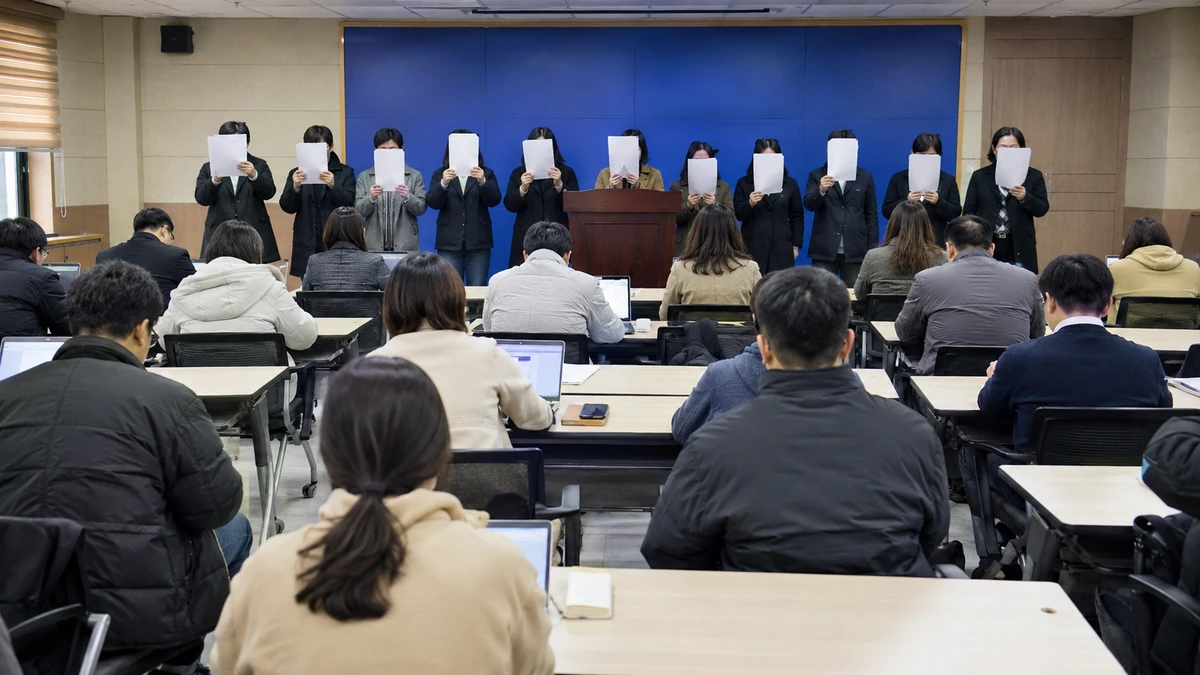
In the Gyeongnam race, progressive and centrist education-related civic organizations have seized on exactly that point. They argue that voters are entitled to know not only what a candidate says about fairness in schools, but whether the candidate’s own family history reflects the same standard. Their demand is not just political. It is framed as a question about the integrity of education itself.
That framing matters. In South Korea, education elections are often discussed in terms of ideology, school reform and student policy. But once a campaign becomes associated with possible favoritism in admissions, the terms of debate can change almost overnight. Policy papers and campaign pledges start to matter less than trust, judgment and whether the candidate appears transparent under scrutiny.
The allegation at the center of the dispute
The immediate controversy focuses on the candidate’s child being listed as the first author of a paper in an SCI-level journal while still in high school, with the child’s mother — a university professor — reportedly participating as an advising professor. SCI refers to the Science Citation Index, a benchmark widely associated with internationally recognized academic journals. In plain terms, this is not the kind of publication most ordinary high school students would be expected to access, much less lead as first author.
That distinction is central to the criticism. The civic groups involved are not treating the matter as a minor résumé oddity or a routine campaign attack. They are presenting it as a possible example of structural advantage — a case in which parental position may have opened doors unavailable to average students.
In the United States, readers may think of anxieties surrounding legacy admissions, private tutoring empires, unpaid internships arranged through family networks or the college admissions bribery scandal that exposed how affluent families could game systems presented as merit-based. South Korea’s version of the fairness debate is different in detail, but similar in emotional charge. The issue is not simply whether one student had a line on an application. It is whether institutions that claim to reward effort and talent are quietly tilted toward families who already know how to navigate them.
The phrase “parent chance” has become part of South Korea’s political vocabulary for exactly this reason. It refers to the way social capital can be converted into academic advantage. A parent’s job title, research network, familiarity with elite admissions culture or access to specialized mentoring may become an invisible boost for a child competing in an ostensibly level field.
In the current case, critics want to know two things. First, they want an explanation of how the first-authorship listing came about. Second, they want proof regarding whether that record was reflected in university admissions materials, including documents related to admission to Seoul National University, one of the country’s most prestigious institutions. In other words, the debate is not only about the publication itself. It is also about whether that publication translated into a concrete admissions benefit.
The candidate’s side has insisted there is no wrongdoing and has previously said the matter was thoroughly examined. But in the eyes of the civic groups pressing the issue, a general denial is no longer enough. They argue that once a candidate claims to have been fully vetted, the burden shifts toward producing records that can substantiate that claim.
Why documentation, not just denial, has become the demand
One striking aspect of the controversy is how specific the demands have become. The civic groups are not merely asking for a press statement or a broad explanation. They are calling for objective supporting materials and the release of admissions-related documents to show whether the publication was or was not considered in the student’s university application process.
That insistence reflects a broader shift in South Korean public life. In earlier eras, a politician or public figure might have hoped to ride out an allegation with indignation and a loyal base. Today, especially on education matters, a claim of innocence often invites a second question: Where are the records?
This is partly because education disputes in South Korea have become intensely document-driven. Whether the issue is test scoring, school violence, admissions screening or résumé inflation, public trust often depends on paperwork, timelines and procedural proof rather than rhetoric. A denial may stop loyal supporters from defecting, but it rarely satisfies a broader public primed by years of scandals to ask for evidence.
For American readers, that dynamic is familiar in a different form. We have seen a similar pattern in ethics controversies, police misconduct cases and campaign-finance disputes, where public opinion increasingly turns on emails, records, metadata and other traceable material. In the Korean education context, the same instinct applies with unusual force because school competition is viewed as consequential not just for individual success, but for family futures and social mobility.
That is why the controversy has grown beyond a debate over one publication. It has become a fight over the standard of proof expected from a would-be education leader. Critics say that if a candidate asks the public to trust his commitment to fairness, he should welcome the chance to resolve doubts with verifiable documentation. Supporters counter that such demands can quickly become excessive, especially when they draw family members into a political battle and expose private records.
That tension — between accountability and privacy — is where many modern democratic controversies now live. In this race, it is no longer enough for either side to claim the moral high ground. The politically decisive question may be which side can persuade voters that its version of fairness is the more defensible one.
Where legitimate scrutiny ends and political attack begins
Kwon’s campaign has answered the criticism with language that underscores how bitter the race has become. The candidate’s side has described the accusations as indiscriminate attacks and as a form of negative political violence against a family. That phrasing is revealing. It suggests the campaign believes the controversy is less about evidence than about weaponizing a child’s past to damage a candidate in the closing stretch of an election.
This argument is not trivial. Democracies routinely struggle to define the line between public-interest scrutiny and private harm. Candidates for public office do not lose all claims to family privacy, and children of politicians or public officials often become unwilling participants in fights they did not choose. Even when questions are legitimate, the way they are raised can feel invasive, especially when opponents invoke elite universities, family status and academic records — some of the most sensitive markers of class and ambition in Korean society.
At the same time, critics say the office itself changes the equation. A candidate for education superintendent is seeking authority over the very system in which the alleged advantage may have occurred. Under that logic, examining the family record is not gratuitous character assassination but a necessary inquiry into whether the candidate has lived by the principles he now promises to uphold.
That clash helps explain why the rhetoric has escalated so quickly. One side says this is public accountability. The other says it is a cruel political ambush. Both claims contain elements that many voters can recognize. Most people believe in fairness. Most people also recoil from the idea of families being torn apart in public. The political difficulty lies in deciding which concern deserves priority in this case.
For now, what is established publicly is relatively narrow: civic groups have demanded extensive disclosure, and the candidate’s camp has forcefully rejected the allegations as unfair political attacks. What remains unresolved is the underlying factual question — not because the issue lacks public interest, but because the records and explanations being demanded have not, at least in the summary of events so far, fully settled the dispute.
That uncertainty is exactly what allows suspicion to flourish. In high-stakes elections, ambiguity often helps neither side for long. If new documentation emerges, it could clarify the matter or intensify it. If it does not, voters may end up filling the gap with their assumptions about class, privilege and the credibility of political denials.
Why education fairness is such a combustible issue in South Korea
To outside audiences, especially those not immersed in Korean society, the intensity of the reaction may seem disproportionate to a dispute over authorship and admissions paperwork. It is not. Education in South Korea is not merely a public service. It is a major arena where ideas of merit, sacrifice and social legitimacy are fought over every day.
Students often face a demanding academic culture shaped by long study hours, high parental investment and fierce competition for entry into top universities. Admissions outcomes can affect career pathways, family status and perceptions of future stability. As a result, any suggestion that one student received elite academic opportunities through family position rather than ordinary access can trigger anger far beyond the immediate facts of the case.
American audiences have their own versions of this sensitivity. Consider the public outrage around varsity-blues bribery cases, debates over standardized testing advantages or anger about unpaid internships reserved for the well-connected. But South Korea’s pressure cooker is in some ways even hotter because educational credentials remain so central to hiring, prestige and life chances.
That broader context is crucial to understanding why a local superintendent race now reads like a national morality play. The allegation evokes a larger fear: that the system tells ordinary families one story about hard work while quietly rewarding insiders by a different set of rules. Whether or not that fear is validated in this specific case, it is already animating the political response.
There is also historical memory at work. In recent years, South Korean politics has repeatedly been shaken by disputes involving academic records, internships, admissions files and claims of résumé inflation among the children of influential families. Those episodes have left the public more skeptical and less willing to accept vague assurances. Once an allegation lands in that atmosphere, it rarely stays small.
So the Gyeongnam election is not just about one candidate’s defense or one set of documents. It is also about how a society under intense educational pressure reacts whenever privilege appears to intersect with opportunity. In that sense, the controversy is not peripheral to Korean public life. It is a concentrated expression of one of the country’s defining democratic anxieties.
A policy election now centered on trust
One of the more consequential effects of the controversy is that it has overshadowed the policy substance a superintendent’s race would normally feature. Issues such as curriculum priorities, student mental health, local school funding, teacher support and the future of educational reform can easily get pushed aside when a campaign becomes consumed by questions of integrity.
That shift is politically understandable, but it is also costly. Elections for education leadership are supposed to help voters decide what schools should do and whom they should serve. When a campaign becomes dominated by allegations and rebuttals, the public may learn far more about a candidate’s family than about how the candidate would address classroom inequality, demographic decline or student stress.
Yet this too reflects a hard truth about democratic politics: policy proposals depend on trust. A candidate may have detailed plans for improving schools, but if voters doubt the candidate’s commitment to fair process, those plans can lose persuasive power. In an education race especially, trust is not a decorative virtue. It is part of the job description.
That is why the final stretch of this election may turn less on ideology than on which side can speak in a way voters find verifiable. The civic groups are betting that demands for records will resonate more strongly than generalized outrage from the campaign. The candidate’s side is betting that voters will see the controversy as opportunistic character destruction rather than substantive proof of favoritism.
At this stage, careful journalism requires restraint. The available summary indicates an active dispute, not a proved violation. It would be wrong to present the allegation as established fact. It would also be wrong to ignore why the allegation matters so much in the first place. The significance lies in the collision between two democratic values: the right of the public to scrutinize those seeking power over schools, and the right of candidates and their families not to be condemned without substantiated evidence.
What remains, then, is a familiar but crucial test. Will the campaign produce records that settle key questions? Will the accusers persuade voters that their demands are proportionate and rooted in public interest? Or will the public conclude that the election has been dragged into a damaging spectacle with too little proof and too much accusation?
However the race ends, the episode has already exposed something larger than a local campaign skirmish. In South Korea, as in the United States, education is where societies rehearse their deepest beliefs about who gets ahead and why. When voters suspect that some children climb using ladders unavailable to others, the backlash can be swift and unforgiving.
That is the real story of the Gyeongnam superintendent election. A contest that should have been about managing schools has become a fight over whether fairness in education is a lived principle or merely a campaign slogan. And for many voters, that may be the only issue they still need to hear answered.
Comments
Post a Comment