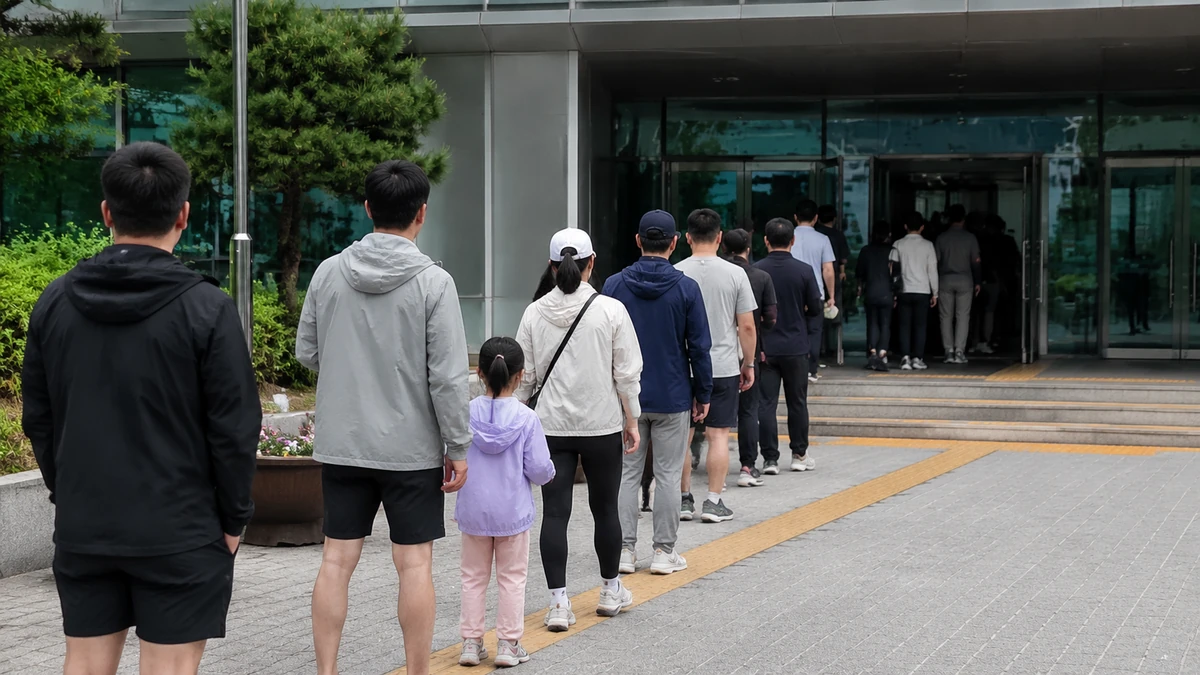
Democracy between a jog and a family outing
On a holiday morning in South Korea, voters in the southern part of Gyeonggi Province began lining up early at neighborhood polling stations — some before heading out for a day trip, others dressed in running clothes and planning to exercise afterward, and still others arriving with small children in tow. The scene, reported by South Korea’s Yonhap News Agency on the final day of early voting for the country’s 2026 local elections, was not dramatic in the way election coverage often is. There were no roaring rallies, no cliffhanger projections, no signs of crisis. What stood out instead was something quieter and, in some ways, more revealing: voting appeared to be folded into ordinary life.
For American readers, it may help to imagine a polling site at a suburban community center or city hall on a long weekend morning, with people stopping by in athleisure on their way to the park, or parents bringing children along before errands and soccer practice. That, in broad terms, is what emerged in cities such as Suwon, just south of Seoul, where early voting sites at local administrative centers drew steady lines from the morning hours. The symbolism was hard to miss. In a democracy, participation is healthiest not only when people care deeply about politics, but when the mechanics of voting become routine enough that they fit naturally into the flow of a normal day.
The election in question was South Korea’s ninth nationwide local election, a major recurring test of grassroots democracy in a country that has, over the past several decades, transformed itself from authoritarian rule into one of Asia’s most vibrant electoral systems. The images from Gyeonggi’s southern communities suggested not merely turnout, but habit: democracy not as a special ceremony reserved for moments of national emergency, but as a practiced civic rhythm.
That matters because democracies are often judged by their biggest moments — presidential races, mass protests, constitutional showdowns. But they are sustained by smaller ones: the parent who votes with a child at hand, the commuter who votes before starting the day, the neighbor who treats the polling place as one more stop in a familiar landscape. In South Korea this weekend, those smaller moments appeared to be everywhere.
Why these local polling places matter
The busiest scenes described in the reporting came from early-voting stations set up at local administrative welfare centers in Suwon’s Yeongtong district, including Mangpo 2-dong and Gwanggyo 2-dong. For readers outside Korea, those facilities require a bit of explanation. An administrative welfare center is a neighborhood-level public office where residents handle everyday government business — everything from paperwork and certificates to local services. It is not unlike a blend of a city neighborhood office, a public service counter and a community-facing municipal building.
Using those spaces as polling places carries practical advantages, but also civic symbolism. People know where they are. They are close to residential areas. They are woven into the map of daily life rather than isolated in an intimidating government complex. In the United States, there has long been debate over the accessibility of voting locations: whether polling sites are too far away, whether they create logistical burdens for working people, whether voting is treated as a civic duty in principle but made inconvenient in practice. South Korea’s use of hyperlocal public spaces points to a different emphasis — one in which the state tries to meet voters where they already are.
That neighborhood familiarity appears to be part of what made the morning scenes in southern Gyeonggi notable. The polling place was not a remote destination requiring a special trip. It was embedded in the same environment as apartment complexes, walking routes, nearby parks and routine weekend movement. When Yonhap described voters arriving before exercise or before an outing, it was describing more than colorful detail. It was showing how institutional design can shape democratic behavior. If the polling place is close, recognizable and easy to incorporate into the day, participation becomes less burdensome and more habitual.
American election administrators and voting-rights advocates have made similar arguments for years, especially around early voting and vote centers. The easier the process is to access physically and mentally, the less likely it is that participation will be reserved for people with flexible schedules, cars, child care or the luxury of free time. The South Korean scenes matter, then, not simply as a local curiosity but as a case study in what it looks like when election infrastructure is integrated into daily civic life.
Early voting as culture, not just convenience
In South Korea, early voting has increasingly become more than a procedural option. It has evolved into a cultural norm for many citizens — a way to cast a ballot without structuring an entire day around Election Day itself. That distinction is important. In many countries, reforms like early voting are defended on technocratic grounds: they reduce congestion, accommodate work schedules and increase flexibility. All of that is true. But reforms become truly significant when they are not only available but socially internalized.
The reporting from Gyeonggi Province suggests that this may be exactly what has happened in South Korea. Voters were not portrayed as making heroic efforts to participate. Instead, they were making ordinary choices. A person heading out for a morning run cast a ballot first. A family on the way to enjoy a day off stopped by a polling place. In one sense, that makes the act seem smaller. In another, it makes it more powerful. A democracy is sturdier when citizens no longer regard voting as a rare, cumbersome disruption but as something compatible with normal life.
For American readers, this may resonate in an era when access to the ballot remains a frequent subject of partisan and legal dispute. In the U.S., states differ dramatically in how easy it is to vote early, by mail or outside standard work hours. Some Americans can drop off a ballot at a secure box on a lunch break; others wait in long lines or navigate shifting rules. South Korea’s example does not eliminate political tension — no election system does — but it does highlight the practical value of designing participation around people’s routines instead of demanding that people reorganize life around a narrow voting window.
There is also a psychological shift embedded in early voting’s normalization. When participation becomes a routine act rather than a high-drama event, it can lower the threshold for engagement across social groups. It stops being something for the deeply political and becomes something for the broadly civic. That may help explain why the images from southern Gyeonggi felt so striking despite their ordinariness. They showed a society in which the ballot box had moved from the margins of life to somewhere much closer to the center.
Families at the polls and the quiet work of civic education
Among the most telling details in the Korean reporting was the presence of parents arriving with young children. Children, of course, cannot vote. But their presence at polling places carries meaning that goes beyond a family snapshot. In any democracy, civic identity is not formed only in classrooms or through speeches by public officials. It is formed through repeated, lived experiences that teach people what participation looks like.
When a child sees a parent enter a familiar public building, wait in line with neighbors and complete the simple ritual of casting a ballot, the lesson is subtle but lasting. Voting becomes part of what adults do. Citizenship is not abstract; it is observed. In the United States, parents often bring children into polling places for the same reason, and some election officials actively welcome it as a way to normalize democratic participation for the next generation. In South Korea, where family-centered public life remains strong, that visual of parents holding children’s hands at a polling site adds another layer: it shows democracy being passed down not by lecture, but by example.
There is also a practical dimension. Family participation can indicate that barriers to voting are relatively low. If parents can vote while out together with children, the system is accommodating not just to idealized individual voters but to real households managing time, care work and movement through the day. In many democracies, one of the least discussed obstacles to participation is the hidden labor surrounding it — arranging a schedule, finding child care, carving out an uninterrupted hour. Systems that allow voting to happen alongside family routines are often more inclusive than those that assume voters will appear as solitary, unencumbered citizens.
The Korean scenes from Suwon suggested exactly that kind of accessibility. Rather than separating public duty from domestic life, they showed the two intersecting. And that intersection may be one of the most important signs of democratic maturity: when civic participation is no longer isolated from the rest of life, but supported by the structures people already inhabit.
What local elections mean in South Korea
To outside observers, local elections can sound less consequential than presidential races or parliamentary contests. But in South Korea, local elections play a significant role in shaping daily governance. Voters choose officials and representatives who influence education, transportation, development, environmental policy and neighborhood-level administration. In a densely populated and highly urbanized country, those decisions can have immediate effects on quality of life.
That helps explain another thread in the reporting: the sense that voters were connecting their ballots directly to local problems. A related report from the country’s southeast described voters expressing hope that their votes would help resolve regional issues. That sentiment is familiar in any democracy, but it carries particular force in local elections, where the relationship between decision-making and lived experience is often easiest to see. Potholes get fixed or ignored. Transit routes expand or stall. Housing projects move forward or get mired in conflict. Air quality, school funding and municipal services all become tangible measures of whether local government works.
For Americans, there is a useful comparison in off-year mayoral, county or school board elections — contests that may receive less national attention but can affect everyday life more directly than Washington’s ideological battles. South Korea’s local elections function in a similarly grounded way. The voter going to the polls before a jog is not merely weighing a national political brand. That person may also be thinking about neighborhood development, local services and the practical concerns of city life.
The South Korean case also reflects the country’s broader democratic trajectory. Modern Korean democracy emerged through struggle, including mass protests and political upheaval, but its endurance depends on whether those gains remain meaningful at the level of ordinary governance. Local elections are where that endurance is tested. If citizens believe their vote can shape the place where they live, democracy deepens. If they do not, the system risks becoming performative. The turnout scenes in Gyeonggi suggest that many voters still see local ballots as worth their time — not in theory, but in practice.
Trust, procedure and the importance of calm administration
No election system is sustained by convenience alone. It also depends on trust: trust that procedures are clear, that ballots are handled properly and that small disputes can be resolved without spiraling into broader suspicion. The Korean reporting included one minor disturbance from another region, where a voter claimed to have received six ballots instead of seven at an early-voting station in Yangsan. By the account available, the incident did not grow into major disruption. But its inclusion is a reminder that even routine election administration must be attentive, transparent and responsive.
That sensitivity is hardly unique to South Korea. Around the world, faith in elections often hinges not on grand constitutional principles but on mundane questions: Was the line manageable? Were poll workers competent? Was confusion explained quickly? Did the setting feel orderly? In highly polarized environments, even minor procedural misunderstandings can become flashpoints. What matters is not the absence of any problem — an impossible standard in any large election — but whether the system contains problems before they erode broader confidence.
By the description offered from the field, the overall atmosphere on the final day of early voting in southern Gyeonggi was calm and steady. That calm is itself worth noting. In the era of viral misinformation and hyper-sensational political coverage, quiet competence rarely becomes the headline. Yet it is often the most important ingredient in democratic legitimacy. A line of voters in running clothes waiting patiently at a neighborhood public office may not make for explosive television, but it represents something many democracies struggle to maintain: participation rooted in trust that the process is normal, understandable and worth doing.
South Korea’s election management body has spent years working to preserve that trust under intense public scrutiny. The country’s politics can be fiercely divided, and electoral fairness is a highly sensitive topic. Against that backdrop, the image of voters steadily showing up to familiar local buildings on a holiday morning suggests not apathy but confidence — the confidence that the process is sufficiently reliable to become routine.
What the rest of the world can learn from a very ordinary scene
For global audiences, including in the United States, the significance of this story lies precisely in its lack of spectacle. The most revealing democratic stories are not always the ones that unfold in capitals or during constitutional showdowns. Sometimes they happen in suburban neighborhoods, at daybreak, when citizens do something simple because the system has made that simplicity possible.
That is what made the scenes in southern Gyeonggi compelling. They illustrated an idea that scholars of democracy often emphasize but that voters experience in practical terms: institutions work best when they align with everyday behavior. If voting can happen near home, at a familiar facility, on a flexible schedule, before a run or a family outing, then participation becomes easier to sustain across time. It becomes less dependent on extraordinary motivation. And when democracies rely less on extraordinary motivation, they become more resilient.
There is a temptation, especially in international coverage, to treat South Korea primarily through the lenses Americans know best: K-pop, Korean film and television, high-tech consumer culture, or the security threat posed by North Korea. Those reference points are real, but they can flatten a much more complex society. Stories like this one offer a different angle. They show a country whose democratic culture is being built and maintained in ordinary neighborhood spaces, by ordinary people, through repeated acts of participation that rarely make it into the global imagination.
They also offer a subtle challenge to democracies elsewhere. Citizens are often told to vote as if the burden rests solely on individual virtue. But the Korean example underscores that institutions share responsibility. People are more likely to participate when the system respects their time, uses familiar spaces and allows civic duty to coexist with the rhythms of family and work. That does not guarantee high turnout or eliminate partisan conflict. It does, however, make democracy feel less like an obstacle course.
On May 30, 2026, the final day of early voting in South Korea’s local elections, the country’s democratic life was visible not in soaring rhetoric but in line formations outside local public offices, in sneakers and casual clothes, in parents guiding children by the hand, and in voters completing a civic task before getting on with the rest of the day. For a world used to judging democracies by their loudest moments, it was a useful reminder: sometimes the strongest sign of democratic health is that it looks almost ordinary.
A snapshot of a mature civic habit
If there is one conclusion to draw from the morning scenes in Gyeonggi Province, it is that democracy becomes durable when it no longer feels separate from life. South Korea’s local election early voting appeared, at least in these reported snapshots, to have reached that threshold. Voting was not staged as a grand public performance. It was woven into a Saturday. That may sound modest, but it is the kind of modesty democratic systems should aspire to — a condition in which participation is neither burdensome nor exotic, neither ceremonial nor rare, but familiar.
For Americans watching from afar, there is both admiration and instruction in that image. Admiration because it reflects a society where democratic practice appears embedded in community routines. Instruction because it suggests that strengthening civic participation is not only about persuading citizens to care more. It is also about constructing systems that fit the realities of how people live. Public trust, local access, flexible timing and familiar spaces are not peripheral details. They are the architecture of everyday democracy.
And so the significance of southern Gyeonggi’s busy early-voting stations extends beyond South Korea’s borders. It speaks to a universal democratic question: not whether citizens support the idea of self-government, but whether self-government is organized in ways that people can actually live with. In Suwon and nearby communities, on one holiday morning in 2026, the answer seemed to be yes.
Comments
Post a Comment