
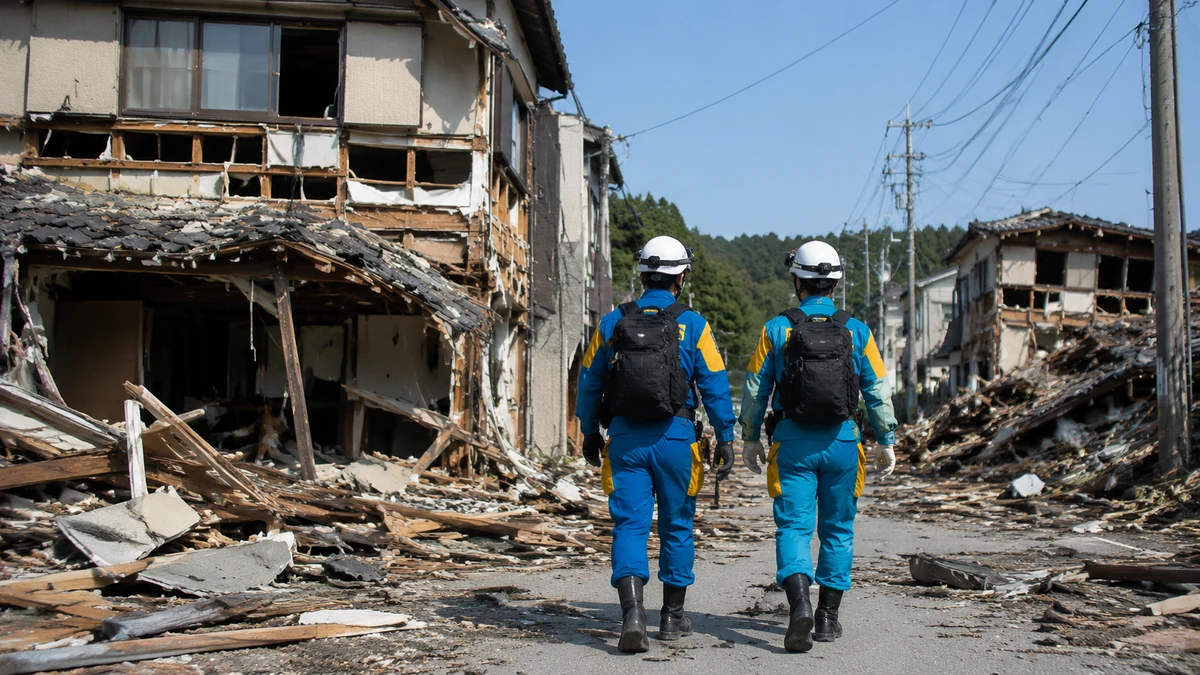
Japan turns a long-feared Tokyo earthquake into a measurable policy test
Japan’s government has set a stark new goal for one of the most consequential disaster scenarios in the world: If a major earthquake strikes directly beneath the Tokyo metropolitan area, officials want to reduce the projected death toll by more than half within the next decade.
That target, reported by Japanese media and cited by South Korea’s Yonhap News Agency, is notable not because it promises to stop an earthquake — no government can do that — but because it translates a long-discussed risk into a concrete benchmark. In a region where earthquakes are treated as an unavoidable fact of life, Tokyo is now publicly saying that mass casualties are not simply fate. They are, at least in part, a policy problem.
Under damage estimates released in December, a powerful earthquake centered beneath the capital region could kill as many as 18,000 people and destroy or burn down about 402,000 buildings. Those are not abstract numbers. They point to a cascading urban catastrophe in one of the most densely populated and economically vital metro areas on Earth.
For American readers, a useful comparison is to imagine Washington, New York and Los Angeles rolled into a single metropolitan zone — a place where national politics, global finance, rail hubs, hospitals, corporate headquarters and dense residential neighborhoods all overlap. That is part of what makes the Tokyo region so important. It is not just Japan’s capital. It is the center of state administration, a massive economic engine and home to tens of millions of people living in tightly packed urban communities.
The new goal matters beyond Japan because it reflects a broader question facing big cities everywhere: How should governments talk about catastrophic risk in an era of climate shocks, infrastructure strain and concentrated urban growth? In this case, Tokyo’s answer is unusually direct. It is putting a number on the danger, then putting a number on what success should look like.
What a “quake directly under the capital” means
The phrase often used in Japan for this scenario is “capital-region earthquake directly beneath the capital,” sometimes shortened in English reporting to a quake striking beneath Tokyo. The wording carries a particular sense of dread because it does not describe a disaster somewhere out on the periphery. It describes the epicenter being effectively under the political and economic heart of the country.
Japan has lived for generations with the possibility of major earthquakes, and public preparedness there is far more developed than in many countries. Schoolchildren routinely participate in drills. Buildings are constructed under strict seismic standards. Emergency kits, evacuation maps and neighborhood training are common parts of civic life. But those measures do not erase risk, especially in older neighborhoods, areas with dense wooden housing and places where fires can spread rapidly after a quake.
That cultural context is important for readers outside East Asia. In the United States, disaster planning often spikes after a major event and then fades from public attention. In Japan, earthquake preparedness is more continuous, more institutionalized and more embedded in everyday life. Yet even there, the possibility of a devastating urban quake under Tokyo has remained one of the country’s most persistent fears.
Experts have warned about the scenario for years. So this week’s policy move is less about unveiling a new threat than about upgrading a familiar warning into a clearer government commitment. Japanese officials are effectively saying: We know this danger exists, we have modeled the casualties and structural losses, and we are now willing to be judged against a timetable for reducing them.
That shift from warning to accountability is one reason the story resonates internationally. Many governments publish hazard maps and issue advisories. Fewer explicitly tie worst-case projections to a numerical, time-bound reduction target that the public can track.
Why fire is at the center of the plan
One of the clearest takeaways from the reporting is that Japan’s government intends to focus heavily on fire prevention. That may surprise some American readers who think first of collapsing buildings when they imagine an earthquake. But in dense urban disasters, the deadliest threat is often not the initial shaking alone. It is what happens next.
After a powerful quake, gas lines can rupture, electrical systems can fail, roads can become impassable and firefighters may struggle to reach multiple blazes at once. In older city districts with tightly spaced structures — especially homes built with more combustible materials — fires can jump quickly from building to building. If transportation is disrupted and water pressure drops, the danger compounds.
This logic is not unique to Japan. Americans have seen how secondary disasters magnify primary ones, whether in hurricanes followed by flooding, wildfires followed by mudslides or winter storms followed by extended power outages. The lesson is that the headline event is only the beginning. The death toll is often determined by failures that unfold afterward.
That appears to be exactly how Japanese officials are framing the Tokyo quake scenario. By emphasizing fire-related deaths, they are identifying not just a hazard but a mechanism of catastrophe — a specific pathway through which thousands of people could die. In policy terms, that matters. A government cannot eliminate tectonic pressure underground, but it can harden infrastructure, strengthen building standards, improve early shutoff systems, widen evacuation routes, upgrade firefighting capacity and target neighborhoods known to be especially vulnerable.
There is also a communications advantage to this approach. Saying “be prepared for disaster” is broad and easy to ignore. Saying “we believe urban fires will be a major killer, and we intend to reduce those deaths” is sharper, more actionable and easier to convert into budget priorities. It signals that the government is moving from general resilience language to a more disciplined triage of risk.
That does not mean the problem is solved. The available summary does not lay out the full menu of measures Tokyo and national officials plan to use. But the emphasis alone tells us something significant: Japan is treating the earthquake not as a single event, but as a chain reaction. And in that chain, post-quake fire appears to be one of the most dangerous links.
The numbers are grim, but the politics of publishing them are significant
The December damage estimate was severe: up to 18,000 dead and roughly 402,000 buildings destroyed or completely burned. Governments are often reluctant to foreground numbers like that. Worst-case projections can trigger accusations of fearmongering, depress public confidence or create a sense of paralysis. Yet withholding them can also breed complacency or leave citizens with no way to judge whether official preparedness is serious.
Japan’s choice to publicize the scale of the threat and then build a policy goal on top of it is, in that sense, politically revealing. It suggests the government sees transparency not as a liability but as part of disaster governance. The public is being told how bad things could get and, just as important, what officials intend to do about it.
In the United States, this debate surfaces after nearly every major disaster. Should officials release the most alarming flood maps? Should wildfire agencies describe the full extent of likely damage? Should city leaders speak in blunt terms about levee failure, grid collapse or heat deaths? The tension is always the same: how to communicate risk honestly without either minimizing it or inducing fatalism.
Japan’s latest move offers one answer. Officials are not pretending the models are comforting. They are using them as a baseline for action. That approach may sound technocratic, but it carries moral weight. When a government names a possible death toll and sets a reduction target, it is implicitly accepting that public policy will be judged by lives saved, not just plans written.
There is another reason these figures command attention. Tokyo is one of the world’s great megacities, and megacities concentrate everything: people, transit, logistics, data centers, hospitals, schools, supply chains and national command functions. A severe disaster in such a place is never only local. It can disrupt markets, diplomatic operations, manufacturing networks and transport systems far beyond national borders.
That is why urban planners, emergency managers and national security officials outside Japan are likely to watch the plan closely. The question is not merely how dangerous Tokyo is. The question is whether a high-capacity state can take a known urban risk, quantify it and drive the projected human cost down over time.
A lesson for Seoul, Los Angeles and every dense modern city
The international interest in Japan’s plan is not just about earthquake science. It is about what modern governments owe residents in high-risk cities. Seoul, Taipei, Istanbul, Mexico City, San Francisco and Los Angeles all live with different combinations of seismic danger, density, aging infrastructure and uneven neighborhood vulnerability. So do many cities facing non-earthquake hazards, from storm surge to extreme heat.
For South Korean readers, Japanese disaster policy is often read through the lens of regional proximity and comparison. The two countries are close neighbors, both heavily urbanized and both dependent on complex infrastructure networks that can fail in cascading ways. For American readers, the parallels are different but still clear. Think of California’s earthquake readiness, the Pacific Northwest’s concern over the Cascadia subduction zone or New York’s vulnerability to extreme weather and infrastructure stress. The hazards differ, but the planning challenge is familiar: how to reduce predictable mass harm in a tightly connected metro region.
There is also a deeper civic lesson here. Disaster policy is often framed around response — rescue crews, shelters, recovery funds and rebuilding. Japan’s announcement shifts the emphasis toward pre-disaster loss reduction. That means asking, before catastrophe strikes, which deaths are most preventable and which neighborhoods, structures or systems are most likely to turn hazard into tragedy.
That may sound obvious, but it is not how every government operates. Politically, recovery spending can be easier to sell than prevention. Ribbon-cutting on rebuilt infrastructure is more visible than retrofitting older homes, replacing unsafe utility lines or investing in low-profile resilience measures whose success may be measured by disasters that become less deadly than they otherwise would have been.
Japan’s 10-year target tries to change that calculus. It inserts a deadline that is long enough for serious upgrades but short enough to create public expectations. In other words, it sits in the space between symbolism and bureaucracy. Too short a timeline would invite skepticism. Too long a timeline would risk becoming an empty pledge passed on to future administrations. Ten years is a period voters, bureaucrats and local governments can all recognize as politically real.
Whether that target is met is another question. Ambition alone does not extinguish fires or reinforce buildings. But in setting a timetable, Japan has done something many governments avoid: It has created a standard against which failure can be measured.
What remains unclear — and why execution will matter more than rhetoric
For all the importance of the headline target, crucial details remain unresolved in the public reporting now available. The broad direction is clear: cut projected deaths to less than half within a decade, with special attention to preventing deadly fires after a quake beneath the capital region. What is less clear is exactly how those goals will be operationalized, funded and enforced.
Will officials prioritize retrofitting older housing stock? Expand mandatory fire-suppression upgrades? Accelerate utility shutoff technology? Rework land-use rules in especially vulnerable districts? Increase stockpiles, evacuation planning and community-level training? Each of those measures has different costs, time frames and political constituencies.
That uncertainty does not diminish the importance of the announcement, but it should temper any rush to celebrate. Public disaster plans are often strongest at the level of diagnosis and weakest at the level of implementation. The harder part comes after the press coverage fades: coordinating national ministries, local governments, utilities, builders, neighborhood associations and emergency services around a shared target.
Japan, to be sure, has institutional advantages. Its long experience with earthquakes means the country already possesses technical expertise, public memory and a stronger culture of routine preparedness than many nations. But it also faces familiar obstacles, including aging infrastructure, densely built urban pockets and the political challenge of paying now for risks that may or may not materialize within any single election cycle.
There is also a human factor that all disaster planners confront. People tend to normalize the risks they live with every day. In a city as busy and economically central as Tokyo, ordinary life can mute extraordinary danger. Trains run on time, offices fill, children go to school, tourists crowd shopping districts and the possibility of catastrophic shaking recedes into the background. A plan like this is, in part, an attempt to keep that danger visible without allowing it to become paralyzing.
That balancing act may be the most important cultural takeaway for outsiders. Japan is not announcing panic. It is announcing management. It is saying that even when a natural hazard cannot be prevented, the scale of death and destruction can still be contested through policy, engineering and public preparation.
Why the world is paying attention
The global significance of this story lies in its clarity. Japan has not merely restated that Tokyo faces earthquake risk. It has said, in effect, that a modern state must do more than warn. It must quantify likely harm, identify the most lethal secondary effects and commit to reducing the toll on a schedule the public can understand.
That framework travels well beyond East Asia. In an era when cities everywhere are confronting concentrated risk — whether from seismic activity, rising seas, extreme heat, wildfire or aging infrastructure — the central policy question is increasingly the same: Can governments move from describing vulnerability to measurably shrinking it?
Tokyo’s answer is still incomplete, and the hardest work is ahead. But the announcement marks an important shift in how one of the world’s most disaster-aware countries is talking about urban safety. Instead of treating a feared earthquake beneath the capital as an unavoidable nightmare to be endured, Japan is recasting it as a test of governance.
If that sounds dry, it should not. Behind the bureaucratic language are lives, homes and neighborhoods. Eighteen thousand projected deaths is not just a statistic; it is a vision of families lost, communities burned and a capital city brought to the edge of paralysis. Cutting that toll by more than half would still leave a terrible disaster. But it would also mean that thousands of people who might have died could survive because officials acted before the ground moved.
For a world full of dense, vulnerable cities, that is the real headline. Japan is putting numbers on a nightmare — and daring itself to make the outcome less deadly.


0 Comments