
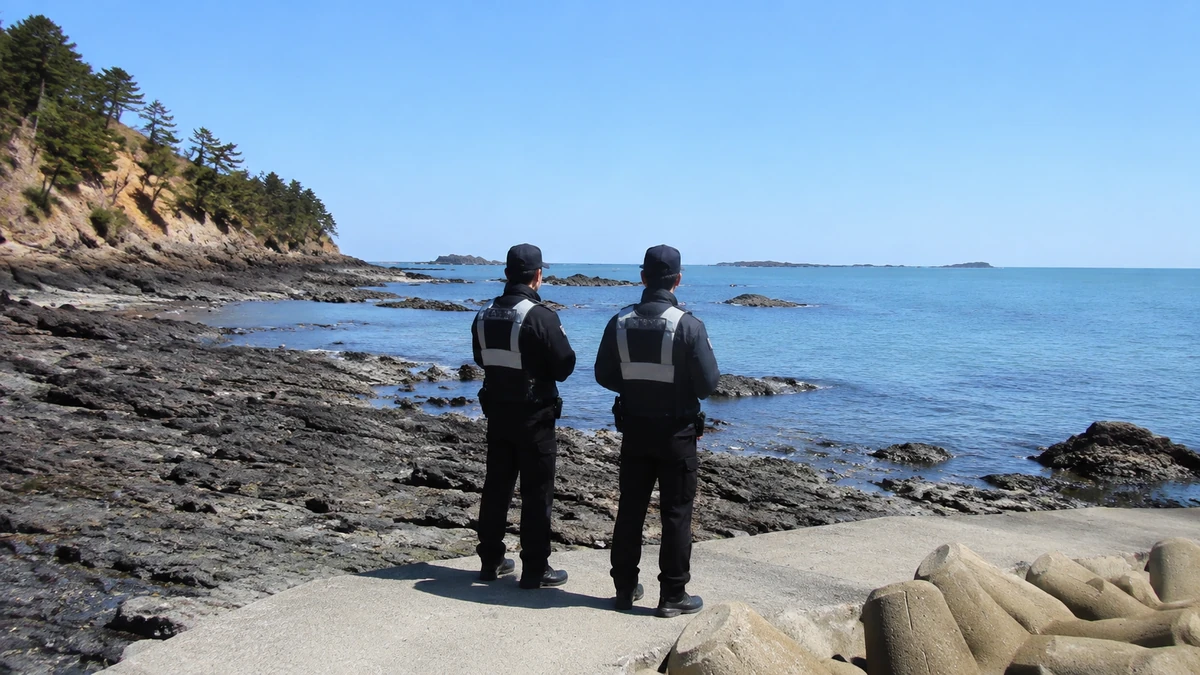
A seasonal warning for one of South Korea’s most popular shorelines
South Korean maritime authorities are issuing an early-season reminder that a beach trip can turn risky when the landscape itself changes by the hour.
The Korea Coast Guard offices overseeing Boryeong and Taean, two coastal areas in South Chungcheong province on the country’s western shore, said they will activate an “interest” level coastal accident risk advisory from June 30 through July 3. The notice applies to beaches, tidal flats, breakwaters and rocky shoreline areas along that stretch of the Yellow Sea, which Koreans often call the West Sea.
At first glance, the advisory can sound like the kind of bureaucratic bulletin that rarely travels far beyond local government websites. But in South Korea, especially along the west coast, those alerts matter in a practical and immediate way. They are not just warnings about weather. They are about timing, terrain and the speed with which seemingly open, walkable coastal space can become dangerous as tides rise and currents strengthen.
The advisory coincides with what is known as a spring tide period, when the difference between high and low tide becomes especially large because of the alignment of the sun, moon and Earth. Despite the name, spring tides have nothing to do with the season. They refer to a tidal range that “springs forth,” creating more dramatic shifts in water level. For visitors unfamiliar with the region, that means a mudflat that appears broad and stable in the afternoon can narrow quickly, fill with water, or become cut off from land by evening.
For American readers, the closest comparison may be a combination of visiting a national seashore and hiking in a place where the trail itself disappears on a schedule. Think of the caution required around fast-changing tide pools in Maine, slick jetties along the Gulf Coast, or sneaker waves on the Pacific coast. Now add South Korea’s unusually broad tidal flats and densely used public shoreline spaces, where tourists, anglers, families and amateur photographers often share the same narrow access points.
What the Korean authorities are signaling is not that people should stay away entirely. It is that this is a coastline where enjoying the scenery safely requires understanding the clock as much as the map.
Why Boryeong and Taean matter
Boryeong and Taean are not obscure corners of South Korea. They are among the best-known coastal destinations within reach of the greater Seoul metropolitan area, home to more than half the country’s population. Much as East Coast residents in the United States might head to the Jersey Shore, Cape Cod or the Delaware beaches for a quick getaway, South Koreans often look to the west coast for short trips centered on seafood, sunsets, beaches and tidal-flat experiences.
Boryeong is widely recognized for Daecheon Beach and for its annual mud festival, a tourism event that has become one of the country’s best-known summer attractions. Taean, meanwhile, is known for Taeanhaean National Park, a marine and coastal park with beaches, coves, rocky outcroppings and camping areas that draw families and retirees as well as younger travelers. The broader region is also associated with shellfish gathering, fishing villages and what Korea calls “tidal-flat experiences,” hands-on visits where travelers walk on exposed seabed, observe marine life or collect clams under guided conditions.
Those attractions are part of the appeal. They are also part of the risk.
South Korea’s west coast is shaped by some of the most pronounced tidal variation in the country. Unlike shorelines that look relatively consistent throughout the day, these coastal areas can change dramatically with the tide. A route to a rocky outcrop can be straightforward at one hour and hazardous a short time later. A breakwater that feels like a calm place to watch the surf can become slippery and exposed when waves, wind and current patterns shift. A family outing to a mudflat can become dangerous if visitors misread how quickly the water returns.
That is why the latest advisory is geographically specific. It is tailored not just to the calendar, but to the physical characteristics of Boryeong and Taean themselves: wide intertidal zones, variable currents and heavy recreational use during the warmer months.
Officials say the alert is being issued because stronger current flow and larger tidal swings can increase the risk of accidents. In plain language, that means people may underestimate how fast conditions can change in places that do not look threatening at first. In a travel culture increasingly driven by scenic stops, social media photos and brief excursions, authorities are trying to get ahead of the moment when a picturesque shoreline becomes a rescue zone.
What the “interest” alert means in South Korea
The most important cultural point for non-Korean readers is that this is not a full closure order and not the highest level of emergency. The term being used, “interest,” is better understood as an early-stage hazard advisory. It is the government’s way of saying that the ingredients for accidents are coming together and that people should adjust their behavior before a crisis develops.
That matters because South Korea’s public safety messaging has evolved in recent years toward more layered, preemptive systems. Rather than waiting for a major incident to trigger a blanket crackdown, agencies increasingly issue narrower alerts tied to weather patterns, crowd conditions, maritime hazards or other short-term risks. The aim is to give residents and travelers actionable information in a usable window of time.
In this case, the Korea Coast Guard says it plans to step up patrols in areas considered prone to accidents and restrict access if necessary. That approach reflects a management philosophy common in modern Korea: highly visible prevention rather than simply post-incident response. Visitors may see more personnel near shoreline access points, more public-address announcements, more signage and, in some places, temporary controls on entry to breakwaters or rock platforms.
To American audiences, the logic may resemble rip current advisories at U.S. beaches or temporary access restrictions on piers and jetties during dangerous surf. But there is a distinct Korean element as well. Because South Korea’s coastal tourism is compact, accessible and heavily frequented, warnings often function as part of the travel experience itself. In other words, people planning a seaside outing may check not only where to go and where to eat, but also the tide tables, local hazard bulletins and access guidance.
That can be surprising to outsiders who think of tourism warnings as a deterrent. In South Korea, they are often treated as planning tools. The message is less “don’t travel” than “travel more intelligently.”
That framing helps explain why the current advisory is being presented not as a dramatic sign of danger, but as a practical guide to how the west coast works. The advisory acknowledges that the region’s appeal lies precisely in its living, shifting shoreline. The challenge for authorities is to preserve public access while making sure visitors understand that the same natural forces that create beautiful coastal scenery can also erase safe routes with little warning.
Breakwaters, tidal flats and rock shelves: Beautiful places with hidden risks
The Coast Guard’s public message includes a direct request that people avoid entering areas such as breakwaters and coastal rock surfaces where accidents are more likely, and that anyone taking part in shoreline or tidal-flat activities check the tide schedule in advance.
That advice may sound basic, but it points to an important reality of Korean coastal recreation. Many of the places people most want to visit are also transitional spaces between land and sea. A breakwater, for example, is not just an engineering structure. In South Korea, it is often a public vantage point, a casual fishing spot and an easy-access place to stand close to the water. Rocky shoreline areas, known for dramatic sea views and marine life, are similarly attractive to sightseers and hobby anglers.
Yet those spaces can become dangerous quickly. Algae and spray make surfaces slick. Waves can break unpredictably. Water levels can rise enough to isolate someone on a rock ledge or narrow access path. During stronger tidal periods, currents may intensify even when the weather appears calm. The danger is not always cinematic or obvious. Often it is cumulative: a little more water, a slightly faster current, a little less time than expected to get back.
Tidal flats present a different kind of risk. To many foreigners, the idea of walking out onto a broad expanse of exposed seabed may be unfamiliar. In Korea, however, mudflat tourism is a recognizable and often family-friendly activity, especially on the west coast. These mudflats are ecologically rich and visually striking, and they have become part of the country’s domestic tourism identity. But they require local knowledge. Mud can trap the unwary. Distances are difficult to judge. And incoming water can return more quickly than inexperienced visitors realize.
This is where the Korean phrase “checking the water time,” or consulting tide timing, carries real weight. It is not a quaint local custom. It is a basic safety practice. In many parts of the West Sea, the day’s best scenic window may also be the period that creates the greatest temptation to go farther than is wise.
Officials are effectively telling visitors that on this coastline, being a good tourist means being a time-aware tourist. You do not simply arrive and wander. You read the shoreline almost the way boaters read weather or skiers read avalanche conditions. The landscape has a schedule, and ignoring it can have consequences.
A broader shift in how South Korea talks about safety
The advisory also fits into a broader story about public safety in South Korea, where governments and agencies have faced years of scrutiny over how risks are communicated and managed. In response, many public institutions have embraced more visible and more preventive forms of messaging. That does not eliminate danger, but it does signal a preference for intervening earlier and in more specific ways.
Along the coast, that can mean targeted patrols during high-risk periods, warnings tied to tidal cycles, and situational access control rather than one-size-fits-all closure. It is a granular model of public safety, one that treats hazard management as a moving process instead of a static rulebook.
There is also an economic dimension. South Korea’s tourism sector depends not only on attracting visitors but on maintaining trust. Travelers are more likely to feel comfortable visiting beaches, islands and marine parks when local authorities clearly explain what is safe, what is not, and when conditions are changing. In that sense, a public warning can serve the tourism industry as much as it serves emergency response. Clear information reduces uncertainty, and reduced uncertainty can make destinations feel more manageable rather than less inviting.
That is especially true in a country where domestic travel often involves short, tightly scheduled trips. Many Koreans take weekend or overnight coastal getaways rather than long vacations. When a trip is compressed into a small window, practical information becomes more important. A traveler deciding whether to stop at a breakwater, join a mudflat activity or walk out to a scenic point may need to know not just whether the place is open, but whether the timing is appropriate.
What makes the Boryeong-Taean notice notable is that it reflects a mature tourism environment in which safety alerts are built into the visitor experience. For international observers, that is a useful reminder that South Korea’s appeal is not limited to Seoul’s high-tech image, K-pop venues or glossy urban districts. Some of the country’s most distinctive destinations are natural spaces that demand a more disciplined kind of sightseeing.
In that way, the advisory tells a larger story about how Korea is trying to balance accessibility and caution. Rather than walling off scenic places at the first sign of risk, authorities are experimenting with a middle path: inform early, patrol visibly, intervene selectively, and ask the public to meet the state halfway by paying attention.
What travelers should understand about Korea’s west coast
For anyone planning a trip to South Korea’s western shoreline, the main takeaway is straightforward: treat tide information as essential, not optional.
That may be second nature to commercial fishers or seasoned coastal residents, but it is less intuitive for casual travelers, especially those from inland cities or from countries where beaches tend to feel more static. On the Korean west coast, the scenery can change so dramatically that the same spot may offer entirely different experiences within a single day. A broad mudflat at low tide can become open water later. A photo stop on a rock shelf can turn into a risky position. A family stroll near the shore can drift closer to danger if no one is tracking the return of the tide.
Checking local conditions, asking residents or staff about timing and following Coast Guard guidance can make the difference between a memorable outing and a dangerous one. Visitors should be especially cautious around breakwaters, jetties, rock ledges and any unofficial paths extending into intertidal zones. Proper footwear matters. So does avoiding solo exploration in unfamiliar areas. And when authorities or signs advise against entry, the safest assumption is that the warning reflects real local experience rather than excessive caution.
For American travelers, this may be a useful mindset shift. South Korea is often marketed abroad through its cities, food, beauty industry and entertainment exports. But its coastal culture, particularly on the west coast, is shaped by rhythms that are older and less predictable than any urban itinerary. To enjoy that side of the country fully, visitors have to adopt a different pace and a different kind of awareness.
In practical terms, that means understanding that the best west coast travel plans are built around time windows. Not just opening hours, but nature’s own timetable.
The current advisory lasts only from June 30 to July 3, a relatively short period. Yet that brevity is part of the point. Coastal risk is not constant. It spikes under certain conditions, and public agencies are trying to identify those windows before accidents happen. The advisory is, in effect, a reminder that some dangers are seasonal, some are situational, and some can be managed simply by knowing when not to push your luck.
That may not sound dramatic, but it is an increasingly important way countries manage public space in the age of hypermobile tourism. Rather than assuming visitors will intuit every risk, authorities are offering a framework for smart recreation. On South Korea’s west coast, where beauty and hazard are often separated by only a few feet of water and a little time, that framework can be as valuable as any travel guide.
The message from Boryeong and Taean, then, is not to stay home. It is to look beyond the postcard view. On this shoreline, the sea does not hold still for visitors. The smartest travelers are the ones who plan accordingly.


0 Comments