On South Korea’s Children’s Day, Packed Parks and Theme Parks Reveal What the Country Wants Childhood to Look Like
A holiday that turns the country toward its children
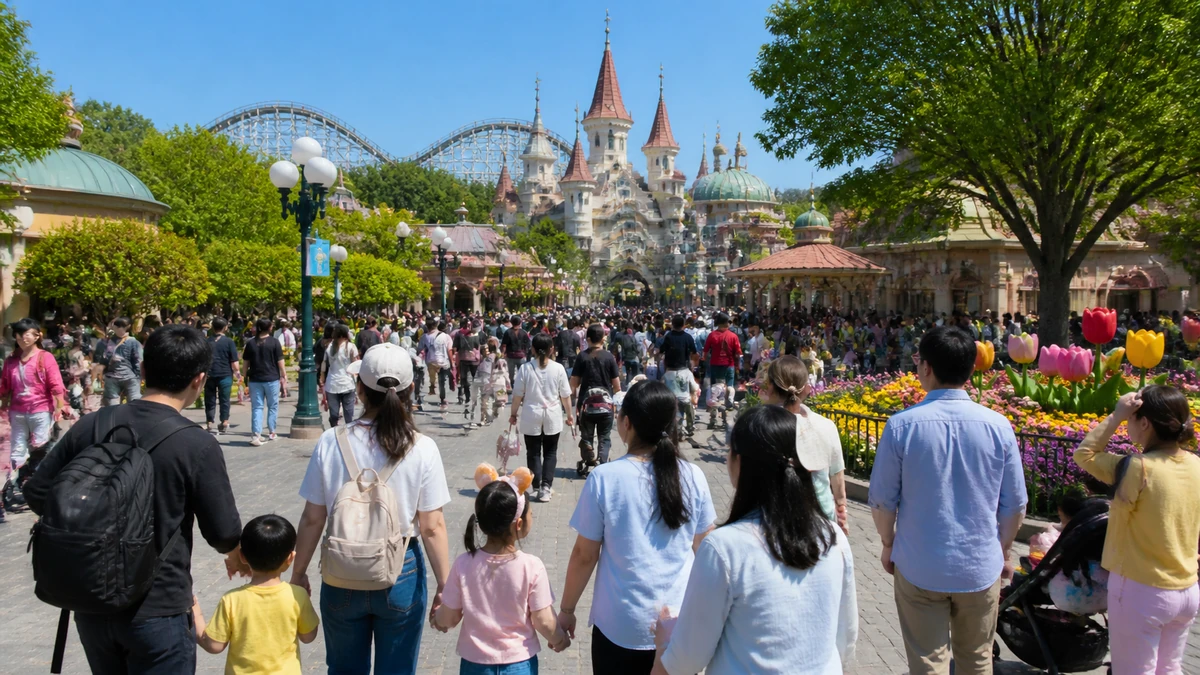
On Monday, South Korea’s annual Children’s Day transformed the country into something like a nationwide family outing. Theme parks filled early. Public parks swelled with strollers, snack bags and children pulling their parents toward rides, animal exhibits and open lawns. In cities and suburbs alike, the holiday’s mood was visible in a simple, repeated image: children holding their mothers’ and fathers’ hands as families set out together.
For Americans unfamiliar with the holiday, Children’s Day in South Korea is not a niche observance or a commercial add-on to the calendar. It is a national holiday, marked each year on May 5, and it carries a cultural weight that is closer to a cross between a family-centered summer kickoff, a civic celebration of childhood and a public statement about what society owes its youngest members. If Mother’s Day in the United States highlights gratitude and if the Fourth of July turns public space into a stage for shared national ritual, Korea’s Children’s Day combines some of those instincts and directs them squarely at kids.
This year’s observance, on May 5, 2026, came with nearly ideal spring weather. Clear skies and daytime highs ranging from 19 to 24 degrees Celsius, or roughly 66 to 75 degrees Fahrenheit, helped push families outdoors. Across the country, that mattered. Holidays are always shaped by weather, but a mild spring day in Korea can make urban life feel suddenly expansive. Instead of retreating indoors to malls or apartment complexes, families fan out into parks, zoos, amusement grounds and public plazas.
According to the South Korean news agency Yonhap, major leisure destinations were crowded throughout the day. At Everland, the country’s largest theme park, children ages 5 to 8 were offered 10 different hands-on programs built around themes including animals, cooking and dance. In Seoul, Children’s Grand Park, a large public park in the eastern part of the capital, also drew heavy crowds. Those scenes may sound familiar to anyone who has spent Memorial Day weekend at a packed amusement park or a city zoo in the United States. But in South Korea, the significance runs deeper than one busy holiday. The crowds reflect how a society publicly organizes time, space and attention around children.
That is part of why the day resonates beyond the cheerful imagery. A full park is not just a sign that families had a place to go. It is evidence of something broader: enough social confidence for children to run in public, enough infrastructure for parents to move with them and enough cultural agreement that setting aside a day for family time is not indulgent but important. In a country often discussed abroad through the lenses of technology, export power, intense education pressure and demographic anxiety, Children’s Day offers another window into national life. It shows what Korea looks like when the pace slows, briefly, for kids.
More than a day off, a social measure of family life
To understand why scenes from amusement parks and public playgrounds become social news in South Korea, it helps to understand what the holiday represents. Children’s Day has roots in the Korean independence era of the early 20th century, when reformers and writers promoted the idea that children should be treated as full human beings deserving dignity, education and care rather than simply as miniature adults under strict authority. Over time, the observance evolved into an official holiday, but that older moral idea still lingers behind the balloons and souvenir headbands.
Today, the holiday acts almost like a national stress test for family life and public space. Where do families go when a whole country tries to make a day special for children at once? Are there enough parks, accessible destinations and programs that welcome young children? Do public spaces feel safe enough for families to spend hours there? Those questions may not show up on ticket booths or event posters, but they sit beneath the day’s public meaning.
In South Korea, that meaning is sharpened by the country’s broader social context. Korea has one of the world’s lowest birthrates, a reality that has prompted years of public hand-wringing, policy debate and political promises. Discussions about child care, education costs, work-life balance and the burdens placed on parents are common in national politics. Against that backdrop, Children’s Day is not merely sentimental. It becomes a visible reminder of what a child-centered society might require in practice: time off, accessible leisure, safe transit, affordable family activities and public acknowledgment that childhood should include joy.
For American readers, there is a temptation to compare the holiday to a more commercial event, maybe something like a themed weekend promotion at Disney or a city-sponsored family festival. But Children’s Day sits somewhere between a civic ritual and a cultural expectation. Parents are not simply looking for entertainment. They are participating in a shared social script in which children become, for one day especially, the center of public life.
That script was on full display in descriptions from around the country. The heart of the day was not children left to their own devices, but families moving together. In the Korean coverage, the image of children out with “mom and dad” carried emotional force because it captured the holiday’s basic promise: not just gifts or outings, but shared time. In a society where long working hours have historically been common and academic schedules often dominate family routines, that kind of time can carry special weight.
At Everland, childhood is increasingly built around experiences
Few places better illustrate the changing shape of family leisure in South Korea than Everland, the sprawling theme park in Yongin, south of Seoul. Known to many foreign visitors as Korea’s answer to the giant amusement parks of the United States and Japan, Everland blends roller coasters and parade-style entertainment with seasonal festivals, gardens and animal attractions. On Children’s Day, it became a showcase for a wider trend: turning children’s leisure into hands-on experience rather than passive spectacle.
According to Yonhap, the park offered 10 themed experience programs for children ages 5 to 8, including activities centered on animals, cooking and dance. That detail matters. It suggests that a modern family outing in Korea is no longer defined only by standing in line for rides or watching a show. Increasingly, it is about immersive, curated participation.
Some children reportedly visited Panda World and used a zookeeper role-play kit, stepping into a version of animal care designed for young visitors. Others put on chef hats and aprons and made desserts. These are small moments, but they point to a larger cultural shift. Childhood recreation in South Korea, as in many affluent societies, increasingly blends play with self-discovery, role-play and lightly educational experience. The line between leisure and enrichment has blurred.
American parents will likely recognize the pattern. Children’s museums, zoo camps, “junior ranger” programs at national parks and make-your-own-pizza birthday workshops all rest on the same premise: kids should not only watch but do. The South Korean version carries its own flavor, often highly organized and polished, but the underlying instinct is familiar. Families increasingly want outings to feel meaningful, memorable and maybe even developmental, without losing the fun.
That does not mean the day is reducible to educational ambition. One of the most striking things about the Children’s Day scenes is their physical looseness: children running, laughing, pulling adults toward the next attraction. The structure is there, but so is spontaneity. In a country where children are often discussed internationally in the context of educational competition and rigorous schedules, the sight of them simply playing outdoors matters symbolically. It presents a counterimage to the stereotype of Korean childhood as all cram school, all the time.
At the same time, Everland’s programming also says something about consumption. Modern family leisure is expensive almost everywhere, and South Korea is no exception. Theme parks are commercial spaces. But the emphasis on experiences rather than merchandise reflects a broader shift visible across many economies: parents are often more willing to spend on memory-making than on objects. In that sense, Children’s Day shows how market culture adapts to contemporary ideas about good parenting. The ideal outing is no longer just a treat. It is an experience the family will remember together.
Public parks matter because not every family celebrates the same way
If Everland represents the polished, high-production version of Children’s Day, Seoul Children’s Grand Park represents something equally important: the public option. Located in Gwangjin district, the park is one of Seoul’s best-known family destinations, offering green space, play areas and family-friendly attractions in a setting far more accessible than a major private theme park. The fact that it, too, was crowded speaks volumes.
In many countries, a family holiday can quietly become a class story. Those with money head to destination attractions; everyone else stays home or makes do. South Korea’s Children’s Day certainly contains those inequalities, but heavily used public spaces complicate the picture. A packed public park suggests that the holiday is not only being performed through private spending. It is also being lived through shared civic space.
That distinction matters for understanding the holiday’s social meaning. When children fill public parks, the celebration belongs not just to ticket holders but to the city itself. It turns ordinary urban space into a communal stage for family life. Parents who may not be able, or may not want, to buy a full-scale theme park experience can still join a visible public celebration. Children see other children everywhere. The holiday becomes collective rather than isolated.
Americans know the power of that feeling. Think of the difference between a family vacation at a private resort and a Fourth of July afternoon in a public park, where the crowd itself becomes part of the event. Children’s Day in Korea can carry a similar sense of shared participation. The location matters because it shapes who gets included in the story of the day.
There is also a policy angle here. When public family spaces are full on a major holiday, they expose both strengths and gaps in urban design. They show how essential parks, open lawns, public restrooms, shaded seating, stroller-friendly paths and child-safe gathering areas are. A successful holiday crowd is not just a happy accident. It is the result of planning, maintenance and a baseline public investment in making cities livable for families.
That is one reason the crowded scenes amount to more than picturesque holiday coverage. They raise a quiet but important question: If these places are so central on Children’s Day, are they equally welcoming on the other 364 days of the year? The answer matters in a country where families regularly navigate high-density city life, expensive housing and limited private space. Public parks are not just decoration. They are part of the architecture of family well-being.
Good weather helps, but the real story is what the weather made visible
Any holiday built around outdoor movement depends partly on luck, and South Korea got lucky this year. Clear skies and mild temperatures created conditions close to ideal for family outings. That fact may sound trivial, but it shaped the entire public rhythm of the day. Had the weather turned rainy or unseasonably cold, the holiday would have contracted inward, into apartments, department stores and indoor play spaces. Instead, it expanded outward.
That outward movement changed the meaning of the celebration. Good weather did not just make the day more pleasant. It made childhood visible. Parks full of children, stroller convoys along city walkways, food vendors doing brisk business, parents photographing moments under spring skies — all of it turned the holiday into a public spectacle of ordinary family life.
In that sense, the weather functioned less as background than as an enabling condition. It allowed the country’s children-centered holiday to become fully legible. Public joy is always easier to register when it takes place outside. The laughter, motion and mild chaos of family recreation became part of the national landscape for a day.
There is a subtle social lesson in that visibility. Much of modern parenting happens in private or semi-private spaces: apartments, cars, schools, after-school academies, small indoor play zones. A major outdoor holiday interrupts that pattern. It lets society see itself caring for children in the open. It turns family time into a public fact rather than a private aspiration.
For a country as urbanized and apartment-centered as South Korea, that kind of collective exhale can be culturally meaningful. It suggests that despite the pressures of work, schooling and city density, there remains a strong appetite for simple outdoor family rituals. Sometimes the most revealing national stories are not about crisis or conflict, but about what people do when conditions are favorable and they are given permission to pause.
The holiday also carried a quieter message about protection and care
Yet Children’s Day in South Korea is not only about happy crowds at amusement venues. The day also brought an official reminder that not all children experience childhood under the same conditions. While families filled parks and leisure sites, Health and Welfare Minister Chung Eun-kyung visited Eden I Ville, a child care facility in Seoul’s Seongdong district, where she spent time with children, reviewed operations and encouraged staff members.
The visit added a more sober dimension to the holiday. In remarks reported by local media, Chung said the government would continue to actively pursue policies supporting the growth and independence of children under social protection. In plain terms, the message was that a day devoted to children also has to include those who are not celebrating with parents in the usual way.
That duality may be one of the most important things for foreign audiences to understand. In South Korea, Children’s Day is not simply a festival of innocence. It is also a moment when the state and the public are reminded of their obligations toward vulnerable children — those in care facilities, those separated from parents, those whose lives are shaped by poverty, disability or other forms of instability.
American readers may hear echoes of the way major holidays can sharpen social contrasts at home. Thanksgiving celebrates family gathering, but it also throws loneliness and food insecurity into clearer relief. Christmas highlights joy but also the vulnerabilities of children without stable homes. Korea’s Children’s Day works in a similar way. The brightness of the public holiday can make quieter forms of need more visible.
That does not diminish the day’s joy. If anything, it broadens its meaning. A society that says it values children must show that value in multiple registers: play, safety, care, access, emotional warmth and long-term support. The packed parks express one register. A ministerial visit to a child care institution expresses another. Together, they create a fuller picture of what children-centered public life is supposed to look like.
There is also an unmistakable policy undertone. In a country wrestling not only with low birthrates but also with concerns about inequality and social cohesion, support for children in protective care is part of a larger argument about what kind of future the nation wants to build. Childhood cannot be treated as a private family matter alone. It is also a public responsibility.
What this holiday says about South Korea right now
To an outsider, a story about crowded amusement parks may seem too soft to matter. But social stories often reveal truths that political speeches and economic charts cannot. Where families go, how children spend a national holiday and what messages the government chooses to pair with that holiday all offer clues about a society’s priorities.
What South Korea’s Children’s Day revealed this year is a country trying, at least for one day, to place children visibly at the center of public life. It revealed a culture that sees family outings not just as leisure but as memory-making. It revealed the importance of public space in a dense, urban society. It showed how private entertainment companies and public parks both contribute to the experience of childhood. And it highlighted a lingering moral idea: that a society is judged, in part, by how it treats its youngest members, including those without the full protections of family stability.
There is a temptation, especially in international coverage of South Korea, to focus narrowly on K-pop, global brands, tech power or tensions with North Korea. Those stories matter. But so do the quieter scenes of domestic life. A nation crowded into parks under mild spring skies can tell us something about itself that export statistics cannot. It can show how people imagine a good life, at least in miniature.
For Americans, the lesson may feel both familiar and distinct. Familiar, because the desire to give children a day of freedom, fun and family time is universal. Distinct, because South Korea has institutionalized that desire in a way the United States has not. There is no American equivalent of a nationally observed Children’s Day that reliably empties adults into parks and fills cities with family-centered ritual. That makes the Korean example especially revealing.
In the end, the most striking thing about this year’s holiday may be how ordinary it looked: children running, parents trailing, parks crowded, weather perfect. But ordinary scenes are often where a society’s deepest values hide. On South Korea’s Children’s Day, those values were on public display — in theme park workshops, in busy city parks, in the laughter carried across open space and in the quieter promise that children who need protection should not be forgotten. For one spring day, Korea’s public landscape became a kind of report on what childhood ought to include: joy, family time, safety, access and care.
Comments
Post a Comment