South Korea rides world No. 1 An Se-young into Uber Cup final, underscoring badminton’s growing global stakes
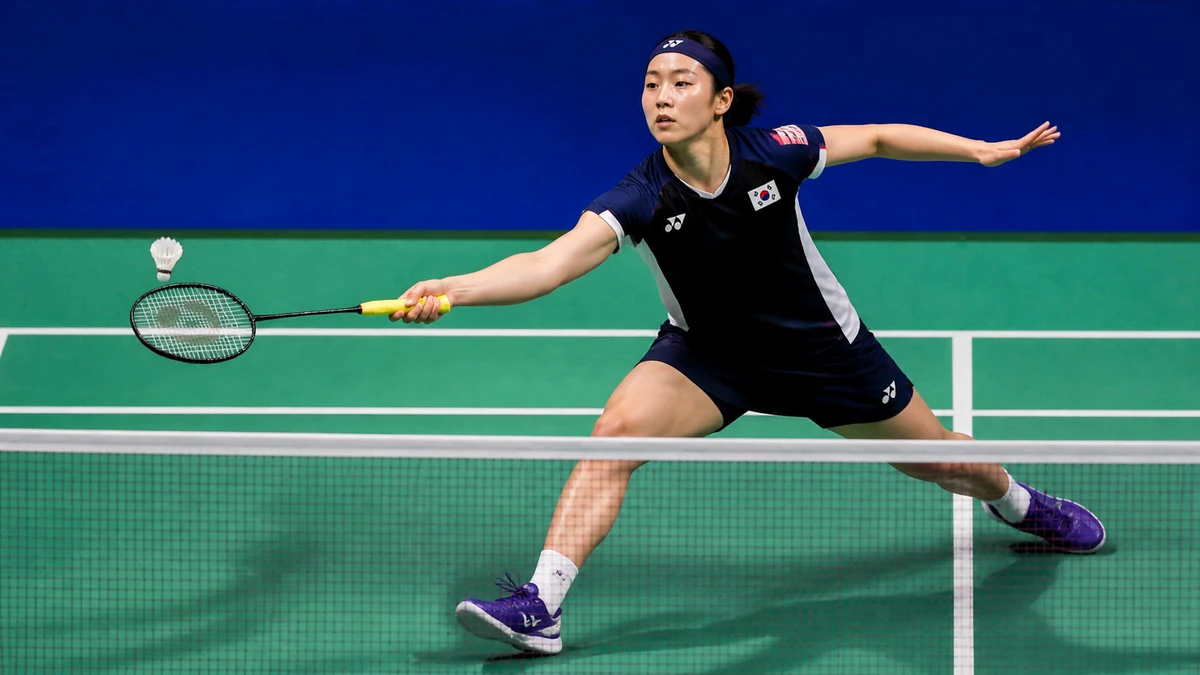
A star goes first, and South Korea follows
For many American sports fans, badminton still carries the reputation of a backyard game — something played casually at family cookouts or on a school gym floor. On the international stage, though, it is something else entirely: fast, punishing, tactical and often emotionally unforgiving. That reality was on full display Friday in Horsens, Denmark, where South Korea’s women’s national team defeated Indonesia 3-1 in the Uber Cup semifinals and advanced to the championship match behind another tone-setting performance from world No. 1 An Se-young.
The headline result was straightforward. South Korea won three of the four matches needed to finish the tie and move on. But in team badminton, especially at the Uber Cup, the score rarely tells the whole story. The match opened with An, the biggest name in the sport’s women’s game right now, defeating Indonesia’s Putri Kusuma Wardani in straight games, 21-19, 21-5. That sequence — a tense first game followed by a demolition in the second — did more than put one point on the board. It established the emotional terms of the semifinal.
South Korea has used the same basic formula throughout this tournament: put its best and most reliable player out first, let her seize control of the tie, and ask the rest of the team to build from there. It is a strategy that can look obvious in hindsight, but at this level, nothing is automatic. The first match in a team event is not just a contest between two players. It can settle nerves on one bench, tighten them on the other and alter the way every subsequent player experiences the court.
That is why An’s role matters so much. The world ranking next to her name is not simply a résumé line. It is a reflection of how often she has proven capable of carrying the heaviest pressure in the biggest moments. Against Indonesia, she once again served as South Korea’s opening statement, cutting short any hope that the underdog side might establish early momentum and forcing the rest of the semifinal to unfold on Korean terms.
For U.S. readers less familiar with the Korean sports landscape, An’s status is difficult to overstate. She is not just a top player in a niche discipline. In South Korea, where international success in sports carries major national resonance, she has become one of the country’s most recognizable active athletes. When she plays for the national team, the expectation is not merely that she will compete well. It is that she will anchor the entire event.
What the Uber Cup means beyond badminton circles
The Uber Cup is the women’s world team championship in badminton, held every two years and considered one of the sport’s most prestigious titles. If that sounds abstract to an American audience, the easiest comparison is to a cross between the Davis Cup in tennis and the World Baseball Classic — a competition where individual stars step into a national-team format and the emotional stakes expand beyond one player’s personal record.
The men’s equivalent is the Thomas Cup, and together the two events are among badminton’s signature international team competitions. Countries with deep badminton traditions — China, Indonesia, South Korea, Japan, Malaysia, Denmark and others — approach these tournaments with a level of seriousness that mirrors how soccer powers treat continental championships or how basketball nations treat Olympic qualifying events. These are not exhibitions. They are identity contests.
That context helps explain why South Korea’s semifinal victory matters. Reaching the final of the Uber Cup is not the same as enjoying a good week at a regular tour stop. It is evidence of depth, preparation and collective resilience. The format itself demands that. A tie consists of five matches: three singles and two doubles. The first team to reach three wins advances. That structure means one superstar can set the tone, but no single player can complete the job alone.
In other words, a country cannot fake its way to the final. It needs at least one elite singles player, competent support across the lineup and enough composure to handle a sequence of matches that can swing quickly on confidence as much as talent. South Korea’s 3-1 result against Indonesia showed all of that. Yes, An was the centerpiece. But the final score also reflected a team that delivered where it had to, match after match, with the tournament on the line.
Indonesia, meanwhile, is not some lightweight opponent. It is one of badminton’s historic powers, a nation where the sport sits much closer to the center of public life than it does in the United States. A semifinal against Indonesia carries history, expectation and technical difficulty. So while 3-1 may look comfortable on paper, it was anything but casual. In a tournament like this, against an opponent like that, the margin says as much about South Korea’s readiness as it does about the day’s scoreboard.
An Se-young’s opening win changed the emotional map
The most revealing numbers from the semifinal were not 3-1, but 21-19 and 21-5. Those two game scores told the story of how An exerts control. The first game, won by the narrowest of respectable margins, was the kind of opening stretch that defines team events. A semifinal can begin with heavy legs, jittery hands and too much awareness of what the moment means. Wardani, ranked No. 6 in the world, was not there to be intimidated merely by reputation. She pushed the opener into a genuine contest.
That mattered because the first game in a tie-opening singles match often operates like a pressure chamber. If the favorite wobbles and loses it, the rest of the lineup can feel the shift immediately. Suddenly the team strategy gets rearranged, the bench grows tense and the opponent senses vulnerability. An avoided that trap. She held on, closed the game 21-19 and, in doing so, gave South Korea exactly what it needed most: certainty.
Then came the second game, and with it the full demonstration of why An is widely regarded as the best women’s singles player in the world. A 21-5 score against another top-10 player is not merely dominant. It is almost surgical. It suggests that once An had solved the rhythm of the match, she did not just maintain an edge — she took away the other player’s options.
In elite badminton, rallies move at extraordinary speed, but the sport is not simply about reaction time. It is about geometry, deception, stamina and the ability to anticipate one shot ahead, then two. The most imposing players can make a match look lopsided not by overwhelming opponents with raw force alone, but by steadily removing space and time from them. That is what a score like 21-5 often indicates. The rallies get shorter on one side, longer on the other. The court starts feeling bigger for one player and impossibly small for the other.
For South Korea, the practical effect was immediate. Once An converted that first point of the tie so decisively, the rest of the team could operate with a cushion. That cushion is psychological as much as mathematical. Players entering the second, third and fourth matches no longer feel that the entire semifinal hinges on their first few rallies. The team is ahead. The bench is calmer. The tactical plan remains intact. In a knockout setting, that can be the difference between controlled aggression and anxious overplaying.
That is one reason South Korea has repeatedly placed An in the opening slot from the group stage through the quarterfinals and now the semifinals. It is a sign of institutional trust. The coaching staff is effectively saying: Let our strongest player absorb the first wave of pressure, and let everyone else follow the current she creates. On Friday, that approach worked exactly as intended.
Why team badminton feels different from the tour
Badminton, especially to audiences who only see it during the Olympics, can appear to be an individual sport defined mainly by rankings and medals. The Uber Cup changes that equation. Players who spend most of the year competing for themselves suddenly take on a role that resembles a relay anchor, a Davis Cup singles ace or the starter in a postseason baseball series. Their performance belongs to the team as much as it belongs to them.
That shift changes the atmosphere. Even the order of matches matters. Coaches think not only about who has the best chance to win, but about who can handle being first, who can stabilize a tie if the score is level and who can step into doubles under stress. The result is a competition where momentum becomes a shared asset. A clean opening win does not just add one point. It can lighten the shoulders of every teammate who follows.
South Korea’s semifinal victory illustrated exactly that dynamic. An provided the initial spark, but the team still had to secure two more match wins. That part of the story is essential. One of the most common misunderstandings in international team events is assuming the star did all the work. In reality, the star often makes it possible for everyone else to do theirs. South Korea’s 3-1 result signaled a lineup that understood its jobs and executed them in sequence.
There is also a broader sports lesson here that American fans can appreciate. Team formats often reveal dimensions of athletes that regular tour play does not. A golfer in the Ryder Cup, a tennis player in Billie Jean King Cup or a basketball star in the Olympics can look subtly different when the flag matters, when the bench reacts to every point and when failure affects teammates instead of just the individual. The same is true in badminton. Composure becomes contagious. So does panic.
South Korea, at least in this semifinal, projected the former. It looked organized, clear in its hierarchy and comfortable with the burden of expectation. That matters because the Uber Cup does not reward emotional drift. It rewards teams that can take a close first match, turn it into momentum and then close the tie before the opponent can find a foothold. South Korea did exactly that against one of the sport’s most respected nations.
What this says about South Korea’s sports system
To understand why this run resonates in South Korea, it helps to know how national-team success is viewed there. International sports are not just entertainment; they are a major stage for national visibility. That is true in many countries, of course, but in South Korea the connection can be especially strong. Olympic medals, World Cup runs and major international titles often become shorthand for the country’s competitiveness, discipline and place in the world.
Badminton occupies a meaningful place in that culture. It may not command the round-the-clock attention that baseball or soccer does, but Korea has a long and serious history in the sport, particularly in doubles and in women’s competition. When a Korean badminton team reaches a world championship final, it is noticed. When it does so with a player of An’s stature leading the way, it becomes a story of both present success and future confidence.
An herself represents a modern version of Korean sporting excellence: technically gifted, mentally durable and globally visible at a relatively young age. She has already become the kind of athlete casual fans know by one name, at least in her home country. Her matches now carry the aura that surrounds top-tier national icons — the assumption that if she is on the court, Korea has a real chance, and if she is healthy and in form, the opponent must solve a problem very few can solve.
That is why Friday’s semifinal felt like more than one win in one tournament. It reinforced the idea that South Korea remains firmly in the mix at the top of women’s badminton. This was not a nostalgic flashback or a one-off upset. It was the continuation of a structure that has held through the group stage, the quarterfinals and now the semis: trust the world No. 1 to open the door, then send a disciplined team through it.
There is also a useful cultural point for non-Korean readers. Korean sports coverage often emphasizes not only outcomes but also the emotional and strategic sequencing of those outcomes — who went first, who steadied the team, who carried the burden at the most delicate moment. That narrative lens is especially apt in a competition like the Uber Cup. Friday’s result was celebrated not simply because South Korea won, but because it won in a way that affirmed a collective identity: composed, prepared and anchored by a star willing to take the first hit.
The final, and the message beyond it
South Korea’s place in the Uber Cup final now gives the team a chance to convert momentum into a title, but the semifinal alone already offered a clear message to the broader sporting world. In an era when badminton continues to search for greater mainstream visibility in places like the United States, performances like this help explain why the sport commands such devotion across Asia and parts of Europe. The speed is real, the pressure is immense and the team drama can be every bit as gripping as more familiar international competitions.
For American readers, there is also value in seeing the event as part of a larger shift in global sports attention. The old assumption that only a handful of sports produce truly international drama no longer holds. A women’s badminton team championship in Denmark can carry national stakes for South Korea and Indonesia, showcase one of the world’s most dominant athletes and generate the kind of emotional swing usually associated with March Madness, the World Cup or Olympic knockout rounds.
And in this case, the central figure was unmistakable. An did what elite stars do in team competition: she made an outcome feel possible before it became official. Her 21-19, 21-5 victory over Wardani was not the entire semifinal, but it was the axis around which the rest of it turned. First she survived the tension. Then she erased it. By the time South Korea finished off a 3-1 victory, the shape of the tie had long since been established by her racket.
The final will bring a different test, as championship matches always do. Pressure intensifies. Depth is challenged. Momentum from one day does not automatically transfer to the next. Still, South Korea enters that stage with the most valuable asset any team can have in a format like this: a proven opening move. As long as An Se-young continues to take the court first and play like the best player in the world, South Korea starts every tie with a psychological advantage no bracket can measure.
That may be the most important takeaway from Horsens. South Korea did not reach the Uber Cup final through sentiment or surprise. It got there through a deliberate team structure, through a star who embraced the heaviest assignment and through the kind of collective steadiness that championship events demand. For a global audience still learning just how compelling badminton can be, Friday’s semifinal offered a nearly perfect introduction. It had stakes, history, strategy, pressure and a lead performer who turned a close opening act into a rout.
In a sports world that often rewards loud brands and familiar leagues, there is something refreshing about the clarity of this story. A world No. 1 stepped onto the court for her country, absorbed the pressure of the first match, broke open the semifinal and helped carry South Korea into the final of one of badminton’s most prestigious tournaments. That is not just a result. It is the anatomy of sporting authority.
Comments
Post a Comment