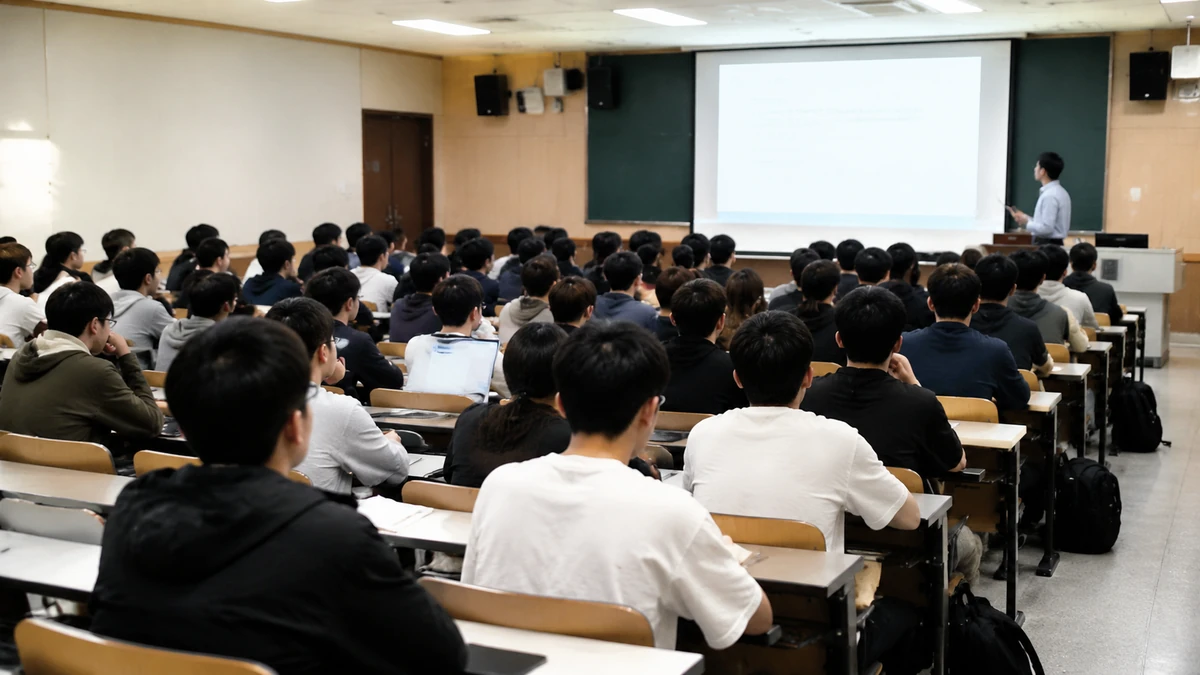
A public health campaign aimed at a familiar rite of passage
South Korea is launching a new effort to challenge one of the most entrenched habits of college life: the expectation that drinking is simply part of growing up. The country’s Ministry of Health and Welfare and the Korea Health Promotion Institute said this week that a national team of university student advocates will work through November to promote what officials call a healthier drinking culture, with a slogan that translates roughly to: “Healthy youth, fun without alcohol.”
On paper, the initiative can sound modest — 244 students, organized into 30 teams across 40 universities, creating educational materials and leading prevention campaigns. But the project points to something larger than a typical campus awareness drive. It is a public health experiment targeting the social environment around young adults at the exact stage when lifelong habits often begin to harden.
For American readers, the closest comparison might be a cross between peer health education programs on U.S. campuses and anti-smoking culture-change efforts that tried to make healthier choices feel normal, not preachy. But the South Korean context matters. In Korea, alcohol has long played a major role in workplace bonding, university socializing and group identity. That makes any attempt to reduce harmful drinking less about telling individuals to have more self-control and more about asking whether the culture around them leaves enough room to choose differently.
Officials are framing the campaign not as prohibition, abstinence or moral judgment, but as “moderation” — in Korean, the term used is often closer to “drinking less” or “drinking responsibly” than to total avoidance. That distinction is important. The message is not that young adults must reject social life. It is that social life does not have to revolve around alcohol to be meaningful, fun or socially accepted.
And that may be the central question behind the campaign: Can a society where drinking has often served as shorthand for closeness, celebration and stress relief make room for a new script?
Why college matters so much in South Korea
College is a formative period almost everywhere, but in South Korea it carries particular social weight. Students are not only adjusting to new academic demands. Many are also entering adult social life in a country where hierarchical relationships, group belonging and ritualized gatherings can shape behavior quickly. University orientation events, student clubs, departmental get-togethers and off-campus dinners have historically been places where drinking is normalized, even when no one formally says it is required.
American readers may recognize parts of this. U.S. campuses have long grappled with binge drinking, fraternity and sorority party culture, and the idea that alcohol can function as social currency. Yet there is a notable difference in emphasis. In South Korea, the concern is often less about the legality of underage drinking — since the students involved are generally adults — and more about the speed with which drinking becomes woven into daily bonding rituals once young people gain social independence.
That helps explain why health officials are focusing on university students rather than waiting until later adulthood, when patterns may be more difficult to change. Public health researchers in many countries have found that behaviors established in the late teens and early 20s can echo for years. Drinking patterns formed in college can influence everything from sleep and diet to mental health, accident risk and future workplace norms.
In South Korea, the symbolic stakes are even broader. Universities are often seen not only as educational institutions but as places where future professionals begin learning how to fit into Korean society. If heavy drinking is treated as part of that transition, it can carry into office culture, business dinners and after-hours gatherings later on. In that sense, a campaign aimed at campuses is also a campaign aimed at the future adult culture those students will help create.
That is one reason the new program stands out. It treats youth drinking not as a side issue for campus administrators, but as a long-range public health problem tied to social norms, everyday habits and the kind of adulthood a country is preparing its young people to enter.
From warning labels to peer-led persuasion
What makes this campaign especially notable is not just its message, but who will deliver it. Instead of relying solely on government notices or expert lectures, the project centers students themselves. The 244 participants will produce and distribute information about the harms of excessive drinking while also leading on-the-ground activities intended to encourage moderation in both campus and community settings.
That design reflects a broader shift in health communication. For years, many public health campaigns relied heavily on top-down warnings: drinking is dangerous, smoking kills, poor diet leads to disease. Those messages can be factually correct and still fail to change behavior if the social reward structure points in the opposite direction. Young adults do not make choices in a vacuum. They make them in dorm rooms, restaurants, clubs, celebrations and group chats.
Peer-led campaigns try to meet that reality head-on. The theory is straightforward: messages often land differently when they come from people living the same routines, facing the same pressures and speaking the same cultural language. A student who says, in effect, “Here is how our group can have fun without centering alcohol,” may be more persuasive than a distant institution saying, “Drink less.”
American universities have used versions of this model for years in programs around sexual assault prevention, mental health awareness and substance use. The logic is that norms are contagious. If students believe everyone is drinking heavily, they may feel pressure to do the same. If they begin seeing visible examples of groups socializing differently — and not being punished socially for it — the norm can start to shift.
That is why the Korean slogan matters. “Fun without alcohol” is more than a catchy phrase. It reframes the issue away from restriction and toward substitution. Rather than scolding students for drinking, it suggests an alternative source of enjoyment and connection. In health messaging, tone can matter nearly as much as content. Messages framed as empowerment tend to travel further than messages framed as control.
The government, in other words, appears to be betting that cultural change works best when it feels less like compliance and more like ownership.
The bigger target: not just students, but the drinking environment around them
One striking element in the Korean announcement is its repeated focus on both universities and local communities. That wording signals an important public health insight: drinking behavior is not only about personal willpower. It is also about environment.
For students, campus life does not end at the school gate. It extends into neighborhoods filled with bars, late-night restaurants, convenience stores and social spaces that often cater directly to student routines. If those spaces reinforce the idea that every celebration, meet-up or stress release should involve alcohol, then telling individuals to make healthier choices can only go so far.
This is a familiar concept in public health. The same thinking has shaped anti-tobacco policy, food labeling, urban walkability campaigns and safe-driving efforts. Instead of asking only why people make unhealthy choices, policymakers ask what kinds of settings make those choices easier, cheaper, more visible or more socially rewarded.
In the Korean case, officials are explicitly trying to change what they call an “environment that encourages drinking.” That phrase is telling. It suggests a move away from blaming young people and toward examining how traditions, marketing, social habits and business practices may normalize excess. It also reflects a more modern public health approach, one that recognizes behavior is often produced collectively even when consequences are borne individually.
For Americans, there is a useful parallel in how many U.S. cities approached smoking over the past few decades. The decline in smoking did not happen only because individuals received more warnings. It also happened because indoor smoking bans, cultural attitudes, price changes and social expectations gradually altered the environment. What once seemed standard started to feel inconvenient, then undesirable, then outdated.
South Korea is not there with alcohol, and alcohol is more deeply embedded in ordinary social life than cigarettes ever were. But the principle is similar. If moderation is to become easier, it must be built into the spaces where young adults actually live.
Why this story matters beyond Korea
At first glance, a student campaign in South Korea may seem like a niche domestic story. In reality, it speaks to a much wider question that many countries are wrestling with: how to address unhealthy drinking without sounding paternalistic, out of touch or morally panicked.
The challenge is especially acute for younger generations. Across wealthy democracies, younger adults are often navigating a paradoxical environment. They are more health-conscious than many of their predecessors in some ways, more open about mental health and more skeptical of old social scripts. At the same time, they face intense academic pressure, economic insecurity, loneliness and digital forms of comparison that can make substance use feel like relief, bonding or escape.
South Korea brings some of those pressures into particularly sharp focus. The country is known for a high-pressure educational system, demanding work culture and strong social expectations around group harmony. Drinking has historically functioned not only as recreation but as a lubricant for relationships in a society where direct emotional expression can sometimes be constrained by hierarchy. Shared drinks can signal trust, soften formal boundaries and help people feel included.
That makes reform difficult. A campaign against harmful drinking can easily be heard as a campaign against togetherness itself. The Korean initiative appears aware of that risk. Rather than attacking drinking culture in absolute terms, it tries to widen the range of acceptable social behaviors. Its message is not “stop having fun.” It is “fun can look different.”
That broader framing may resonate well beyond Korea. In the United States, public health officials have increasingly moved away from one-size-fits-all abstinence messaging in favor of harm reduction, behavioral nudges and community-based strategies. Whether the subject is opioids, vaping or alcohol, the question is often the same: how do you reduce harm in the real world, where people’s choices are shaped by peers, habits and identity?
Seen that way, the Korean student campaign is not a small local initiative. It is part of a global search for healthier ways to live socially in cultures where drinking has long been taken for granted.
The language of moderation, not moralism
Another reason the campaign deserves attention is the vocabulary surrounding it. In Korean public health language, “preventing the harms of drinking” does not necessarily mean condemning alcohol as such. It usually refers to reducing the physical, emotional and social damage that can come from excessive or repeated drinking — everything from disrupted routines and accidents to strained relationships and longer-term health effects.
That may sound obvious, but it marks an important distinction. Public conversations about alcohol often become polarized between laissez-faire attitudes on one side and puritanical overreach on the other. Health officials in Korea appear to be trying to avoid that trap by emphasizing everyday health behavior. Their point is that moderation is not primarily a hospital issue or a law enforcement issue. It is a daily-life issue.
That framing places this story squarely within a broader trend in health policy. The most powerful improvements in population health often do not come from dramatic medical breakthroughs alone. They also come from ordinary, repeatable behaviors: eating less salt, exercising regularly, sleeping enough, driving safely and drinking in healthier ways. Those habits may lack the glamour of high-tech medicine, but they often have wider public impact.
The Korean announcement comes amid a larger stream of health messaging in the country emphasizing prevention and lifestyle management. In that sense, the student campaign is not an isolated effort. It fits into a national conversation about how to reduce risk before it becomes disease.
And that may be what gives the project its quiet significance. It asks students to see moderation not as a denial of freedom, but as a form of self-management — and to view a healthier social culture as something they can actively build rather than passively inherit.
Will it work?
The honest answer is that no one knows yet. Culture is harder to change than policy, and alcohol remains deeply rooted in Korean social life. A campaign that lasts through November is enough time to create visibility, repetition and some momentum, but not enough to guarantee lasting transformation. Much will depend on what the student teams actually do on the ground, how universities support them, and whether local communities take the message seriously.
The numbers themselves are both encouraging and modest. Forty universities and 244 participants represent a meaningful national footprint, but not a mass movement. Still, social change often begins with relatively small groups if they are strategically placed. A student club, a residence hall, a campus event or a popular neighborhood gathering spot can become a testing ground for new norms. What matters is not only how many students participate directly, but whether their message begins to feel visible, relatable and socially safe.
There is also the question of resistance. Some students may see the effort as performative, bureaucratic or out of touch if it fails to address why drinking feels so central in the first place. Others may support moderation in theory but still default to old routines when faced with peer pressure or social awkwardness. That is why environment matters so much. If the campaign produces only information without changing actual social options, its effect could be limited.
But there is reason to take the initiative seriously. It is grounded in an increasingly well-established idea: people are more likely to make healthier choices when those choices do not isolate them. If students can create forms of belonging, celebration and stress relief that do not require heavy drinking, the campaign may do more than reduce alcohol-related harm. It may also expand how young adulthood is imagined.
For Americans watching from afar, the details are Korean, but the underlying story is universal. Every society has rituals that feel normal until someone asks what they are costing us. On South Korean campuses this year, that question is being posed not by scolds or outsiders, but by students themselves. Their argument is simple, modern and surprisingly ambitious: a healthier youth culture does not have to be less social. It just has to learn that alcohol is not the only way to belong.
If that message takes hold, even incrementally, the campaign will have done more than distribute brochures or stage events. It will have challenged one of the quiet assumptions of early adult life — in Korea and, arguably, far beyond it.
Comments
Post a Comment