
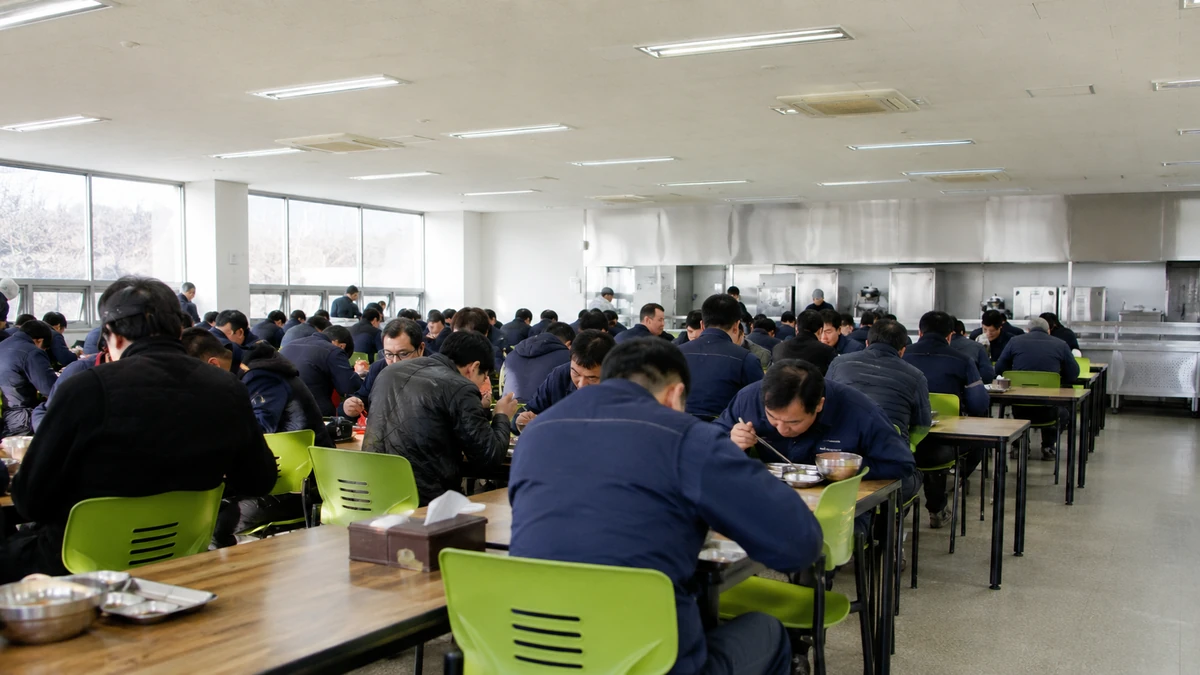
A routine meal becomes a public concern
What began as an apparent food safety incident inside a staff cafeteria on South Korea’s Yeongjong Island has quickly become something larger: a potential test of how vulnerable a major public transit system can be when the workers who keep it running fall ill at the same time.
Officials in Incheon said drivers and others who ate at the cafeteria inside the Yeongjong-area public bus garage in Unbuk-dong on June 21 began reporting suspected food poisoning symptoms the following day, including stomach pain and diarrhea. As of June 25, authorities had identified 50 suspected cases, and five of those people were hospitalized for treatment.
On its face, this is the kind of story that might sound local and contained — a possible outbreak tied to a single workplace dining hall. But in South Korea, as in the United States, the location matters. This was not a neighborhood restaurant where diners came and went by chance. It was a cafeteria inside a public bus depot, a tightly linked workplace where drivers on fixed schedules often eat the same food at roughly the same time. When something goes wrong in a setting like that, the consequences can ripple well beyond the lunch line.
That is why the story has drawn attention not only as a public health issue but also as a transportation issue. Bus drivers are not office workers who can simply power through a mild stomach illness while sitting at a desk. They operate large vehicles, often on demanding schedules, through heavy traffic and with responsibility for dozens of passengers at a time. If many of them are simultaneously dealing with gastrointestinal symptoms, normal service becomes difficult, and in some cases unsafe, to maintain.
For residents of Incheon and especially for people traveling through Yeongjong Island — home to Incheon International Airport, the country’s main global gateway — the possibility of bus disruptions is not an abstract bureaucratic concern. It is a reminder that essential public systems often depend on invisible routines: workers reporting on time, eating safely, staying healthy and keeping tightly coordinated schedules.
At this stage, authorities have described the situation as suspected food poisoning, not a confirmed final diagnosis with a publicly identified cause. That distinction matters. The source of the illness, the specific food item involved, the preparation process and the exact pathogen, if any, had not been publicly confirmed in the information available so far. But even without those answers, the event already offers a revealing look at the fragile links between food safety, labor conditions and urban mobility in modern South Korea.
Why this matters beyond one cafeteria
To American readers, a useful comparison may be the role of transit depots, airline hubs or school district kitchens in the United States. A breakdown in one of those places can quickly become a community-wide issue because the workers involved are part of a larger chain that people rely on every day. A suspected outbreak in a cafeteria serving bus operators is less like a problem at a random fast-casual restaurant and more like a problem inside the cafeteria of a large airport operations center or a municipal sanitation garage. The immediate victims are workers, but the secondary effects can be felt by thousands of people who never stepped inside the building.
That is especially true in South Korea, where bus systems form a central part of daily life. In many Korean cities, buses are not a backup option; they are a core piece of the transportation grid, linking residential neighborhoods, subway stations, business districts and regional corridors. Public garages, where buses are stored, maintained and dispatched, serve as the operational heart of that network. Their cafeterias are part of the basic infrastructure that supports shift workers whose jobs do not fit neatly into standard meal hours.
The Korean term often used for such a dining hall is “gu-nae-sik-dang,” which refers to an in-house cafeteria or staff canteen operated within a workplace, institution or industrial facility. Americans might think of a company cafeteria, but the social function can be more pronounced in Korea, particularly in sites where workers have limited time or ability to leave the premises. In a bus depot setting, where departures are scheduled and breaks may be short, workers may have little practical alternative to eating on site.
That concentration creates efficiency under normal circumstances and risk when something goes wrong. If dozens of workers eat similar meals from the same kitchen in a compressed time frame, any food safety lapse can affect many people at once. The resulting pattern — a cluster of workers becoming ill after eating in the same place on the same day — is exactly the kind of circumstance that public health investigators pay close attention to.
It also helps explain why officials and media outlets quickly framed the story in terms of possible disruption to bus service. That framing is not sensational by itself. It reflects the underlying structure of the workplace. Drivers are a coordinated workforce, not a random sample of consumers. When they are taken out of commission in bunches, it becomes harder to preserve the normal rhythm of public transportation.
Yeongjong Island is not just any neighborhood
The setting adds another layer of significance. Yeongjong Island, off the coast of Incheon, is best known internationally as the home of Incheon International Airport, one of Asia’s busiest and most important air travel hubs. For many foreign visitors, Yeongjong is literally the front door to South Korea. For local residents and airport workers, it is also a living, commuting space with its own bus-dependent travel patterns.
That geography matters because buses on and around Yeongjong do more than shuttle local residents to errands or school. They connect workers to airport jobs, travelers to terminals, neighborhoods to rail stations and communities to the broader Incheon region. Any disruption in the local bus system can therefore affect people with very different needs: airport employees trying to make shifts, travelers with luggage and tight departure times, contract workers commuting across the island and residents going about ordinary weekday routines.
Americans may recognize a similar dynamic in places like Queens near JFK Airport, neighborhoods around Los Angeles International Airport or the transit corridors serving O’Hare in Chicago. When transportation service wobbles in those areas, the effect is not just local inconvenience. It can complicate access to one of the most important transportation nodes in the country.
That does not mean the current situation has already produced widespread transit breakdown. The reporting to date centers on the risk of disruptions and the reason that risk is being taken seriously. But the concern is credible because the island occupies an outsized role in national mobility. In South Korea, where transport networks are generally expected to be punctual and highly functional, even the possibility of staffing-related interruptions can become a significant public issue.
There is also a psychological element. Public confidence in transportation depends not only on buses actually running but on the belief that the system is stable. News that dozens of drivers may have fallen sick after eating at the same depot cafeteria can make passengers uneasy, even before they personally experience delays. It highlights how much trust is embedded in unseen support systems — including kitchens, supply chains and workplace health protocols.
What is known — and what is not
So far, the basic timeline appears straightforward. People who used the bus garage cafeteria on June 21 began reporting symptoms such as abdominal pain and diarrhea on June 22. By June 25, 50 suspected cases had been identified, with five hospitalizations. Those are the facts public officials have disclosed. Beyond that, much remains unsettled.
No publicly confirmed source food had been identified in the summary of the case. The specific organism — whether bacterial, viral or another cause — had not been established in the available reporting. Nor had authorities, based on the information so far, publicly assigned blame to a particular worker, supplier or kitchen practice. That restraint is important, particularly in foodborne illness investigations, where early assumptions can prove wrong.
In the United States, local health departments often issue preliminary notices during possible outbreaks that note a suspected cluster without immediately naming a definitive cause. South Korean authorities operate under similar pressures: They need to alert the public, assess risk, manage any operational fallout and investigate the cause, all while avoiding unfounded conclusions. In that sense, the current public messaging appears focused on the essentials — where the cases may be linked, when symptoms began and how many people were affected.
That kind of early-stage communication serves an important purpose. It tells the public what is known while making clear that the story is still developing. For journalists, that distinction is crucial. “Suspected food poisoning” is not just cautious phrasing; it reflects a real limit in the evidence. Food poisoning can refer broadly to illness following contaminated food, but the actual mechanism can vary widely. Sometimes a single ingredient is responsible. Sometimes temperature control, cross-contamination or food handling is the issue. In other cases, a virus spreads in a communal dining environment and initially resembles a classic foodborne event.
For the drivers and other workers affected, those distinctions may not matter in the immediate sense — illness is illness, and those hospitalized need treatment. But for accountability and prevention, they matter enormously. The eventual answers will determine whether this was a one-off lapse, a systems problem in food service management or part of a broader pattern that deserves closer scrutiny.
The hidden infrastructure behind public transit
One reason this incident resonates is that it reveals a truth common to many modern cities: public transit depends on far more than vehicles, routes and timetables. It depends on the well-being of the workforce and the quality of the infrastructure that supports that workforce. A clean break room, reliable rest facilities, adequate scheduling and safe meals may sound secondary next to buses on the road, but they are not secondary in practice.
Bus driving is physically and mentally demanding work. It requires sustained attention, quick reaction time and the ability to manage fatigue, stress and unpredictable road conditions. A driver experiencing severe stomach cramps or repeated diarrhea is not in a condition to safely transport passengers. In that sense, a food safety problem in a depot cafeteria becomes a direct operational concern in a way that might not be obvious to outsiders.
In both South Korea and the United States, transit agencies often struggle with staffing pressures even under normal conditions. A cluster of illnesses can place sudden strain on dispatch schedules, replacement staffing and route frequency. If the workers affected are concentrated in a single depot, the disruption may be geographically uneven, with some lines or regions feeling the effects more than others.
The event also underscores a broader labor reality. Workers in transportation, logistics and public services often depend on institutional dining because their jobs are built around shifts and fixed reporting times. That means workplace cafeterias are not a perk; they are a functional necessity. When food served in those spaces is unsafe, workers may have little ability to protect themselves through consumer choice. They cannot simply browse the block for alternatives if they have 20 minutes before the next assignment and no nearby commercial district to walk to.
This is one reason food safety incidents in institutional settings — whether schools, military bases, hospitals, factories or transit depots — tend to draw outsized public concern. The people affected are often captive diners in a practical sense, and the potential for rapid clustering is much higher than in ordinary retail dining.
A wider food safety backdrop in South Korea
The Yeongjong depot case does not stand alone in a vacuum. South Korea, like the United States, routinely conducts inspections and enforcement actions related to food handling, labeling and sanitation. The broader context in the reporting included a separate announcement from South Chungcheong province that local special judicial police had inspected 376 businesses dealing in livestock products and found 19 violations. Those included mismatched animal tracking numbers, labeling violations, missing health checks, false country-of-origin labeling and facility standard violations.
That separate enforcement action is not directly tied to the suspected food poisoning case at the bus depot. It would be inaccurate to treat the two as the same story. But together they illustrate a larger point: food safety requires constant monitoring, and regulators in South Korea continue to find problems across different parts of the supply and service chain.
That is hardly unique to Korea. Americans are familiar with recurring headlines involving tainted produce, mislabeled meat, school lunch concerns or outbreaks traced to institutional kitchens. What differs from country to country is often less the existence of risk than the structure of oversight and the public expectation of state response.
In South Korea, there is generally strong public sensitivity to failures involving public systems, whether in transportation, consumer safety or food oversight. That sensitivity stems in part from the country’s dense urban environment and high reliance on centralized systems. When something goes wrong, many people may be affected quickly, and there is often intense pressure on local governments to respond visibly and fast.
The bus depot case fits squarely into that pattern. Even before investigators determine a precise cause, the combination of worker illness, public transit implications and a communal food setting makes this more than a routine workplace health complaint. It becomes a test of whether local authorities can establish the facts, contain the fallout and reassure the public without overpromising what they know.
Why caution in reporting matters
Stories like this can easily veer into either complacency or overstatement. On one hand, it would be a mistake to dismiss a cluster of 50 suspected illnesses and five hospitalizations as a minor inconvenience. On the other hand, it would also be irresponsible to leap from preliminary symptoms to definitive conclusions about contamination, negligence or large-scale transit collapse before those claims are supported by evidence.
That is why the most important facts right now are the simplest ones: a shared place, a shared date of exposure, a next-day onset of symptoms, a known number of suspected patients and a credible risk to service continuity because the affected group includes bus drivers. Those facts are enough to explain why the case matters. They are not enough to establish every detail of what happened.
For English-speaking readers unfamiliar with Korean news coverage, it is worth noting that South Korean reporting on public incidents often moves quickly from the immediate event to the wider social implications. In this case, that means the story is not just about whether one cafeteria may have served unsafe food. It is about what the event reveals regarding the hidden support structure of everyday urban life: the people who operate essential services, the facilities they depend on and the consequences when one support point fails.
That framing can seem expansive, but it is not misplaced. The modern city is an ecosystem. A transit breakdown can begin not only with a mechanical fault or labor strike, but with something as ordinary as a lunch service gone wrong. When the workers in question are responsible for moving the public, private illness quickly becomes public risk.
What this episode says about modern Korean life
In the end, the Yeongjong Island case is a reminder that the systems people trust most are often only as strong as their least visible components. South Korea is widely recognized for its efficient infrastructure, dense transit networks and high-functioning urban services. But efficiency can also mean interdependence. When many people rely on the same facilities, the same timetables and the same institutional support, failures can spread quickly.
This episode throws several features of contemporary Korean society into sharp relief at once: the central role of buses in daily mobility, the dependence of public services on shift labor, the importance of workplace cafeterias in structured job environments and the expectation that local government will quickly provide at least basic facts during a public health concern.
It also invites a broader conversation that extends well beyond one island or one bus depot. Are workplace dining facilities receiving the level of oversight their importance demands? Do transportation systems have enough flexibility and backup staffing to absorb sudden health-related shocks? And do public agencies communicate early-stage risks in a way that informs the public without triggering unnecessary alarm?
Those questions are not uniquely Korean. They would resonate in New York, Chicago, Los Angeles or Atlanta just as easily. Any city that depends on transit workers, airport access corridors and institutional food service has similar vulnerabilities, even if they tend to remain unnoticed until something goes wrong.
For now, the confirmed public picture remains limited but meaningful: dozens of suspected illnesses, several hospitalizations and concern that a health incident inside a bus garage cafeteria could complicate transportation for the surrounding community. The investigation will determine whether this was the result of a specific contaminated meal, a preventable sanitation lapse or another cause entirely.
But the larger lesson is already visible. Urban life rests on more than roads, bridges and vehicles. It also rests on safe meals in staff dining halls, healthy workers able to report for duty and institutions capable of responding quickly when ordinary routines suddenly fail. On Yeongjong Island, a suspected outbreak in a cafeteria has turned into a window on that larger reality — one that many cities, in Korea and beyond, would be wise to study closely.


0 Comments