Hyundai E&C Wins $4 Billion Contract in Seoul’s High-Stakes Apgujeong Rebuild, Underscoring South Korea’s Urban Development Boom
A marquee deal in one of Seoul’s most famous neighborhoods
Hyundai Engineering & Construction has secured the right to build one of South Korea’s most closely watched urban redevelopment projects, winning approval to lead the reconstruction of Seoul’s Apgujeong District 3, a massive undertaking valued at about 5.5 trillion won, or roughly $4 billion.
The decision, made Saturday by the district’s redevelopment association, lands as more than a routine construction award. In South Korea, and especially in Seoul’s upscale Gangnam district, redevelopment projects of this scale are equal parts real estate play, financial event and status contest. For builders, winning a project like this can shape brand prestige for years. For residents, it can determine not just future home values, but the identity of an entire neighborhood. For investors, it offers a window into how South Korea’s biggest builders are positioning themselves in a housing market where land is scarce, density is high and prime addresses carry enormous symbolic weight.
Apgujeong is not just another Seoul neighborhood. For many South Koreans, it evokes wealth, old-money prestige, luxury shopping and the rise of modern Gangnam. If Americans think of neighborhoods that combine exclusivity, cultural cachet and outsize influence on property markets, comparisons might include Manhattan’s Upper East Side, Beverly Hills or parts of San Francisco’s Pacific Heights. The analogy is imperfect, but it helps explain why the outcome of a local construction vote became national business news.
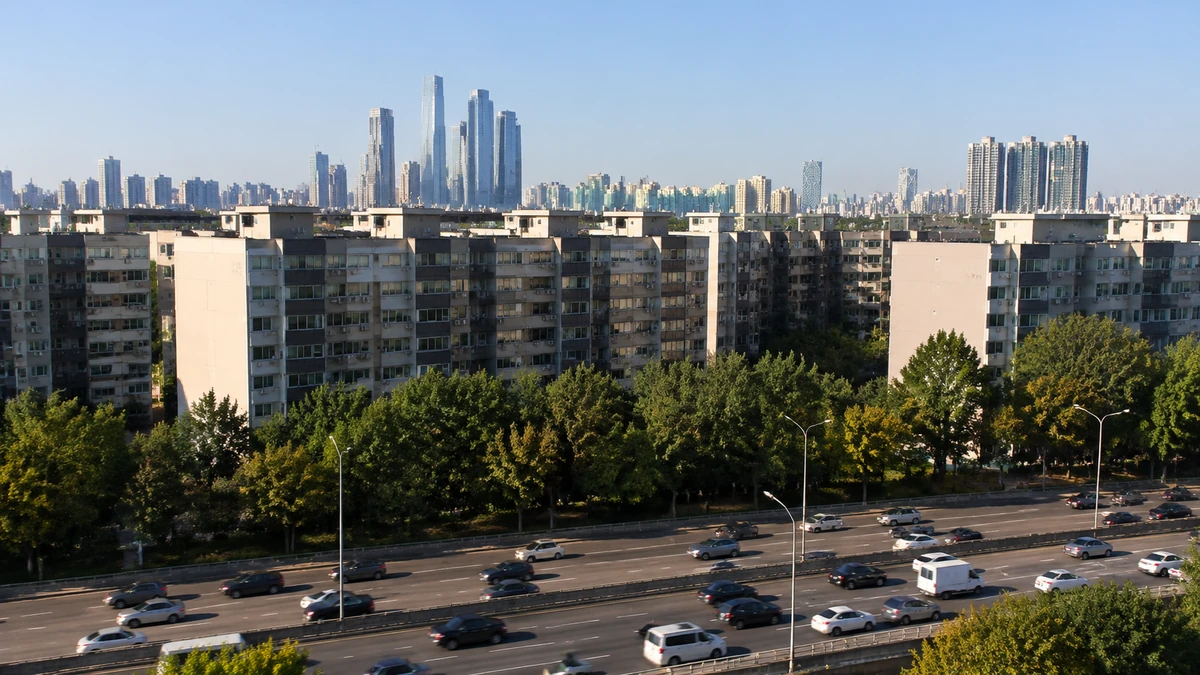
The Apgujeong District 3 project covers a cluster of aging apartment complexes and villa properties in one of Seoul’s most coveted residential areas. Current plans call for replacing 3,934 existing homes with 5,175 units in towers reaching as high as 65 stories. That would not only reshape the skyline along a key stretch of the Han River, but also add new housing in a city where supply constraints are a chronic political and economic issue.
For Hyundai E&C, the win carries added significance because it follows the company’s earlier selection for Apgujeong District 2. Taken together, the back-to-back victories give the builder a stronger foothold in one of the country’s most symbolic redevelopment zones and reinforce its position as a dominant player in South Korea’s premium urban housing market.
Why this neighborhood matters far beyond real estate
To outside readers, the intensity surrounding a residential rebuild may seem surprising. But in South Korea, apartment complexes are not merely places to live. They function as the backbone of middle- and upper-middle-class wealth, a barometer of social status and a central arena of public policy. In Seoul, where the metropolitan area holds roughly half the country’s population, competition for housing in desirable districts can be fierce.
Apgujeong occupies a special place in that landscape. Developed decades ago as Seoul expanded south of the Han River, the neighborhood became synonymous with affluence and aspiration. It has long been associated with high-end retail, elite education, cosmetic surgery clinics and the polished image often linked with modern Gangnam. Even for people who have never visited South Korea, Gangnam may ring a bell because of the global popularity of the 2012 hit “Gangnam Style.” But while pop culture introduced the district to the world as a symbol of flash and consumption, in Korea it also represents the concentration of wealth, educational competition and political attention around housing.
That is why redevelopment in Apgujeong is watched so carefully. This is not simply about tearing down old buildings and putting up new ones. It is about who gets to shape one of Seoul’s signature neighborhoods for the next generation. It is also about whether South Korea can modernize older apartment districts in a way that expands supply, satisfies residents and preserves sky-high land values.
In the United States, large redevelopment projects often involve city councils, zoning boards, preservation fights and prolonged court battles. South Korea has its own version of complexity, but one key actor is the residents’ redevelopment association, a formal body representing property owners in a designated project area. These associations can wield major power because they vote on essential decisions, including the choice of a builder. In projects worth billions of dollars, those votes become closely studied signals of political support, bargaining power and project momentum.
The vote that sealed the contract
According to the project association, 2,621 of its 3,988 members participated in the general meeting, a turnout of 65.7%. Of those who voted, 2,002, or 89%, supported the agenda item authorizing a negotiated contract with Hyundai E&C, which had already been named the preferred bidder.
Those numbers matter. In any large-scale redevelopment project, support from residents can be fragile. Property owners may share the same broad goal of replacing aging housing stock, but they often differ sharply over financing terms, design proposals, moving timelines, compensation formulas and long-term expectations for property values. A strong approval vote does not erase future conflicts, but it can reduce one layer of uncertainty by showing that a clear majority has coalesced around a single construction partner.
For American readers, the closest analogy might be a condominium or co-op board decision magnified to neighborhood scale and mixed with the financial stakes of a major infrastructure contract. The residents are not merely approving cosmetic renovations or amenity upgrades. They are effectively selecting the company that will help transform a large and valuable slice of the city, while also influencing financing conditions, timelines and ultimately the marketability of the homes to be built.
That helps explain why business circles and capital markets paid attention. When residents in a premier district vote overwhelmingly for one builder, the decision can be interpreted as an endorsement of that company’s reputation for project management, engineering capability and brand value. In South Korea’s construction sector, reputation can be as important as price. Prestige projects are often viewed as living advertisements for a builder’s long-term competitiveness.
The association’s vote took place at Apgujeong High School’s auditorium, a reminder that redevelopment in Korea often unfolds through highly organized, community-based processes rather than distant government fiat. Even so, the public symbolism goes far beyond a school hall meeting. A strong turnout and lopsided approval in a neighborhood this prominent send a message to competitors and investors alike: Hyundai E&C is not just winning contracts; it is winning trust in the country’s most scrutinized redevelopment contests.
Why Apgujeong District 3 is called a “whale” project
In Korean business coverage, especially in construction and finance, reporters often describe a major contract or acquisition target as a “big fish” or “whale,” shorthand for a prize so large it can redefine the competitive landscape. Apgujeong District 3 fits that description.
The headline number alone explains part of the attention. At 5.5 trillion won, the project stands among the largest and most symbolically potent redevelopment jobs in Seoul. But scale is only one factor. The district combines three elements that builders covet: a rare central location, a very large number of units and a premium neighborhood identity that can elevate the builder’s brand well beyond the project itself.
There is also the technical challenge. Replacing nearly 4,000 homes with more than 5,000 new units in towers rising up to 65 stories is not the kind of assignment a company wins on brochure promises alone. It requires extensive experience in high-density urban construction, careful sequencing, coordination with residents and lenders, and confidence that the builder can deliver a premium product in a market where expectations are exceptionally high.
In Seoul, where buildable land is limited and older apartment districts are aging, redevelopment has become one of the most important mechanisms for urban renewal and housing supply. That makes projects like Apgujeong District 3 a proving ground for the country’s largest builders. Winning one demonstrates not just construction strength, but the ability to manage a complicated ecosystem of finance, regulation, design, logistics and resident relations.
For global readers, this is one of the most revealing aspects of the story. South Korea is often understood through the lens of semiconductors, automobiles, shipbuilding and K-pop. Those are all major parts of the economy. But the country has also built deep expertise in large-scale urban transformation. In a city as dense and land-constrained as Seoul, redevelopment requires the kind of project management discipline more commonly associated with megainfrastructure or industrial manufacturing. That capability is one reason Korean firms have developed competitive identities not only at home, but in overseas construction and engineering markets as well.
What Hyundai E&C gains from back-to-back wins
For Hyundai E&C, the Apgujeong District 3 selection is significant not only because of its size, but because of its continuity. The company had already won the right to build in Apgujeong District 2 last year. Securing District 3 extends its influence across one of Seoul’s premier redevelopment corridors and suggests that the firm has successfully positioned itself as a preferred partner for residents in this elite market.
In the construction business, one-off wins matter, but repeat wins in the same zone can be even more meaningful. They suggest that a company’s pitch resonates with local stakeholders and that its brand is becoming associated with the future image of the area. That can have knock-on effects in other redevelopment contests, where residents and investors look to prior victories as evidence of reliability and momentum.
South Korean builders compete heavily on branding in the high-end residential market. Their apartment brands, marketing language, design promises and amenity packages are often central to how they appeal to resident associations. In this sense, a project like Apgujeong is not unlike a flagship retail location or a high-profile sports venue deal in the United States. It confers visibility, credibility and bragging rights that extend far beyond the immediate revenue from the contract.
Hyundai E&C’s advantage also lies in narrative. Winning in a place as recognizable as Apgujeong allows the company to tell a story about engineering sophistication, operational stability and premium-market acceptance. Even before construction begins in earnest, the company can point to the vote as proof that residents in one of the nation’s toughest and most high-expectation markets chose its proposal over rivals.
That narrative matters because the redevelopment market in Seoul is both crowded and politically sensitive. Builders are judged not only on whether they can erect towers, but on whether they can navigate delays, rising costs, resident demands and design revisions without jeopardizing the broader project. A company seen as dependable in Apgujeong may have an easier time persuading other associations that it can handle similarly complex work.
What this says about Seoul’s housing economy
The Apgujeong decision also offers a glimpse into a larger issue that has long shaped South Korean politics: housing affordability and supply in Seoul. For years, presidents, mayors and regulators have wrestled with how to increase housing stock without destabilizing prices or provoking backlash from homeowners. Redevelopment of older apartment complexes is often presented as one answer, especially in districts where land is already built out and new large-scale construction opportunities are rare.
Yet redevelopment creates its own tensions. New towers can raise overall housing supply, but they also tend to reinforce the value of already expensive neighborhoods. In prime districts, redevelopment can produce more units while preserving, or even enhancing, exclusivity. That means projects like Apgujeong District 3 are economically important but politically complicated. They can help modernize old housing and increase unit counts, even as they underscore how difficult it is for ordinary buyers to access elite parts of the city.
Still, from a purely urban economic perspective, the effects can spread widely. A project of this size supports demand for building materials, architectural services, engineering, project finance, legal advisory work and property marketing. It also serves as a confidence indicator for related industries that rely on large-scale construction activity. When Korean business reporters focus on redevelopment, they are often tracking not just housing, but a much larger industrial network.
That broader lens helps explain why this story belongs in business pages as much as in real estate coverage. The builder selection shows where capital, confidence and corporate capacity are concentrating. It can influence stock market sentiment around listed construction companies. It can shape expectations for other pending redevelopment projects in Seoul. And it can offer clues about whether resident groups in premium districts are prioritizing financial certainty, engineering reputation or brand prestige when choosing partners.
In that sense, Apgujeong District 3 is more than a neighborhood story. It is a case study in how South Korea allocates urban opportunity in a mature, high-cost, high-density metropolis where the next round of growth often comes not from building outward, but from rebuilding what is already there.
What comes next, and why the market will keep watching
The association’s vote settles one major question: who will build. It does not end the long process ahead. Large redevelopment projects in South Korea typically move through multiple stages involving design refinement, administrative approvals, financing arrangements, resident coordination and eventual relocation and construction. Each phase can generate delays or new disputes, particularly when costs shift or timelines stretch.
That is why even a resounding vote should be seen as a strong signal, not a final guarantee of a smooth path. The practical demands of transforming an aging, densely settled urban district into a 65-story residential complex are immense. Construction inflation, financing conditions and regulatory reviews will all matter. So will the ability of Hyundai E&C and the resident association to maintain trust as details become more concrete.
Even so, the immediate significance of the weekend’s decision is hard to overstate. One of Seoul’s most famous redevelopment zones has chosen its builder, and that builder is now positioned at the center of a project that combines prestige, scale and strategic importance in a way few others can match. For Hyundai E&C, the win strengthens its standing in Seoul’s premium reconstruction market. For the city, it represents another step in the ongoing remaking of Gangnam’s aging apartment landscape. And for outside observers, it is a vivid reminder that South Korea’s economic story is not only about exports and entertainment, but also about the complex business of remaking its capital city, block by block, tower by tower.
For Americans used to thinking about construction in terms of stadium deals, transit fights or suburban sprawl, Seoul’s redevelopment model can seem highly compressed: enormous capital, limited land, intense resident involvement and sky-high stakes, all concentrated into a single project. Apgujeong District 3 captures that model at its most visible. It is a local vote with national business implications, and a neighborhood rebuild that doubles as a measure of corporate power, urban policy and social aspiration in modern South Korea.
That is why this was never just a contract award. It was a referendum on who gets to shape one of Seoul’s most iconic addresses, and a sign that in the battle to rebuild the city’s most valuable neighborhoods, Hyundai E&C has emerged with a larger and louder claim to the future.
Comments
Post a Comment