Veteran Actor Yoo Seung-mok Says He Never Expected ‘Scarecrow’ to Strike Such a Chord, Underscoring the Weight of True-Crime Drama in South Korea
A breakout moment years in the making
For American viewers used to the star-making machinery of Hollywood, the story of South Korean actor Yoo Seung-mok may feel both familiar and distinctly Korean. After years of steady work, mostly in supporting roles, Yoo is suddenly hearing something many character actors wait a lifetime to hear: audiences are not just noticing the project, they are noticing him.
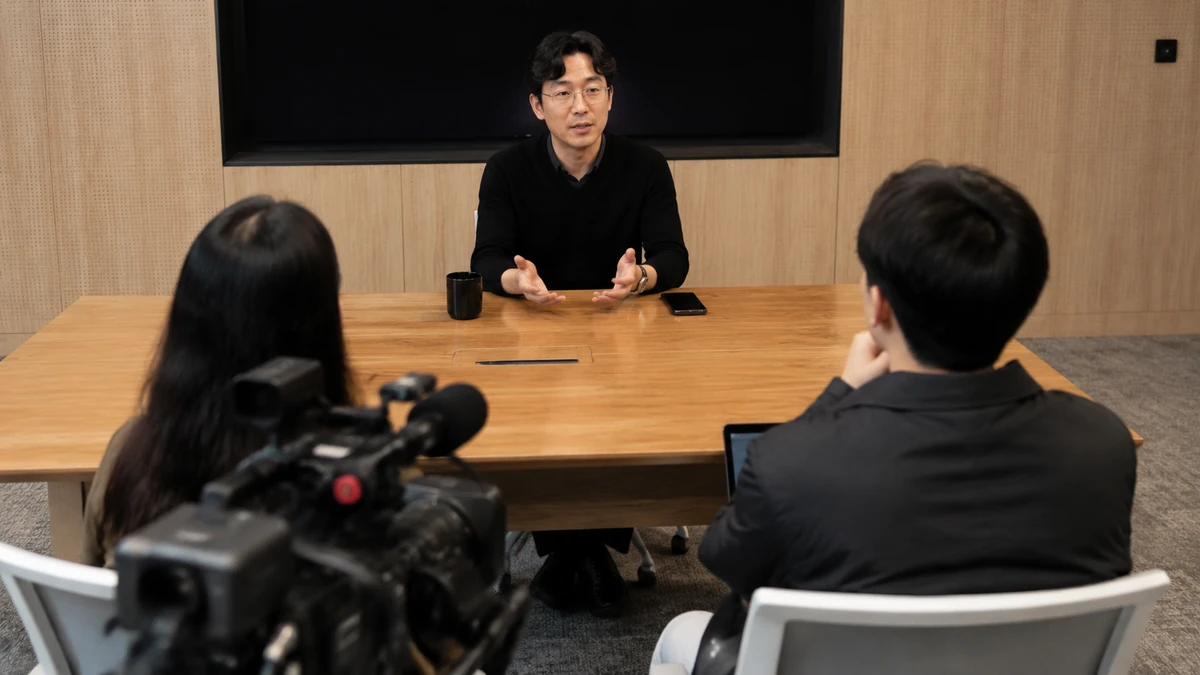
In an interview in Seoul, Yoo said he did not expect the recently ended ENA drama “Scarecrow” to receive such an intense outpouring of support. The series finished its run with an 8.1% nationwide rating, according to Nielsen Korea, making it the second-highest-rated drama in the cable channel ENA’s history. In the fragmented world of modern television, where streamers, social media clips and binge habits often scatter attention, that figure is significant in the South Korean market, especially for a serious drama rooted in real-life tragedy rather than glossy fantasy or romantic escapism.
But the most revealing part of Yoo’s comments was not the ratings milestone itself. It was the way he described what the success meant to him personally. He said that since he first began acting, he had long prayed for one thing: to become an actor who was truly good at acting. That distinction matters. He was not talking about becoming rich, famous or conventionally glamorous. He was talking about being respected for craft.
That sentiment will resonate with anyone who has watched a beloved American supporting actor spend years elevating scenes without always getting top billing. Think of the way audiences eventually rally around veteran performers who have been doing excellent work in the background for decades, only to receive broader public recognition later in their careers. Yoo’s moment appears to be one of those rare intersections where industry respect, audience affection and commercial success all arrive at once.
He said that reading viewers’ online comments recently made him feel, perhaps for the first time, that the dream he had been carrying for so long was becoming real. In an era when audience response is immediate and deeply personal, that kind of affirmation can land differently than a rating report or an award nomination. It tells an actor not simply that people watched, but that they felt something.
That emotional recognition helps explain why Yoo’s remarks have drawn attention in South Korea beyond the standard post-finale victory lap. What he offered was not a routine expression of gratitude after a hit. It was a portrait of what success feels like for a veteran performer whose career has been built slowly, role by role, over time.
Why ‘Scarecrow’ matters beyond the ratings
“Scarecrow” is not just another successful Korean drama. Its resonance is tied to the subject it takes on: the series is inspired by the Hwaseong serial murders, one of the most notorious criminal cases in modern South Korean history. For readers unfamiliar with the case, the Hwaseong murders are often described in Korea with a weight similar to the way Americans talk about a crime that permanently altered public consciousness — a case that became larger than a police file and entered the realm of national memory.
From the mid-1980s into the early 1990s, a series of murders in the city of Hwaseong terrified the country and exposed the limitations of law enforcement at the time. For years, the case remained unsolved, becoming a symbol of institutional frustration, social fear and unresolved trauma. It was eventually linked through later forensic advances to Lee Choon-jae, but the long period of uncertainty had already left a deep mark on South Korea’s cultural imagination.
That history is crucial to understanding why “Scarecrow” carries a different burden than an ordinary crime series. In the United States, true crime has become a booming entertainment genre, spanning documentaries, podcasts, prestige dramas and streaming franchises. But the boom has also sparked ethical debates: When does storytelling become exploitation? How do creators center victims rather than the spectacle of violence? Can a dramatization revisit painful history without turning suffering into content?
Those same questions are clearly hovering over “Scarecrow,” and Yoo seems fully aware of them. He has emphasized that the show is not simply about catching a criminal or generating suspense. In his description, the series is also about looking carefully at the grief of the people who lived through that era — the people who were frightened, harmed and emotionally scarred.
That is an important distinction. Crime dramas often reward the mechanics of the hunt: clues, interrogations, breakthroughs and the eventual reveal. By contrast, Yoo’s comments suggest that “Scarecrow” is trying to do something more reflective. Rather than consuming the case as a puzzle, it asks what the case did to a community. That shift mirrors a broader change in how many societies, including South Korea and the United States, talk about traumatic historical events. The question is no longer only, “What happened?” but also, “Who is still carrying the pain?”
That may help explain why the series found such strong audience support. Viewers often respond not only to polish or suspense but to a sense that a show understands the moral stakes of its own material. If “Scarecrow” managed to be both gripping and careful, that combination would set it apart in an overcrowded drama landscape.
The long road of the Korean character actor
Yoo’s reaction also opens a wider window into the structure of the Korean entertainment industry, where actors are often categorized in ways that can shape the arc of a career. As in the United States, there is a clear difference between stars who drive marketing campaigns and the veteran performers who provide depth, realism and authority around them. In South Korea, those seasoned supporting actors frequently become recognizable faces long before they become household names.
For years, Yoo has been part of that tradition: the kind of actor viewers may instantly recognize even if they cannot immediately place his name. These performers are essential to the texture of Korean television and film. They play detectives, officials, fathers, bosses, civil servants, teachers, witnesses and neighbors — the characters that make a fictional world feel inhabited rather than staged. They are often the emotional ballast in stories built around younger marquee leads.
In his recent remarks, Yoo suggested that the current stretch of recognition has given him what he called great courage. That comment is telling. It suggests that validation, especially late-career validation, does more than flatter the ego. It can reinforce an actor’s sense that the work has landed as intended, that the instincts honed over years were not misplaced, and that the choices he made in building a career were meaningful.
For American audiences, the comparison might be to a veteran actor who spends decades appearing in respected supporting roles before finally becoming the center of public conversation after an awards run or a breakout prestige series. There is often a feeling of collective correction in those moments, as if audiences are belatedly catching up to what peers in the industry already knew.
South Korea’s awards culture adds another layer. Yoo has recently gained momentum through honors including a supporting actor prize at the Baeksang Arts Awards, one of the country’s most prestigious entertainment awards and often loosely compared to a blend of the Emmys, Golden Globes and Screen Actors Guild recognition in terms of symbolic weight. He has also appeared in entertainment and variety programming, which in Korea can significantly expand an actor’s public profile beyond scripted work.
That matters because South Korean celebrity culture often moves across multiple formats at once. A performer is not only judged by dramatic roles, but also by how he is received in interviews, panel shows and other public-facing appearances. Yoo’s recent visibility suggests that audiences are beginning to connect the face they know from countless roles with the person and career behind it. That kind of recognition can feel overdue — and all the more powerful because it was not manufactured overnight.
A second encounter with a national trauma
There is another reason Yoo’s involvement in “Scarecrow” has attracted notice: he previously appeared in “Memories of Murder,” the landmark 2003 film directed by Bong Joon Ho that was also based on the Hwaseong killings. In that film, now widely regarded as one of the defining works of modern Korean cinema, Yoo played a reporter.
For many American readers, “Memories of Murder” may be the strongest reference point here. Long before Bong won the Oscar for “Parasite,” he had already become one of the most acclaimed filmmakers in the world, and “Memories of Murder” remains a cornerstone of his reputation. The movie used the case not simply as a procedural framework but as a lens on authoritarian culture, police incompetence, social anxiety and the frustration of unresolved evil.
Yoo has said that while “Scarecrow” and “Memories of Murder” spring from the same underlying case, they are not trying to say the same thing. That observation is more than a promotional talking point. It gets at how cultural works evolve over time in response to changing social sensibilities.
When “Memories of Murder” premiered in 2003, South Korea was still processing both the mystery of the case and the failures it exposed. The sense of incompletion was central to its power. “Scarecrow,” arriving in a different era and a different television ecosystem, appears more interested in the emotional afterlife of the violence — in what it meant for the people who endured it, and in how memory itself can become part of the story.
That difference reflects a larger trend in Korean storytelling. Over the past two decades, South Korean film and television have become more globally visible, but they have also become more attentive to how trauma is narrated. The emphasis is increasingly not just on recreating shocking events, but on asking what ethical responsibility comes with retelling them. In that sense, “Scarecrow” belongs to a broader conversation that stretches well beyond one actor or one series.
For Yoo personally, returning to the same historical source material through a new project must carry a particular resonance. Few actors get to revisit the same national wound from two distinct cultural moments, under two different creative frameworks. His comments suggest he understands that continuity — and the responsibility that comes with it.
The ethics of dramatizing real pain
One of the most striking parts of Yoo’s interview was his repeated emphasis on caution. He said the director, the writer and the cast all recognized the weight of working with material tied to a real case and tried to approach it carefully so as not to wound anyone. In a media environment where true-crime storytelling can sometimes feel industrialized, that language stands out.
Carefulness in this context does not simply mean toning down graphic content. It means thinking through perspective, proportion and purpose. Which characters are centered? Which emotions are given room to breathe? What does the audience leave remembering: the thrill of the chase, or the grief left behind? These are the questions that determine whether a drama treats real suffering as background texture or as something worthy of dignity.
American readers will recognize the stakes. Similar debates have surrounded U.S. dramatizations of serial killings, school violence, wrongful convictions and family tragedies. The criticism is often the same: victims become footnotes while perpetrators become brands. The best creators try to resist that gravitational pull by widening the frame beyond the killer and by acknowledging that the damage extends far past a single narrative climax.
Yoo’s comments suggest that “Scarecrow” was built with that challenge in mind from the beginning. He did not frame the show’s success as proof that anything was permissible so long as audiences tuned in. Instead, he spoke as someone aware that public acceptance of a sensitive drama cannot be taken for granted. That may be why his gratitude sounds less like celebrity modesty and more like relief — relief that a project dealing with profound pain appears to have been received in the spirit it intended.
There is also something notable about this happening in South Korea at a time when its entertainment industry is more globally scrutinized than ever. Korean dramas are no longer domestic products with occasional overseas breakout appeal. They are now part of a worldwide content pipeline, consumed instantly by viewers who may not know the historical context. That raises the stakes for how shows communicate cultural memory. A drama based on a notorious Korean case is now speaking not just to Koreans, but to an international audience that may encounter the history first through fiction.
In that setting, an actor publicly stressing restraint, empathy and seriousness matters. It helps frame the show not merely as a commercial property but as a work entering a moral conversation.
What audience comments revealed to him
Yoo’s remark about reading viewer comments may seem minor, but it points to a major shift in how actors experience their careers. In an earlier era, especially before social media and expansive online fandoms, performers often encountered public reaction through newspaper reviews, ratings reports, fan mail or occasional street recognition. Now the response is immediate, searchable and emotionally detailed.
In South Korea, online comments can be notoriously intense, swinging from adoration to cruelty with little middle ground. Yet they can also provide a vivid record of what an audience actually connected with. A viewer may not only say a performance was good, but explain why a particular line reading, expression or scene felt devastating or humane. For an actor whose ambition has been tied to craft more than celebrity, that kind of feedback can carry unusual force.
It is one thing to know a drama performed well. It is another to see thousands of viewers write that a supporting performance made them trust the story, deepened their grief, or illuminated the emotional stakes of a scene. Those are the kinds of responses that tell an actor his work did not disappear into the machinery of the production.
That is likely why Yoo described the moment in such personal terms, saying he wondered whether he had finally achieved his dream. It was not a boast. It sounded more like a private realization spoken aloud: that the work he had spent years refining was now being recognized not only inside the industry but in living rooms, on phones and in the collective reaction of ordinary viewers.
That dynamic is also part of why Korean television can feel so culturally alive. The feedback loop between audiences and creators is unusually visible. Ratings still matter, but so do online communities, clip circulation and the emotional afterlife of an episode once it airs. For a veteran actor, that can be exhausting, but it can also be affirming in a way older systems of prestige were not.
A sign of where Korean drama is headed
The success of “Scarecrow” and the response to Yoo Seung-mok say something larger about Korean drama at this moment. Internationally, the Korean Wave — or “Hallyu,” the term used to describe the global spread of South Korean popular culture — is often associated with polished idol groups, addictive thrillers and export-ready streaming hits. But one reason Korean storytelling has proved so durable is that it also makes room for morally serious, locally rooted work that trusts audiences to engage with complexity.
“Scarecrow” appears to be one of those projects: a drama that drew viewers not because it offered easy comfort, but because it treated difficult history with enough emotional intelligence to create genuine connection. That it did so on a relatively young cable network, and with a veteran supporting actor at the center of the post-finale conversation, makes the result even more notable.
For American audiences paying closer attention to Korean media, Yoo’s story is a useful reminder that the Korean Wave is not only about breakout stars and flashy premises. It is also about the performers who build entire careers in the supporting ranks, the filmmakers and writers who revisit national trauma with fresh ethical questions, and the viewers who reward seriousness when they feel it is earned.
In the end, Yoo’s comments land because they are about more than one role in one successful drama. They are about time — the time it takes for a craft to mature, for an audience to see it clearly, and for an industry to recognize that quiet excellence can become its own kind of event. They are also about the burden of telling stories drawn from real suffering, and the care required to do so without turning pain into spectacle.
That is what gives this moment its emotional force. A veteran actor who spent years hoping simply to be considered good at his job has found himself at the center of a national conversation, not because he chased attention, but because attention finally caught up with the work. In a television culture often obsessed with what is new, fast and instantly marketable, that may be the most meaningful success story of all.
Comments
Post a Comment