Why a Japanese Singer-Songwriter Is Launching His First Overseas Tour in Seoul — and Why Korean Fans’ Singalongs Matter
Seoul becomes the first stop, not a side stop
For years, the story of Asian pop music in the United States has usually been told in one direction: K-pop artists breaking into overseas markets, selling out arenas in Los Angeles, New York and London, and building global fandoms that operate across languages and time zones. But a concert announcement out of Seoul points to a different current in the regional music business — one that says as much about South Korea’s cultural gravity as it does about the artist at the center of it.
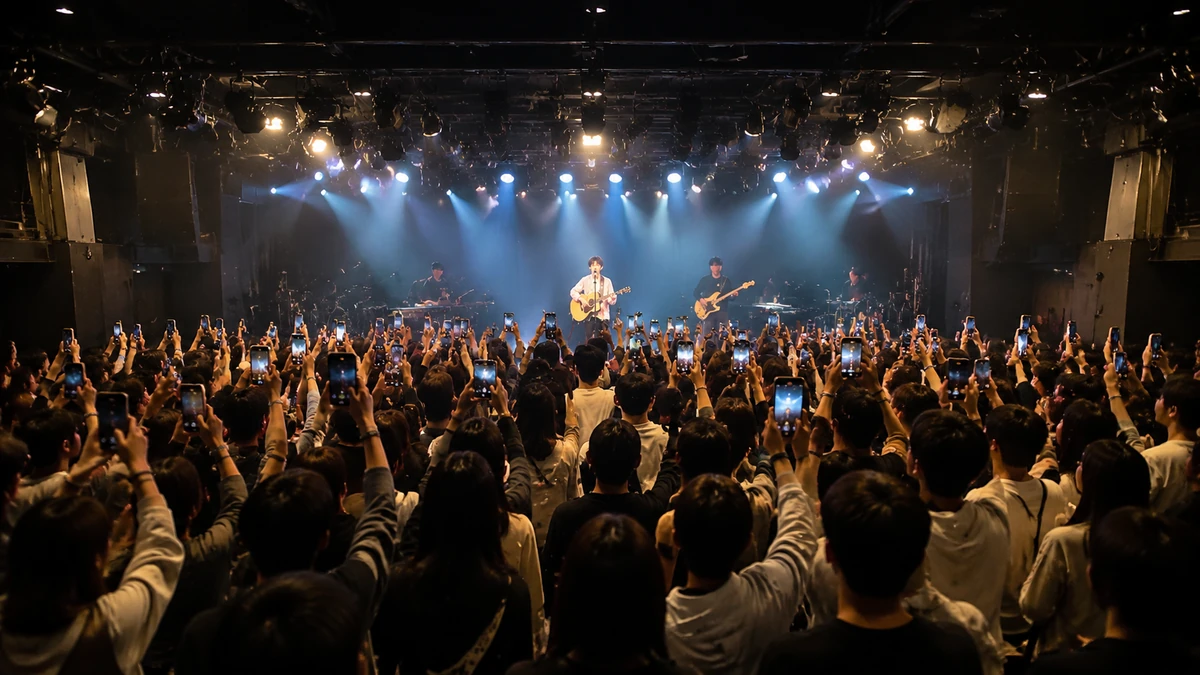
Japanese singer-songwriter Keina Suda is set to hold his first-ever performances in South Korea on May 23 and 24, 2026, at Rolling Hall in Seoul’s Hongdae neighborhood. According to Yonhap News Agency, the two-night stand, titled “2026 GLIMMER,” will also mark the first overseas stop of his first Asia tour. In remarks given a day before the shows at the offices of Amuse Entertainment in Seoul’s Gangnam district, Suda said he was especially excited about one thing: the possibility of hearing Korean fans join in for a full-throated singalong.
That detail may sound small to casual readers, but it carries unusual weight. In South Korea, audiences are known for a concert culture that is both intensely participatory and highly organized. Fans do not simply show up, clap and go home. They often learn set lists, memorize key lyrics, coordinate chants and treat live shows as communal events rather than passive entertainment. In K-pop, that collective participation is almost expected. What is striking here is that an artist from outside Korea is looking to Seoul not just as another date on a tour calendar, but as the place where his relationship with overseas audiences will begin.
His comment — that he is glad his first show abroad is in Seoul — reflects a growing reality in Asian pop culture. South Korea is no longer only a launchpad for its own stars. It is increasingly a proving ground for artists from elsewhere who want to test, deepen or formalize their connection with regional fans. In American terms, it is the difference between a musician adding a city because it makes logistical sense and choosing a city because it means something symbolically. Seoul, in this case, is not a detour. It is the opening statement.
The timing adds to that sense of immediacy. This is not a vague long-range industry announcement or a speculative expansion plan. These comments came on the eve of the concerts, when anticipation is still untested and unfiltered. That gives the story an on-the-ground feeling: the artist is not talking about some future dream of international success. He is about to walk onstage, in a foreign country for the first time as a headlining performer, and he is imagining what it will feel like if fans in Seoul sing his songs back to him.
Why Seoul matters to artists beyond K-pop
Suda said he had long known that people in South Korea were listening to his music. Until now, those fans often had to travel to Japan to see him perform. This time, he is the one crossing the border. That reversal may be one of the most revealing parts of the story.
For American readers, one way to understand it is to think about how fan commitment used to work before streaming and social media erased many cultural boundaries. If you loved a niche British band in the 1990s or early 2000s, seeing them live might have required a plane ticket, a festival trip or a major-city pilgrimage. Eventually, if the audience proved strong enough, the artist came to you. That is what this Seoul concert appears to represent for Suda’s Korean fans: the moment when interest becomes undeniable enough to shape touring decisions.
There is an important nuance here. The available facts do not justify sweeping claims about market size, ticket sales trends or the overall scale of Japanese music in South Korea. What they do support is simpler, and in some ways more meaningful. Suda recognized that he had listeners in Korea. He knew those listeners had made the effort to see him in Japan. And that awareness played a role in making Seoul the site of his first overseas performances.
That says something about South Korea’s place in the regional live music ecosystem. For many artists, especially in Asia, Seoul offers more than population density or convenient flight routes. It offers a highly engaged audience, a sophisticated concertgoing culture and a reputation for turning fandom into visible energy inside a venue. To perform in Seoul is, increasingly, to seek a certain kind of response: loud, prepared, emotionally available and musically literate.
It also suggests that South Korea’s influence in popular music is not limited to exporting its own acts. American coverage often frames Korean cultural power through the lens of K-pop idols, Korean dramas on Netflix or Oscar-winning films like “Parasite.” Those examples are real and important. But another measure of influence is whether artists from other countries see Korea as a place where meaningful artistic validation can happen. Suda’s Seoul dates point to exactly that kind of cultural pull.
The meaning of “ttechang,” Korea’s signature concert phenomenon
The Korean word Suda singled out was “ttechang,” often written in English as a mass singalong by the audience. The direct translation does not fully capture the feeling. This is not merely crowd noise, nor is it the occasional chorus everyone knows from a stadium anthem. “Ttechang” refers to a distinctly Korean style of audience participation in which fans sing substantial portions of a song together, often with remarkable volume, timing and unity.
American audiences have their own versions of this. Think of tens of thousands of people belting out the hook to Taylor Swift’s “Love Story,” Bruce Springsteen leading an arena through “Born to Run,” or a crowd at a country concert shouting every word to a Morgan Wallen chorus. But Korean concert culture often takes that instinct and intensifies it. The participation can feel less spontaneous and more ritualized — not in a stiff way, but in a prepared way. Fans arrive ready.
That matters because “ttechang” is not just about enthusiasm. It is evidence of prior intimacy with the music. To sing along in that way, listeners have to know the songs well enough to become part of the performance. Suda’s expectation of “ttechang” connects directly to his belief that Korean audiences have been listening to him for a long time. In other words, he is not hoping for polite applause from curious newcomers. He is hoping for confirmation that his music has already taken root.
There is also an emotional dimension that helps explain why artists remember Korean audiences so vividly. When a crowd sings back to a performer in unison, the usual border between stage and seats begins to blur. The audience stops being a collection of consumers and becomes a collaborator in the atmosphere of the night. For a musician playing his first show abroad, that kind of response can transform a career milestone into something more personal — proof that songs written in one place can live in another place, in another language environment, among people he may never have met before.
That is why Suda’s excitement over “ttechang” is more revealing than a generic statement about being happy to perform overseas. It tells us what he values in the encounter. Not spectacle for spectacle’s sake. Not just ticket numbers. A response. A relationship made audible.
A small venue can say more than a big arena
Another telling piece of this story is the venue itself. Suda is not making his Korean debut in a giant dome or a corporate arena. He is performing at Rolling Hall in Hongdae, an area of Seoul long associated with youth culture, indie music, clubs, street performance and artistic experimentation. For anyone unfamiliar with Seoul geography, Hongdae occupies a place in the city’s imagination somewhat like a cross between Brooklyn’s Williamsburg, the old Lower East Side and a college-town arts district — nightlife-heavy, trend-sensitive and closely tied to live music culture.
That choice matters. A venue like Rolling Hall emphasizes proximity over scale. It gives an artist less room to hide and more room to connect. Suda himself reportedly said he liked that the concert hall would allow him to breathe closely with the audience, a phrase that in Korean entertainment coverage often signals intimacy and shared emotional tempo rather than literal physical closeness.
For a first overseas performance, that is a meaningful choice. In the modern concert business, especially amid the social-media economy of sold-out screenshots and headline-friendly attendance figures, there can be pressure to equate success with size. But artists and promoters know that not every important show is a large one. Sometimes the most consequential room is the smaller one where the artist can hear the audience clearly, read faces, test emotional chemistry and build a base that lasts.
That is particularly true for singer-songwriters whose appeal depends not just on hooks but on tone, vulnerability and lyrical atmosphere. The available summary does not present this show as a blockbuster commercial statement. It reads more like a deliberate first meeting — a chance to create memory rather than merely generate numbers. In that sense, the Seoul concerts resemble the kind of career-defining club dates that fans remember for years after the artist has moved on to larger rooms.
There is also something fitting about a Japanese artist making this kind of debut in Hongdae, a neighborhood that has long functioned as a contact zone for regional music scenes. Hongdae’s significance goes beyond trendiness. It is one of the places in Korea where music audiences have historically shown openness to discovery, subcultural credibility and performances that feel less manufactured than lived-in. For an artist making a first impression across borders, that setting can be as meaningful as the set list.
From drummer to singer-songwriter, and why that backstory matters
Suda also spoke about his musical path, saying that he originally worked as a drummer in a band. Over time, he felt increasingly constrained, eventually sold off all of his drum equipment and began writing songs himself. It is a compact anecdote, but it adds a layer of narrative to the Seoul shows that goes beyond simple touring logistics.
Musicians who move from the back line to the front line often carry a different sense of authorship into their performances. A drummer supports the shape of a song; a singer-songwriter has to inhabit it. That transition can mean taking on new exposure, new risk and a new relationship to the audience. You are no longer just helping create the rhythm of the room. You are asking listeners to meet you in your own language, your own melodies and your own emotional architecture.
For American readers, there is a familiar archetype here: the musician who leaves a more contained role behind to pursue a fuller artistic identity, uncertain whether the gamble will pay off. It is the sort of career turn that music fans often romanticize because it suggests conviction over security. Suda’s story, at least as described in the available summary, fits that pattern. He did not simply add another skill set. He changed direction.
That helps explain why his first overseas performance may carry extra significance. A show like this is not just a checkpoint in market expansion. It is also a test of whether the self he built after that creative pivot travels well. Can songs born from personal reinvention resonate with listeners in a different country? Can a crowd that did not share his immediate context still hear itself in the music?
Nothing in the provided information suggests he is framing the concerts in such dramatic terms himself, and good reporting should resist turning every tour stop into a destiny narrative. But it is fair to say that this kind of artistic backstory affects how fans experience a performance. They are not only seeing a catalog of songs brought to life. They are seeing the outcome of a decision: to step forward, write his own material and trust it to carry beyond home turf.
The preference for a closer, more intimate venue also seems consistent with that trajectory. Artists who write their own music often place special value on the conditions under which that music is received. If these songs represent a hard-won identity, then the first international performance is not simply about reaching more people. It is about seeing how deeply the songs land when they reach them.
A snapshot of fan movement between Japan and South Korea
One of the most compelling parts of Suda’s remarks was his acknowledgment that Korean fans had previously traveled to Japan to see him, and that he was now happy to perform in Korea himself. That line captures a reality often flattened in broad discussions of Asian pop culture: fans have long been mobile, committed and willing to cross borders well before industry structures fully catch up.
In the United States, international fandom is often discussed through internet behavior — streaming numbers, fan cams, group chats, online campaigns. But the offline dimension matters just as much. Before an artist officially enters a market, there are often fans already investing real money and time to close the gap themselves. Flights, hotels, vacation days, ticket lotteries, navigating foreign-language venues — these are familiar parts of serious fandom, whether the artist is Korean, Japanese, British or American.
Suda’s Seoul concerts suggest that this fan movement between Japan and Korea is not theoretical. It has already been happening. What changes now is the direction of travel. The artist is meeting listeners where they are. For Korean fans, that means their city becomes the site of a first encounter that once required crossing the sea. For Suda, it means his first overseas stage is not an anonymous market entry but a response to an audience that has already demonstrated loyalty.
That dynamic gives the concerts emotional weight on both sides. The word “first” applies twice: it is Suda’s first overseas performance, and it is many Korean fans’ first chance to see him without leaving home. In live music, those dual firsts can create a charged atmosphere even before the house lights go down. Anticipation becomes part of the event itself.
It also complicates simplistic narratives about regional cultural exchange. South Korea and Japan share deep cultural ties, commercial competition and a long, often difficult political history. Popular culture does not erase that complexity, but it does create real, everyday forms of contact. Fans learn songs across languages. Artists watch where their listeners are coming from. Promoters notice. A concert like this is not a geopolitical event, but it is one small example of how people-to-people cultural exchange actually operates: through listening habits, travel decisions and the desire to be in the room when a song matters most.
What this moment says about Seoul’s place in the global music map
The easiest way to read this story would be as a niche entertainment item: a Japanese singer-songwriter is playing Seoul, and local fans are excited. But there is a larger takeaway, especially for English-speaking readers trying to understand how Asia’s music landscape is evolving.
For the better part of the last decade, Seoul has become synonymous in the global imagination with cultural export. It is the city of trainee systems, K-drama buzz, fashion-week street style and fan communities capable of influencing charts continents away. What is increasingly clear, though, is that Seoul also functions as an importing city in a more culturally meaningful sense. Artists from outside Korea are not just passing through. They are choosing it as a place to begin, validate and deepen their relationship with audiences.
That matters because cities gain cultural status not only by producing stars but by becoming places where other artists want to be tested. Nashville means something to country musicians. Austin means something to indie acts. New York still carries symbolic weight for countless performers even when it is no longer the commercial center of every genre. Seoul is developing a similar kind of symbolic role in parts of Asia’s music circuit: a city whose audiences are known enough, engaged enough and culturally influential enough to make a first show there feel significant.
Suda’s comments crystallize that idea in a human-scale way. He is not talking in industry jargon. He is talking about fans singing. About closeness. About finally performing for people who used to come to him. Those are simple sentiments, but they point to a larger shift: Korea’s live music scene is becoming not just a domestic market or a springboard for Korean acts, but a destination that foreign musicians themselves imagine emotionally.
There is a tendency in international entertainment coverage to reduce Asia’s music scenes to competition, chart records and fandom statistics. Those things matter, but they can crowd out the quieter signals that show how a cultural center forms. Sometimes it forms when an artist says, in effect, “My first show abroad had to be here.” Sometimes it forms when the most anticipated sound of the night is not the opening guitar chord, but the audience already knowing what comes next.
That is what makes this Seoul debut noteworthy. Before the concerts even begin, the story already reveals a reversal that would have been less obvious to outsiders a decade ago. Instead of asking how Korean artists are received abroad, the moment asks how an overseas artist imagines being received in Korea. And the answer, at least for Suda, is not with polite curiosity but with a roomful of voices ready to sing.
Before the show, the expectation is the story
At the time of the remarks cited in Korean coverage, the concerts had not yet happened. No set list had been revealed in the materials summarized. No reviews existed. There were no clips yet of the audience response Suda was hoping for. That absence is part of what makes the story compelling.
In entertainment journalism, post-show coverage usually focuses on outcomes: turnout, standout songs, viral moments, surprise guests, encore reactions. Here, the emotional center lies in expectation. The artist is on the threshold of a first encounter, imagining what kind of welcome awaits him in a city that has already been listening from afar. The audience, meanwhile, stands on the opposite side of that threshold, preparing to meet an artist they may have known through headphones and screens but not yet in person.
That pre-show tension is something fans everywhere understand. It is the feeling before the lights dim, before the artist says hello, before anyone knows whether the night will simply be good or truly unforgettable. In Suda’s case, that feeling is intensified by the fact that Seoul is not just hosting another stop. It is hosting a beginning.
Whether or not the concerts ultimately produce the “ttechang” he is hoping for, the anticipation alone tells us something important about contemporary Korean concert culture: it has become recognizable enough, and emotionally powerful enough, that artists from abroad arrive with specific dreams about what a Seoul audience can be. For a city that has spent years being discussed as the headquarters of K-pop’s global rise, that may be the most revealing sign yet of its next role. Seoul is not only sending music out to the world. The world is increasingly coming there to be heard back.
Comments
Post a Comment