A Cambodian Boy’s Cochlear Implant Surgery in Seoul Highlights the Promise — and Limits — of Cross-Border Pediatric Care
A 6-year-old’s trip to Seoul becomes a story about far more than one surgery
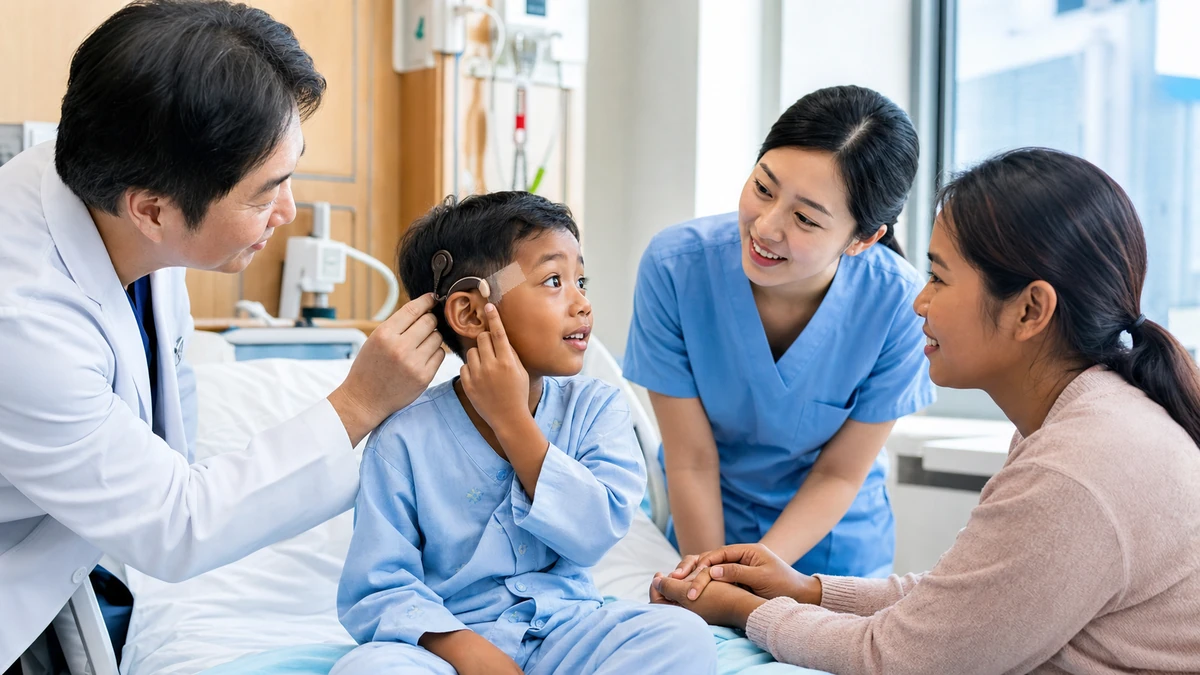
A 6-year-old boy from Cambodia traveled to South Korea this month for a cochlear implant operation, a medical procedure that could open a path to sound after a lifetime of congenital hearing loss. Severance Hospital in Seoul said it invited the child, identified as Heying Mongkol, and performed the surgery as part of an effort to extend specialized care beyond national borders to children who might otherwise have limited access to treatment.
On one level, the story is simple and deeply personal: a young child with hearing impairment received a highly specialized operation at one of South Korea’s best-known hospitals. But the case also speaks to a larger global issue that American readers will recognize from debates at home over rural hospital closures, unequal access to specialists and the high cost of pediatric developmental care. Medical breakthroughs matter only if patients can actually reach them. For children born with conditions that affect hearing, timing can shape the rest of their lives.
That is what makes this case notable beyond the feel-good headline. According to the information released by the hospital, the procedure is only the first step. After Mongkol returns to Cambodia, Severance Hospital said it plans to work with KT, one of South Korea’s largest telecommunications companies, to support follow-up care through a program called “KT Kkumpoom Classroom.” The support is expected to include mapping — the fine-tuning process used after cochlear implantation — as well as speech and language therapy meant to help the child adjust to hearing and communication in daily life.
In practical terms, that means this was not presented as a one-time medical mission or a symbolic operation performed for publicity. At least as described by the hospital, the plan acknowledges a reality well understood by audiologists, speech therapists and parents of deaf or hard-of-hearing children in the United States: Surgery alone does not automatically produce language, social confidence or classroom success. Hearing is not just about the ear. It is about development, relationships and opportunity.
For American readers less familiar with South Korean institutions, Severance Hospital is one of the country’s major academic medical centers, part of Yonsei University’s medical system and often mentioned alongside the elite hospitals that anchor Korean specialty care. In a nation known globally for cutting-edge medicine, advanced cancer care and a tightly concentrated urban health system, cases like this also reflect South Korea’s growing interest in what might be called medical diplomacy — using domestic expertise to provide care for patients from abroad, especially in cases where local treatment options may be limited.
That does not mean the story should be read as a triumphalist tale about one country “saving” a child from another. The more meaningful angle is less nationalistic and more practical: What happens when high-skill medicine, corporate support and long-term rehabilitation planning actually connect? In pediatric hearing loss, that question can make the difference between a successful operation on paper and a meaningful change in a child’s life.
Why congenital hearing loss matters so much in early childhood
Congenital hearing loss, meaning hearing impairment present at birth, is one of the most consequential sensory conditions affecting young children. The background information provided with the case said the condition is found in roughly one to three out of every 1,000 newborns. That may sound uncommon, but for pediatricians and early intervention experts, it is common enough to be a major public health concern.
The reason is straightforward. Early childhood is when the brain is rapidly developing the foundations of language. Babies and young children are not simply collecting words; they are learning patterns of sound, tone, rhythm and social meaning. They are figuring out that a raised voice can signal urgency, that a soft voice can signal comfort, that a name being called matters, that language carries both information and emotion. When those sound cues are reduced or absent, development can unfold differently.
That does not mean deaf or hard-of-hearing children cannot thrive. In the United States, many do, including children who use spoken language, sign language or both. But clinicians have long stressed that early identification and intervention give families more options and children a stronger chance to build communication systems that fit their needs. In the U.S., newborn hearing screening has become a routine part of hospital care precisely because waiting too long can make later intervention more complicated.
For readers familiar with American special education debates, this may sound similar to conversations around early autism services, speech delays or vision impairment. The earlier a developmental challenge is identified, the more time families and professionals have to adapt. When hearing loss is detected late — or when treatment and rehabilitation are not consistently available — children can face added barriers in school, peer interaction and everyday communication.
That broader developmental context is central to why Mongkol’s surgery drew attention. The key issue is not simply whether a child can detect sound after an operation. It is whether that child can use hearing as part of a larger process of language growth, emotional connection and social participation. That is why hearing specialists often describe pediatric hearing treatment as multidisciplinary. Surgeons may implant the device, but audiologists, speech-language pathologists, teachers and family members all play crucial roles afterward.
In many parts of the world, that full continuum of care is hard to assemble. A country may have doctors capable of diagnosis but not enough surgeons trained in cochlear implants. Or it may have surgical capacity but limited follow-up therapy, especially outside major cities. Or families may face transportation barriers, language barriers or financial barriers that make consistent treatment difficult. In that sense, hearing loss exposes a familiar truth about medicine: The gap between what is medically possible and what is realistically accessible is often widest for children.
What a cochlear implant does — and why surgery is only the beginning
Cochlear implants are sometimes described in simplified terms as devices that help people hear, but the reality is more nuanced. Unlike hearing aids, which generally amplify sound, cochlear implants are designed for people with severe hearing loss who may not benefit enough from amplification alone. The device bypasses damaged parts of the inner ear and directly stimulates the auditory nerve, allowing sound signals to reach the brain in a different way.
For families unfamiliar with the technology, it can be tempting to imagine a before-and-after movie scene: silence, then sudden, effortless hearing. Real life is usually much more complicated. Children who receive cochlear implants, especially if they have had limited auditory input early in life, often need extensive post-surgical adjustment. The brain must learn how to interpret new signals. Sounds may initially be unfamiliar, confusing or overwhelming. Parents, therapists and clinicians have to help the child make sense of what is being heard.
That is where the term “mapping” becomes important. In cochlear implant care, mapping refers to the process of adjusting the device settings so they match the child’s auditory responses and needs. It is not a one-and-done technical step. It typically requires repeated visits and careful monitoring. Think of it less like turning on a switch and more like calibrating a complex instrument over time so the child can better distinguish speech sounds and environmental cues.
Speech and language therapy is equally important. A child may begin to detect sound after implantation, but recognizing sound is not the same as understanding language. Learning to connect a sound to meaning, to imitate words, to distinguish similar consonants, to follow conversation and to use language socially can take months or years of guided work. Families often become active participants in therapy, reinforcing exercises and communication strategies at home.
That is why the post-surgery support described by Severance Hospital may be the most significant part of this story. It signals an awareness that successful hearing intervention does not end when the child leaves the operating room — or even when he leaves the country. For American readers, a useful comparison might be pediatric cancer care or physical rehabilitation after a major injury. The surgery or acute treatment can be lifesaving, but long-term outcome often depends on what happens next: repeated appointments, therapy, educational support and caregiver involvement.
The hospital’s statement also emphasized social development, not just auditory function. That may sound like a small detail, but it is a meaningful one. Children with untreated or insufficiently treated hearing loss can struggle not only with vocabulary and pronunciation, but also with forming friendships, reading social cues and participating comfortably in group settings like classrooms or playgrounds. Support aimed at “sociality,” as it is often phrased in Korean health and education contexts, generally refers to social adjustment, relationship-building and confidence in interpersonal situations.
For an American audience, that is worth spelling out because the phrase can sound abstract in translation. In everyday terms, it means helping a child not just hear sounds, but live more fully among other people.
South Korea’s medical reach is growing, and cases like this show how
South Korea is often better known internationally for K-pop, Oscar-winning films, beauty exports and consumer technology than for hospital systems. But in Asia, and increasingly beyond it, the country has built a reputation for advanced medical care in fields ranging from organ transplantation to oncology to complex surgery. Large Seoul hospitals, especially university-affiliated institutions, serve as referral centers for difficult cases and sometimes treat patients from overseas.
That larger context matters here. The decision to bring a Cambodian child to Seoul for cochlear implant surgery is also an example of how South Korean institutions are positioning themselves in global health. Unlike the broad humanitarian frameworks often associated with Western aid organizations or U.N. agencies, this kind of effort can be highly targeted: a major hospital identifies a patient with a specific need, performs advanced treatment, then works with a corporate or nonprofit partner on follow-up support.
There are obvious benefits to that model. It can move quickly, mobilize expertise and focus resources on conditions where specialized intervention can make a major difference. It also reflects the reality that tertiary hospitals — the places with the most advanced equipment and subspecialists — often have capabilities not easily replicated in lower-resource settings.
But the model also raises questions familiar to global health experts in the United States. How scalable is it? How are patients selected? What happens if long-term device maintenance becomes difficult? Can local systems in the patient’s home country sustain the follow-up care that complex technologies require? The answers are not fully available in the materials released about Mongkol’s case, and it would be premature to assume long-term outcomes. Still, those questions are part of any serious conversation about cross-border care.
In fairness, Severance Hospital’s announcement appears to recognize at least one of those concerns by emphasizing ongoing rehabilitation after the child returns to Cambodia. That detail keeps the story from becoming a simple narrative of rescue through high-tech surgery. It points instead toward continuity — the hardest part of global health work, and often the part that determines whether early success lasts.
KT’s involvement is also notable. In South Korea, large conglomerates and national-scale corporations often play visible roles in social programs, philanthropy and public-private initiatives. To American readers, that may resemble a blend of corporate foundation work and community health partnership, though South Korea’s business culture has its own distinct history. The program named in the announcement, “KT Kkumpoom Classroom,” appears aimed at supporting children with hearing disabilities through rehabilitation and developmental assistance. In this case, the company’s role suggests that digital connectivity and institutional coordination may be part of sustaining care across borders.
At a moment when telehealth, remote monitoring and cross-border specialty consultation are increasingly common, that approach has clear relevance outside Korea as well.
For American readers, the deeper issue is access — not just innovation
Stories about advanced medicine often tempt readers to focus on the technology itself. The implant is impressive. The surgery is specialized. The hospital is prestigious. But the more durable lesson may be about access. A treatment is only transformative if a child can be diagnosed early, evaluated properly, brought to surgery, supported through rehabilitation and followed over time. Break any link in that chain and outcomes can suffer.
That problem is hardly unique to Cambodia or South Korea. In the United States, where pediatric specialty care is among the most sophisticated in the world, families still confront serious access barriers. A child in a major city may have relatively easy access to pediatric audiology and speech therapy, while a child in a rural county may face hours of travel. Even when insurance covers part of the treatment, parents can struggle with copays, missed work, school coordination and inconsistent local services.
There is also a broader conversation in the U.S. about what counts as successful care for deaf and hard-of-hearing children. Some families pursue cochlear implants and spoken-language rehabilitation. Others emphasize Deaf culture, sign language and identity, or combine multiple approaches. Those discussions can be deeply personal and sometimes contentious, involving medical, educational and cultural perspectives. The facts released in Mongkol’s case do not suggest that larger debate was part of the decision-making here, but American readers should know that hearing intervention exists within a wider human context, not just a surgical one.
Even so, one principle cuts across many approaches: Children benefit when they receive consistent support early and when families are not left to navigate complex systems alone. That is why the structure of this case matters. The surgery was paired with a plan, however preliminary, for continued mapping and language therapy after the child’s return home. That is a practical acknowledgment that medical care is not merely a clinical event. It is an ongoing relationship.
For journalists covering health, there is also a cautionary note here. It is easy to frame such stories as miracles. But “miracle” language can flatten the reality families actually live with. Hearing rehabilitation is work. It involves appointments, trial and error, emotional adjustment and long stretches of uncertainty. A child may make strong progress, gradual progress or uneven progress. The materials provided about this case do not offer long-term outcome data, and no responsible report should imply that a single surgery guarantees a full or simple recovery.
What can be said, based on the available information, is that the operation created an opportunity — perhaps a profound one — and that the institutions involved appear to understand that opportunity will need reinforcement over time.
A small story with a bigger message about children, disability and global care
In one sense, this is a narrow medical story from Seoul: a South Korean hospital invited a Cambodian child with congenital hearing loss, performed cochlear implant surgery, and said follow-up support would continue after he returned home. But the reason the story resonates more broadly is that it speaks to a universal question: Who gets a fair chance at development?
When a child cannot hear well from birth, the consequences can ripple outward into language, schooling, confidence and social belonging. When intervention comes early and is matched with long-term support, those same pathways can widen again. Not perfectly, not instantly and not identically for every child — but meaningfully. That is true whether the child lives in Phnom Penh, Seoul, Los Angeles or rural Mississippi.
The statement attributed to Severance Hospital’s ear, nose and throat specialists captures that logic. Helping a child hear is not only about restoring a sense. It can also expand the possibilities for communication, education and relationships. That is a point American families with children in speech therapy, occupational therapy or special education will likely recognize immediately. Development is interconnected. Gains in one area can influence many others.
It is also why continuity deserves more attention than spectacle. The operation itself may generate the headline, but the quieter work afterward is often what shapes a child’s future. Can the device be adjusted properly? Will therapy continue consistently? Will caregivers receive enough support? Will the child be able to integrate new auditory experiences into home life, school life and friendships? Those are the questions that turn medical intervention into lived change.
There is, finally, something telling about the fact that this story emerged from South Korea, a country whose global image has changed dramatically in the past two decades. Once seen primarily through the lens of geopolitics and manufacturing, South Korea is now a cultural and technological reference point for millions of people around the world. Increasingly, it is also becoming a reference point in health care. Cases like this suggest that Korean institutions want to be seen not only as providers of advanced treatment for domestic patients, but as participants in a wider network of regional and global care.
Whether that aspiration leads to durable models of support will depend on what happens after the headlines fade. For now, the most honest way to understand Mongkol’s journey is neither as a completed success story nor as a symbolic gesture alone. It is a beginning. A young boy who had lived with congenital hearing loss has been given a new chance to engage with sound. The significance of that chance will rest not only on the skill of the surgeons in Seoul, but on the persistence of everyone who helps him make sense of what he hears next.
In that respect, this story is not ultimately about one country’s medical prowess. It is about what children need everywhere: timely care, sustained support and adults willing to stay connected long after the dramatic part is over.
Comments
Post a Comment