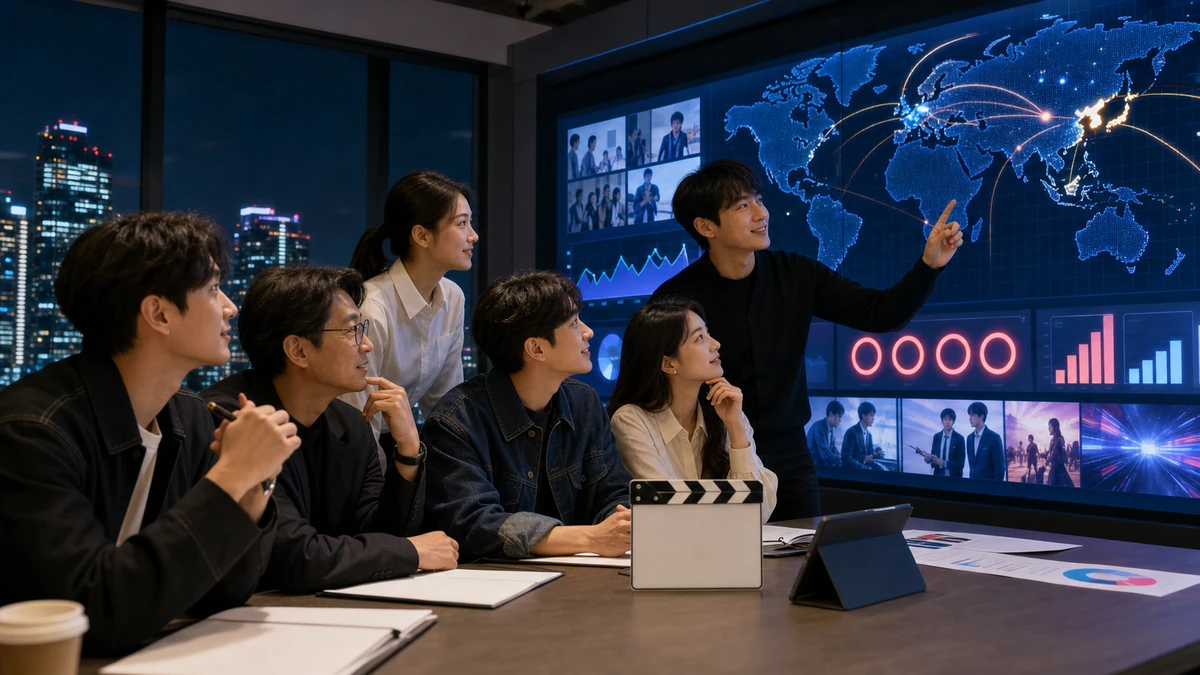
A Korean hit with global staying power
A South Korean series called “True Education” has now spent four consecutive weeks at No. 1 on Netflix’s global chart for non-English-language television, a milestone that says as much about the maturity of Korean entertainment exports as it does about the show itself. According to Netflix’s Tudum rankings, the series logged 7.3 million views worldwide for the week of July 22 to 28, enough to remain atop the platform’s non-English TV list in a streaming market where even buzzy releases often rise and fall in a matter of days.
For American viewers who may not closely follow the Korean entertainment industry, that kind of durability matters. A show can debut high on Netflix because of curiosity, pre-release marketing or an existing fan base. Staying there for four weeks is different. It suggests that viewers kept recommending it, that new audiences kept finding it and that the show’s premise translated across cultures well enough to outlast the usual churn of the algorithm.
“True Education” first reached No. 1 just three days after its release on July 5. Since then, it has maintained the top spot even as fresh titles have continued to flood the platform. It also reached No. 1 in six countries, including Japan, Singapore and Indonesia, and landed in the Top 10 in 75 countries overall. Those numbers point to something bigger than a niche “K-drama fan” phenomenon. They suggest broader mainstream traction, especially across Asia, where Korean television has long been influential, but also in the wider global streaming audience that now treats Korean content as part of the regular entertainment menu rather than a specialized import.
In that sense, the success of “True Education” belongs to a larger post-“Squid Game” era, one in which Korean series no longer need to explain why they deserve international attention. They are already in the conversation. The question now is what kind of Korean stories can travel. For years, many Americans associated Korean television mostly with romance dramas, historical epics or high-concept thrillers. “True Education” offers a different answer: a socially charged action fantasy rooted in the frustrations of public education.
What “True Education” is actually about
The title may sound like a classroom documentary or a sober social drama. It is neither. “True Education,” based on a Korean webtoon of the same name, imagines a fictional government-like body called the Teacher Rights Protection Bureau. That bureau does not exist in real life. In the show, it functions as an extra-legal intervention unit that steps into schools where authority has collapsed and conflicts among students, teachers and parents have spiraled out of control.
That premise is important to explain for non-Korean audiences, because the show is not simply reporting on school policy. It is turning real anxieties about the education system into a revenge-action fantasy. In other words, it is less “Abbott Elementary” than a morally charged vigilante thriller set against the emotional terrain of public schooling. Its central dramatic engine is not lesson plans or campus bureaucracy, but the cathartic fantasy that someone powerful might finally intervene when institutions fail.
The series stars Kim Mu-yeol, a South Korean actor known for intense performances and a screen presence that suits material built on confrontation and moral ambiguity. In a genre like this, the lead matters. A show that asks viewers to accept harsh methods in the name of restoring order needs a performer who can project both authority and unease. The appeal comes not just from action scenes, but from the tension between what feels emotionally satisfying and what feels ethically dangerous.
That tension is also part of why the premise travels. Americans do not need to know the details of South Korea’s school administration to understand the emotional logic of a story about adults, children and institutions locked in conflict. Many U.S. viewers are already familiar with heated debates over classroom authority, parental intervention, school discipline, student mental health and what happens when public institutions are asked to solve social problems far beyond their walls. The specifics differ from country to country, but the pressure points are recognizable.
What “True Education” does is package those anxieties in a form that is dramatically legible across borders: a broken system, an outraged public and a forceful fixer operating outside normal limits. That is one reason the series appears to be resonating even with viewers who have never read the source material and may know little about Korean schools.
Why the school setting hits a nerve in South Korea
To understand the show’s deeper resonance, it helps to understand how central education is in South Korean life. South Korea’s school culture is often defined by intense academic competition, high parental involvement and enormous pressure surrounding exams, especially the country’s college entrance system. For decades, education has been treated not just as a path to opportunity, but as one of the core engines of family mobility, social prestige and economic survival.
That pressure has produced one of the most discussed education cultures in the world. American readers may be familiar with stories about South Korean students attending late-night private academies, known as hagwons, after finishing regular school. These private cram schools have become shorthand for the intensity of Korean academic life, much the way SAT prep, elite college admissions counseling and hypercompetitive suburban school districts symbolize educational pressure in the United States. The difference is one of scale and social centrality. In South Korea, the education question often sits at the heart of national conversations about inequality, parenting, youth stress and the future of the middle class.
Within that environment, tensions among teachers, students and parents can become politically and emotionally charged. In recent years, public debate in South Korea has included concern about teacher authority, classroom disorder, parental complaints and the difficulty of resolving school conflicts through ordinary administrative channels. “Teacher rights” is a loaded phrase in the Korean context, referring in part to the ability of teachers to maintain authority and perform their jobs without harassment or humiliation.
That does not mean the series should be read as a policy blueprint. It should not. The show’s fictional bureau is a dramatic invention, and its methods belong squarely to fantasy. But it draws energy from real frustrations. Instead of presenting those frustrations through documentary realism, “True Education” channels them through genre storytelling, where anger can be condensed, stylized and violently resolved.
That kind of storytelling has obvious appeal. It allows audiences to feel the release of seeing intolerable behavior punished, while also keeping one foot in social commentary. The Korean phrase in the title carries connotations beyond the literal meaning of “true education.” In public discourse, it can evoke the idea of setting things straight, of delivering a hard corrective lesson, even of restoring proper order where norms have broken down. That layered meaning helps explain why the title lands so strongly in Korean. The drama is not about better curriculum design. It is about discipline, justice and the fantasy of decisive correction.
How webtoons became a pipeline to global TV
Another reason “True Education” has found such a wide audience is that it comes from one of South Korea’s most successful storytelling pipelines: the webtoon industry. Webtoons are digital comics, designed primarily for smartphones and serialized for online reading. In South Korea, they have become a major source of intellectual property for television and film, in much the same way comic books, young adult novels and prestige podcasts have fed Hollywood adaptation culture.
For global platforms like Netflix, webtoons offer several advantages. They tend to come with proven audiences, strong character hooks, clearly defined worlds and fast-moving plots that adapt well to serialized streaming. They also often rely on bold premises that can be explained in a sentence or two, which is crucial in a crowded platform environment where viewers are constantly deciding what to click next.
“True Education” fits that model neatly. Its setup is clear, provocative and easy to market: schools are in crisis, normal institutions are failing and an aggressive, fictional bureau intervenes to restore order. Even viewers unfamiliar with the source material can immediately grasp the stakes. That helps explain why the series could break out quickly after release and continue attracting late-arriving viewers after its initial surge.
The webtoon-to-screen pipeline has become one of the defining features of contemporary Korean entertainment. It has allowed producers to take stories already tested in the domestic market and repackage them for global audiences through high-production-value adaptations. Sometimes the results are romantic fantasies, supernatural thrillers or zombie sagas. In this case, the result is a school drama with the pulse of a revenge-action series and the scaffolding of a social issue debate.
For American readers, the closest comparison might be the way Hollywood mines graphic novels or serialized comic franchises, except that Korean webtoons encompass a wider range of genres and everyday subjects. They are not limited to superheroes. They can just as easily center office politics, family drama, horror, campus life or social critique. That versatility has made them an especially rich source for streaming-era adaptation, when platforms need stories that feel both specific and instantly accessible.
Why the show works beyond Korea
Not every successful Korean drama travels because of universal themes. Some travel because they offer novelty, visual style or the pleasure of entering an unfamiliar social world. “True Education” appears to be doing something slightly different. It starts from a very Korean issue, the pressure and disorder surrounding public education, but translates it into a format recognizable almost anywhere: the system does not work, people are angry and someone steps in to do what official channels cannot.
That emotional structure is exportable. Viewers in the United States, Britain, Southeast Asia or Latin America may not share the same school rules or cultural expectations, but many understand the basic frustration of institutional paralysis. They know the feeling of watching adults pass responsibility back and forth while ordinary people absorb the consequences. They understand why a story that promises direct action can feel satisfying, even if it raises uncomfortable questions.
The show’s performance in 75 countries suggests that audiences are not responding solely to Korean specificity, but to a broader emotional package: injustice, humiliation, outrage and release. In streaming terms, those are highly legible feelings. They cross language barriers more easily than subtle satire or culturally dense procedural drama. Action helps, too. So does a premise built around clear conflict rather than slow exposition.
There is also a larger trend at work. Korean television has become particularly adept at taking local social realities and converting them into globally understandable emotional stories. That was true of “Parasite,” which used a very Korean housing and class environment to tell a story about inequality recognizable to viewers everywhere. It was true of “Squid Game,” which transformed debt and desperation into dystopian spectacle. And it is true, on a smaller but still notable scale, of “True Education,” which turns school conflict into a fantasy of moral reckoning.
For Netflix, that kind of storytelling is ideal. It offers cultural specificity without requiring total insider knowledge. A viewer may not know every social reference, but can still follow the stakes and feel the intended emotions. The best international streaming hits tend to operate that way. They do not flatten local culture into generic sameness. Instead, they preserve enough of the original context to feel distinct while presenting conflicts sharp enough to travel.
What the Netflix numbers do and do not mean
The series’ latest weekly total, 7.3 million views, is based on Netflix’s current reporting method, which calculates views by dividing total watch time by runtime. That means the number reflects actual watching activity, not just clicks, trailers or accidental starts. It is still a platform-defined metric, not an independently audited measure of popularity, but it is more meaningful than simple impressions.
For entertainment reporters and industry analysts, the bigger story may be less the exact weekly number than the consistency. Streaming hits frequently open strong and then vanish from the charts as viewers move on. A four-week run at No. 1 in the non-English category suggests that “True Education” has achieved a second phase of success: not just launch-week curiosity, but ongoing audience momentum.
That distinction matters in the modern streaming economy. In the old network television model, a hit was often defined by steady weekly appointment viewing. In the streaming model, a hit can be driven by bursts of social media discourse, recommendation loops and platform visibility. A show that keeps holding its rank likely benefits from all three. Existing fans watch immediately, new viewers arrive through word of mouth and Netflix’s own interface continues surfacing the title because it is already performing well.
At the same time, chart success has limits as an analytical tool. It tells us a series is being watched, but not exactly why each audience segment is responding. It does not tell us whether viewers are drawn primarily by the action, the school setting, the lead actor, the webtoon fandom or the broader appeal of Korean drama. It also does not reveal how individual countries differ in viewing behavior or how much of the audience finishes the series. Those details remain largely inside the platform.
Still, public rankings are useful as a cultural signal. They show what has broken through the noise. And in this case, the signal is clear: a Korean series centered not on romance, palace intrigue or apocalyptic games, but on the emotional wreckage of education, has become one of the most-watched non-English shows in the world.
A sign that Korean drama keeps broadening its range
Perhaps the most interesting thing about the rise of “True Education” is what it says about the current state of Korean drama as a global category. For years, international distributors and fans often sorted Korean shows into a few familiar lanes: swooning romance, serial-killer thriller, historical spectacle and, more recently, high-concept survival drama. Those lanes still matter, but they no longer define the whole field.
“True Education” points to a broader range of exportable subject matter. It suggests that Korean content can find worldwide traction even when it tackles a socially sensitive domestic issue and wraps it in a darker, more confrontational genre form. That is a marker of confidence, both from Korean creators and from global audiences who have become more willing to engage with stories grounded in Korean institutions and debates.
It also reflects a deeper shift in how U.S. and English-speaking audiences consume foreign-language television. There was a time when subtitled entertainment was treated as homework by much of the American mainstream, something prestigious but peripheral. Streaming has changed that habit. Viewers now move between languages more casually, especially when a show offers urgency, clear stakes and strong visual storytelling. Korean content, in particular, has benefited from that change because its television industry has become exceptionally skilled at marrying melodrama, social critique and genre mechanics.
That does not mean every Korean hit will cross over, or that chart success automatically translates to long-term cultural imprint. But “True Education” shows that the appetite remains strong and may even be expanding into less expected corners of Korean storytelling. A drama about school authority and institutional breakdown would once have sounded too locally specific to become a global streaming phenomenon. Now it is holding the top spot for a month.
For American audiences, that is the larger takeaway. The Korean Wave is no longer just about discovering something exotic or trend-driven. It is increasingly about recognizing a mature entertainment system capable of turning highly local tensions into stories that make sense nearly everywhere. “True Education” may begin in the Korean classroom, but its success suggests that viewers around the world recognize the feeling at its center: the anger that builds when institutions fail, and the dangerous pleasure of imagining someone powerful enough to set them right.
Comments
Post a Comment