SEVENTEEN’s New Unit V8 Turns an Album Into a Place, Underscoring How K-pop Sells an Experience as Much as a Soundtrack
A new SEVENTEEN offshoot gets a very K-pop kind of debut
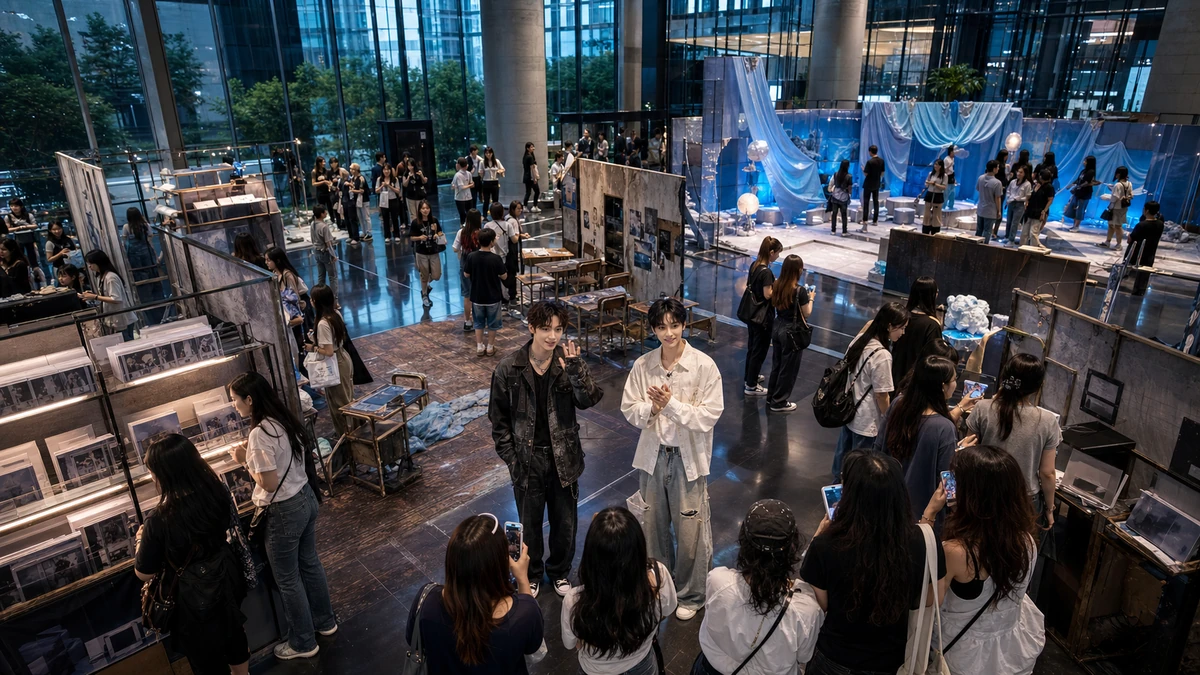
SEVENTEEN, one of the biggest names in contemporary K-pop, is giving fans another way to step inside its ever-expanding universe. The group’s new subunit, V8 — made up of members THE 8 and Vernon — will hold a six-day pop-up store from July 4 through July 9 at HYBE’s headquarters in Seoul, according to South Korean entertainment company PLEDIS Entertainment.
For American readers who may hear the phrase “pop-up store” and think of a temporary retail kiosk or a limited-edition sneaker launch, the K-pop version is usually far more elaborate. In South Korea’s music business, a pop-up is rarely just a place to buy T-shirts, albums or collectible photo cards. It is often a carefully designed physical extension of an album’s mood, visual identity and story line — something closer to a miniature immersive exhibit than a standard merch shop.
That is especially true in this case. PLEDIS said the V8 space is designed around the theme of the duo’s first mini-album, also titled “V8,” which was released June 29. The emotional concept at the center of the project is what the company describes as “worn-out youth” or “consumed youth” — a phrase that may sound stark in English, but fits into a familiar strand of Korean pop storytelling in which youth is portrayed not simply as carefree and glamorous, but as intense, fleeting, overextended and emotionally expensive.
The pop-up will feature props from the music video for the title track “singasong,” including a sofa and an RC car, along with a listening zone where visitors can hear the new album and a photo zone built with original graphics tied to the project. The result is an event meant to let fans do more than listen. It invites them to walk through the atmosphere of the record, recognize visual clues from the video and create their own shareable record of the visit.
That approach says a great deal about where K-pop is right now. In an era when any song can be streamed instantly from anywhere, the industry has doubled down on building experiences that feel tactile, communal and highly photographable. V8’s first pop-up is not just a promotional stop. It is a case study in how K-pop turns a release into a world.
Why a subunit matters in a group as large as SEVENTEEN
To understand why this pop-up is drawing interest, it helps to understand how K-pop groups often operate. SEVENTEEN is not a small act trying to break through. It is one of the most established boy bands in South Korea, known internationally for synchronized performances, devoted fans and a large-member structure that allows for multiple creative combinations. Like some American franchises that can spin off side projects without losing the identity of the parent brand, major K-pop groups often create subunits to spotlight different musical styles, personalities or themes.
That is what V8 represents. Rather than promoting as the full SEVENTEEN lineup, THE 8 and Vernon are stepping forward as a two-member act with its own emotional register and visual language. For fans, that matters because subunits can reveal sides of artists that may be less visible in full-group releases, where every member has to fit into a broader concept. A duo can feel more intimate, more distilled and often more experimental.
THE 8, born Xu Minghao in China, and Vernon, a Korean American rapper and singer who grew up partly in the United States, bring distinct identities into the collaboration. Even without overstating the biographical angle, their pairing reflects one of K-pop’s defining strengths: its ability to combine individual sensibilities inside a highly organized group system. In other words, the same machinery that produces the polished spectacle of a major boy band can also carve out room for smaller, moodier, more focused side narratives.
American audiences can think of it as somewhere between a supergroup side project and a prestige TV spinoff. The parent property still matters. The fan base still comes with it. But the side project has to establish its own tone quickly. In that sense, V8’s first week matters well beyond merchandise sales. It helps answer a basic question: What emotional and visual territory belongs to this duo, and not just to SEVENTEEN as a whole?
The pop-up appears designed to answer that question in physical form. Instead of introducing V8 through interviews alone, the label is using space, objects, sound and fan participation to define the unit’s identity. That is not incidental. In K-pop, identity is often built as much through design and ritual as through music.
What “consumed youth” means in a Korean pop context
The phrase at the center of the V8 project — “consumed youth” — may not have an exact one-to-one equivalent in everyday American entertainment coverage, so it is worth pausing on what it likely signals. In Korean popular culture, youth is frequently depicted as a period of pressure as much as possibility. It can carry the weight of academic competition, career anxiety, social expectation and emotional burnout, even when wrapped in polished visuals and pop hooks.
That does not mean the V8 project is necessarily grim. K-pop often works through contrast: glossy surfaces paired with melancholy, playful visuals offset by loneliness, high energy performances tethered to inward-looking themes. The idea of youth being “consumed” suggests exhaustion, overuse or depletion — the sense that young people can be asked to give too much of themselves, too fast, in a culture of constant performance.
For American readers, the nearest cultural parallels might be found in indie coming-of-age films, Gen Z discussions of burnout, or the kind of pop albums that package vulnerability inside vivid art direction. The difference is that K-pop tends to externalize those feelings in an unusually integrated way. A concept does not live only in lyrics. It shows up in wardrobe, teaser photos, stage design, videos, product packaging and, increasingly, temporary physical spaces like pop-ups.
That helps explain why props from the “singasong” music video matter. A sofa is not just a sofa if fans have seen it in a video and assigned meaning to it. An RC car is not simply a decorative object if it recalls a scene, a mood or a recurring symbol. K-pop fandom is deeply attentive to visual detail. Fans freeze-frame teasers, connect motifs across releases and debate how certain objects fit into an artist’s narrative universe. When labels place those objects in a real-world setting, they are effectively rewarding that attention and inviting deeper participation.
There is also a larger commercial logic at work. In a crowded global market, successful K-pop acts do not just release songs; they build recognizable emotional ecosystems. A theme like “consumed youth” becomes more legible and more memorable when fans can stand inside a room that reflects it. That sort of embodied storytelling is one reason K-pop promotion often travels farther online than its physical footprint would suggest. Only a fraction of fans can visit in person, but the images and reactions spread internationally within minutes.
Why HYBE headquarters is more than a convenient address
The location of the V8 pop-up matters too. It will be held at HYBE’s headquarters in Yongsan, a major district in central Seoul. For global fans, HYBE is not just another office building. It is one of the most recognizable corporate hubs in K-pop, the company closely associated with some of the industry’s most internationally successful acts and with the globalization of Korean pop music over the past decade.
That gives the event a degree of symbolism. Holding the pop-up at HYBE’s building places V8’s debut inside one of the industry’s most visible institutional spaces. PLEDIS, SEVENTEEN’s agency, operates within the HYBE labels system, so the site also reflects how contemporary K-pop functions: artist, label, architecture, branding and fandom often intersect in a single ecosystem.
For American readers, the closest comparison might be if a major music label or entertainment conglomerate regularly transformed its headquarters into a fan-accessible exhibition site tied directly to an artist’s new release. That kind of overlap between corporate space and fan pilgrimage is less common in the United States, where album promotion is more often scattered across media appearances, arena tours, digital marketing and occasional experiential brand tie-ins. In Seoul, those elements can be concentrated much more visibly.
Yongsan itself also carries significance as a central urban district that blends commercial, residential and cultural traffic. Fans visiting the HYBE building are not just attending a store opening; they are participating in a form of destination fandom. The visit becomes part of a Seoul itinerary, often documented online with the same enthusiasm that travelers might bring to a stop at Abbey Road in London or a studio tour in Los Angeles.
That matters because K-pop’s physical spaces are increasingly part of its soft power. They help turn Seoul into both a production center and a tourism draw for international fans. Even those who never make the trip are aware of these places through social media, fan videos and entertainment coverage. The building itself becomes a kind of icon, and every event held there adds another layer to its meaning.
Listening zones, photo zones and the architecture of fandom
One of the most telling details about the V8 event is not the merchandise but the way the space is divided into types of experience: things to see, things to hear and things to photograph. That reflects a sophisticated understanding of fandom behavior in the social media era.
The listening zone, for instance, might seem unnecessary at first glance. Why create a dedicated place to hear songs that are already available on streaming platforms? But the point is not access. It is context. A listening zone frames the music as an event rather than background noise. Fans hear the album in a shared environment designed around its concept, surrounded by others who are there for the same reason. That changes the experience, much the way a movie seen in a packed opening-night theater feels different from one watched alone on a laptop.
The photo zone serves a different but equally important function. In K-pop culture, taking photos at an event is not just about personal memory. It is part of how the fandom communicates with itself. Images are uploaded to Instagram, X, TikTok and fan forums, where they become proof of attendance, social currency and informal promotion all at once. A well-designed photo zone is essentially built to travel beyond the room.
That is one reason pop-ups have become so central to K-pop marketing. They create content that fans are eager to circulate voluntarily. A visitor does not leave with only a purchased item. They leave with images, impressions and often a sense of having briefly crossed into the artist’s fictional or emotional world. That material then ripples outward to fans who were never there.
Seen that way, the sofa, RC car, listening zone and graphic installations are not random attractions. They are a tightly coordinated set of cues guiding fans through different forms of engagement. See the object. Recognize the reference. Hear the album. Take the picture. Share the picture. In practical terms, the fan becomes both participant and distributor.
That kind of participation is one of the clearest differences between K-pop fandom and more passive consumer models of pop music. Fans are not treated simply as buyers. They are treated as interpreters, amplifiers and co-authors of a release’s afterlife online. V8’s debut pop-up appears designed with that reality in mind.
The RIIZE example shows the business case for offline experiences
V8’s event also arrives amid growing evidence that these offline activations can be commercially powerful. Another recent example comes from RIIZE, the boy group under SM Entertainment, which held a pop-up in Seoul tied to its second mini-album, “II.” According to the company, the event sold out across all sessions during its run from June 16 to June 28 in Seoul’s Mapo district.
RIIZE’s pop-up was built around the album’s visual concept of members setting out on a journey in search of inspiration. Like V8’s upcoming event, it translated a musical and visual idea into a navigable physical route, allowing fans to move through the project as though entering a narrative rather than merely observing a display.
The significance here is broader than one successful event. RIIZE also reportedly notched its fourth million-seller with the new mini-album, underscoring the way album sales and offline engagement often reinforce one another in K-pop. When a release hits, fans do not necessarily stop at streaming and buying. They want proximity to the concept, and pop-ups provide a manageable way to offer that without mounting a full concert production.
For U.S. readers, this may sound like the music industry borrowing tactics from theme parks, fashion launches and fandom conventions all at once. In truth, that is not far off. K-pop has become highly skilled at blending those worlds. A pop-up can function as retail, exhibition, media event and fan gathering simultaneously. It occupies the middle ground between a museum installation and a branded fan meetup.
That helps explain why even temporary events can attract intense demand. They create urgency through scarcity, emotional value through concept and visibility through fan sharing. In a digital marketplace saturated with endless content, temporary physical events feel meaningful precisely because they are limited. If you miss them, you really miss them — except, of course, for the fragments preserved and circulated online.
What V8’s rollout says about the future of K-pop promotion
At one level, the V8 pop-up is a straightforward entertainment story: a new SEVENTEEN subunit is opening a themed fan space in Seoul shortly after releasing its debut mini-album. But at a deeper level, it illustrates how K-pop has continued to refine one of its most important advantages in the global music business: the ability to make promotion feel like participation.
In the streaming age, music companies everywhere are searching for ways to turn attention into loyalty. K-pop’s answer has been to build release cycles that are multisensory and community-driven. Teasers arrive in stages. Visual motifs are seeded across formats. Music videos are loaded with detail. Live appearances, fan sign events and pop-ups create in-person touchpoints. Then fans circulate and reinterpret everything online, often in real time and across multiple languages.
That is why a local event at a Seoul office building can matter to fans in Los Angeles, London or Manila. The event is local in geography but global in distribution. Photos will travel. Fan accounts will translate signage and impressions. Video clips will appear across platforms almost instantly. For international fans who cannot attend, the pop-up still becomes part of the comeback narrative.
In that sense, V8’s first pop-up is not only about foot traffic in Seoul. It is about setting an identity for the duo at the exact moment the project enters public view. The first week after a release can be decisive, especially for a new unit emerging from a well-known group. The goal is not merely to announce that THE 8 and Vernon have teamed up. It is to make sure audiences understand what that pairing feels like.
The chosen theme, the objects from “singasong,” the listening space and the photo installations all point to the same strategy: anchor the duo in a specific emotional and visual vocabulary from the outset. If SEVENTEEN represents a broad and powerful collective identity, V8 appears positioned as something more compact, moody and curated.
For American audiences accustomed to thinking of album promotion primarily in terms of singles, interviews and tours, that can be a useful reminder that K-pop often works on a wider canvas. The song is still the center. But the song is rarely left to stand alone. It is surrounded by imagery, storytelling, architecture and ritual designed to make fandom feel lived-in.
That broader method is one reason K-pop continues to command attention far beyond Korea. It understands that in an era of abundance, people do not just want media to consume. They want worlds to enter, symbols to decode and experiences to share. V8’s Seoul pop-up may last less than a week, but the real event is larger: it is the ongoing transformation of pop music into an immersive cultural system, one temporary room at a time.
Comments
Post a Comment