A K-pop breakthrough arrives on one of sports’ biggest stages
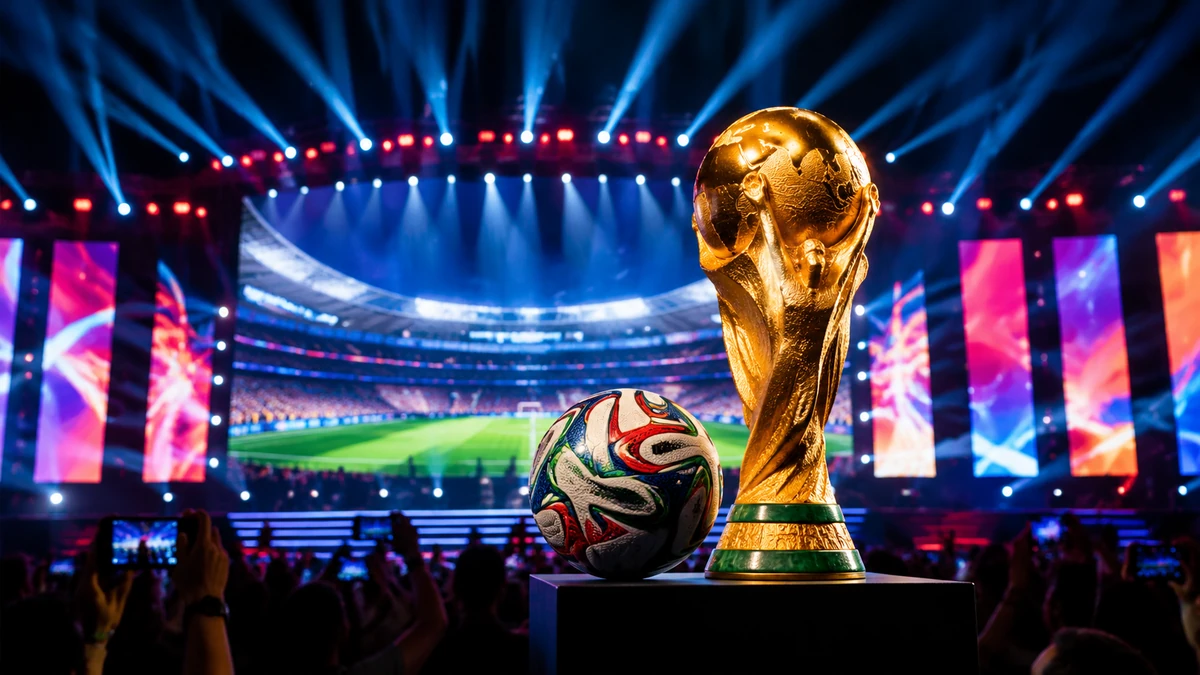
The 2026 FIFA World Cup is still months away from its opening kickoff, but one of the tournament’s earliest cultural flashpoints has already arrived: the official song. FIFA on June 11 unveiled “DNA,” a global collaboration tied to the World Cup in North America, and one of the most notable names attached to it is Lee Jae, the South Korean singer-songwriter who recently rose to international attention through Netflix’s animated feature “K-pop Demon Hunters.”
On paper, the song’s lineup is designed for scale. Italian tenor Andrea Bocelli, French hitmaker David Guetta, American rapper Megan Thee Stallion and Lee Jae represent very different corners of the music industry, from crossover classical to EDM, hip-hop and Korean pop. But what makes Lee’s involvement especially significant is not simply that a Korean artist made the guest list. It is that he performs a Korean-language line in the official music surrounding the world’s largest sporting event, a platform that reaches far beyond the existing K-pop fan base.
For American audiences, it may help to think of this less as a routine soundtrack credit and more as a symbolic marker of where global pop culture is now headed. The World Cup opening ceremony occupies a place somewhere between the Super Bowl halftime show, the Olympics opening pageantry and a globally syndicated awards telecast. It is a spectacle meant to tell the world what kind of moment this is. The artists chosen to soundtrack that moment are not just entertainers; they become part of the event’s identity.
That is why Lee’s appearance on “DNA” has drawn attention beyond music circles in South Korea. This is not merely a case of an artist picking up an international feature. It is a sign that Korean-language pop is now being folded directly into the shared cultural vocabulary of one of the planet’s most watched events. For K-pop, which has spent years proving it could sell out stadiums, top Billboard charts and dominate social media, this is another kind of validation: not only commercial success, but ceremonial inclusion.
FIFA also said Bocelli and Lee are expected to perform at the opening ceremony in Mexico City, adding another layer of visibility. If that goes forward as announced, millions of viewers who might never have sought out Korean music on their own could hear a Korean lyric in real time, at the front end of the world’s biggest soccer tournament. That matters in an era when exposure is often less about niche fandom and more about whether an artist can break into a general audience without losing what makes them distinctive.
Why one Korean line matters more than it might seem
The most discussed moment in “DNA” is a brief Korean lyric Lee delivers late in the song: “Even if I fall again, I rise again.” The line is short, but it carries the kind of emotional clarity that sports anthems are built on. Resilience, comeback, pressure, ambition — these are the themes that define World Cup mythology, from underdog runs to penalty shootout heartbreak to national teams trying to rewrite their histories on the biggest stage.
For listeners who do not speak Korean, the words may initially register as texture rather than literal meaning. But that is part of the point. One of K-pop’s most important contributions to global pop over the past decade has been proving that language is not necessarily a barrier to emotional connection. American audiences have already seen versions of this shift. BTS turned Korean-language songs into stadium-scale sing-alongs. “Squid Game” became a mainstream U.S. phenomenon without flattening its Korean identity. Parasite won the Oscar for best picture while asking viewers to meet it on its own terms. The cultural lesson has been consistent: audiences are increasingly willing to cross language boundaries when the storytelling, emotion and production feel immediate.
In that context, the Korean lyric in “DNA” is not a novelty insertion. It is a reflection of how international pop now works. Rather than translating everything into English to reach a Western audience, producers are more willing to preserve the linguistic identity that gives a song its character. The Korean line does not interrupt the song’s global ambitions; it helps define them. It tells listeners that international does not have to mean culturally neutral.
That distinction is important because official World Cup music has a different life cycle than an ordinary album track. It is not consumed once and filed away by fans. It is replayed in highlight packages, pregame shows, montage reels, social clips, promo spots and ceremony broadcasts. It becomes background music for a shared emotional experience. In practical terms, that means a single line sung in Korean may be heard over and over by audiences who are not tuned in for K-pop at all, but for soccer.
For Korean pop culture, that kind of repeated incidental exposure can be just as powerful as a chart hit. It places the language in a setting where it feels organic rather than explanatory. Viewers do not need a cultural primer in the middle of a World Cup broadcast. They simply hear a voice, a phrase and an emotional cue that lands. That subtle kind of normalization is often how cultural influence deepens.
Who Lee Jae is, and why his rise fits this moment
Lee’s participation also reflects a newer pattern in how Korean artists are entering the global mainstream. According to the Korean report, he recently achieved international breakout status through Netflix’s animated project “K-pop Demon Hunters.” That résumé line may sound unusual to readers accustomed to more traditional pop-star trajectories, but it makes sense in today’s entertainment ecosystem, where streaming platforms, animation, soundtrack work and social media can combine to launch an artist faster than the old label-and-radio pipeline ever could.
What is striking here is not only that Lee became visible through a Netflix title, but that the title itself merges forms in a very 2020s way. “K-pop Demon Hunters” suggests a mash-up of music, fantasy, serialized fandom and high-concept visual storytelling — precisely the kind of transnational pop package that travels well online. Korean entertainment companies and creators have become particularly adept at building artists and stories that work across formats. A singer is not just a singer. They may also be part of a narrative universe, a streaming property, a fashion conversation and a meme economy, all at once.
That helps explain why Lee’s World Cup appearance does not read as random. It follows a broader shift in how Korean cultural exports move internationally. Earlier phases of the Korean Wave, or Hallyu — the term used to describe the global spread of South Korean entertainment — were often organized around specific sectors: first TV dramas, then pop idol groups, then films. Now those categories overlap much more fluidly. An artist can emerge through animation, streaming or digital fandom and then pivot into a world-sports soundtrack without seeming out of place.
It also says something about the changing image of K-pop itself. For years, many American observers understood K-pop mainly through idol groups: tightly choreographed teams with fandom-heavy international followings. That model still matters, but it no longer tells the whole story. Korean music’s global footprint now includes soloists, producers, singer-songwriters, soundtrack specialists and multilingual performers who move between industries. Lee’s presence on “DNA” underscores that “K-pop-based” is now less a narrow genre label than a broad cultural ecosystem.
In that sense, his participation has two stories running at once. One is personal — a rising artist reaching a career-defining platform. The other is structural — a sign that Korean pop has matured into something flexible enough to plug directly into global mega-events, not just its own fan-driven circuits.
A lineup built to sound like the world
The artist roster on “DNA” is part of the message. Bocelli brings prestige and a familiar sense of grandeur; Guetta brings big-room festival instincts and a track record for creating songs that thrive in enormous public spaces; Megan Thee Stallion brings U.S. star power, energy and contemporary pop-rap relevance; Lee brings a Korean musical sensibility and a voice tied to one of the strongest fan ecosystems in global entertainment. Put together, the collaboration appears engineered to represent not a single style, but a cross-border event.
That approach is increasingly common in international sports music. The goal is rarely artistic purity in the album-review sense. It is accessibility, instant recognition and emotional scale. A World Cup song has to function in a stadium, on television, on streaming services and in internet snippets that last only a few seconds. It must be broad enough for casual listeners, but distinct enough to feel like more than wallpaper.
Lee’s role is especially revealing because he is not there simply to check a geographic box. By delivering a Korean lyric near the song’s latter section, he adds a tonal turn and a regional marker that the track can build around. His presence suggests that Korean music is no longer being invited only as an accessory to a larger Western frame. It is being positioned as one of the ingredients that helps define what “global” sounds like now.
For American readers, this is worth noting because K-pop has often been discussed in the U.S. as if it were a parallel industry — huge, influential, but somehow adjacent to the Western mainstream. Collaborations like this challenge that framing. When FIFA chooses a Korean artist for an official World Cup song alongside Bocelli and Megan Thee Stallion, it is treating Korean pop as central to the contemporary music conversation, not peripheral to it.
There is also a practical fan-culture dimension here. Sports fans who tune in for the World Cup may end up discovering Lee through the music. Music fans who follow Lee may pay closer attention to the opening ceremony, or even to the tournament itself. That kind of crossover visibility is incredibly valuable. It is the entertainment equivalent of a two-way bridge: each audience becomes a possible entry point for the other.
The opening ceremony may be the real milestone
If the official song is the announcement, the opening ceremony is the real test of impact. FIFA said Bocelli and Lee are scheduled to appear in Mexico City for the ceremony, an event likely to draw massive global viewership and set the emotional tone for the tournament. In sports terms, the opening ceremony is not the game itself, but it is often the first image that becomes part of public memory.
That matters because ceremonies confer symbolism in a way standard performances do not. A concert is an artist’s own space. An opening ceremony is a host platform — a stage that says, intentionally or not, “This is who we want the world to see right now.” If Lee appears there, it will signal more than popularity. It will suggest that Korean pop culture now belongs comfortably within the visual and musical grammar of the world’s most high-profile international events.
For K-pop fans, that moment would likely feel like the culmination of a long arc. The genre has spent years fighting old assumptions in the West that it was either a niche export or a passing trend. Yet the evidence has piled up: stadium tours across the United States, major chart achievements, fashion-industry influence, festival appearances and a highly organized global fan infrastructure. A World Cup opening ceremony slot adds a new dimension because it reaches the truly casual viewer — the person who may know none of the backstory, but sees the performance and absorbs its meaning anyway.
That broad audience is what makes the ceremony especially valuable. Most music consumption is intentional; you choose an artist, a playlist, a genre. World Cup ceremony music is different. People encounter it because they have shown up for something else. When that music sticks, the artist benefits from a type of awareness that is hard to manufacture through fandom alone. It can shift someone from “never heard of them” to “I’ve seen that performer on a huge stage,” which is often how mainstream recognition begins.
And because the 2026 World Cup will be spread across North America, with the United States deeply involved as a host nation, the exposure may be particularly meaningful for English-speaking audiences. Soccer still does not occupy the same all-consuming place in American culture that football does, but the World Cup is one of the few sporting events that consistently breaks through those boundaries. Its opening ceremony is, by design, a mass-cultural event.
Korean pop’s expansion is no longer just about charts
The news around “DNA” lands at a moment when Korean pop is already proving its strength through more familiar metrics. The Korean summary points to other recent examples: strong album sales, Billboard 200 entries and growing visibility in major public events. Those achievements still matter. In the American music industry, charts remain one of the easiest ways to validate global influence because they offer a straightforward language of success.
But what this World Cup story shows is that Korean pop’s expansion now extends well beyond chart positions. It is moving into spaces of public ritual, cross-industry collaboration and symbolic representation. In other words, K-pop is not only winning market share; it is becoming part of the staging language for major global occasions.
That is a meaningful evolution. A chart hit can prove popularity. An official World Cup song can suggest cultural embeddedness. One tells you people are listening. The other tells you institutions have started treating that music as part of the world’s shared soundtrack.
For years, critics and fans alike debated whether K-pop’s global rise was driven mainly by intensely loyal fandoms or by broader public adoption. The answer, increasingly, appears to be both. Fan communities helped build the infrastructure — the streaming campaigns, sold-out tours, social media trends and translation networks that pushed Korean artists into global consciousness. But moments like this one indicate that the broader cultural establishment is catching up. FIFA is not a fan account. It is one of the world’s most powerful sports brands, and its choices carry symbolic weight.
There is also a larger lesson here about how Korean culture now travels. It does not have to arrive as a fully self-contained cultural package, and it does not need to abandon its identity to fit international formats. A Korean lyric can sit inside a World Cup anthem. A Netflix animation can launch a singer into a global event. An artist associated with K-pop can stand beside Bocelli and Megan Thee Stallion without the pairing seeming strange.
That is what mature globalization in entertainment looks like: not one culture replacing another, but multiple traditions meeting on a platform large enough to hold them all. In that sense, “DNA” is more than a promotional song. It is a snapshot of a world where Korean pop culture is no longer a side story in the global entertainment economy. It is one of the headline acts.
What to watch next
The immediate question, of course, is how “DNA” will be received outside existing fan circles. Official tournament songs can be unpredictable. Some become unavoidable global hits; others function mainly as ceremonial branding. But even before the song’s long-term fate is clear, Lee’s participation has already registered as a milestone because of where it places a Korean artist — inside the official framing of the World Cup itself.
The next focal point will be the opening ceremony in Mexico City. If Lee performs there as FIFA has indicated, the moment could become one of the most visible Korean music appearances ever staged before a general global audience. That would not just be a personal breakthrough. It would further cement the idea that Korean pop is now woven into mainstream international culture at the highest levels.
For American readers who have watched the Korean Wave move from arthouse curiosity to cultural force over the past decade, this development feels like part of a larger pattern. Korean creators are no longer simply exporting content that succeeds abroad. They are helping define the shared experiences that global audiences consume together. In this case, that shared experience just happens to be the World Cup.
And when the tournament opens, one of the voices carrying that moment may be singing in Korean.
Comments
Post a Comment