
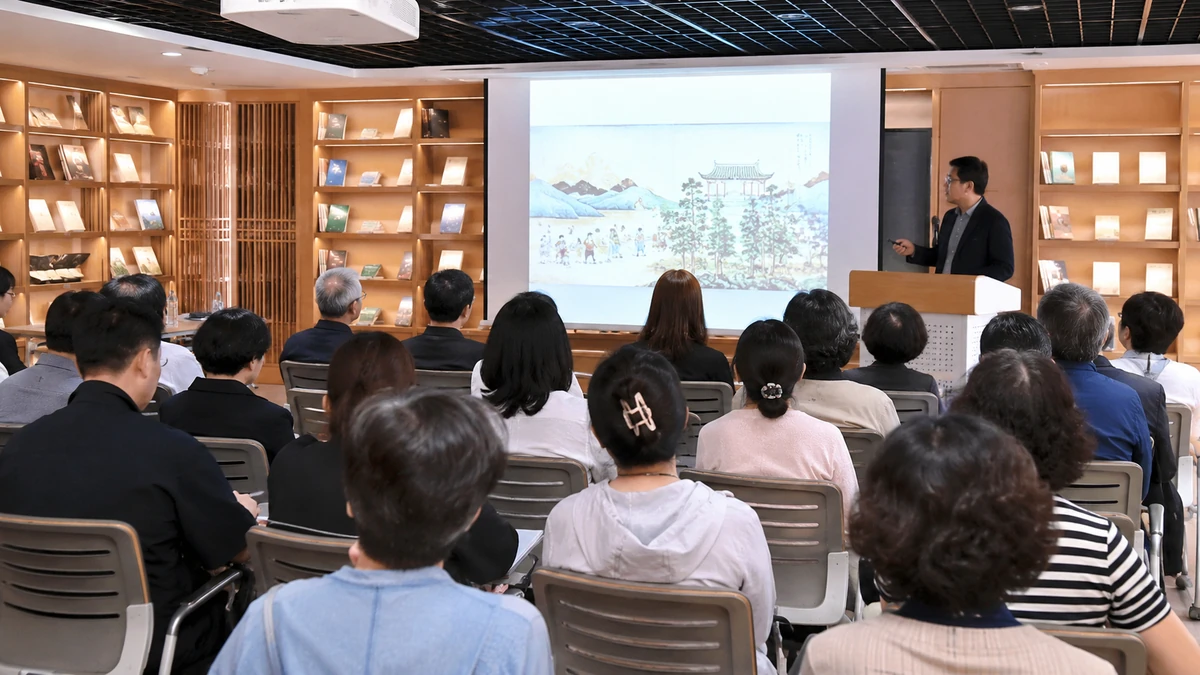
A local museum event with a bigger story behind it
In a city better known to many foreign visitors for K-pop, palaces and neon shopping districts, one of Seoul’s quieter public institutions is making a case for a slower, more thoughtful kind of cultural life. Songpa District, in southeastern Seoul, said it will host its first book-culture lecture of the year on June 17, 2026, at 2 p.m. at the Songpa Book Museum, inviting historian Shin Byung-joo, a professor at Konkuk University, to speak on a subject that blends popular culture, royal history and place-based memory.
The lecture’s title, roughly rendered as “The Man Who Lives With the King, and Yeongwol,” is designed to echo the familiarity of cinema while leading audiences somewhere deeper. According to district officials, the talk will use the Korean film “The King and the Clown” as a point of entry before moving into the historical lives of King Danjong and King Sejo, as well as the story of Yeongwol, the county closely associated with Danjong’s exile and death. On paper, that might sound like a standard municipal cultural event. In practice, it says something more revealing about how South Korea’s public institutions increasingly package history: not as a dry lecture detached from everyday life, but as a layered, accessible experience that connects books, film, scholarship and geography.
For American readers, a useful comparison might be a city museum using “Hamilton” to invite the public into a more serious conversation about the Founding era, or a local library programming a talk that starts with a familiar Hollywood period drama and then pivots into the real people, contested memories and overlooked places behind it. The point is not simply to capitalize on a known title. It is to take a story people think they know and reopen it with context, tension and historical specificity.
That approach helps explain why this event stands out beyond the usual calendar notice. Seoul is a city saturated with high-profile attractions and globally marketed entertainment. Yet some of its most telling cultural shifts are happening in places like neighborhood museums, district-run lecture halls and public programs that cost nothing to attend. The Songpa lecture is free and open to adults, a detail that matters. It underscores the way culture in South Korea is often treated not only as a consumer good, but also as a public service.
That may sound modest, but it is one of the reasons this story resonates. The event is not a blockbuster exhibition or a celebrity-driven festival. It is a public lecture in a book museum. And yet it captures several of the most important currents in contemporary Korean cultural life: the use of familiar media to unlock difficult history, the blending of local government and cultural programming, and the idea that a museum visit can be more than a stop on a tourist checklist. It can be, in effect, a form of civic participation.
Why a book museum matters in Seoul
To understand why this lecture carries weight, it helps to understand the venue. Songpa Book Museum is not simply a place that displays rare volumes behind glass. It has positioned itself as a public platform where readers can meet the people who make books — authors, editors, publishers and planners — and where reading is treated as a social act rather than a solitary habit. In that sense, it reflects a broader trend in South Korea’s cultural sector, where museums and libraries are increasingly expected to host dialogue, not just preserve materials.
That expectation is especially striking in Seoul, a city where public space is constantly being renegotiated. Residents live in one of the most densely wired, fast-moving urban environments in the world. Leisure can easily default to shopping malls, streaming platforms and smartphone screens. Against that backdrop, a district-run museum offering a free afternoon lecture on history and narrative is making a quiet but pointed statement: culture does not have to be spectacular to be meaningful, and learning does not have to be formal to be rigorous.
For Americans, the closest analogy may be the civic role once played by local public libraries, university extension programs or historical societies that served as meeting grounds for shared inquiry. But South Korea’s version often folds in a distinctive mix of polish and accessibility. Public cultural spaces in Seoul are frequently designed to be visually inviting, family friendly and highly programmed. They are expected to be useful. A museum is not just there to house collections; it is there to activate them, interpret them and make them relevant to urban life.
That helps explain why this lecture is framed as part of the museum’s signature book-culture series, not as a one-off add-on. Officials said the museum plans five such lectures this year. The first one’s choice of topic is revealing. Rather than opening with an abstract or narrowly academic subject, the museum is starting from a recognizable story world and widening outward. It is a programming choice that suggests confidence in the audience’s curiosity. People do not need to be lectured at from a distance, the model assumes. They can be invited in through familiarity and then guided toward complexity.
There is also something distinctly urban about that strategy. In a city where time is scarce and competition for attention is intense, cultural institutions have to offer not only information but a reason to linger. The museum becomes a destination not merely because it exists, but because it creates occasions — a schedule, a voice, a theme, a conversation. That is what makes the Songpa event feel larger than its scale. It shows how a district-level institution can shape the rhythm of city life one afternoon at a time.
From movie memory to royal history
The centerpiece of the lecture is its use of “The King and the Clown,” one of South Korea’s best-known historical films, as a bridge into the Joseon Dynasty’s political history. For readers unfamiliar with Korean cinema, the film is a landmark period drama released in 2005 that became a major box office success and helped cement the modern Korean entertainment industry’s confidence in telling historical stories through emotionally vivid, commercially appealing formats. It is remembered for its court intrigue, performance culture and exploration of power, vulnerability and spectacle.
By invoking that film, the museum is leaning on a reality every cultural institution understands: audiences often encounter the past first through fiction. Movies supply faces, moods and memorable scenes. They do what textbooks usually do not. They make people feel they have entered a world. The risk, of course, is that cinematic memory can flatten or distort complex events. That is where the historian comes in.
Shin, a scholar of Korean history at Konkuk University, is expected to use the movie not as an endpoint but as a starting point, tracing the historical figures of Danjong and Sejo and the political turmoil surrounding them. For non-Korean readers, this requires a bit of context. Danjong was a boy king of the Joseon Dynasty, one of Korea’s longest and most influential royal periods, which lasted from the late 14th century to the late 19th century. He was eventually forced from the throne by his uncle, who became King Sejo. Danjong’s story has long occupied a powerful place in Korean historical memory because it combines dynastic politics with themes Americans would recognize instantly: youthful innocence, family betrayal, the moral ambiguity of power and the way a state rewrites legitimacy after a palace struggle.
Sejo, for his part, remains one of those historical figures who resist easy moral sorting. He is often remembered for seizing power, but he was also a consequential ruler in terms of statecraft and governance. That tension makes him historically important and culturally combustible. In the United States, one might think of the continuing fascination with Richard III in English history — a ruler whose reputation is inseparable from questions of ambition, bloodline and the stories later generations choose to tell. Korean history has its own versions of those debates, and Danjong and Sejo are central to them.
The museum’s programming concept appears built on that exact tension. Rather than asking the public to memorize chronology, it offers an interpretive structure: start with a familiar narrative frame, then revisit the people and places behind it. That matters because public appetite for history increasingly depends on story. Across the world, museums, podcasts and documentaries have learned that audiences respond less to lists of dates than to human stakes. South Korea is no exception. If anything, the country’s cultural institutions have become especially adept at turning history into a conversation between scholarship and popular memory.
Yeongwol and the power of place
Just as important as the royal figures in this event is the place name embedded in the lecture title: Yeongwol. To many Koreans, Yeongwol is not just a point on a map. It carries a historical afterimage linked to Danjong, who was sent there after losing the throne. The region, now a county in Gangwon Province, has become associated with exile, mourning and the long afterlife of dynastic tragedy. In other words, Yeongwol functions in Korean cultural memory the way certain landscapes do in other countries: as real places that also hold symbolic force.
Americans are familiar with this phenomenon even if the specific Korean reference is new. Think of Appomattox in the Civil War imagination, or Dealey Plaza in the memory of the Kennedy assassination. The place itself becomes inseparable from the story, and over time it acquires a second life as a destination for reflection, education and even pilgrimage. Yeongwol has a similar resonance in Korean historical consciousness. Mentioning it calls up not only geography but a narrative of dispossession and remembrance.
That is one reason the Songpa lecture is especially interesting. It is taking place in Seoul, far from Yeongwol, but it uses the capital’s museum space to summon another region’s memory. This is a common but powerful function of cultural programming: it connects urban audiences to stories rooted elsewhere. In doing so, it turns a museum visit into a kind of travel of the mind, and potentially a real one. People who hear a compelling lecture about a historical place often want to see that place for themselves.
That gives the event an almost travel-journalism quality. It presents a date, a location in Seoul, a narrative hook through film and a destination beyond the city embedded in history. It suggests that cultural tourism in Korea is not limited to headline sites such as Gyeongbokgung Palace or the nightlife districts foreign visitors often know first. It can also take shape through public lectures, smaller museums and story-driven encounters that enrich the meaning of later travel.
In that sense, the event reflects a larger change in how Korea markets and understands its own cultural landscape. There is still plenty of emphasis on scale and spectacle, from K-pop concerts to major heritage sites. But there is also growing interest in “slow” culture — experiences that ask visitors and residents alike to spend more time with context. The Songpa Book Museum lecture fits squarely in that category. It is not about checking off landmarks. It is about building the kind of understanding that makes places linger in memory.
Public culture as a civic service
One of the most telling details in the announcement is that the lecture is free. In many countries, that would be a nice feature but not necessarily the heart of the story. In South Korea, it points to something broader about the role public institutions are expected to play. Culture here often operates in a hybrid system: aggressively commercial on one side, strongly subsidized and publicly managed on the other. Massive entertainment industries coexist with district museums, municipal libraries and publicly accessible lecture series designed to lower barriers to participation.
That arrangement has become a significant part of everyday urban life. Residents can encounter history, literature and art not only through ticketed major events, but through local infrastructure embedded in neighborhoods. Songpa, a district better known internationally for housing Lotte World Tower and for once hosting Olympic venues, also invests in a book museum that serves adults seeking an afternoon of conversation and interpretation. That juxtaposition is revealing. It shows how Seoul’s cultural identity is made not only by landmarks, but by public systems that sustain less glamorous forms of engagement.
Officials described the museum’s lecture series as one of its representative programs, where citizens can meet people involved in making books. That phrasing is important. It frames reading culture as something relational. Books are not treated as finished objects that descend from on high; they are the result of decisions, arguments, editing, curation and historical framing. Bringing scholars and cultural workers into direct conversation with the public acknowledges that interpretation itself is part of civic life.
It is also worth noting that this event targets adults. Much of the international conversation about Korean cultural policy focuses on youth — students, digital natives, pop fandoms. But Korea’s public cultural ecosystem also serves adults who want intellectually substantial programming outside formal education. In the United States, that sort of lifelong-learning space often feels fragmented or underfunded. In Seoul, it is more visibly built into the machinery of local government.
Songpa District Mayor Seo Kang-seok said the lecture would offer a fresh way to encounter a story familiar through film from the perspective of a historian. The comment is standard official language in one sense, but it also neatly captures the value proposition. Familiarity gets people in the room. Expertise gives them a reason to stay.
What this says about Korean Wave culture now
For years, the Korean Wave — known in Korean as Hallyu — has been shorthand abroad for exports: K-pop, streaming dramas, beauty brands and Oscar-winning or Emmy-winning screen hits. Those industries remain central to South Korea’s global image, and for good reason. But events like this one point to a less flashy and arguably more durable dimension of Korean cultural influence: the ecosystem beneath the exports.
The lecture at Songpa Book Museum does not directly sell music, television or fashion. Yet it grows from the same cultural confidence that made Korean entertainment globally legible in the first place. It assumes stories matter. It assumes the public is willing to move between genres and registers — from film to history, from entertainment to scholarship, from city museum to regional memory. And it assumes that local government has a role in facilitating that movement.
That is an important lesson for outsiders trying to understand why Korean cultural production has proven so resilient. The Korean Wave did not emerge only from talent agencies and film studios. It also emerged from a broader social investment in education, curation, public programming and institutions that teach audiences how to read cultural material closely. A museum lecture may seem worlds away from a global streaming hit, but they are part of the same cultural continuum.
There is also a democratic impulse in the design of this event that deserves attention. By choosing a movie as the doorway into royal history, the museum is not diluting the past. It is acknowledging the pathways through which people actually encounter it. That is a pragmatic and, in its own way, egalitarian approach. It does not require prior expertise. It asks only for curiosity.
For foreign readers interested in South Korea beyond the usual headlines, this may be the most revealing part of the story. Korean cultural life is not only built in mega-events and globally distributed franchises. It is also built in district museums, weekday lectures and programs that connect a city resident to a book, a scholar, a film and a county several hours away. That is the infrastructure of cultural depth. It rarely makes international news. But it may be one of the clearest explanations for why Korean culture, once encountered, often feels so richly interconnected.
A small event, a larger invitation
By itself, the June 17 lecture is a small item on a local calendar: one afternoon, one museum, one historian, one topic. Yet it offers a compact portrait of Seoul at its most interesting — a city where public institutions are trying to make culture not just available, but interpretable. It also offers a useful corrective to the idea that Korean history and culture must be consumed only through grand monuments or entertainment spectacles.
What Songpa Book Museum is proposing is something subtler. Start with a story people recognize. Add expert context. Tie it to a real place. Keep the doors open. Let the museum become not just a repository but a meeting point. That formula may not produce viral clips, but it does produce informed audiences, and informed audiences are one of the hidden engines of any cultural scene.
For travelers, scholars and casual observers alike, there is a lesson here. The most rewarding entry into another country’s culture is often not the biggest attraction, but the place where local people go to think together about what their stories mean. On June 17 in Songpa, that place will be a book museum in Seoul, where a film remembered by many Koreans becomes the starting line for a deeper conversation about kingship, exile, memory and the geography of history.
In an era when culture is often measured by scale, speed and export value, there is something refreshing about a public lecture that asks for none of those things. It asks only that people show up, sit down and reconsider what they thought they knew. In that sense, the event is more than a lecture. It is a quiet argument for why cities still need shared spaces of interpretation — and why Korea’s local cultural institutions deserve as much attention as the global phenomena they help make possible.


0 Comments