A beach city better known for skyline views is hosting a conversation about smell
BUSAN, South Korea — On any given summer postcard, Busan sells itself easily: crowded beaches, neon-lit seafood markets, high-rise hotels facing the water and a coastal energy that feels more Miami than Manhattan, if Miami were wrapped around steep hills and backed by one of the world’s busiest ports. But this week, South Korea’s second-largest city is offering a different kind of calling card. Instead of surf and sunsets, the spotlight is on smell.
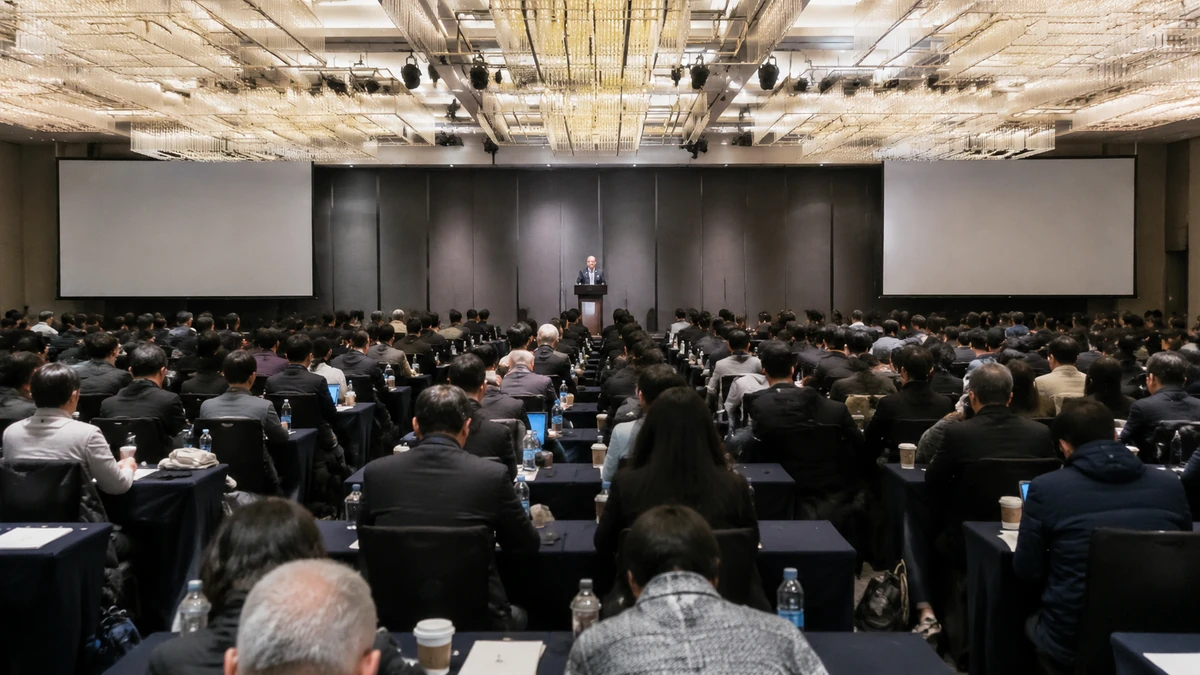
At the Grand Josun hotel in Haeundae, Busan’s best-known beach district, researchers from South Korea and abroad gathered Friday for the opening of the first HIRC International Conference, a four-day academic meeting focused on “olfactory display” technology — a specialized field that studies how scents can be detected, analyzed and used through digital systems. Organizers say it is the world’s first international academic conference centered specifically on the olfactory display field.
The event, hosted by Pusan National University’s Humanoid Olfactory Display Center, runs from July 10 through July 13 and drew about 160 participants on opening day, including researchers, university officials and representatives from South Korea’s Ministry of Science and ICT and the Busan city government. By the standards of consumer expos like CES in Las Vegas or Mobile World Congress in Barcelona, that is a modest crowd. In research terms, though, it is the kind of size that can matter: a concentrated gathering in a narrow, emerging field where the people in the room are often the people setting the agenda.
That may sound highly technical, even niche. But the conference arrives at a moment when the digital world is increasingly trying to move beyond screens and speakers. For decades, most mainstream consumer technology has focused on what people can see and hear — televisions, smartphones, streaming platforms, headphones, virtual reality headsets. Olfactory display research asks a more unusual question: What happens when technology tries to engage the nose, too?
For American readers, the easiest comparison may be the long-running ambition in Silicon Valley and Hollywood to make media more immersive. Think of the old movie-theater gimmick “Smell-O-Vision,” or today’s interest in virtual reality, augmented reality and haptics that let users feel a buzz, vibration or simulated touch. Scent technology belongs to that same family of ideas, but with a much more difficult challenge. Smell is deeply tied to memory, emotion and physical environment, yet it is notoriously hard to standardize, reproduce and deliver in a precise way. That is part of what makes the Busan gathering notable: it reflects a sense that this once-fringe concept is becoming serious enough to merit its own international research platform.
What “olfactory display” means — and why it matters
The phrase “olfactory display” is not everyday vocabulary, even in English-language technology coverage. Broadly speaking, it refers to systems that can present scent as a form of information or experience, much as a screen presents images or a speaker outputs sound. That can include technology that detects odors, analyzes their chemical signatures and reproduces or deploys them for practical uses. The field overlaps with robotics, sensory engineering, human-computer interaction, health applications, environmental monitoring and immersive media.
In plain English, researchers are asking whether smell can become part of the language of technology rather than just a background feature of life. Could a machine detect a hazardous odor before a person does? Could digital environments eventually include scent cues to make training simulations or entertainment more realistic? Could smell be used in rehabilitation, accessibility design, marketing, tourism or mental-health settings where memory and emotion matter? Those questions stretch beyond a single conference, and the Busan meeting is not, based on the available summary, unveiling a blockbuster product ready for store shelves. Still, the fact that researchers are convening internationally around the topic suggests the field is maturing.
There is also a reason smell, in particular, captures imagination. Neuroscientists have long noted that scent is unusually powerful in triggering memory. Most people know the experience even if they do not know the science: a whiff of sunscreen can send someone back to childhood summers; cigarette smoke can summon a specific relative; the smell of rain on hot pavement can revive a place you have not visited in years. In a travel context, smell often does as much work as scenery. A city is not remembered only by what it looks like. It is remembered by subway air, coffee shops, ocean salt, food stalls, hotel lobbies and the particular scent of a season.
That is one reason a conference like this has implications beyond the lab. A tourism board may promote beaches, museums and skyline views, but people experience destinations through all their senses. If sight and sound dominated the first generation of digital storytelling and travel marketing, scent may be part of whatever comes next — not necessarily as a gimmick, but as a more sophisticated attempt to represent place and memory. That is still speculative, and nothing in the conference summary suggests a new Busan tourism product is about to launch. But as a cultural signal, the event shows that sensory experience itself is becoming a more serious subject of research and design.
Why Busan, and why Haeundae?
The choice of venue matters. Haeundae is one of the most internationally recognizable neighborhoods in Busan and among the most familiar Korean beach destinations to foreign visitors. If Seoul is often the first stop for travelers drawn by K-pop, Korean dramas and palace tourism, Busan is frequently the city that broadens their view of South Korea. It is a place where the country’s global image shifts from hyper-urban capital to maritime gateway — a city of container terminals, seafood, film festivals, beaches and convention spaces.
Americans might think of Busan as something like a blend of San Diego, Seattle and a convention city, though no U.S. comparison is exact. It has a strong local identity, major port infrastructure and a polished ability to host international events. That matters because where a conference happens is never just a logistical detail. Participants do not only attend panels and presentations. They sleep in the city, eat in the city, move through its streets and come away with a memory of what kind of place it is.
That is especially true for specialized academic gatherings. Big trade shows can feel detached from local life, almost interchangeable from one convention center to another. Smaller, more focused conferences often do the opposite. They let attendees absorb a city’s rhythm more directly, whether through a walk along the waterfront before morning sessions, a late dinner of grilled eel or raw fish after formal events, or a short train ride that reveals the urban landscape between campus, hotel and coast.
In that sense, the HIRC conference functions as more than a technical meeting. It also becomes a form of city branding, even if unintentionally. Busan has long marketed itself through its beaches, seafood and festivals, especially the Busan International Film Festival, which helped cement its reputation as a cultural hub. Hosting what is being billed as a world-first academic event in an emerging sensory technology field adds another layer. It suggests Busan wants to be seen not only as a place people visit for leisure, but as a place where new ideas are tested, debated and launched into wider circulation.
For foreign readers who may know Busan only as a vacation city or as the setting of the zombie thriller “Train to Busan,” the conference adds useful context. Modern Busan is not just a scenic stop on a Korea itinerary. It is also a serious university city, a research node and a location where local institutions are trying to stake claims in future-facing industries. That distinction matters as South Korea continues to compete globally not just through manufacturing or entertainment exports, but through research ecosystems and urban reputation.
The role of Pusan National University and public institutions
The host institution, Pusan National University, is one of South Korea’s leading national universities and a major academic anchor in the southeast region of the country. For American audiences, the phrase “national university” may need explanation. In South Korea, it generally refers to a public university established and supported by the national government, often with strong regional significance. These schools are not identical to state universities in the United States, but they play a similarly important role in shaping local talent, research capacity and civic identity.
That matters because the conference is not simply a hotel-based industry event chasing media buzz. It is being driven by a university research center — the Humanoid Olfactory Display Center — which signals a deeper institutional investment in developing the field. Universities often do some of their most important work not when they mirror existing industries, but when they help define an area before it becomes commercially obvious. Artificial intelligence, biotechnology and human-computer interaction all followed versions of that path. Specialized labs and academic networks did the early work long before the public understood what would become possible.
The presence at the opening ceremony of officials from the Ministry of Science and ICT, along with Busan city representatives, also says something about how South Korea approaches emerging technologies. Korean public institutions often appear in close partnership with universities and local governments, especially in fields that touch on industrial policy, urban development or national competitiveness. That does not automatically mean a major government program or investment package is forthcoming; the available reporting does not mention any such announcement, and it would be a mistake to overstate the point. But it does show that olfactory display research is not being treated as a purely isolated academic curiosity.
There is a broader Korean context here that may be familiar to anyone who has watched the country’s rise in semiconductors, batteries, telecommunications or pop culture. South Korea has built a global reputation by taking areas that may once have seemed secondary or risky and pursuing them with coordinated intensity. The result has been an outsized international profile for a country of roughly 51 million people. Whether olfactory display becomes the next major frontier remains unclear. But the institutional choreography in Busan — university, city and central government showing up in one room — fits a recognizable Korean pattern: nurture the field early, build credibility through research and use international convening power to strengthen legitimacy.
A small conference can still signal a big shift
The figure attached to the conference — about 160 attendees on the first day — is worth understanding in context. In mainstream news culture, numbers often drive perceptions of importance. A giant crowd implies significance; a small one can seem marginal. But academic influence does not work that way. In many emerging fields, a conference of 160 specialists can be far more consequential than a convention of thousands browsing corporate booths. Early communities tend to be compact, interconnected and capable of moving quickly if a shared language begins to form.
That is why the “world’s first” label, while easy to dismiss as promotional, deserves a more measured reading. First-of-its-kind events matter not because they instantly transform an industry, but because they create a formal meeting place where none existed before. They help researchers decide what belongs inside a field, what standards may be needed, which applications seem credible and which collaborations should continue after the closing session. If the conference becomes recurring rather than one-off, that founding status may matter more in retrospect than it does in the moment.
There is also something revealing about the scale itself. Busan is not trying to mimic a mass-market tech expo. Instead, it is hosting a dense, highly specialized exchange. That can be better for a city’s long-term intellectual profile. A destination that becomes known for serious, repeatable gatherings in distinct areas — maritime logistics, film, medical conferences, design, sensory engineering — builds a different kind of prestige than one chasing spectacle alone. It becomes a place professionals return to, not just tourists passing through.
For South Korea, whose international image is often filtered through K-pop, beauty products, food trends and hit television dramas, conferences like this complicate the story in useful ways. The “Korean Wave,” or Hallyu, introduced millions of global fans to Korean culture through entertainment. But the country’s influence is broader than cultural exports. It also lies in how Korean cities and institutions position themselves in research, advanced manufacturing and the design of future experiences. Busan’s olfactory technology conference may not generate the kind of viral attention a K-pop concert does, but it represents another form of soft power: the ability to convene global expertise around a novel idea.
How technology, tourism and memory meet in one city
At first glance, it may seem odd to read a technical conference through the lens of tourism or urban image. Yet cities are increasingly judged by the kinds of experiences they can host and the kinds of conversations they can attract. In a global travel economy, visitors are not just choosing scenery; they are choosing atmospheres, events and a sense of participation in something current. A city that feels like a backdrop is different from a city that feels like a stage where things are happening.
That distinction is important in Busan. The city already has the natural advantages: coastlines, seafood, dramatic terrain and a pace that many visitors find looser than Seoul’s. What events like HIRC add is proof of contemporary relevance. On Friday, Busan was not simply a beach city receiving visitors. It was a meeting point where researchers from multiple places gathered to think about one of the least understood frontiers in digital experience. That fact, by itself, subtly changes how the city can be imagined abroad.
It also changes how one might think about the future of travel. The next era of tourism may be less about collecting landmarks and more about curated, multisensory stays — places where hospitality, design, wellness, entertainment and technology merge. South Korea is well positioned for that possibility because it already excels at integrating physical spaces with digital convenience, from high-speed transit and cashless systems to carefully staged retail and cultural environments. If scent becomes a more viable medium in design, exhibitions or immersive storytelling, Korean cities like Busan may be eager test beds.
None of that should be confused with immediate reality. The conference summary offers no evidence of a commercial rollout, no promise of scent-based tourism programs and no claim that olfactory display is about to redefine travel next year. Responsible reporting requires staying close to what is known. What is known is straightforward: a first international academic conference dedicated to the field opened in Haeundae, hosted by Pusan National University’s Humanoid Olfactory Display Center, with public officials and roughly 160 domestic and international researchers in attendance.
But facts do not exist in a vacuum. Their significance comes from context. And the context here is a South Korean city that increasingly wants to be understood as more than a pretty coastline or a seasonal vacation choice. Busan is presenting itself as a site of exchange — between local and global, tourism and knowledge, sensory experience and technical research. The conference may be specialized, but the message is broad enough for any international audience to understand: this is a city trying to shape future conversations, not just host them.
What this moment says about Busan — and about South Korea
There is a temptation, especially in fast-moving international coverage, to sort cities into simple categories. Seoul is the megacity. Jeju is the island escape. Gyeongju is the historic destination. Busan is the beach-and-port city. Those shorthand labels are useful, but they flatten reality. Places become more interesting when the categories overlap, and Busan is increasingly one of those places. It is still the city of ocean views and market food, but it is also the city of film, conventions, logistics and now a world-first conference on the technological uses of smell.
That layering reflects something bigger about South Korea’s evolution. Over the past two decades, the country has become adept at turning local strengths into globally legible narratives. Entertainment companies did it with music and television. Consumer brands did it with electronics, cosmetics and cars. Universities and cities are now doing it with research identity and event hosting. The HIRC conference is a small example, but a telling one: it translates a highly specialized body of work into an international gathering in a recognizable destination.
For American readers, the importance of such a story may not lie in whether they will one day buy a scent-enabled device. It lies in understanding how South Korea continues to build influence. Not always through splashy announcements. Not always through scale. Sometimes through quieter acts of institution-building — a university center, a carefully organized conference, a city willing to lend its international profile to a new field before the rest of the world fully catches up.
On paper, Friday’s event was a niche academic opening ceremony in a hotel ballroom near one of Korea’s most famous beaches. In practice, it was also a snapshot of a country and a city trying to define what comes next. For Busan, that means being remembered not just for what visitors see along the shore, but for what ideas they encounter once they arrive. And for a technology centered on smell — the sense most closely tied to memory — there may be no more fitting ambition than that.
Comments
Post a Comment