
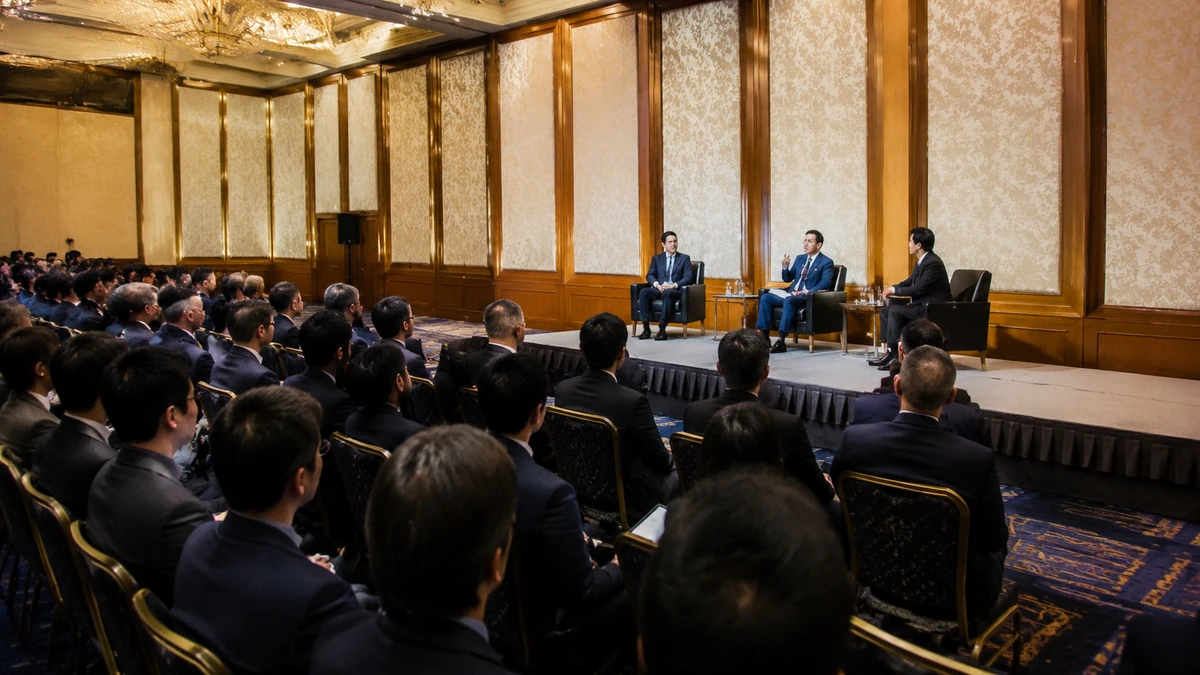
A new signal from one of South Korea’s most important business leaders
When the chairman of one of South Korea’s biggest industrial groups says the company may need to look beyond its home country for its next semiconductor factory, people in Seoul, Tokyo, Washington and Silicon Valley all tend to listen. That is essentially what happened this week when Chey Tae-won, chairman of SK Group, said the company is keeping both domestic and overseas locations on the table for a future SK hynix chip plant after completion of the company’s four planned fabs in Yongin, south of Seoul.
Chey’s remarks, made in Tokyo after a Nikkei forum session focused on South Korea-Japan relations, were brief but highly revealing. He did not announce a final decision. He did not identify a specific city in South Korea or a foreign country. And he did not say a deal was imminent. What he did say, however, was enough to underscore a much bigger reality: the world’s voracious appetite for chips is rising so quickly that major manufacturers are already thinking past their current megaprojects and toward the next round of production capacity.
For American readers, it may help to think of this the way Detroit once thought about auto assembly or the way Texas, Arizona and Ohio are now thinking about advanced manufacturing plants. A chip fab is not just another factory. It is a multibillion-dollar strategic bet that can shape regional economies for decades, create entire supplier ecosystems and influence national industrial policy. So when the head of SK Group says the company cannot simply avoid expanding somewhere, he is speaking not only to shareholders but also, in effect, to governments competing to host the next node in the global semiconductor chain.
That is why the comment mattered. It was not just a corporate aside about real estate. It was a public acknowledgment that the next chapter for one of the world’s leading memory chipmakers may not be confined to South Korea, even though the company remains one of the crown jewels of Korean manufacturing.
Why SK hynix matters far beyond South Korea
SK hynix is not a household name in the United States in the same way Apple, Intel or Nvidia might be, but it plays a central role in the technology people use every day. The company is one of the world’s leading makers of memory semiconductors, particularly DRAM and NAND flash, the chips that help servers, smartphones, PCs and artificial intelligence systems store and process information. If Nvidia is helping define the AI boom with high-performance processors, companies like SK hynix are supplying the memory that makes those systems possible at scale.
That position gives SK hynix unusual importance in the global economy. South Korea has long been a semiconductor powerhouse, especially in memory chips, and SK hynix, along with Samsung Electronics, anchors that dominance. So when Chey discusses where future production might go, the implications extend well beyond one company’s capital spending plans. They touch on how much manufacturing South Korea can keep at home, how aggressively other countries are courting advanced chip production and how global supply chains are being redrawn in an era increasingly shaped by AI demand, industrial policy and geopolitical risk.
Americans have become much more familiar with the political and strategic importance of semiconductors in recent years, especially after pandemic-era supply disruptions and the passage of the CHIPS and Science Act. Washington has made clear that semiconductors are no longer viewed solely as commercial products. They are now discussed as critical infrastructure, economic security assets and, in some cases, strategic leverage. South Korea, Taiwan, Japan, the United States and Europe are all navigating that same reality, even if their approaches differ.
That is what makes Chey’s comment resonate. In a world where governments are offering subsidies, tax breaks, infrastructure packages and regulatory fast-tracking to land fabs, saying the next plant might be overseas amounts to a message with real weight. It says the company is not taking for granted that future production belongs automatically in South Korea. It says conditions matter. Market response matters. Timing matters. And increasingly, geography itself has become part of corporate strategy.
The meaning of “after Yongin”
At the center of this story is Yongin, a city in the greater Seoul area that is set to become one of South Korea’s biggest semiconductor hubs. SK hynix is developing a major chip cluster there, and Chey’s remarks came in response to a question about what happens after the company completes its fourth fab in that complex. That framing is important. It suggests the discussion is no longer about whether the current expansion is enough. It is about what comes next once even that large-scale investment is accounted for.
Chey reportedly said chip demand continues to grow and that the company cannot simply avoid going somewhere, describing the need to prepare as a kind of looming assignment. The word choice matters. In Korean public discourse, calling something a “homework” or “assignment” often conveys a practical burden, not an academic exercise. It means an unresolved but urgent task that leadership knows it must address. In this case, the task is future capacity: where to put it, how fast to build it and what balance to strike between national loyalty, market efficiency and strategic flexibility.
That is also why this should not be overread as an announcement. Chey was careful not to say a final call had been made. He said the decision would be made comprehensively, suggesting a broad review rather than a predetermined answer. That sort of language is standard in corporate strategy, but it also reflects the sheer complexity of fab planning. Building an advanced semiconductor plant involves far more than securing land. Companies must weigh electricity supply, water access, logistics, skilled labor, supplier networks, permitting timelines, customer proximity, political risk and the availability of public incentives.
In other words, this is not like deciding where to put a warehouse. It is more like deciding where to build a new airport, research park and industrial district all at once, with the added pressure that technology cycles move quickly and customers expect supply resilience. From that perspective, even a preliminary public acknowledgment that overseas options are in play tells us something meaningful: SK hynix is already thinking on a horizon beyond its current flagship domestic buildout.
A subtle but unmistakable message to Seoul
The most striking part of Chey’s remarks was not simply that overseas locations are under consideration. It was how plainly he appeared to say that if a project cannot be done under suitable conditions in South Korea, then building abroad may become necessary. That is not a threat, exactly. It is better understood as a market signal. South Korea is home base, but home base is not immune from competition.
For South Korea, this touches a sensitive issue. The country takes understandable pride in its chip industry, which has been central to its rise from war devastation to high-tech economic power. Semiconductors are not just another export sector there; they are part of the national growth story. In Korea, large family-influenced conglomerates known as chaebol, including Samsung, Hyundai, LG and SK, have historically played an outsized role in industrial development. To American audiences, they can be loosely compared to a blend of industrial giants and national champions, though the Korean model has its own history and political baggage.
That context helps explain why any hint that a future flagship manufacturing investment could go overseas draws attention. It raises uncomfortable but important questions: Can South Korea provide enough infrastructure, talent and speed to remain the most attractive location for the next generation of fabs? Are electricity costs, land constraints or regulatory processes becoming a bigger concern? And in a world where the United States, Japan and parts of Europe are offering stronger incentives for strategic manufacturing, how much can patriotism alone influence where a company spends tens of billions of dollars?
Chey did not explicitly criticize South Korean policy. The available remarks do not support that conclusion. But his comments do suggest that SK hynix will not pledge, as a matter of principle, to keep every future plant at home regardless of market conditions. That distinction is critical. This is not a rejection of Korea. It is a reminder that even Korean companies are making increasingly global decisions in response to a global semiconductor race.
For policymakers, the subtext is clear enough. If South Korea wants to keep as much of the value chain as possible within its borders, it must remain competitive not only in technology but in the conditions that make large-scale manufacturing feasible. That includes infrastructure, permitting, workforce development and broader industrial support. Every country in this race is effectively asking the same question: What does it take to become the place where the next fab makes economic sense?
Why the Tokyo setting carries extra weight
The location of Chey’s remarks added another layer of symbolism. He made them in Tokyo, after a session at a Nikkei forum devoted to South Korea-Japan issues. That matters because relations between South Korea and Japan are both economically intertwined and historically fraught. The two U.S. allies are deeply linked in advanced manufacturing, especially in the materials, parts and equipment that go into chip production, but they are also competitors and have, at times, used trade policy as a pressure point.
American readers may remember the 2019 dispute in which Japan tightened export controls on certain critical semiconductor materials bound for South Korea, sparking fears about supply disruptions and exposing how vulnerable highly specialized tech chains can be. Since then, the two countries have moved toward greater cooperation, driven in part by shared concerns about economic security, China, and the need for resilient supply chains. Even so, the relationship remains layered, shaped by both business pragmatism and unresolved historical tensions stemming from Japan’s colonial rule over Korea in the first half of the 20th century.
Against that backdrop, a South Korean business leader publicly discussing the possibility that a future chip plant could be located outside Korea carries significance beyond the company itself. Doing so in Tokyo, at a high-profile policy and business forum, effectively places the issue before an international audience already attuned to the strategic reordering of Asian manufacturing. It is the kind of setting where comments are heard not just as internal planning chatter but as external messaging.
The choice of venue does not mean Japan is the chosen destination. There is no evidence of that in the summary of the remarks. But it does amplify the international dimension of the conversation. A statement made in a domestic boardroom might be read as routine management. A statement made in Tokyo, in front of a regional and global audience, becomes part of a broader dialogue about where the world’s advanced manufacturing base is headed.
That is especially true now, when Japan is seeking to rebuild its semiconductor ecosystem, the United States is trying to onshore and ally-shore more production, and companies across Asia are reassessing risk. In that environment, public ambiguity can itself be a strategic tool. By keeping domestic and overseas options open, SK hynix preserves flexibility while also reminding host governments that it has choices.
What the global chip race means for American readers
If this sounds distant from everyday life in the United States, it really is not. The semiconductor industry is now one of the clearest examples of how international politics, consumer technology and local economic development intersect. Whether Americans are buying a phone, using cloud services, driving a modern car or relying on AI-powered applications, they are depending on a supply chain that runs through places like South Korea, Taiwan and Japan.
That is why announcements, or even non-announcements, about future fab locations matter. Where a company like SK hynix builds next can affect delivery times, production resilience, relationships with major customers and the geographic distribution of technical expertise. It can also influence how much leverage different governments have over one of the most consequential industries in the world economy.
The United States has already made a strong play to bring more chip manufacturing to its own soil. Intel is expanding. Taiwan Semiconductor Manufacturing Co. is investing in Arizona. Samsung is building in Texas. Micron has ambitious U.S. plans as well. In that context, Chey’s openness to overseas expansion will naturally invite speculation about whether North America could someday be part of the equation for SK hynix’s future manufacturing footprint, especially as AI accelerates demand for advanced memory.
That speculation should remain just that for now. Chey named no countries and gave no timetable. Still, his comments fit a broader pattern in which major semiconductor companies no longer think of manufacturing geography as fixed. Instead, they are building a more diversified map, one shaped by subsidies, customer ecosystems, alliance politics and the lessons of recent supply shocks.
For Americans, there is another takeaway. Stories like this show why Asian economic news increasingly belongs on the front page of global business coverage, not buried in a niche section. A comment made by a Korean conglomerate chairman in Tokyo can foreshadow investment competition in the United States, shifts in AI supply chains and new debates over industrial policy. In an era when chips are as strategically important as oil once was, the location of the next fab is never merely a local issue.
Not a decision yet, but a revealing look at the next phase
The most accurate way to read Chey’s remarks is not as a declaration of where SK hynix will build next, but as a sign that the decision has entered a more public and more urgent phase. He described the matter as something like an assignment still to be solved, which suggests the company sees future capacity planning as unavoidable rather than optional. Demand is rising. Existing projects are not the end of the story. And the next move may require choices that are more flexible, more international and more politically sensitive than in the past.
That is what makes this such a revealing moment. South Korea’s semiconductor industry has long been a source of national strength, but even national champions are now operating in a world where supply chains are being reorganized in real time. The question is no longer just how much can be built, but where it makes sense to build it and under what conditions.
Chey’s remarks also remind us to separate fact from projection. The fact is that both domestic and overseas sites are under consideration for a future SK hynix plant after Yongin’s fourth fab. The fact is that he linked the issue to continued growth in semiconductor demand and said the company would decide after considering the issue comprehensively. Anything beyond that, including assumptions about preferred countries or near-term investment announcements, goes further than the evidence currently allows.
Even with that caution, the significance is hard to miss. One of South Korea’s most influential business leaders has publicly acknowledged that the next major production base for a top memory chipmaker may not automatically be in South Korea. That alone tells us something about the new era of semiconductor competition.
In the end, this is less a story about a single site search than about the next map of advanced manufacturing. The world’s demand for chips is pulling companies into bigger, more expensive and more geopolitically loaded decisions. SK hynix is now openly grappling with that reality. Wherever the next fab eventually lands, the decision is likely to say a great deal about the balance of industrial power in the years ahead.


0 Comments