Psy’s Drenched Summer Spectacle Opens in Uijeongbu, Showing How a K-pop Concert Became a Korean Seasonal Ritual
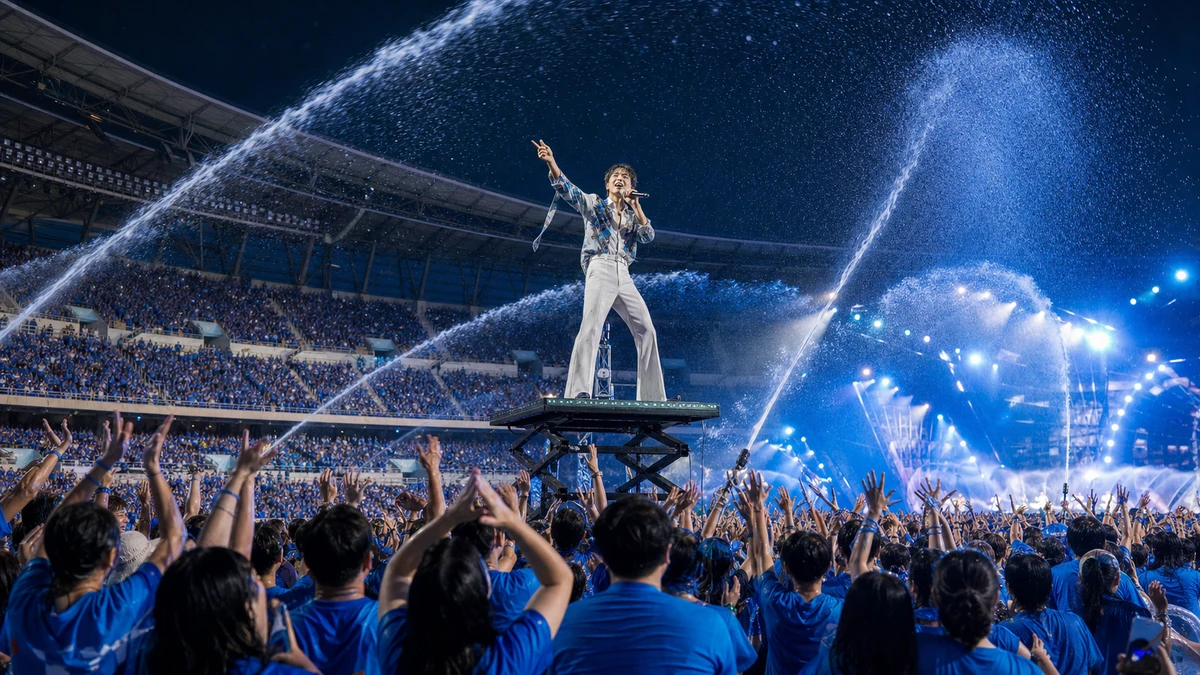
A summer concert built for getting soaked
On a sweltering day north of Seoul, with temperatures climbing to about 90 degrees Fahrenheit, South Korean pop star Psy opened the latest edition of his signature summer concert series in a way that has become instantly recognizable to fans across the country: by turning extreme heat into part of the show.
The opening night of “Psy Soak Show Summer Swag 2026” began Friday at Uijeongbu General Stadium in Uijeongbu, a city in Gyeonggi Province just outside the South Korean capital. According to South Korean media reports, the venue quickly filled with roaring fans, blasts from oversized water cannons and a sea of blue shirts — a visual calling card of a concert that has evolved far beyond a standard pop performance.
Psy, the singer best known globally for the 2012 viral megahit “Gangnam Style,” rose onto the stage on a lift and immediately pushed the crowd into high gear. “Are you ready to give everything, leave nothing behind, and jump around like crazy so you won’t regret it tomorrow?” he shouted, setting the tone for a performance that was less about quiet appreciation and more about collective release.
For American readers who know Psy primarily as the face behind one of YouTube’s first truly global music phenomena, the annual “Soak Show” offers another way to understand his place in Korean pop culture. In South Korea, Psy is not just a nostalgic viral star. He is also one of the country’s defining live performers, and this concert series has become a recurring summer ritual — part pop concert, part water park, part communal endurance test under the hottest skies of the year.
That helps explain why the opening moments of the Uijeongbu concert mattered. They did not just launch another stop on a tour. They reaffirmed why this event has come to symbolize a distinctly Korean version of summer entertainment: loud, participatory, carefully branded and designed to make the audience part of the spectacle.
Why the “Soak Show” means more than a normal concert
At first glance, the premise sounds simple. Fans gather at an outdoor stadium in summer. Psy performs his biggest hits. Massive jets of water drench the crowd. But over the years, the formula has become something closer to a seasonal institution.
The concert series, which began in 2011, is widely regarded in South Korea as Psy’s signature summer event. In the way some Americans associate summer with outdoor amphitheater tours, state fairs or holiday weekend music festivals, many Korean fans now associate the hottest part of the year with Psy’s “Soak Show.” The event returns with enough consistency and enough recognizable elements that its name alone evokes a full sensory experience: blue shirts, ponchos, waterproof shoes, dance-heavy hit songs, screaming fans and sudden walls of water blasting across a stadium.
That consistency is a major part of the brand. In the concert business, a repeatable experience can be as valuable as a new one. Audiences do not buy tickets only for surprise; they also buy them for certainty. Fans of this show know they are going to get soaked. They know they will be standing, shouting and jumping. They know the performance will lean heavily on crowd-pleasing hits rather than obscure deep cuts. They know the visual identity will be instantly shareable.
In South Korea, where pop fandom is often highly organized and deeply participatory, that predictability works less like formula and more like tradition. Fans prepare for the show well before arriving. They dress for it. They anticipate it with friends. They build a shared mood around it. By the time the concert starts, the audience has already done part of the work of becoming a unified crowd.
That is one reason the blue shirts matter. Reports from the venue described the stadium and its surrounding areas as filled with concertgoers dressed in the event’s signature color, many also equipped with rain ponchos or water-resistant footwear. In practical terms, that is preparation for being sprayed for hours. Symbolically, it turns the audience into part of the stage picture. The crowd is no longer a background. It becomes a coordinated visual field — one of the defining features of Korean concert culture, where fan participation can shape the atmosphere as much as the artist does.
Turning a heat wave into the headline attraction
Outdoor concerts in high summer can easily become stories about discomfort, safety and weather-related strain. What makes Psy’s event unusual is that it takes the very thing that could be a liability — oppressive heat — and reframes it as a central production element.
On Friday, the reported high hit 32 degrees Celsius, or roughly 90 Fahrenheit. In many contexts, that kind of weather would be treated as a challenge to overcome. At the “Soak Show,” it is built into the premise. The water cannons are not a side effect or an occasional gimmick. They are essential stage machinery. They transform the audience from people enduring the heat into active participants in a choreographed summer release.
That shift is important. Good live entertainment often depends on changing how people experience a setting. A baseball game on a humid night can still feel romantic under stadium lights. A Fourth of July crowd can tolerate punishing temperatures if fireworks are coming. Psy’s show applies a similar logic, but more aggressively. It says the heat is not a problem to ignore; it is the reason the concert feels the way it does.
For U.S. readers, perhaps the closest comparison is not another K-pop concert but a hybrid of several American experiences: the scale of a stadium pop tour, the exuberance of a summer music festival and the deliberately messy joy of a water ride at a theme park. Yet even that analogy does not fully capture the sense of uniform crowd participation that South Korea’s pop scene can produce. In many American concerts, audience members may sing along. At Psy’s show, they arrive seemingly ready to be physically transformed by the event.
That helps explain why the venue itself becomes part of the story. The streams of fans approaching an outdoor stadium in matching blue, dressed for drenching rather than avoiding it, create images that are effective both in person and on social media. In the digital era, concerts are not only live experiences. They are also visual products designed to circulate through short clips, fan photos and viral posts. A packed stadium full of synchronized color and exploding water has immediate storytelling power, whether someone is in the front row or seeing it on a phone screen thousands of miles away.
The result is an event that feels almost engineered for the age of K-pop’s global circulation. It is rooted in a local summer ritual, but it is also legible to international audiences because the imagery is so strong. Even without understanding Korean lyrics, viewers can understand what is happening: it is hot, it is loud and everyone seems to be having the same ecstatic experience at once.
Hit songs, crowd chants and the mechanics of live charisma
Psy opened the show with “Napal Baji,” known in English as “Daddy’s Bell-Bottoms,” one of his best-known performance tracks in South Korea. It was a strategic choice. Rather than easing into the evening, he began with a number designed to get a crowd standing and moving immediately. Reports said the stadium responded with loud cheers and applause after the first stage, a reminder that Psy’s reputation as a live entertainer still rests on his ability to create momentum from the opening minute.
He followed with another hit, “Celebrity,” and fans answered not just with cheers but by shouting his real name, Park Jae-sang. That kind of moment matters because it captures something Korean pop concerts often do especially well: they reduce the emotional distance between star and audience without reducing the scale of the production. The artist remains larger than life, but the crowd is encouraged to feel like an essential counterpart rather than a passive recipient.
Psy reportedly told the audience he was nervous — “I’m so nervous” — after the opening stage. In another setting, that might sound surprising from a veteran performer with international fame and years of stadium-scale experience. But comments like that are part of what can make a show feel immediate rather than overly polished. They remind the crowd that however rehearsed the event may be, it is still unfolding live, with genuine stakes and energy on both sides of the stage.
This is a point sometimes lost in discussions of K-pop outside Korea. International coverage often emphasizes the industry’s precision: the training systems, synchronized choreography, immaculate styling and tightly managed promotion cycles. All of that is real. But the live dimension of Korean popular music can be more unruly, communal and visceral than those stereotypes suggest. Psy’s concerts, in particular, lean into that messier side of performance. They are not built around cool distance. They are built around sweat, noise, repetition and mutual escalation between singer and crowd.
That structure also says something about Psy’s specific appeal. While many K-pop acts are associated with youth-oriented fandoms or carefully stylized group identities, Psy occupies a different lane. He is a mass entertainer in the broadest sense, someone whose catalog and stage persona are meant to generate instant recognition across age groups. His big songs are designed to be yelled, danced and laughed through in public. That gives him a durable role in Korean entertainment even as the global K-pop landscape keeps evolving.
Why Uijeongbu matters in a Seoul-centered music industry
The opening took place in Uijeongbu, not in central Seoul, and that detail helps illuminate another aspect of contemporary Korean pop culture. To many international observers, South Korea’s entertainment industry can appear almost entirely concentrated in the capital. It is true that Seoul dominates as the country’s political, cultural and media hub. But major concerts regularly spill into neighboring cities and regional stadiums, using a wider urban landscape tied together by transportation networks and the gravitational pull of the Seoul metropolitan area.
Uijeongbu, located north of Seoul in Gyeonggi Province, is one of those cities that often sits in the capital’s orbit while maintaining a distinct local identity. For a large-scale outdoor event like Psy’s, a stadium there can become both a practical venue and a symbolic reminder that K-pop culture is not confined to a handful of glossy neighborhoods in Seoul. It travels through surrounding cities, suburban spaces and regional infrastructure, turning sports venues and municipal districts into temporary stages for national pop culture.
That matters for international readers because it broadens the picture of how Korean entertainment works on the ground. The global image of K-pop is often sleek and urban, shaped by music videos, TV studios and downtown landmarks. But the lived culture of K-pop also includes hours-long trips to venues, fan gatherings in transit hubs, crowds dressed to a theme and local neighborhoods transformed by a major event. In that sense, the “Soak Show” is not just about what happens onstage. It is also about the temporary city that forms around it.
Reports from the concert emphasized exactly those visual scenes: streams of audience members in blue, people arriving already dressed for water, a sense that the approach to the stadium was itself part of the event. That is a familiar pattern in Korea, where fan culture often extends well beyond a venue’s gates. Merch, dress codes, chant culture and coordinated anticipation all contribute to the sense that an event begins before the lights go down.
For visiting fans from abroad, that can be one of the most striking parts of the experience. Korean concerts are frequently described in terms of production value, but the audience-side organization can be just as impressive. Even when coordination is informal, the social pressure to join the mood is strong. At a Psy “Soak Show,” that means embracing not only the music but the premise: you are there to be drenched, to move with the crowd and to surrender to a form of collective summer chaos that is nonetheless highly ritualized.
What this says about Korean summer culture and K-pop’s global reach
In the United States, summer music culture often carries a sense of escape — festivals in the desert, beach concerts, amphitheater tours, county fair headliners and reunion acts turning nostalgia into a seasonal business model. South Korea has its own version of seasonal entertainment, but Psy’s “Soak Show” stands out because it packages the season itself as the product. Summer is not just the backdrop; it is the concept, the challenge and the selling point.
That helps explain why the concert continues to attract attention more than a decade after it began. Since 2011, the show has accumulated the kind of brand recognition performers spend years trying to build. Audiences know what emotional and physical experience the name promises. In an entertainment landscape crowded with content, that clarity is powerful.
It also makes the event especially interesting for global fans of Korean music. Much of K-pop’s international success has been driven by digital distribution — streaming, social media, subtitled content and fan communities that thrive online. But Psy’s stadium event points to something that cannot be fully replicated on a screen. It highlights a side of Korean entertainment where atmosphere, weather, bodily participation and group behavior are central. The performance is not just watched. It is completed by the crowd.
That may be why the concert remains compelling even to people who already know Psy’s broad outline. Outside Korea, he can still be reduced to “the ‘Gangnam Style’ singer,” a shorthand that misses both his longevity and his domestic stature. Inside Korea, he has built a second identity that is arguably just as significant: the architect of one of the country’s most recognizable live music rituals.
The opening night in Uijeongbu underscored that point. There was the lift entrance, the explosive opening talk, the hit-heavy set list, the shouted chants of his real name and the familiar torrents of water washing over a crowd dressed for exactly that moment. None of it sounded accidental. That is the point. The event works because it knows exactly what it is.
For American and other English-speaking audiences trying to understand why certain Korean cultural events matter beyond headline chart numbers or viral clips, Psy’s “Soak Show” offers a vivid case study. It shows how pop culture can become seasonal ritual, how fandom can extend into dress and physical preparation, and how live music in Korea often draws its force from participation as much as performance.
In a global entertainment economy obsessed with novelty, Psy’s enduring summer spectacle suggests another path to relevance: do one thing so distinctly, so reliably and so memorably that it becomes inseparable from a time of year. In South Korea, that thing is a stadium full of blue shirts, deafening singalongs and thousands of people choosing, together, to get absolutely soaked.
Comments
Post a Comment