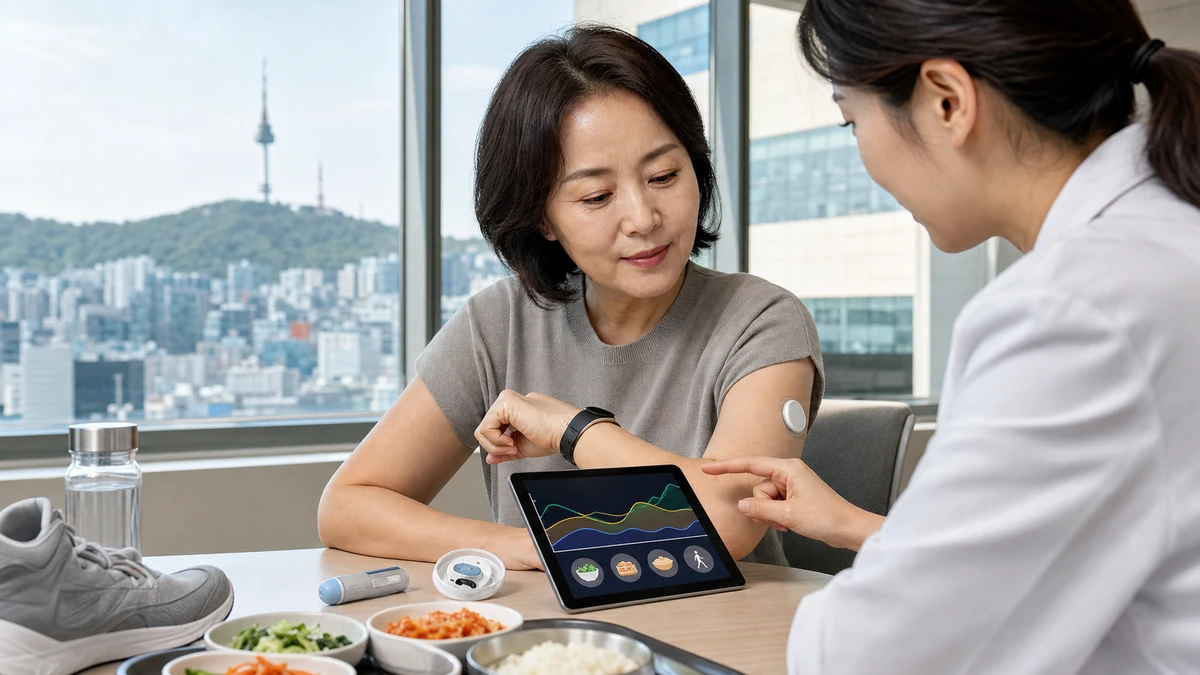
From step counters to blood sugar alerts
Seoul’s city government is taking a familiar piece of consumer health tech — the wearable wellness platform — and pushing it into more medically sensitive territory: real-time blood sugar management. Beginning in September, the city plans to pilot a program that helps residents at high risk of diabetes track glucose changes throughout the day using continuous glucose monitors, or CGMs, while also receiving guidance on meals, exercise and counseling from health professionals.
The program, announced by Seoul officials and reported by Yonhap News Agency, is aimed not at people already diagnosed with diabetes but at residents identified as being in a prediabetic stage during metabolic syndrome screenings. In other words, this is less about treatment than prevention. The city says it will bundle discounted access to CGM devices with professional consultations and lifestyle coaching, then plug that support into its existing public health platform, known as “Sohn Mok Doctor 9988.”
For American readers, the easiest comparison may be a city-run mix of Fitbit, a diabetes-prevention app and a rewards program, all backed by a local government rather than a private insurer or Silicon Valley startup. That is what makes the Seoul experiment notable. In the United States, wearable health tools are everywhere, but they are usually marketed by technology companies, health systems or employers. Seoul is trying something different: using a municipal digital platform to intervene early, before high blood sugar turns into chronic disease.
The name “Sohn Mok Doctor 9988” may sound unusual in English because it carries a distinctly Korean cultural flavor. “Sohn mok” means wrist, a reference to wearable devices, while “9988” is a shorthand expression associated in Korea with the wish to stay healthy until old age — roughly, living vigorously to 99 and then passing peacefully at 88, depending on the phrase’s interpretation in popular use. Like many Korean public campaigns, the branding is practical, a little catchy and built to be memorable in everyday life.
Until now, the platform has been known mainly as a city-backed wellness service that encourages healthier habits through activity tracking and incentives. The new glucose-management component signals a broader ambition. Rather than simply counting steps or logging workouts, Seoul wants residents in a high-risk category to see how their bodies respond in real time to rice, noodles, sleep, stress, walking and other everyday variables. That shift matters because it changes public health from general advice — eat better, move more — into something more personalized and immediate.
In a country that is already highly digitized, deeply urban and comfortable with app-based public services, the pilot may offer a preview of how governments could try to manage chronic disease risk in the future. It is also a reminder that South Korea’s much-discussed technological sophistication is no longer limited to semiconductors, smartphones and high-speed internet. Increasingly, it is being applied to the less glamorous but more universal problem of how to keep people healthier for longer.
Why prediabetes has become a public health battleground
The logic behind Seoul’s new program is straightforward. Prediabetes is a warning sign, not a final diagnosis, but it can be a crucial window for intervention. People in that stage have blood sugar levels that are higher than normal but not yet high enough to qualify as diabetes. Left unchecked, prediabetes can progress into Type 2 diabetes, which in turn raises the risk of heart disease, kidney problems, vision loss and other serious complications.
That basic story is familiar in the United States, where diabetes prevention has become a major public health priority amid rising obesity rates, sedentary lifestyles and an aging population. South Korea faces its own version of the same challenge, though it unfolds in a somewhat different social setting. The country is older than it used to be, work lives can be intense, sleep can be short and meals often combine healthy traditions with increasingly modern patterns of convenience eating. As in many industrialized countries, metabolic disorders are no longer fringe concerns; they are mainstream health risks.
Seoul says the pilot will focus on residents flagged as high-risk through metabolic syndrome screenings. Metabolic syndrome refers to a cluster of conditions — such as elevated blood sugar, high blood pressure, excess abdominal fat and abnormal cholesterol or triglyceride levels — that together increase the risk of diabetes and cardiovascular disease. In practical terms, it is a way of identifying people whose bodies are already showing multiple warning lights at once.
That focus on a clearly defined risk group is important. The city is not presenting CGMs as a gadget for everyone or as a substitute for formal medical diagnosis. Instead, the pilot targets people who have already been identified through screening as needing closer attention to blood sugar and lifestyle management. That makes the program more of a preventive public-health tool than a mass-market tech rollout.
It also reflects a broader lesson that doctors and public health officials have repeated for years: chronic illnesses often emerge gradually, through habits and biological changes that are easy to ignore until they become harder to reverse. If people can see those changes sooner — and understand what they mean — they may have a better chance of changing course.
That is the promise Seoul is trying to test. Rather than asking residents to wait for their next annual checkup, receive a number on a lab report and then vaguely “do better,” the city wants them to watch fluctuations unfold in daily life. Did a late-night convenience-store meal send glucose levels soaring? Did a walk after dinner flatten the spike? Did lack of sleep or a stressful day seem to make control worse? Those are the kinds of patterns CGM users often talk about, and Seoul appears to be betting that seeing them firsthand can motivate behavior change more effectively than general advice alone.
What continuous glucose monitors actually do
At the center of the pilot is the continuous glucose monitor, a small sensor-based device that tracks glucose trends throughout the day and night. Unlike the traditional finger-stick method, which captures a single reading at a single moment, a CGM shows change over time. That makes it easier to understand not just where blood sugar is, but where it is headed and what may have caused it to rise or fall.
For people already living with diabetes, especially those who use insulin, CGMs can be a major management tool. In the United States, they have become increasingly visible through television ads, social media health communities and endorsements from doctors who say better monitoring can reduce dangerous highs and lows. More recently, CGMs have also attracted interest from wellness enthusiasts who do not have diabetes but want insight into their metabolism, though that trend remains controversial among some medical experts who worry about overuse, anxiety or unclear benefits for healthy users.
Seoul’s pilot lands somewhere in the middle of those worlds. It is not positioning CGMs as a consumer biohacking accessory. Nor is it presenting them strictly as a treatment device for diagnosed patients. Instead, the city is using them as a bridge: a way for prediabetic residents to observe their own patterns and adjust behavior with expert support.
That distinction matters. A CGM alone does not prevent diabetes. Data, by itself, can just as easily overwhelm as empower. A line graph showing a blood sugar spike after lunch might be interesting, but if a user does not know whether that spike is meaningful, temporary or alarming, the device may generate more confusion than clarity. That is why Seoul is pairing discounted CGM purchases with professional consultations and guidance on meals and physical activity.
The city’s emphasis suggests an understanding of one of the central tensions in digital health: people can now gather more information about their bodies than ever before, but information is not the same thing as care. What changes outcomes is usually interpretation, follow-through and sustained habit change. Seoul’s design appears to acknowledge that reality by treating real-time glucose data as a prompt for coaching, not an end in itself.
There is also a practical equity dimension here. CGMs can be expensive, and cost remains a barrier even in wealthier societies. By offering discounted access, Seoul is attempting to lower the threshold for participation among people who might benefit from monitoring but would not otherwise buy the device on their own. In the American context, where insurance coverage and out-of-pocket costs often determine who gets access to preventive tools, that may be one of the most striking parts of the model.
How Seoul’s rewards system turns health into daily habit
One of the more distinctly Korean features of the program is the way it links health behavior to a local payments ecosystem. Participants in the Sohn Mok Doctor 9988 platform can earn points for engaging in health management activities, and those points can be converted into Seoul Pay, a local payment system that can be used much like cash at places such as convenience stores, pharmacies and hospitals.
To an American audience, that may sound like a blend of a wellness-rewards app and a municipal stored-value system. It is easy to imagine a U.S. version tied to a transit card, a local digital wallet or insurer-sponsored healthy-living credits. But Seoul’s model is particularly notable because it folds the reward structure into the rhythms of city life. The same program that nudges you to walk more or log your health behavior can also reward you in ways that show up in routine purchases.
This is not a trivial design choice. Public health experts have long known that starting a healthy habit is usually easier than sustaining one. Keeping a food log, walking after meals, attending counseling sessions and monitoring glucose are all behaviors that can fade once enthusiasm wears off. Incentives do not solve that problem on their own, but they can help keep people engaged long enough for routines to become more durable.
There is something culturally revealing here as well. South Korea has become highly adept at integrating digital platforms into ordinary civic and commercial life, from mobile payments to delivery apps to government services. In that setting, using a public health app that also generates spending power is less jarring than it might sound to outsiders. It fits into a broader Korean pattern of dense, app-mediated urban living where technology is expected to be functional, fast and connected to tangible everyday benefits.
Still, incentives have limits. Rewarding someone with points redeemable at a convenience store may boost participation, but it does not automatically produce better metabolic health. Much depends on what residents do with the information they receive and whether the counseling component successfully helps them make better choices over time. The city’s own design seems to recognize this by emphasizing expert support alongside the rewards system.
There is also an irony that Seoul will have to navigate carefully: convenience stores in Korea, as in the United States, can be both useful and nutritionally problematic. They are woven into urban life and can offer everything from bottled water and bananas to sweet drinks, instant noodles and packaged desserts. A rewards structure that broadens access is valuable, but public health results will likely depend on whether participants are also learning how to make smarter choices within the environments they already inhabit.
Why meals, exercise and counseling matter more than the device
The most important part of Seoul’s pilot may be the least flashy. The city is not just handing out a sensor and hoping residents figure it out. It is building the program around the idea that blood sugar numbers only become useful when they are translated into action — especially around eating patterns, movement and routine decision-making.
That may sound obvious, but it addresses a common weakness in digital health initiatives. Technology companies often promise that better data will naturally lead to better outcomes. In reality, many people already know, in broad terms, what healthy advice looks like. The challenge is applying it consistently in real life, under conditions of limited time, stress, habit and convenience. A person may know that a balanced meal is better than a rushed carb-heavy lunch, or that a walk after dinner can help, but knowledge often loses out to schedule, fatigue or temptation.
What real-time glucose monitoring can add is specificity. It can show that two people eating the same meal may have different responses. It can reveal that meal order, portion size, sleep quality or the timing of exercise affects glucose more than someone realized. That is one reason CGMs have drawn so much attention in both clinical medicine and consumer wellness circles: they make the body’s reaction visible.
But visibility is only the first step. Interpreting those reactions requires context. If someone sees a sharp spike after a bowl of white rice, does that mean rice must be eliminated entirely, or simply paired differently with protein, vegetables or post-meal activity? If glucose rises more than expected after a stressful day, is that alarming or understandable? If evening exercise seems to help, what kind of routine is realistic enough to maintain three or four times a week?
Those are coaching questions, not just device questions. By including professional consultation in the pilot, Seoul is effectively saying that the program’s success will depend less on the sensor itself than on whether residents can turn data into manageable lifestyle changes. That is a more modest and probably more credible promise than the sweeping rhetoric that often surrounds digital health technology.
It also aligns with a larger reality in diabetes prevention: no single app, wearable or metric can compensate for a broader environment that pushes people toward inactivity, rushed eating and chronic stress. A city can encourage healthier habits, lower barriers to monitoring and create incentives for participation. But chronic-disease prevention remains slow, personal work. The best technology can do is make that work more visible, more responsive and perhaps a little easier to sustain.
A Korean-style public health experiment with global relevance
What makes Seoul’s pilot especially interesting beyond South Korea is the way it combines several trends that are often discussed separately in the West. There is the rise of wearables. There is the growth of personalized health data. There is the push to prevent chronic disease earlier. There is the effort to build incentives into healthy behavior. And there is the increasing role of local governments in building digital platforms that shape everyday urban life.
In many countries, those elements exist but remain fragmented. A person might use an Apple Watch, receive counseling from a doctor, collect wellness points through an employer and pay for care through an insurer, all without those systems speaking to one another. Seoul’s model, at least in concept, tries to stitch more of that together at the city level for a defined risk group.
That does not mean the model will be easy to replicate elsewhere. South Korea has several structural advantages: dense urban populations, high smartphone penetration, strong digital literacy and a public culture that is generally comfortable with coordinated technology platforms. Americans, by contrast, tend to encounter health care through a far more fragmented system split among private insurers, employers, hospital networks, Medicare, Medicaid and local public health agencies. A city-run glucose-prevention program in the United States would face questions not only about cost and privacy but also about who owns the data, who pays for the devices and how such a program fits into existing care structures.
Even so, Seoul’s pilot points toward a future that many health systems are likely to explore. Chronic diseases account for enormous costs and suffering, and prevention remains both urgent and notoriously difficult. If governments can identify high-risk residents earlier and offer them affordable tools, timely guidance and practical incentives, the payoff could be significant.
The key word, however, is “pilot.” Seoul has not yet laid out, at least in the material summarized publicly, the full scale of the program or whether it will expand citywide after the initial test. Much will depend on uptake, user experience, measurable changes in behavior and whether participants actually improve markers associated with diabetes risk. Like many digital health projects, the concept is easier to announce than to prove.
Still, the announcement is meaningful. It reflects a public-health philosophy that sees disease prevention not as something confined to the doctor’s office, but as something embedded in the ordinary routines of city life: what people eat, when they walk, how they sleep, what they buy and how quickly they can get feedback on their own physical responses.
What Americans can learn from Seoul’s approach
For English-speaking readers, especially in the United States, the broader takeaway is not that Seoul has discovered a magic solution to diabetes prevention. It is that the city is testing a more integrated, behavior-focused model at a moment when health systems around the world are still struggling to move from reactive medicine to proactive care.
Americans are already familiar with many pieces of this approach. Fitness watches and step goals are commonplace. Glucose monitors are increasingly visible. Nutrition apps, employer wellness challenges and pharmacy-based preventive care are all part of the landscape. What is less common is for a local government to package those ideas into one public program aimed specifically at people who are not yet sick, but may be headed in that direction.
That approach may resonate in an era when chronic disease often feels both personal and structural. Individuals are told to exercise more and eat better, yet they live in environments shaped by long commutes, processed food, work stress and uneven access to care. Seoul’s pilot does not erase those pressures, but it tries to meet residents inside daily life rather than waiting for a formal diagnosis to trigger action.
There is also a political subtext. Public trust in institutions can rise or fall depending on whether people feel those institutions help with practical problems. A city-backed health platform that offers real tools, personalized feedback and usable rewards may be one way for local government to show relevance in a digital age. Whether residents embrace it will depend on details — privacy safeguards, ease of use, quality of counseling and whether the benefits feel real rather than bureaucratic.
For now, the pilot stands as a distinctly Korean response to a global problem. It reflects South Korea’s comfort with digital infrastructure, its emphasis on preventive public programs and its habit of linking technology to everyday convenience. But the health issue at its center is not uniquely Korean at all. Prediabetes, metabolic syndrome and the challenge of building sustainable healthy habits are as familiar in Chicago, Houston and Los Angeles as they are in Seoul.
If the program works, its biggest contribution may be conceptual rather than technological. It would suggest that the future of public health is not just more data, but smarter use of data inside ordinary life. Not just a reading on a screen, but a reason to walk after dinner. Not just a warning from a lab result, but a daily nudge before disease takes hold. That is the promise Seoul is putting to the test this fall — and one that health officials far beyond South Korea will likely be watching.
Comments
Post a Comment