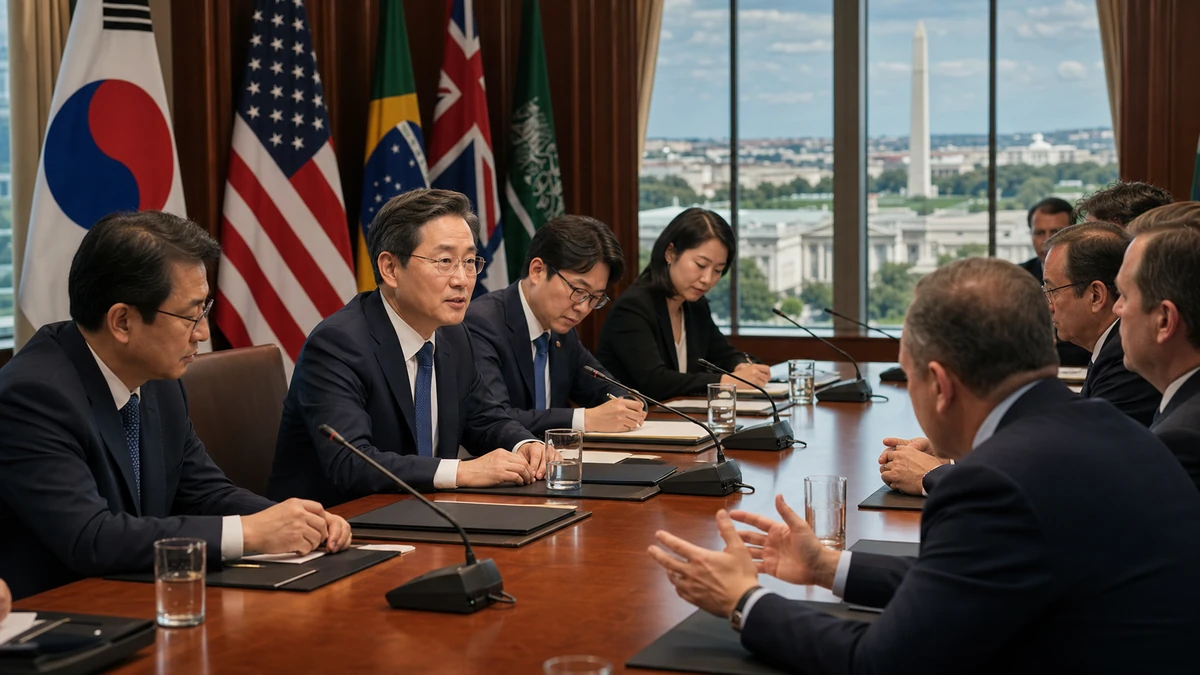
South Korea joins a quiet but consequential phase of global summit diplomacy
South Korea has sent its top G20 representative to Washington for a high-level preparatory meeting ahead of this year’s Group of 20 summit, a sign that Seoul is not simply watching the global economic conversation from the sidelines but actively helping shape it.
According to South Korea’s Foreign Ministry, Kim Hee-sang, the country’s G20 sherpa, attended the two-day senior officials meeting in Washington on June 29 and 30 as Seoul’s chief delegate. The gathering was part of the United States’ preparations as this year’s G20 chair and served as the second regular high-level sherpa meeting leading up to the leaders summit scheduled for December in Miami.
That may sound procedural, even dry. But in the world of summit diplomacy, these are the meetings where the future headlines are often born. By the time presidents and prime ministers appear before cameras for the formal summit, much of the real work has already been negotiated in rooms like this one. Language is tested, priorities are sorted, and areas of disagreement are narrowed before leaders ever arrive.
For American readers, one way to think about it is this: if the summit itself is opening night on Broadway, the sherpa process is the script workshop, rehearsal period and technical run-through combined. It is where governments decide what can realistically be achieved, what will be left vague, and which issues are important enough to elevate into the final communique or other summit deliverables.
South Korea’s participation matters because the country occupies a distinctive place in the global economy. It is a U.S. treaty ally, a major exporter, a technology power and a democracy deeply tied to global supply chains. Americans may know South Korea through K-pop, Korean dramas, Samsung phones, Hyundai cars and a growing list of cultural exports. But in forums like the G20, South Korea shows another side of its global role: not just a producer of influential culture and consumer products, but a middle power deeply invested in the rules and direction of the international economy.
The Washington meeting, from what South Korea has publicly described, did not produce a splashy bilateral announcement or a major standalone Korean proposal. That is not unusual. The significance lies less in a final decision than in participation itself — in being at the table as agendas are structured and as member countries position themselves ahead of ministerial meetings later this year and the summit in Miami.
What a sherpa actually does — and why the title matters
The word “sherpa” can be confusing to readers unfamiliar with summit jargon. Borrowed from the ethnic Sherpa communities of the Himalayas, whose members became associated globally with guiding climbers up Mount Everest, the term in diplomacy refers to the senior official who helps guide a national leader through the complex climb of international summit negotiations.
A sherpa is not the head of state, but in many ways serves as that leader’s advance strategist and chief negotiator for summit preparation. Sherpas meet repeatedly before major summits to work through agendas, draft language, identify red lines and search for consensus. Their work is technical, political and intensely strategic. If leaders later claim a breakthrough, there is a good chance their sherpas spent weeks or months making it possible.
That is why Kim’s presence in Washington matters. As South Korea’s sherpa, he is not attending as an observer or protocol representative. He is there to help shape the framework within which leaders will later talk about trade, energy, growth and innovation. In practical terms, these meetings help determine which ideas become serious agenda items and which fade into the background.
For Americans, there is a rough parallel to the way White House staff, cabinet officials and senior negotiators prepare the ground before a high-stakes summit or congressional deal. The public often focuses on the president’s speech or handshake, but the outcome depends heavily on what happened beforehand in detailed policy talks. In international diplomacy, the sherpa process fills that role.
In South Korea’s case, the fact that the Foreign Ministry publicly highlighted Kim’s participation suggests Seoul sees value in signaling that it is engaged early in the process. Diplomatic attendance can itself be a message: we are present, we are listening, and we expect our interests to be reflected as global priorities take shape.
That message is especially relevant at a moment when economic diplomacy is increasingly inseparable from national security. Trade policy, energy access, regulation, supply-chain resilience and emerging technology are no longer niche technocratic topics. They affect inflation, manufacturing, jobs, geopolitical leverage and the everyday cost of living. A meeting that once might have been framed narrowly as economic coordination now sits closer to the center of strategic policymaking.
The four U.S.-led working groups reflect the world’s biggest economic anxieties
At the center of the Washington discussions were four working groups being led by the United States as this year’s G20 chair: trade, energy abundance, economic growth and deregulation, and innovation. Even without a detailed readout of who said what, those four categories reveal a great deal about what major economies see as their most urgent concerns.
Trade remains the backbone of the global system, even as it becomes more politically contested. For a country like South Korea, whose economy depends heavily on exports and cross-border industrial networks, the direction of G20 trade discussions matters enormously. South Korean companies are embedded in sectors that Americans know well — semiconductors, automobiles, batteries, consumer electronics, shipbuilding and advanced manufacturing. Any shift in the tone or substance of global trade policy can ripple through those industries.
For American households, trade may sound abstract until it shows up in the price of a car, the availability of electronics, or the resilience of supply chains during a crisis. Since the pandemic, U.S. policymakers have been far more focused on how goods move across borders and where critical inputs come from. South Korea, as a major supplier and production partner, has a direct stake in those discussions.
The inclusion of “energy abundance” is also telling. That phrase suggests an emphasis not only on energy security but on availability, affordability and the infrastructure needed to sustain economic growth. In the U.S., energy debates often split between climate policy, fossil fuel production, utility prices and industrial competitiveness. Internationally, those same tensions play out at a larger scale. Governments want cleaner systems, but they also want stable power, manageable prices and strategic independence.
South Korea has good reason to pay attention. It is a major industrial economy with substantial energy needs and limited domestic natural resources, making it especially sensitive to global energy markets and long-term transitions in power generation, fuel supply and infrastructure. Decisions or even broad political direction set at the G20 can influence how countries think about energy cooperation, investment and risk.
The working group on economic growth and deregulation speaks to another current in global policymaking: the search for ways to stimulate investment and productivity without choking business activity under overly complex rules. Americans are familiar with this debate from domestic politics, where arguments over regulation often touch everything from banking to clean energy permits to startup formation. At the G20 level, the conversation is broader but related. Countries are looking for policy frameworks that support growth while competing for capital, talent and industrial leadership.
Then there is innovation — arguably the most expansive and politically charged category of all. In 2025, innovation is not just shorthand for Silicon Valley-style entrepreneurship. It can encompass artificial intelligence, digital infrastructure, semiconductors, biotech, advanced manufacturing, data governance and the race to commercialize emerging technologies. For South Korea, one of the world’s most wired and technologically sophisticated economies, this is not a side topic. It is central to its economic future.
For the U.S., too, innovation is increasingly tied to strategic competition. Washington has spent years rethinking industrial policy, supply chains and technology controls. That means G20 discussions about innovation are likely to carry implications that go far beyond generic praise for new ideas. Even when no specific policy is announced, the vocabulary countries choose can reveal how they want to frame the next stage of economic competition.
Why South Korea’s role matters beyond K-pop and consumer brands
For many Americans, South Korea is one of those countries that can feel both familiar and underexplained. Familiar because its culture has gone global. Underexplained because the country is still too often seen primarily through the lens of North Korea tensions or entertainment exports. In reality, South Korea is also a major diplomatic and economic actor with interests that stretch well beyond the Korean Peninsula.
Its presence in G20 preparations underscores that reality. South Korea is not one of the largest countries by population or territory, but it routinely punches above its weight in trade, technology and industrial output. It is home to companies that help power the devices Americans use every day and the manufacturing networks governments increasingly treat as strategically important. It is also one of the few countries that has moved within a generation from aid recipient to advanced economy, giving it a distinct perspective in international forums where developed and developing nations do not always share the same priorities.
That background helps explain why Seoul values engagement in institutions like the G20. These meetings allow South Korea to do more than react to decisions made by bigger powers. They give it an opportunity to press its interests, build coalitions and make sure its economic priorities are understood in rooms where major agendas are set.
There is also symbolic importance here. The G20 was created to bring together not just the traditional Western powers but a broader set of major economies whose decisions affect global stability. South Korea’s continued visibility in that setting reinforces its status as a country that belongs in top-tier discussions about growth, regulation, energy and innovation.
For an American audience, this is a useful reminder that alliances today are not defined only by military cooperation. The U.S.-South Korea relationship increasingly spans chips, electric vehicle batteries, critical minerals, technology standards and industrial policy. When South Korea participates in G20 agenda-setting, it does so as a partner whose choices can affect American economic interests in concrete ways.
It also highlights a broader trend in how Seoul presents itself internationally. South Korea has spent years broadening its global brand. The Korean Wave, or “Hallyu,” helped familiarize the world with Korean music, television, film, food and beauty products. But Korean officials have also worked to position the country as a serious stakeholder in global governance, whether on health, development, climate, digital policy or economic coordination. A sherpa meeting in Washington may not generate the same attention as a hit Netflix series, but it reflects the same larger story: South Korea is increasingly visible on the world stage, and not by accident.
The U.S. chairmanship and the road to the Miami summit
This year’s G20 chair is the United States, which means Washington is responsible for steering the summit process, convening regular high-level sherpa meetings and guiding member states toward whatever outcomes are possible by December. Under that structure, the host country does more than provide a venue. It plays a central role in shaping the architecture of the discussion.
The Washington gathering was the second of what are typically four regular sherpa-level meetings held by the chair over the course of the year. That puts the process in a midpoint phase: far enough along that priorities are becoming clearer, but still early enough for countries to influence how those priorities are framed in the months ahead.
The summit itself is scheduled for Miami in December, a location that carries its own symbolism. Miami is not Washington, New York or a traditional diplomatic capital. It is a global city with deep links to Latin America, international finance, migration and trade. Holding a summit there could reinforce a message about the Americas, connectivity and the changing geography of influence. It also reflects how major U.S.-hosted events increasingly aim to project not just federal power but the broader economic and cultural reach of the country.
South Korea’s Foreign Ministry said the United States briefed members on the progress of discussions in each of the four working groups and on plans for later ministerial meetings and final summit outcomes. The U.S. also asked for cooperation from member countries in producing visible results by the time leaders gather in Miami.
That is a familiar challenge in G20 diplomacy. The group is powerful because its members collectively account for most of the world economy, but it is also unwieldy because those members have divergent political systems, strategic rivalries and economic priorities. Reaching consensus can be difficult even on broad principles, let alone specific measures. The chair’s job is part traffic control, part persuasion and part damage limitation.
For South Korea, attending these interim meetings is one way to make sure it is not merely reacting to a draft text in the final days before the summit. It can hear firsthand how the U.S. wants to frame progress, what kinds of compromise may be emerging and where points of friction remain. Even when outcomes are modest, process matters. Countries that engage early often have a better chance of shaping the tone and content of final documents.
Just as important, this phase allows governments to coordinate expectations. That can prevent political embarrassment later by ensuring leaders are not asked to endorse language their teams have not adequately vetted. It may not be glamorous, but it is essential to how modern summitry works.
What is known — and what is not — at this stage
There are limits to what can be said about the Washington meeting based on the information made public so far. South Korea has confirmed Kim’s attendance and described the broad scope of discussions, including the four U.S.-run working groups and the focus on preparations for ministerial meetings and the Miami summit. But it has not publicly detailed any specific Korean proposal, line-by-line negotiation or finalized agreement emerging from this session.
That matters, especially in a media environment where diplomatic participation is sometimes overstated as a policy breakthrough. At this point, the safest conclusion is not that Seoul won a concession or announced a new initiative, but that it is actively engaged in the preparatory process and directly involved in exchanges over the direction of upcoming G20 work.
That may sound modest, but in multilateral diplomacy it is often how meaningful influence begins. Much of international negotiation happens incrementally. A country signals concern here, supports a formulation there, resists a phrase in one document, endorses a compromise in another. Over time, those choices shape the final product. Publicly, however, that work often appears only as a short notice about attendance at a preparatory meeting.
It is also worth noting what this story is not about. It is not about a new South Korean domestic policy. It is not about a new bilateral initiative with the U.S. And it is not, based on the information available, about a major negotiated breakthrough on trade or technology. The headline development is participation and coordination — not a concluded deal.
Still, participation can be substantive. In global economic governance, being inside the conversation matters. It gives governments the chance to defend national interests, test ideas with partners and understand where the political momentum is heading before formal decisions are made.
For a country like South Korea, whose economy is highly exposed to shifts in global demand, trade architecture, technology policy and energy markets, that kind of early engagement is not optional. It is part of protecting national interests in an era when economic questions are increasingly settled through international bargaining as much as domestic policymaking.
Why American readers should pay attention
At first glance, a South Korean official attending a G20 sherpa meeting in Washington may seem like niche diplomatic news. But the issues under discussion are tied closely to everyday concerns in the United States: inflation, job growth, energy prices, supply-chain stability, technological competition and the rules governing the global economy.
When major economies talk about trade, Americans can feel the effects in product availability and industrial policy. When they debate energy abundance, the consequences can reach everything from electricity bills to factory investment. When they discuss growth and deregulation, those ideas can influence how countries compete for business and how they design policy around investment. And when innovation is on the agenda, the debate touches artificial intelligence, chip production and the next generation of strategic industries.
South Korea’s role matters because it is deeply connected to all of those areas. It is a major semiconductor power, a key manufacturing ally and an increasingly important partner in the technologies that Washington sees as central to economic security. Whether Americans realize it or not, many of the products, components and industries that shape life in the U.S. are linked to Korean firms and Korean policy choices.
There is also a broader lesson in the story. News about South Korea often reaches American audiences through two familiar channels: security crises involving North Korea or cultural moments driven by the Korean Wave. Both are important, but neither fully captures Seoul’s place in the world. Stories like this one show a more institutional kind of influence — slower, less flashy and arguably more consequential over time.
By taking part in the Washington sherpa meeting, South Korea demonstrated that it is engaged in the behind-the-scenes mechanics of global economic governance. The meeting did not produce a grand announcement, and it was not meant to. Its importance lies in the quieter work of alignment, persuasion and preparation that ultimately shapes what leaders can claim when they meet in Miami in December.
In that sense, the takeaway is straightforward. South Korea is not just a country whose music, television and brands travel well overseas. It is also a country helping negotiate the frameworks that affect trade, energy, growth and innovation worldwide. For Americans trying to understand the real scope of South Korea’s international role, that may be the most important part of the story.
Comments
Post a Comment