From City Hall Paperwork to Repairs at Home
In one district of Seoul, local officials are trying to redefine what social welfare looks like for older residents living on limited incomes. Instead of focusing only on cash assistance, formal benefits or paperwork-heavy social services, the Seoul district of Seongbuk has launched a program aimed at something much more ordinary: fixing the small problems around the house that can quietly become major threats to safety and independence.
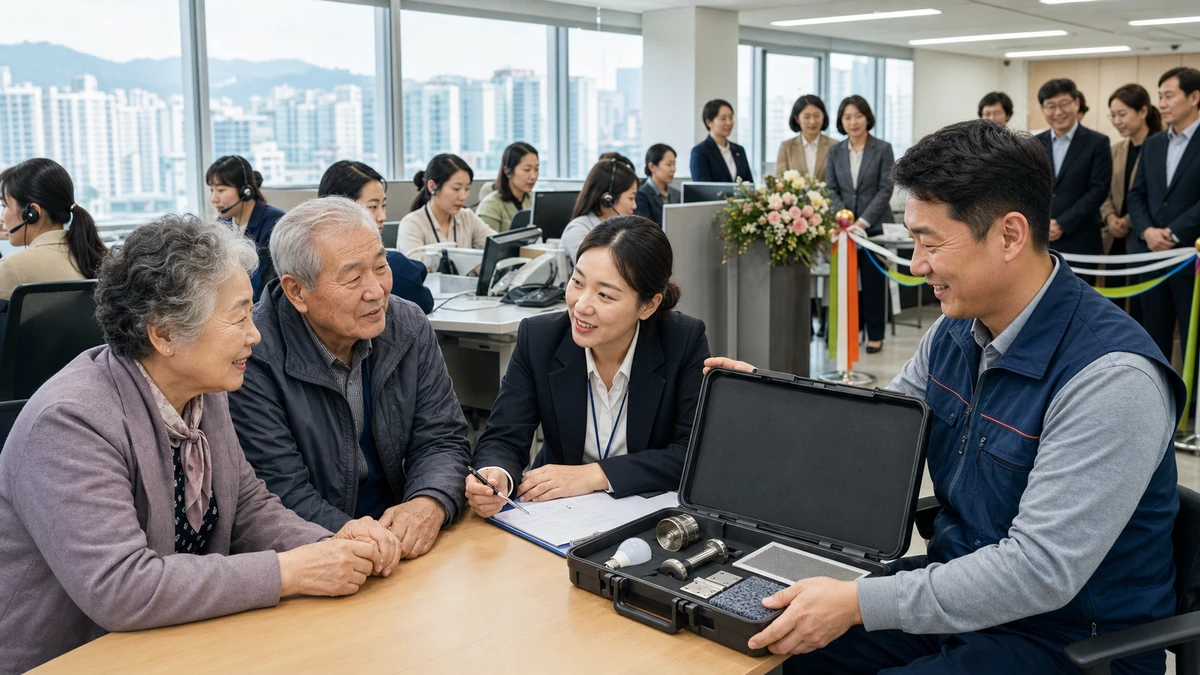
The new initiative, called the Seongbuk Haedeurim Center, officially opened this week as the first signature project of Seongbuk’s new local administration. The center is designed to help low-income senior households with minor but essential home repairs, including replacing fluorescent lights and light bulbs, repairing door handles and hinges, fixing window screens and installing anti-slip pads.
To an American reader, that list may sound less like a traditional welfare program than a hybrid of a senior services office, a handyman hotline and a fall-prevention campaign. But that is exactly what makes the launch notable. In a rapidly aging society, Seongbuk officials are betting that modest repairs inside a home can do more to protect dignity and daily independence than another stack of forms or another office appointment.
Seongbuk is one of Seoul’s 25 district-level governments, roughly comparable in some ways to a city borough or a county subdivision with its own local administrative responsibilities. In South Korea, these district governments often serve as the most direct point of contact between residents and the state. While national ministries set broad welfare policy, it is often the local district office that residents actually call when they need help navigating daily life.
The Haedeurim Center is housed inside the district office’s welfare policy division, where dedicated staff members will manage requests, operate a call center and connect households to services. The structure matters. Rather than asking older residents to figure out which government office handles which problem, the district is trying to create a one-stop front door for routine household difficulties that many younger or wealthier residents might solve with a quick trip to a hardware store or a service app.
For older adults on tight budgets, especially those living alone, those “small” problems are rarely small for long. A dim light in a hallway can increase the risk of a fall. A broken door handle can turn into a daily hazard. A damaged screen can become a health and comfort issue during hot weather. A slippery floor in a bathroom or entryway can mean the difference between aging safely at home and suffering an injury that leads to hospitalization.
What Seongbuk is doing, in other words, is moving welfare out of the office and into the home — and grounding it in the ordinary mechanics of everyday life.
Why Small Repairs Matter More Than They Sound
The logic behind the new center is rooted in a reality that the United States, Japan and many European countries also know well: older adults often want to remain in their own homes as long as possible, but the home itself can become a barrier to safe living.
In the United States, the phrase “aging in place” has become standard shorthand for helping seniors stay in familiar surroundings rather than move into nursing homes or assisted living facilities. That concept usually brings to mind wheelchair ramps, walk-in showers or expensive remodeling. But many of the most immediate risks are lower-cost and less dramatic. Loose flooring, poor lighting, malfunctioning doors and slippery surfaces cause real danger, especially for people with limited mobility, reduced vision or chronic health conditions.
Seongbuk’s program appears built around that practical insight. The district is not promising major renovations or large-scale housing reconstruction. Instead, it is targeting the nagging repairs that pile up in older housing and often go unresolved because they seem too minor for emergency help but too difficult, costly or intimidating for an older person to handle alone.
That is particularly important in South Korea, where rapid urban development has often existed alongside older apartment buildings and long-lived neighborhoods. A district like Seongbuk includes a mix of housing types, from denser urban residences to aging homes where maintenance needs can accumulate over time. For low-income seniors, even a simple service call can be financially burdensome. Beyond cost, there is also the challenge of access: finding a trustworthy repair person, scheduling a visit and explaining the problem can all be obstacles.
Officials in Seongbuk are framing the center as a form of “daily life-oriented welfare,” a phrase that reflects a broader Korean administrative style of emphasizing close-to-home, resident-centered services. The idea is that public support should not stop at benefit eligibility. It should also help remove the routine frictions that make daily life harder, less safe and less independent.
In practical terms, that means recognizing that an elderly person’s quality of life can hinge on whether a light turns on reliably, whether a door closes properly and whether a floor is safe to walk across.
American policymakers and social service agencies have been moving in a similar direction in recent years, especially in public health and elder care. Programs that address “social determinants of health” increasingly look beyond hospitals and prescriptions to factors like housing quality, food access and home safety. Seongbuk’s new center fits squarely within that way of thinking, even if it uses the language of local welfare rather than health care reform.
Aging in South Korea Is Reshaping Local Government
The opening of the Seongbuk Haedeurim Center also reflects a larger demographic shift that is transforming South Korea at remarkable speed. The country is one of the fastest-aging societies in the world, a reality driven by low birthrates and rising life expectancy. While international coverage of South Korea often focuses on K-pop, semiconductors, beauty brands and geopolitical tensions with North Korea, another story is unfolding more quietly in city neighborhoods and district offices: how to build a livable society for a much older population.
That challenge is especially pressing for lower-income seniors. South Korea’s industrial rise happened so quickly that many older adults lived through war, poverty and social upheaval before the country became one of the world’s most advanced economies. As a result, some elderly Koreans entered old age without the level of retirement security that Americans might associate with a mature welfare state. Senior poverty has long been a major concern in Korea, even as the country’s global profile has soared.
That tension — immense national wealth alongside vulnerability among many older residents — helps explain why local governments are experimenting with hands-on programs like this one. For a low-income senior, the question is not simply whether a pension check arrives. It is whether the home remains functional, safe and manageable.
In Korea, the term “eoreusin,” often translated as “elder” or “senior,” carries more cultural weight than a purely demographic label. It reflects social respect for older people and is embedded in norms of family duty and hierarchy shaped by Confucian tradition. But cultural respect does not automatically solve material hardship, especially in an urbanized, modern economy where family structures are changing and more older adults live alone.
That gap between cultural expectation and practical support is where district-level policies increasingly matter. If family members live far away, work long hours or face financial pressures of their own, local government becomes a critical support system. A resident who cannot replace a burned-out kitchen light or fix a loose door latch may not need a large welfare intervention, but they do need a responsive one.
Seongbuk’s decision to make this the first approved project of the new administration sends a political message as well. Mayor Lee Seung-ro said he chose the initiative as his administration’s first official priority because he wanted to pursue welfare that “finds answers in the field,” helping make daily life safer and more comfortable for older residents. In local political terms, that is a declaration about what kind of governance the district wants to represent: visible, practical and measured by lived experience rather than slogans alone.
The Symbolism of a Call Center and a Door Hinge
There is something deceptively powerful about the design of the Haedeurim Center. It is not just a repair dispatch service. According to district officials, the center will manage complaints or requests related to daily living inconveniences, run a call center and connect residents to appropriate service support. That makes it less like a standalone maintenance crew and more like an administrative platform that receives, sorts and resolves practical household problems.
That may sound bureaucratic, but it addresses a common flaw in public services nearly everywhere: fragmentation. Older residents are often expected to know which office handles housing, which office handles welfare, which office handles safety and which nonprofit or contractor can actually do the repair. That system assumes a level of time, mobility and confidence that not everyone has.
By centralizing intake and coordination, Seongbuk is trying to reduce what Americans might call the “runaround.” Instead of forcing an elderly resident to navigate multiple departments, the district is creating a single entry point. The strategy is especially relevant for people who may be uncomfortable with digital systems, smartphone apps or online service marketplaces.
The center’s name also carries a tone of reassurance. “Haedeurim” suggests helping or doing something for someone in a supportive way, the kind of naming local Korean programs often use to signal warmth and care rather than cold administration. For American readers, a rough comparison might be the way community programs are often branded with words like “neighbors,” “care” or “support” to emphasize approachability.
Even the supported repair items reveal a philosophy. Anti-slip pads are not glamorous, but falls are one of the biggest threats to senior health in any aging society. Window screens may seem trivial, but in humid summer weather they affect ventilation, insects and comfort. Door hinges and handles are mundane until arthritis, limited grip strength or balance issues turn them into daily obstacles. Good lighting, meanwhile, is one of the simplest ways to improve safety and reduce accidents.
Urban policy often gets attention when it involves large budgets, dramatic construction or cutting-edge technology. But life in a city can be made or broken by the reliability of very basic things. A resident does not experience government only through tax policy or infrastructure megaprojects. They experience it when a small but persistent problem finally gets solved.
That may be one reason Seongbuk’s approach has broader significance. It suggests that “age-friendly cities” are not built only through grand urban design plans. Sometimes they are built through a functioning light fixture, a safe floor and a local office that picks up the phone.
A Pilot Program With Broader Implications
District officials say the center will operate on a pilot basis through the end of the year, with plans to refine the system after evaluating how it works in practice. That cautious rollout is telling. Small-repair welfare may sound simple, but building an effective system requires choices about triage, staffing, response times and service standards.
What qualifies as urgent? How are requests prioritized if need exceeds capacity? How does the district verify income eligibility or identify seniors most at risk? What happens when a “small repair” turns out to be evidence of a larger housing problem? And how should local government draw the line between basic safety support and more extensive home improvement?
Those are the kinds of questions a pilot program can surface. Officials appear to understand that the model will need adjustment based on real demand. One household may need a screen repaired immediately during the summer. Another may urgently need lighting replaced or a dangerous threshold stabilized. Over time, the district will likely learn which requests are most common, which interventions produce the greatest benefit and whether additional partnerships are needed with contractors, community groups or health services.
There is also the question of scale. The district has not, based on the information released so far, detailed the full budget, expected number of households served or how far the program could expand after the trial period. Still, the pilot itself indicates that Seongbuk sees this as more than a one-off gesture. It is trying to build an operational model that could become a permanent part of elder welfare policy.
That alone makes the initiative worth watching. Local government innovations often begin with narrow, highly practical experiments rather than sweeping reforms. If the program proves effective, it could become a template for other Seoul districts or municipalities elsewhere in South Korea. Given the country’s aging demographics, officials across the nation will be under pressure to find interventions that are affordable, visible and capable of producing immediate improvements in daily life.
And because the program focuses on prevention rather than crisis response, it may appeal to policymakers beyond Korea as well. A relatively low-cost repair completed early can be far cheaper than the medical, caregiving or institutional costs that follow a serious fall or a decline in home safety.
What Other Countries Can Learn From Seongbuk
For international readers, the lesson from Seongbuk is not that every city should copy this program exactly. Housing stock differs, government systems differ and the needs of older adults vary from place to place. But the district’s approach highlights a question that cities around the world should be asking: Are public services designed around how older people actually live, or around how bureaucracies prefer to categorize problems?
Too often, social welfare is divided into rigid boxes. One office handles income support. Another handles housing. Another handles disability services. Another handles public health. But real life does not arrive in separate files. For a low-income senior, a broken light fixture can be a health issue, a housing issue, a mobility issue and a social welfare issue all at once.
That is why Seongbuk’s experiment feels timely. It treats the home as a frontline site of welfare policy. It assumes that preserving independence may depend as much on fixing practical obstacles as on expanding formal benefits. And it recognizes that for many elderly residents, the hardest part of getting help is not the repair itself but navigating the system needed to request it.
In the United States, cities and counties have tested comparable ideas through home modification grants, nonprofit repair programs and coordinated aging services. But those efforts are often patchy, funding-dependent or fragmented across agencies. Seongbuk’s model stands out because it is being housed directly within district government and explicitly framed as a central welfare function, not a charitable add-on.
That distinction matters. When a government formalizes small-scale household repairs as part of its social support mission, it makes a statement about what counts as public care. It suggests that dignity in old age includes not only medical access or income assistance, but also the ability to move safely through one’s own home, close one’s own door and live without avoidable hazards.
In a city celebrated globally for its high-tech image and relentless pace, Seongbuk’s new center points in a humbler direction. It says that not every meaningful innovation comes from an app, a tower or a billion-dollar redevelopment plan. Sometimes innovation is a district office deciding that a senior citizen should not have to choose between paying a bill and fixing a dangerous floor.
The launch of the Seongbuk Haedeurim Center will not by itself solve the broad challenges of aging, poverty or housing inequality in South Korea. But it offers a concrete glimpse of what responsive local government can look like. It is small-scale, unglamorous and highly specific. And that may be exactly why it matters.
In public policy, grand promises often grab attention. What people remember, however, are the moments when government tangibly improves daily life. In Seongbuk, officials are wagering that one repaired hinge, one brighter hallway and one safer apartment at a time can add up to something larger: an age-friendlier city and a more human form of welfare.
Comments
Post a Comment