South Korea Waits on World Cup Math After Costly Loss, Training in Mexico as Knockout Hopes Hang in the Balance
A team caught between elimination and possibility
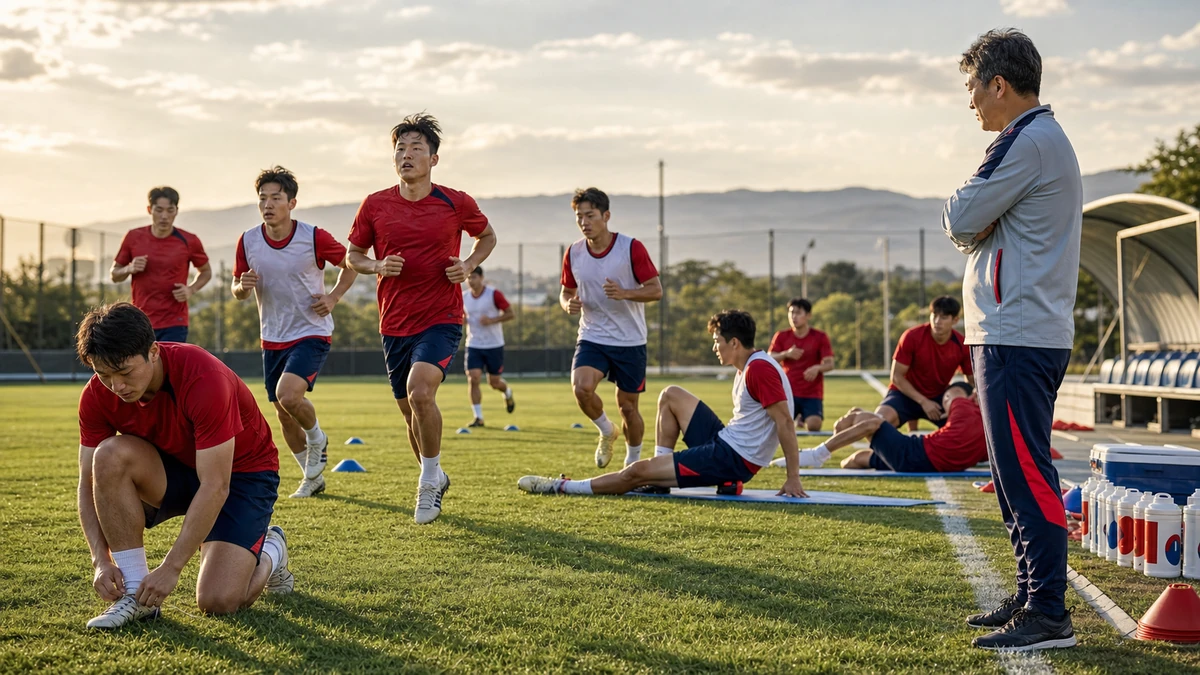
ZAPOPAN, Mexico — South Korea’s national soccer team returned to the training ground Sunday in a mood that was equal parts routine and reckoning. At Chivas Verde Valle, the training complex near Guadalajara where the team has been based during the 2026 World Cup, players ran drills, coaches watched closely and the work of a tournament continued. But this was not a normal practice. South Korea was training without knowing whether it would get another meaningful game to play.
That uncertainty followed a damaging 1-0 loss to South Africa on June 25 in the team’s third and final Group A match, a result that dropped South Korea to third place in the group with three points. A draw would have been enough to send the Koreans into the round of 32. Instead, one of Asia’s most closely watched soccer powers was left depending on results elsewhere, forced into the uncomfortable role of spectator while other groups finished their schedules.
In American sports terms, it is something like an NFL team finishing the regular season on the couch, scoreboard-watching on the final Sunday and hoping for a string of favorable outcomes. Except at the World Cup, the emotional stakes are amplified by national identity, global scrutiny and the simple finality of the event. There is no next week if the numbers do not break your way.
For South Korea, that is what made Sunday’s training session more than a recovery workout. It was a public act of readiness in the middle of private anxiety. The players had taken a day to regroup after the defeat, then returned to the field knowing this might be their last session together in the tournament. They trained anyway, because that is what teams do when they still have even the thinnest path forward.
The scene reflected one of the harshest emotional spaces in sports: not when a team has definitively lost, but when it cannot yet tell whether it is still alive.
The loss that changed everything
South Korea entered its final group-stage match with a straightforward assignment. Avoid defeat, and the team would advance. That kind of scenario can be dangerous in tournament soccer, where playing not to lose often invites tension, caution and the sort of mistake that becomes impossible to erase. Against South Africa, South Korea did not find the control or urgency the moment required. The 1-0 loss transformed what could have been a relatively calm progression into a tense waiting game.
On paper, the difference between second place and third place in a World Cup group can look small: one point, one goal, one lapse in concentration. In practice, it can mean the difference between controlling your own future and surrendering it to the schedule. South Korea now sits in exactly that position, forced to monitor the remaining matches in other groups and calculate whether its point total and tiebreakers will be enough to carry it into the knockout stage.
That reality has produced frustration among fans and no shortage of criticism at home. South Korean soccer supporters are deeply invested in the national team, which is commonly referred to as the Taegeuk Warriors — a nickname drawn from the taegeuk, the red-and-blue symbol at the center of the South Korean flag. The term conveys more than simple branding. It suggests that national team players are carrying not just competitive ambitions but a broader sense of national representation.
That symbolism helps explain why a flat performance can resonate so strongly. In South Korea, as in many soccer nations, supporters can forgive a loss more easily than they can forgive a display perceived as passive or lacking fight. What stung about the defeat to South Africa was not only the scoreboard but the feeling that South Korea had let a manageable opportunity slip away without fully imposing itself on the game.
That perception surfaced again in the comments players made after returning to training — remarks that offered a window into the team’s state of mind and the standards it believes it failed to meet.
What the players said — and why it matters
Midfielder Kim Jin-gyu delivered the most striking quote of the day, saying that if another chance comes, the team will throw itself into the effort and not repeat the lifeless showing from the third match. His language was blunt and physical, the kind of statement athletes make when they know explanations will not satisfy anyone. The point was less tactical than moral: South Korea believes it owes a more forceful version of itself if the tournament grants it one more opening.
For American readers, it may help to understand that athletes in South Korea often speak in a register that places strong emphasis on collective responsibility, effort and humility after failure. Public self-criticism is not unusual, especially after a major national disappointment. Kim’s comments fit that tradition. He was not offering a technical breakdown of shape, pressing triggers or finishing chances. He was saying, in effect, that the team must show greater commitment and intensity than it did in a game that carried knockout-stage stakes.
Winger Yang Hyun-jun was even more direct about the team’s mood. He said the atmosphere, frankly, was not good, and that the players would have to watch and root through the remaining matches in other groups. It was an unusually candid acknowledgment of helplessness — the kind of truth athletes do not always say out loud during a major tournament.
There is a particular discomfort in that admission. Elite players are conditioned to believe outcomes should be decided by their own performance, not by remote scorelines scrolling across television screens. Yet that is exactly where South Korea finds itself. The games that matter most now are games its players cannot influence.
Kim, who plays club soccer for Jeonbuk Hyundai Motors in Korea’s K League, and Yang, who plays for Celtic in Scotland, also represent two important strands of modern South Korean soccer. One is rooted in the domestic league system that continues to develop and produce national team talent. The other reflects the increasingly global footprint of Korean players, many of whom build careers in Europe and bring that experience back into international competition. In normal times, that blend can be a strength. In moments like this, it becomes part of the question: Why did a team with this much talent and exposure fail to secure the single result it needed?
Those answers will be argued over at length if South Korea is eliminated. For now, the players’ comments suggest that inside the camp, the first response is not excuse-making but acknowledgment.
Hong Myung-bo and the pressure of managing uncertainty
Manager Hong Myung-bo, one of the most recognizable names in South Korean soccer, cut a quiet figure at training as he watched his players work. For older American fans who remember international tournaments from the 1990s and early 2000s, Hong is more than a coach. He is a former South Korean captain and one of the defining figures of the country’s soccer rise, especially during the 2002 World Cup, when South Korea reached the semifinals on home soil in one of the most memorable runs in modern tournament history.
That 2002 team remains a touchstone in South Korea, much the way the 1999 U.S. women’s national team or the 1980 “Miracle on Ice” remains woven into the American sports imagination. It was not just about winning games. It was about a nation seeing itself perform boldly on one of the world’s biggest stages. Every South Korean men’s national team since then has played in the long shadow of that achievement.
That history sharpens the pressure on Hong. He is not merely coaching a group of players through a difficult patch. He is managing expectations shaped by decades of World Cup appearances and by a national soccer culture that expects competitiveness, discipline and emotional resilience. South Korea has long been viewed as one of Asia’s most reliable World Cup participants, a team capable of upsetting stronger opponents and making life difficult for almost anyone. That reputation is part of why the current predicament feels so jarring.
Still, there was meaning in Hong’s restraint at training. Silence in this setting does not necessarily indicate resignation. Often, it signals an understanding that words have limited value until the bracket is settled. There is no tactical speech that can alter a match already played. What a coaching staff can do is preserve readiness — keep players sharp, focused and physically prepared in case the standings turn in their favor.
That is a difficult assignment. It requires convincing athletes to maintain competitive intensity while they wait for events beyond their control. Too much emotional drain, and a team can look flat if it advances. Too much false hope, and the eventual blow of elimination can be even harder. Managers in this situation must strike a balance between realism and belief, a line Hong appeared to be trying to hold.
Why this moment feels so familiar in Korean sports culture
To understand why this story carries such weight in South Korea, it helps to see the national team not just as a sports program but as a recurring stage for collective emotion. International competitions in South Korea often become shared civic events, drawing viewers far beyond the usual base of club soccer fans. During major tournaments, public watch parties, late-night crowds and intense media coverage can make a national team game feel closer to a political event or a major holiday than an ordinary sporting contest.
That broad investment has roots in modern Korean history. For a country that rapidly transformed itself economically and culturally over the past several decades, international sports have often served as a highly visible measure of arrival and recognition. Just as K-pop, Korean film and television have introduced global audiences to South Korean culture in recent years, the men’s national soccer team has long functioned as one of the country’s most visible ambassadors on the world stage.
American audiences may be more familiar today with Korean cultural exports such as BTS, “Parasite” or “Squid Game.” But before the current Korean Wave became a mainstream term in the United States, the World Cup was one of the clearest ways many global audiences encountered South Korea in a mass, emotional setting. That visibility matters. When the team underperforms, the disappointment is not confined to sports talk radio or social media arguments about formations. It taps into larger ideas about representation, pride and how the country is seen abroad.
There is also a distinctly Korean dimension to how disappointment is processed publicly. Athletes and coaches are often expected to show accountability in direct terms, and supporters can be unforgiving when they believe a team has fallen short in spirit as well as execution. That helps explain why words like “lifeless” or references to fighting harder carry such significance. They are not clichés tossed out after a bad day. They are judgments about whether a team honored the seriousness of the moment.
At the same time, persistence itself has symbolic value. The image of players returning to the field in a subdued mood, still training while uncertain of their fate, resonates because it reflects a familiar sports narrative: even after a bitter setback, the proper response is to continue preparing. For fans looking for a reason not to disconnect, that can be enough to keep hope alive a little longer.
The brutal logic of tournament soccer
World Cup soccer has a way of exposing how thin the line is between order and chaos. Over a long club season, talent usually asserts itself across months of matches. In a short international tournament, one off night can distort everything. A single defensive lapse, a missed chance in front of goal or a few minutes of lost composure can turn a stable campaign into a desperate chain of scenarios.
That is the math South Korea is living with now. The team’s situation is not unusual in World Cup history, but it is always cruel. When a nation with genuine expectations reaches the point of depending on other groups, the loss of agency becomes part of the punishment. Players are left to analyze what they should have controlled, while fans begin studying permutations and tiebreakers with the fervor of tax accountants in late April.
For Americans who follow March Madness, the feeling is not entirely foreign. It resembles the tension of the NCAA tournament bubble, when teams that failed to handle their business spend Selection Sunday hoping the committee sees things kindly. The difference is that in the World Cup, the calculations unfold in real time and under global scrutiny, with no room for spin once the numbers harden into fact.
South Korea’s predicament also underscores a broader truth about the expanded 2026 tournament format. More teams means more pathways into the knockout round, but it also creates more conditional dramas — more third-place calculations, more scoreboard dependency and more emotionally suspended teams living from one outside result to the next. For television networks and neutral fans, that can be compelling. For the teams involved, it is exhausting.
And yet, this is also where sports produce some of their most enduring stories. A team that backs into the knockout stage can suddenly look reborn three days later. A side that seemed dead can gain fresh psychological life simply because it has been granted one more chance. That possibility, however slim, is why South Korea trained in Zapopan instead of packing up.
What comes next for South Korea — and what the world is watching
If South Korea advances, the conversation will shift immediately from regret to recovery. The central question will become whether the team can restore the energy and conviction it lacked against South Africa. The players themselves have already framed the issue in those terms. It is not enough to survive on tiebreakers; a team that enters the knockout stage through the side door still has to prove it belongs there.
If South Korea is eliminated, the loss to South Africa will linger as one of those tournament moments that feels preventable in retrospect. Analysts will revisit lineup choices, substitutions, attacking ideas and game management. There will be debate over whether the squad was too cautious, too emotionally tense or simply not good enough on the day. There may also be broader questions about the direction of the program under Hong and how a country with South Korea’s infrastructure, player pool and soccer pedigree should measure success going forward.
Either way, Sunday’s training session already captured something essential about this team’s World Cup. It showed a group forced into humility by a result it cannot undo, yet still obligated to prepare as though the tournament may call on it again. That combination of disappointment and discipline is not as cinematic as a last-minute winner or a penalty shootout. But it may be a more honest portrait of tournament life.
Globally, South Korea remains one of the most important barometers for Asian soccer. The team’s results are watched not only by its own supporters but by fans and federations across the region that see the Korean program as a benchmark for consistency, competitiveness and ambition at the highest level. When South Korea struggles, it resonates beyond one national fan base. It raises questions about how Asian teams are progressing and how narrow the margins remain against a deepening field.
For now, though, the story is simpler and more human than any continental analysis. A team that thought it controlled its future no longer does. Players who expected to be preparing for a knockout match are instead waiting for other scoreboards to rescue them. A coach with a historic name in Korean soccer stands quietly at a training field in Mexico, watching his team move through drills while the tournament clock keeps ticking.
That image is why this moment matters. South Korea’s World Cup is not over, at least not officially. But it is no longer entirely its own. Until the remaining results settle the bracket, the Taegeuk Warriors can do only what they did in Zapopan: run, recover, wait and hope that one more game is still there to be earned.
Comments
Post a Comment