South Korea’s Choi Se-bin wins Asian fencing silver in Delhi, signaling new depth in a national powerhouse
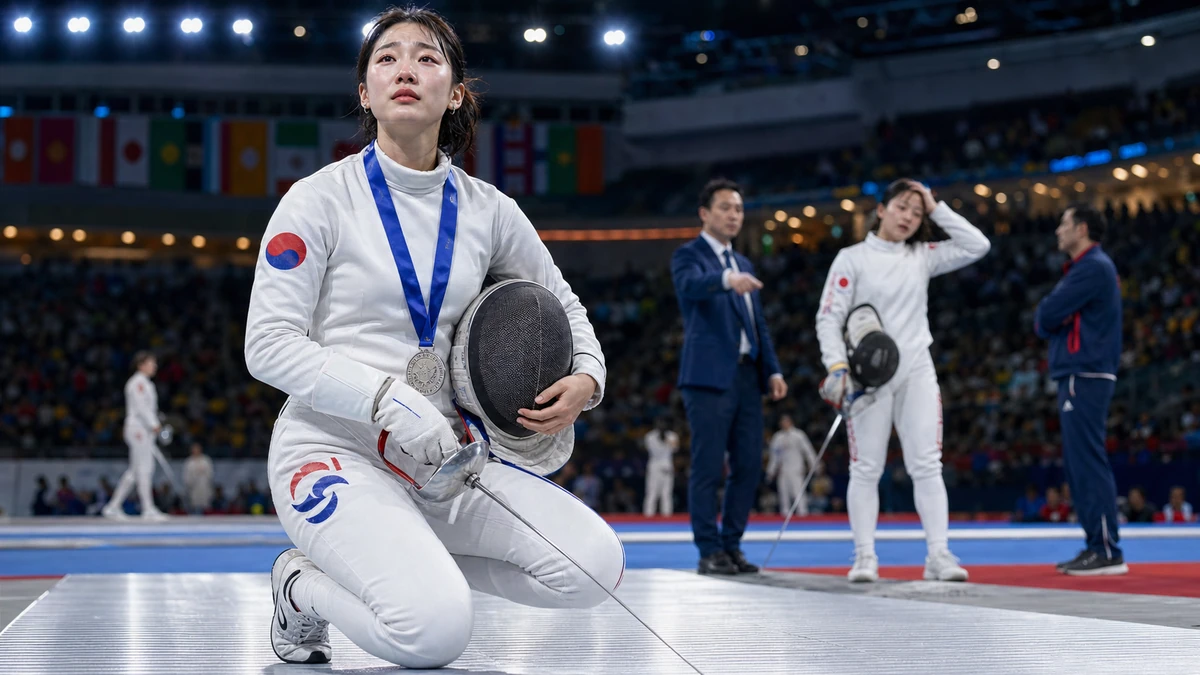
A breakthrough run on one of Asia’s biggest stages
South Korean fencer Choi Se-bin claimed the silver medal in women’s individual sabre at the 2026 Asian Fencing Championships in New Delhi, delivering the kind of performance that resonates beyond the podium. For American readers more familiar with Olympic swimming, gymnastics or track than with the finer points of fencing, Choi’s finish is best understood as both a personal breakthrough and another sign that South Korea remains one of the sport’s most formidable programs.
Choi, who represents the Daejeon Metropolitan City Hall team in South Korea’s domestic system, finished runner-up after falling 15-12 in the final to Japan’s Sano Yui. The defeat left her just short of gold, but it did little to diminish the importance of the result. According to the Korean summary of the event, this marked Choi’s first individual medal at the Asian championships, a notable step forward for a fencer who had already experienced the Olympic spotlight as part of South Korea’s women’s sabre team silver-medal squad at the 2024 Paris Games.
On paper, a silver medal can sometimes read like a straightforward result. Choi’s path was anything but straightforward. She survived a one-touch opener, upset a higher-ranked South Korean teammate, handled a dangerous quarterfinal and then dominated a semifinal against China. By the time she reached the final, her day had become a case study in how momentum builds in fencing: a narrow escape can sharpen a competitor rather than rattle her, and confidence can accumulate touch by touch.
That arc matters in a sport as fast and unforgiving as sabre. Unlike épée, where the whole body is a target and double touches can count, or foil, which emphasizes right-of-way and torso targets, sabre rewards explosive offense and split-second timing. The target area includes everything above the waist, and points often unfold in a blur that can look almost instantaneous to casual viewers. In that environment, the difference between an early exit and a medal often comes down to a few decisions made in fractions of a second.
For South Korea, Choi’s silver also fit into a larger trend at the championships. The country continued to pile up medals in sabre, underscoring a sustained excellence that has made Korea one of the discipline’s global benchmarks. For Choi herself, the medal offered something equally important: proof that her success is not limited to team events or to supporting roles alongside more established names.
The one-touch escape that changed the day
Every deep tournament run has a hinge point, the moment when a player or athlete could just as easily have been headed for the airport. For Choi, that moment came immediately. In the round of 32, she edged India’s Bhavani Chadalavada 15-14, surviving by a single touch in front of the host nation’s crowd.
That score alone tells much of the story. In sabre, bouts in the knockout stage are raced to 15, and a 14-14 tie is the sport’s version of sudden-death drama. There is no room for easing into form. One mistimed attack, one poorly judged distance, one hesitation in reading the referee’s interpretation of initiative, and a medal contender is gone. Choi did not dominate the opener. She endured it.
For American sports fans, the dynamic may feel familiar in a March Madness game where a favored team escapes on a last-second free throw, or in a tennis major where a player saves match point in the first week and suddenly looks transformed by the escape. In elite competition, surviving the danger can become the source of belief. That appears to have been the case for Choi.
The significance of beating the host-country athlete should not be overstated, but it matters in emotional terms. Host venues carry a certain energy even in sports without the roar of a soccer stadium. The pressure on the road is real. An early bout against a local fencer can be tricky, especially when the margin remains thin from start to finish. Choi’s ability to close it out suggested composure as much as skill.
It is tempting in hindsight to view the round of 32 as merely a prelude to bigger wins later in the bracket. In reality, it may have been the foundational result of the day. Without that final touch, there is no silver medal narrative, no breakthrough discussion, no broader conversation about the depth of South Korea’s women’s sabre team. The medal run began with Choi proving she could stay poised when the line between success and failure was as narrow as possible.
Beating a teammate and top-ranked countrywoman
If the opening match tested Choi’s nerve, the next bout tested her standing within South Korea’s own pecking order. In the round of 16, she defeated Jeon Ha-young, 15-10. That result was arguably the most symbolically important of the tournament because Jeon, according to the Korean summary, carried the higher world ranking and entered as one of the most prominent names in the South Korean women’s sabre setup.
In international tournaments, bouts between teammates can be especially complicated. They know each other’s rhythms, habits and preferred tactics. They have likely fenced one another in training countless times. The anonymity that sometimes benefits an underdog disappears. There are few surprises, and that familiarity creates a different kind of pressure. Winning requires not only executing one’s own plan, but also breaking through an opponent who understands your tendencies nearly as well as your coach does.
Choi’s 15-10 margin matters because it was not a fluky one-touch upset. It was clear and convincing. Against a teammate with a loftier ranking, she built separation and maintained control. Rankings are useful indicators, but anyone who follows combat sports, tennis or golf knows they are not prophecies. On a given day, form, confidence and matchups matter. Choi showed that her No. 34 ranking did not capture the level she could produce in a major event.
For readers unfamiliar with how South Korean Olympic sports are structured, it is worth noting that many elite athletes compete for city-run or corporate-backed teams rather than for school programs in the American sense. Choi’s affiliation with Daejeon Metropolitan City Hall reflects a long-standing system in which local governments and public institutions help support elite athletes. Jeon is associated with Seoul Metropolitan Government. These are not casual civic clubs; they are part of the infrastructure that sustains Korean high-performance sports.
That background adds another layer to the matchup. Choi was not simply beating a fellow national-team member. She was winning within a system where internal competition is intense and where selections, support and prestige are closely tied to results. South Korea’s best athletes often sharpen each other long before they face foreign opponents. Choi’s win over Jeon suggested she is not merely a reliable team contributor but a serious individual threat in her own right.
From survival to dominance
After squeezing through her first bout and then knocking off a higher-ranked compatriot, Choi settled into the tournament with increasing authority. In the quarterfinals, she beat Singapore’s Juliet Heng 15-12, a score that indicated control without complacency. She then produced her most emphatic statement of the day in the semifinals, overwhelming China’s Rao Xueyi 15-4.
Set side by side, Choi’s scores traced a compelling progression: 15-14, 15-10, 15-12, 15-4. The pattern suggests an athlete who grew sharper as the bracket advanced. She did not arrive in rhythm; she built it. The semifinal in particular stands out because China has long been a force in Asian fencing and because a double-digit margin at that stage is rare enough to command attention on its own.
For casual sports audiences, a 15-4 semifinal in sabre may be hard to visualize. Imagine a basketball conference final that is tied early and then turns into a blowout because one team suddenly dictates tempo, wins every loose ball and reads every play before it develops. In sabre, that kind of dominance comes from mastering distance, timing and initiative all at once. A fencer who gains control of those elements can make a world-class opponent look strangely limited.
It also matters that Choi defeated opponents from several distinct national programs on the way to the final: India, South Korea, Singapore and China. This was not a medal built around a soft draw or a single upset. It required navigating different styles, different pressures and different tactical demands in successive rounds. That kind of versatility is a hallmark of a mature competitor.
By the time Choi reached the gold-medal bout, she had already done something consequential: she demonstrated that South Korea’s women’s sabre program has more than one headline name capable of making a major individual run. In elite international sports, depth is what sustains a powerhouse. One star can win a title; a pipeline of contenders keeps a nation relevant year after year.
A final against Japan and the familiar edge of a regional rivalry
The championship bout added another layer of intrigue because it matched South Korea against Japan, two neighboring countries whose sports rivalries carry extra visibility across Asia. Choi ultimately lost 15-12 to Japan’s Sano Yui, a competitive final decided by a modest three-touch margin.
That score suggests a match that remained within reach. In sabre, leads can evaporate quickly because the action is so compressed and scoring sequences can swing on interpretation and timing. A three-touch deficit is meaningful, but not insurmountable, and the final score indicates Choi stayed competitive even if she could not deliver the late run necessary to take gold.
For American readers, the South Korea-Japan dynamic is somewhat akin to rivalries shaped by geography, history and repeated high-level meetings, though the historical context in East Asia is much more sensitive and far-reaching than most sports rivalries in the United States. In international competition, meetings between Korean and Japanese athletes often draw added scrutiny because they carry cultural and emotional weight beyond the immediate event. That does not mean every match becomes a referendum on history, but it does mean audiences notice.
In this case, the final can be read on two levels. The narrow loss was undoubtedly disappointing for Choi, who had come within striking distance of a continental title. At the same time, reaching the final and pushing a Japanese opponent in that setting reinforced her status as a fencer capable of contending with Asia’s best. Silver, in this context, was not a consolation prize. It was evidence.
There is also a broader significance for women’s sabre in South Korea. The Korean summary emphasized that the team is not dependent on one athlete alone. That point matters in Olympic-cycle sports, where injuries, form changes and generational turnover can reshape a national team quickly. Choi’s run suggests the program has multiple athletes who can win meaningful matches at the highest regional level.
Why this medal matters in South Korea’s sports culture
Fencing occupies a distinctive place in South Korea’s sporting identity. It does not command the week-to-week mass audience of baseball or soccer, and it is not as universally followed as figure skating at its peak or as obsessively covered as Olympic archery. But when the Olympics or major international championships arrive, fencing reliably becomes one of the sports in which South Korea expects to contend for medals.
That expectation did not emerge by accident. South Korea has spent years building a sophisticated fencing program, particularly in sabre, where its athletes are known for speed, aggression and tactical sharpness. For many American audiences, the country’s fencing prominence may still come as a surprise. But within Olympic sport, Korea’s rise has been well established.
Choi’s own résumé reflects that system. She was part of South Korea’s women’s sabre team that won silver at the Paris Olympics in 2024. Team success, however, does not always translate directly into individual results. In team fencing, athletes rotate through segments, momentum can be shared and one competitor’s off moment can be absorbed by the group. Individual fencing is more exposed. Every tactical adjustment, every scoring run and every lapse belongs to one person alone.
That is why this silver medal matters. Choi was already known as an Olympic team medalist. Now she has added a significant individual result, one that stands as its own credential rather than an extension of collective success. In sports storytelling terms, this is the moment when a supporting cast member proves she can carry the lead role.
The result also reflects something specific about South Korean athletics: elite competition often takes place within overlapping layers of representation. Athletes compete for city teams, for national-team places and for the country itself on international stages. Choi’s rise from Daejeon’s municipal system to the Asian championship podium illustrates how local institutions feed national success. To American readers, that structure may feel unusual, but it is one reason South Korea consistently produces athletes ready for high-pressure international events.
A bigger picture for Korean sabre
Choi’s medal was not an isolated bright spot. It was South Korea’s third medal of the championships, following gold by Oh Sang-uk and bronze by Do Gyeong-dong in the men’s individual sabre event. Taken together, those results paint a clear picture: South Korea continues to be exceptionally strong in the sabre discipline across both the men’s and women’s sides.
For U.S. readers, it may help to think of sabre as a specialized event in which one country has developed a repeatable formula for excellence, similar to how the United States has long approached women’s basketball or how certain countries become annual medal threats in specific swimming events. When a nation keeps producing podium finishers in the same discipline, it usually signals more than a single golden generation. It points to coaching continuity, effective athlete development and a competitive domestic pipeline.
That appears to be what South Korea has in sabre. Oh’s gold, Do’s bronze and Choi’s silver all came in the same weapon category. The consistency across multiple athletes suggests a system rather than a coincidence. It also raises the stakes for future international events, because countries with this kind of depth are often the ones best positioned to sustain success through world championships and the next Olympic cycle.
For Choi, the immediate takeaway is simpler and more personal. She left Delhi with the first individual Asian championships medal of her career, earned through a run that tested nearly every part of her skill set. She survived pressure, beat a better-ranked teammate, handled diverse opponents and reached a final against one of the region’s best.
There is a common tendency in sports coverage to focus only on the champion, as if every other result exists in the shadow of gold. But medals like this one tell their own story. Choi did not merely lose a final. She announced herself more fully on the Asian stage and, in doing so, offered a reminder of why South Korean fencing remains one of the most compelling programs in Olympic sport. On a day when other major events may have commanded headlines elsewhere, one of the most revealing performances in Korean sports happened on a fencing piste in New Delhi, where a silver medal said as much about the future as it did about the result itself.
Comments
Post a Comment