
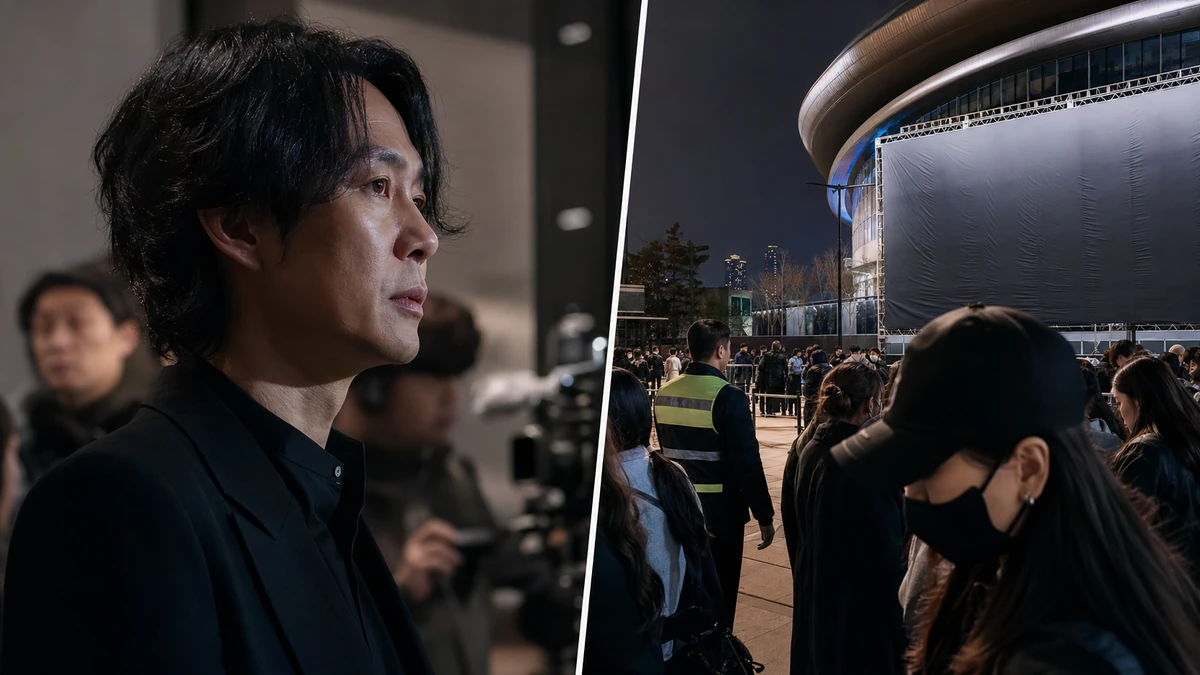
A different kind of comeback for one of K-pop’s most recognizable names
T.O.P, the rapper and actor best known internationally as a former member of the hugely influential K-pop group BigBang, is preparing for something he has never done before in two decades in the public eye: an Asia fan meeting tour.
His agency, TOPSPOT Pictures, said the tour will be called “T.O.P PRE-STUDIO 2026,” according to South Korea’s Yonhap News Agency. The announcement, sparse on details but heavy on symbolism, has drawn outsized attention across K-pop fan circles not because of a packed itinerary or a splashy album launch, but because it marks a first. For fans who have followed T.O.P for years, the significance is not just that he is going on the road. It is that after 20 years since his debut, he is choosing a format built around direct interaction, memory and reconnection.
That matters in K-pop, where the relationship between performers and fans often extends beyond music releases or arena concerts. In the American pop business, fans might think of an artist meet-and-greet as a premium add-on attached to a tour. In South Korea and much of the broader K-pop industry, a fan meeting is its own category. It is usually less about a polished, stadium-scale performance and more about conversation, games, storytelling, gratitude and a sense of intimacy, even when the room itself is large.
That distinction helps explain why this announcement landed as more than another tour notice. A concert says an artist is performing. A fan meeting says an artist is showing up to be seen, heard and measured in a more personal way. For someone like T.O.P, whose public image has long been defined by charisma, mystique and periods of distance from the spotlight, that shift carries particular weight.
As of June 30, 2026, the full list of cities, dates and programming details has not been released. TOPSPOT Pictures said more information will be announced in stages, a common strategy in K-pop that lets anticipation build through teasers, title reveals and carefully timed updates. Even so, the broad outline is enough to make the announcement one of the more closely watched pieces of entertainment news in Asia this week.
Why a fan meeting tour means more than a concert run
For readers less familiar with K-pop culture, it is worth pausing on the term itself. A fan meeting is not simply a smaller concert. It is a ritual of relationship maintenance in an industry built on unusually high levels of fan engagement. Artists talk directly to supporters, share updates from their lives, revisit career moments and create the impression of a two-way exchange, even within the realities of celebrity and security.
If an American comparison is useful, think less of a standard concert stop and more of a hybrid between a live show, a television special and a highly curated town hall for devoted supporters. The emotional center is not only the music. It is access, acknowledgment and continuity. Fans attend to confirm that the bond they have invested time, money and emotion into still exists in the present tense.
That helps explain why the phrase “first fan meeting tour in 20 years” has resonated so strongly. Twenty years is a long enough span for an entertainment industry generation to turn over. Some fans who first encountered BigBang as teenagers are now adults with careers and families. Newer fans may know T.O.P through old performances, social media clips, fashion coverage or his acting work rather than through BigBang’s peak-era promotions. A fan meeting tour creates a space where those generations can overlap.
It also sends a message about what kind of return this is. The title “PRE-STUDIO” suggests a stage before something else, a prelude rather than a final statement. The word “studio” evokes a workshop, a place where new ideas take shape. The full title can be read as a signal that T.O.P is not simply revisiting his past, but positioning himself in relation to whatever comes next.
That interpretation should be handled with caution, because the agency has not publicly laid out the tour’s concept in detail. Still, in K-pop, names matter. Fans are trained to read meaning into titles, teaser images and even small wording choices in official statements. That interpretive culture is part of the business model, and it is part of what keeps global fandoms in a constant state of active attention. A few words can generate days of analysis across Korean, Japanese, Chinese and English-language online communities.
The Yokohama event offers the clearest signal so far
Before the broader Asia tour begins, T.O.P is scheduled to hold a free fan meeting next month on the 9th at Pia Arena in Yokohama, Japan, for members of his official Japanese fan community. The venue’s reported 10,000-seat scale is striking on its own. So is the decision to make the event free.
In a music industry where access is often monetized at every level, a free event for official fan community members carries a specific message. It emphasizes loyalty and recognition over immediate ticket revenue. It says, in effect, that the first priority is reconnecting with the base that stayed engaged over time. For artists with long careers, especially those returning to more public-facing activity after periods of relative quiet, that kind of gesture can have strategic value as well as emotional force.
Japan is also a meaningful place to begin. For decades, Japan has been one of the most important overseas markets for South Korean pop acts, often serving as both a commercial proving ground and a symbolic stage for regional reach. BigBang, like several top-tier K-pop acts before and after it, cultivated a strong following there. A major event in Yokohama is therefore not just a practical scheduling choice. It is a reminder of how K-pop’s regional infrastructure developed long before the genre became a mainstream talking point in the United States.
Still, the most important confirmed fact is not the symbolism of Yokohama itself, but the structure of the event: a large-scale, fan-centered gathering before the formal Asia tour fully unfolds. That suggests the tour’s core identity will be shaped less by spectacle than by direct contact.
For American readers used to major music coverage focusing on album sales, streaming numbers or chart placement, this may seem like soft news. In the K-pop ecosystem, it is not. Fan culture is not a side story; it is one of the industry’s organizing principles. A 10,000-seat free fan meeting for official community members is not a footnote. It is a statement of priorities.
T.O.P’s place in K-pop history explains the attention
To understand why this announcement is drawing such close scrutiny, it helps to understand T.O.P’s place in the larger K-pop story. As a member of BigBang, he was part of a group that helped redefine what idol stardom could look and sound like in the late 2000s and 2010s. BigBang’s influence reached beyond hit songs. The group helped shape the global image of K-pop as stylish, high-concept and exportable on a massive scale.
For many American readers, BTS and Blackpink are the most familiar reference points in K-pop’s global rise. BigBang belongs to an earlier but crucial chapter of that same expansion. The group helped build the regional and international fan infrastructure that later acts would inherit and amplify. Its members also cultivated distinct individual personas, allowing each to occupy a particular lane in fashion, music, television or film.
T.O.P stood out for a deep-voiced rap style, an intense onstage presence and an image that mixed luxury, irony and reserve. Over the years, he became one of those celebrities whose public persona was defined as much by aura as by output. That can be an asset in entertainment, but it can also create distance. A fan meeting, by design, narrows that distance.
That is part of why the phrase “symbolic turning point” fits here. The story is not simply that a veteran artist is holding events for fans. It is that he is doing so in a way that invites reassessment of the relationship between artist and audience after a long and complicated career arc. Even without adding speculation beyond what has been officially announced, the format itself tells us something. It suggests a willingness to be present in a setting where personality, reflection and emotional tone matter as much as performance.
There is also a generational dimension. K-pop now moves at a dizzying pace, with constant debuts, comeback cycles, social media content drops and global brand tie-ins. Against that backdrop, a 20-year career milestone carries a different kind of authority. It speaks to endurance in an industry that often seems built on speed. For older fans, this is a reunion. For younger ones, it may be their first real-time chance to encounter a figure they know more as legend than as current event.
What is confirmed, and what fans should not assume yet
In fast-moving global fandoms, the line between confirmed news and hopeful interpretation can blur quickly. That is especially true in K-pop, where information circulates at high speed across multiple languages and platforms. So far, three facts are clearly confirmed.
First, T.O.P will hold his first Asia fan meeting tour, titled “T.O.P PRE-STUDIO 2026.” Second, this is being described as his first fan meeting tour since debuting 20 years ago. Third, ahead of the tour, he is set to hold a free 10,000-seat fan meeting on the 9th of next month at Pia Arena in Yokohama for members of his official Japanese fan community.
What has not yet been confirmed is equally important. The agency has not publicly announced the full list of tour stops, any additional cities, the structure of the fan meetings, whether there will be performance segments, or how broadly access will extend beyond the initial Japan event. The title may spark expectations, but expectations are not facts.
That distinction matters because K-pop fandom is participatory by design. Fans do not merely consume announcements; they decode them, map them onto prior patterns and build collective forecasts. Sometimes that crowd-sourced reading is sharp. Sometimes it outruns reality. A measured reading of the news right now is simple: the tour is official, the Yokohama event is the starting point, and further details are still to come.
There is nothing unusual about the staggered rollout. In fact, it is almost standard practice. Entertainment companies often release information in phases to sustain interest and give each update its own news cycle. But in a hyperconnected fandom environment, that also means every missing detail becomes part of the story. Which countries will be included? Will Southeast Asia be central? Will there be any stops that gesture toward a broader global expansion later? None of that has been established yet.
A reunion story in a K-pop landscape still driven by novelty
The timing also says something about where K-pop is as an industry in 2026. On the same day this news circulated, other K-pop headlines highlighted newer creative projects, including a fresh unit release from Seventeen members The8 and Vernon. That contrast is revealing. One side of the industry continues to run on constant reinvention, subunits, concept shifts and rapid-fire releases. The other side makes room for legacy, return and long-term fan relationships.
Those two currents are not opposites so much as parallel engines. K-pop thrives on novelty, but it also thrives on continuity. Rookie groups attract attention with fresh aesthetics and evolving identities. Veteran acts and artists retain power by activating memory, loyalty and the sense that fandom is a long story rather than a short campaign. T.O.P’s planned fan meeting tour belongs squarely to that second category.
For English-speaking readers who have watched American music fandom grow more fragmented in the streaming era, this is one of the most notable differences in how K-pop operates. The business is not only about the next single. It is about sustaining emotional ecosystems around artists over time. That is why a fan meeting can become a major headline even without a new chart-targeting album attached to it.
There is another reason this news has drawn a positive response: it centers on reconnection rather than controversy. Korean entertainment coverage, like celebrity coverage everywhere, can be dominated by disputes, scandals or legal battles. Here, the headline is more straightforward and, for fans, more welcome. It is about a scheduled return to direct fan contact, a free event for an established community and a tour framed around encounter rather than conflict.
That may seem modest compared with the spectacle Americans often associate with global pop. But modesty can itself be strategic. A fan meeting does not need pyrotechnics to matter. In some cases, especially with an artist whose public appearances have been comparatively limited, the willingness to meet supporters face to face is the headline.
Why global audiences should pay attention
Even for readers who do not closely follow K-pop, this story offers a useful window into how the genre’s global culture works. It shows that in Korean pop, audience relationships are institutionalized through official communities, special events and recurring rituals of appreciation. It also shows how senior artists can re-enter the public conversation through formats that prioritize fan trust over mass-market splash.
T.O.P’s announcement is significant not because every detail is already known, but because enough is known to understand the emotional geometry of the moment. A veteran artist with a 20-year history is launching his first Asia fan meeting tour. He is doing so under a title that implies a beginning rather than a conclusion. And he is opening with a 10,000-seat free event in Yokohama for official Japanese fans, emphasizing gratitude and reconnection as the first step.
That combination helps explain the reaction. For long-term followers, it is a marker of renewed movement after years in which even small official updates could feel consequential. For newer fans, it is an accessible entry point into a figure whose reputation predates K-pop’s biggest American breakthroughs. And for the industry itself, it is a reminder that longevity in pop culture is not only about catalog or nostalgia. It is about finding credible ways to reactivate the bond between artist and audience.
More announcements will determine how large the tour becomes and how far its reach extends across Asia. But even before those details arrive, the basic story is clear. In a genre often associated with speed, churn and constant nextness, T.O.P is stepping forward with a format built around pause, recognition and return. That is why this announcement has landed with such force. It is not just news of an event. It is news of a relationship being formally reopened in public.



0 Comments