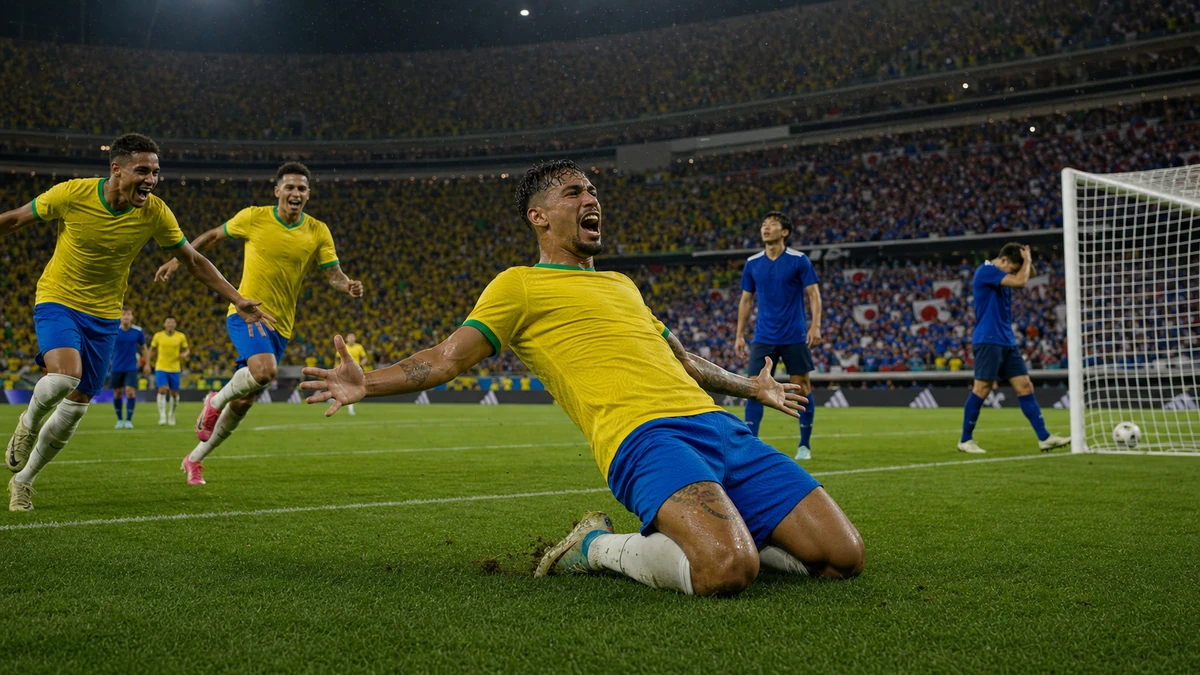
Brazil survives a scare in Houston
Brazil, the most decorated men’s national team in World Cup history, needed nearly every last second to avoid one of the tournament’s biggest shocks so far. In a dramatic Round of 32 match at Houston Stadium in Texas, Brazil rallied from an early deficit and beat Japan 2-1 on a stoppage-time goal from Gabriel Martinelli, punching its ticket to the Round of 16 and preserving its pursuit of a first World Cup title since 2002.
The winning goal came in the 50th minute of the second half, deep into added time, after a game that had increasingly looked headed either for extra time or for a famous Japanese upset. Instead, Brazil did what traditional powers so often do in high-pressure tournaments: it found one decisive moment when the margin for error had disappeared.
For American sports fans, the emotional arc was familiar even if the setting was global soccer rather than the NFL playoffs or March Madness. The favorite came in carrying the weight of history, expectation and brand-name talent. The underdog did not just hang around but landed the first blow and made the favorite uncomfortable for long stretches. Then, just when it seemed the giant might finally stumble, the giant rediscovered its edge.
That sequence is what made this match feel bigger than a routine knockout victory. Brazil did not simply advance. It escaped. And in doing so, it reminded the rest of the field why even a vulnerable Brazil remains one of the most dangerous teams in the world.
Japan showed it belonged on the same field
Japan’s exit will officially go into the record as a Round of 32 loss, but that sterile description does not come close to capturing the performance. Japan was not overawed by the five-time champions. It did not play as if it were just happy to be there. From the opening stages, Japan pressed, organized and attacked with confidence, showing once again that the gap between elite South American and European powers and the best Asian teams is no longer as wide as many casual fans still assume.
That confidence was rewarded in the 29th minute of the first half, when Sano Kaishu put Japan ahead 1-0. The goal changed the tenor of the match immediately. It gave Japan proof that its tactical discipline and energy could translate into real danger, and it forced Brazil into a role it rarely enjoys: chasing the game in a World Cup knockout round.
To American readers who may be less familiar with Japan’s standing in international soccer, this was not a Cinderella team pulled from nowhere. Japan entered the knockout stage after navigating what Korean coverage described as a “group of death,” a phrase used in international soccer for a particularly difficult first-round group stacked with strong teams. Japan finished second in Group F with one win and two draws, going unbeaten against the Netherlands, Sweden and Tunisia. In other words, its resilience against Brazil was not a fluke. It was an extension of the form it had already shown in the tournament.
Japan’s development over the last few decades has been one of the most significant stories in Asian soccer. The country’s professional J.League, launched in the early 1990s, helped build a stronger domestic infrastructure, and generations of Japanese players have since moved to major European leagues. The result is a national team that is technically polished, tactically organized and increasingly comfortable against the sport’s royalty. Japan has reached the World Cup knockout rounds multiple times, and while it still seeks a true breakthrough run, its performances now regularly demand global respect rather than polite surprise.
Against Brazil, Japan again showed the hallmarks that have made it one of Asia’s standard-bearers: disciplined defensive shape, quick transitions and a collective belief that the badge on the other team’s jersey is not the same thing as superiority.
Casemiro’s equalizer changed the emotional balance
If Japan’s opener shook Brazil, Casemiro’s equalizer restored its pulse. Brazil had spent the latter part of the first half and the opening stretch of the second dealing with both the scoreboard and its own rising anxiety. In tournament soccer, conceding first is not merely a numerical problem. It creates a psychological one. Every missed chance feels heavier. Every misplaced pass feeds impatience. The clock itself becomes an opponent.
That pressure is especially intense for a team like Brazil, which is never judged only by whether it wins but by whether it wins like Brazil. The country’s soccer identity carries decades of artistry, swagger and expectation. For generations of fans around the world, Brazil has represented the sport’s romantic ideal: yellow shirts, attacking flair, improvisation and stars who can settle a match in a flash. But heritage can become burden as easily as inspiration, particularly in a World Cup knockout game where one mistake can end a campaign.
Brazil found relief in the 56th minute, when Casemiro scored with a header to make it 1-1. The goal mattered for obvious reasons, but its deeper significance was emotional. It gave Brazil a way back without requiring panic. It also changed the feeling of inevitability that had begun to build around Japan’s lead. Suddenly, Japan was no longer protecting a famous advantage. It was trying to reassert control against a favorite that had rediscovered its footing.
Casemiro’s role in that moment also fit the veteran midfielder’s reputation. He is not the glamorous face most casual fans associate with Brazil, but he has long been one of the team’s stabilizers, a player known for steel, timing and composure under pressure. His equalizer functioned almost like a reset button. Brazil was still under strain, but it was no longer in crisis.
From that point forward, the game became a test not simply of tactics but of endurance and nerve. Japan had already proven it could trouble Brazil. The question was whether it could withstand the final wave of Brazilian pressure that so often arrives in knockout soccer.
Martinelli delivers the moment Brazil needed
The answer, painfully for Japan and dramatically for everyone else, arrived in the 50th minute of the second half. With added time nearly exhausted and the game appearing destined for extra time, Gabriel Martinelli scored the winner that sent Brazil through and left Japan devastated.
Late goals in soccer can feel uniquely cruel because of how little time remains to respond. A game that seems balanced one second can become irretrievable the next. That was the case here. Japan had absorbed pressure, managed the emotional swing of Casemiro’s equalizer and stayed alive deep into stoppage time. Then Brazil found one more opening, and Martinelli converted it.
For Brazil, the goal was about more than advancement. It was proof of the ruthless finishing that separates contenders from merely talented teams. Tournament soccer does not always reward the side that looks smoother or more aesthetically pleasing. It rewards the team that recognizes and seizes the few moments that truly matter. Brazil’s final attack did exactly that.
Martinelli’s winner also underscored an uncomfortable truth for opponents: even when Brazil is not at its free-flowing best, it still has enough quality to punish the smallest lapse. That is why global powers remain dangerous deep into tournaments. They can look uneven, frustrated or even vulnerable for long stretches and still produce the one touch, run or finish that changes everything.
In American terms, it was the soccer equivalent of a star closer nailing the final pitch with the season on the line, or a championship contender draining the shot everyone in the arena knows is coming. You may spend most of the night proving the favorite can be rattled. But if you leave even a small window open at the end, elite teams often slam it shut.
Why this victory matters so much for Brazil
Brazil’s place in World Cup history can obscure its more recent frustrations. It remains the only men’s national team with five World Cup titles, but the most recent of those came in 2002, in the tournament co-hosted by South Korea and Japan. For a nation so central to the sport’s mythology, that is a long drought. Each new World Cup arrives with fresh stars and fresh hope, but also with the accumulated pressure of unfinished business.
This tournament, held across North America, has offered Brazil another chance to end that wait. The stakes are magnified by the team’s stature and by the tournament’s expanded format. This is the first men’s World Cup to feature 48 teams, which broadens access to the field but also creates new knockout dynamics. Reaching the knockout phase may be more attainable for more countries, but once that stage begins, the margin becomes brutally thin. A favorite can no longer count on reputation to carry it through.
That is what this match illustrated so clearly. Brazil won, but the victory was not the kind that allows complacency. It highlighted both Brazil’s resilience and its vulnerability. The team showed character by recovering from an early deficit and pushing relentlessly until the final whistle. At the same time, it showed that the rest of the soccer world has caught up enough to make every matchup hazardous, even for the sport’s old aristocracy.
Brazil now advances to face the winner of Ivory Coast vs. Norway in the Round of 16 on July 6 at the New York/New Jersey Stadium, according to the tournament schedule. On paper, Brazil will still command attention as one of the title favorites. But if this match proved anything, it is that there are no ceremonial passages left in the modern World Cup. Every opponent is organized. Every game is tactical. Every mistake is amplified.
That reality may actually sharpen Brazil going forward. Sometimes a close call early in the knockout stage can jolt a contender into the kind of urgency it will need later. A team that survives one brush with elimination often learns lessons that prettier wins do not teach.
Japan’s loss still carries a bigger message for Asian soccer
For Japan, the immediate feeling will be heartbreak. It led Brazil, one of the game’s superpowers, and remained level into the final moments, only to see the match slip away in stoppage time. But the larger takeaway for Japan and for Asian soccer is more encouraging than the final score suggests.
Asian teams have spent decades fighting stereotypes that cast them as tactically neat but physically overmatched, or technically competent but lacking the final cutting edge to beat the global elite. Those assumptions have been fading for years, and Japan’s performance against Brazil offered another strong rebuttal. Japan did not merely defend bravely. It attacked purposefully, created genuine stress for Brazil and looked like a team with a coherent plan, not just hopeful energy.
That matters beyond Japan. In South Korea, where fans closely track Japan’s performances because of the two countries’ intense sporting rivalry and shared place in Asian soccer, this kind of match inevitably sparks comparison and reflection. Korean audiences often measure their own national team’s progress against Japan’s, just as both countries judge themselves against the best teams from Europe and South America. A Japanese side that can push Brazil to the edge in a World Cup knockout match becomes a reference point across the region.
For American readers, that regional dimension may require a little explanation. South Korea and Japan are geographic neighbors with a long, complicated history, and competition between them in sports can be especially charged. But beyond rivalry, there is also a broader sense that major international tournaments serve as benchmarks for how Asian soccer is evolving. When one team from the region stands toe-to-toe with a global heavyweight, it resonates far beyond its own fan base.
Japan’s tournament run, including an unbeaten group stage and a near-upset of Brazil, suggests that Asian teams are no longer content merely to reach the knockout rounds. The next ambition is to stay there, win there and make deep runs feel attainable rather than exceptional. Japan did not complete that last step here. But it looked far closer to doing so than the final result alone would indicate.
A World Cup reminder: history helps, but it does not protect you
One of the enduring appeals of the World Cup is that it compresses history, pressure and national identity into 90 minutes, sometimes a little more, and asks even the sport’s most celebrated teams to prove themselves all over again. Brazil brought its five titles, its global brand and its ambition to end a 24-year championship drought. Japan brought an unbeaten group-stage record, growing self-belief and a chance to redefine what is possible for an Asian side against one of the sport’s immortals.
In the end, Brazil’s pedigree and persistence won out. But the match did not reinforce an old hierarchy so much as expose how hard that hierarchy now is to preserve. Japan demonstrated that a disciplined, modern Asian team can unsettle the most famous jersey in world soccer. Brazil demonstrated that giants, when pressed, still know how to survive.
That is why this game is likely to linger in memory even as the tournament moves on. It had the ingredients that make knockout soccer irresistible: a heavy favorite under pressure, an underdog with no fear, a first goal that changed the emotional weather of the stadium, an equalizer that flipped momentum and a winning strike delivered at the absolute edge of time.
For Brazil, the story continues. For Japan, the tournament is over, but not in a way that diminishes its progress. And for everyone watching, especially in a World Cup being staged in North America, the match served as a reminder that global soccer’s power map is shifting even if its oldest powers still know how to write the final line.
Comments
Post a Comment