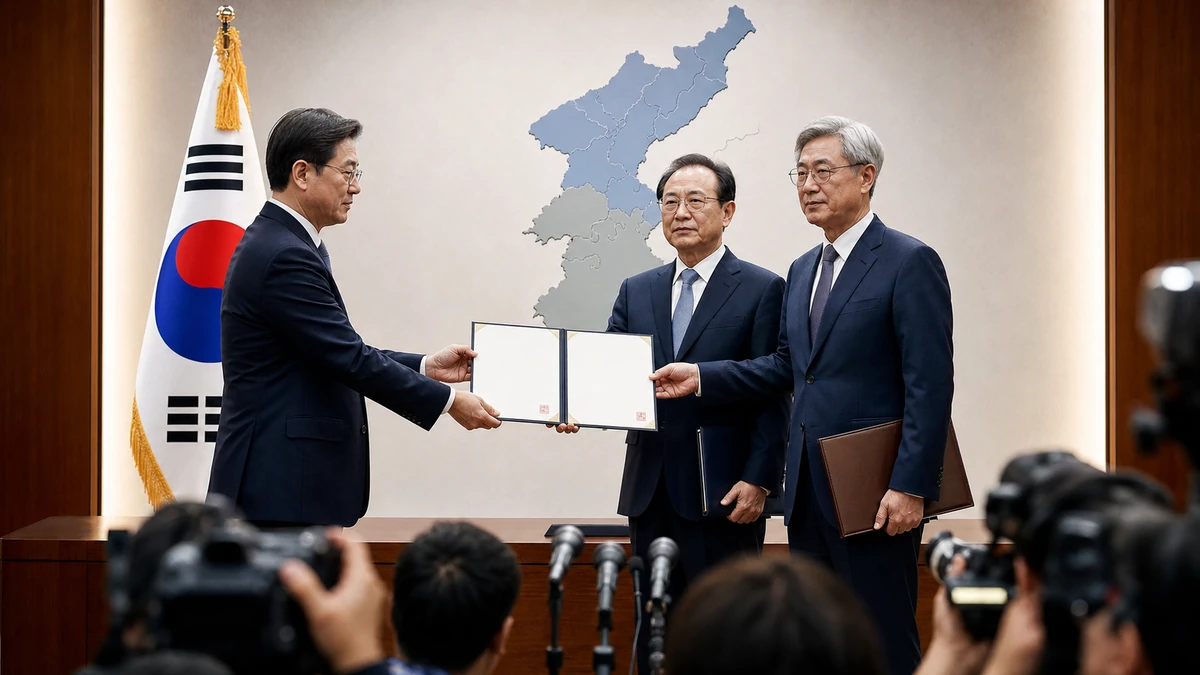
A routine personnel announcement that opens a window into Korea’s divided history
South Korea’s Ministry of the Interior and Safety said Thursday that it had appointed Jin Bong-heon, an attorney at the law office Jeil, as governor of South Hamgyong Province, and Choi Myeon, an emeritus professor in the Department of Bio-health Engineering at Kangwon National University, as governor of North Hamgyong Province. On paper, it read like a standard government personnel notice: two names, two titles and short summaries of their professional backgrounds. Jin was identified as a former judge who later worked as a lawyer. Choi was identified as a retired academic.
But in South Korea, those titles carry a meaning that is anything but routine. The provinces named in the announcement — South Hamgyong and North Hamgyong — are not part of the territory governed by the Republic of Korea today. They are in what is now North Korea. Yet Seoul still maintains an official administrative framework for what Koreans call the “Five Northern Provinces,” a symbolic but state-recognized structure that preserves the names, offices and historical identity of provinces north of the Demilitarized Zone.
For many Americans, the idea may sound unusual at first. Imagine a modern U.S. federal agency announcing the appointment of governors for states that exist in national memory and legal history but are outside the government’s actual control. The comparison is not exact, but it hints at why this otherwise quiet appointment matters. It shows how South Korea, a country often associated abroad with K-pop, smartphones, semiconductors and hypermodern city life, also carries the unresolved legacy of national division inside its institutions.
In that sense, Thursday’s appointment was not just about staffing. It was a reminder that in Korea, history is not only remembered in museums, family stories or political speeches. It is also embedded in the structure of government itself.
What the “Five Northern Provinces” mean
The term “Five Northern Provinces,” or Ibuk Odo in Korean, refers to five provinces that were part of Korea before the peninsula was divided after World War II and later hardened into separate states after the Korean War. In South Korean official language, those provinces remain part of the historical and constitutional imagination of a unified Korea, even though they are under the control of North Korea in practice.
The system is one of those distinctly Korean institutional arrangements that can be easy to miss unless you know where to look. South Korea’s constitution has long reflected the idea that the Republic of Korea is the legitimate government of the entire peninsula, even while everyday political reality is defined by partition. That tension — between constitutional principle and geopolitical fact — has shaped not only security policy but also symbolic public administration.
The Five Northern Provinces administration is part of that landscape. It does not function like a regular provincial government in the way California, Texas or even South Korea’s own Gyeonggi Province does. It does not oversee roads, collect local taxes or run schools in Hamgyong. Instead, it exists as a formal state body that preserves administrative titles and regional identity tied to territories north of the border. The offices have historically served as a way to represent displaced people and their descendants, maintain community ties for families with roots in the North, and keep alive the notion that the division of the peninsula is unresolved.
That helps explain why names such as South Hamgyong and North Hamgyong still appear in contemporary government announcements. To a foreign reader, they may seem like relics. To many Koreans, they are relics — but living ones, preserved in an official register rather than sealed away in the past.
The announcement of new governors for two of those provinces therefore matters less for any immediate policy shift than for what it reveals about how South Korea remembers itself. The state is not simply managing present-day territory. It is also curating a national narrative shaped by displacement, division and the long shadow of war.
Why these appointments stand out, even without a major policy announcement
The ministry’s statement did not outline sweeping new initiatives for the two appointees. It did not announce major programs, legislative changes or inter-Korean projects tied to the appointments. The confirmed facts were modest and precise: Jin Bong-heon was appointed governor of South Hamgyong Province, and Choi Myeon was appointed governor of North Hamgyong Province. Their professional backgrounds — law and academia — were highlighted, but detailed future plans were not disclosed.
Even so, the way the announcement was framed is telling. Jin’s profile as a former judge turned practicing lawyer suggests a figure with legal and institutional experience. Choi’s identity as an emeritus professor points to scholarly standing and public credibility. In many countries, biographies like that might be little more than ceremonial padding in an official release. Here, they do more than that. They show the government presenting these symbolic offices through the language of professional expertise and public service, not nostalgia alone.
That matters because the Five Northern Provinces system, while symbolic, is not treated as fiction by the South Korean state. The titles are formal. The appointments are official. And the people named to those roles are drawn from respected parts of society, including the judiciary, the legal profession and academia. That choice sends a message that these offices remain part of the country’s institutional architecture, not merely a historical footnote trotted out on anniversaries.
There is also a broader social meaning here. In a nation that has changed at astonishing speed over the past half-century — from war-ravaged poverty to one of the world’s leading economies — symbols that endure inside government can tell you as much about a society as the changes that dominate headlines. South Korea is famous for reinvention, but it is also a place where long memory is built into bureaucracy. Thursday’s appointments are one example of that duality.
For an American audience used to thinking of government in practical terms — budgets, elections, service delivery, partisan conflict — the Korean case can feel more layered. These offices are not powerful in the way governors are in the United States. They are better understood as state-backed custodians of memory, identity and continuity. That may sound abstract, but on the Korean Peninsula, abstraction often has political and emotional weight.
How division lives on in public institutions, not just in politics
When Americans think about the Korean Peninsula, the images that often come first are familiar: missile tests, summit diplomacy, soldiers at the DMZ and the ever-present question of nuclear weapons. Those are real and important parts of the story. But they can also flatten Korean life into a security narrative alone. The appointment of governors for the northern provinces points to a quieter truth: division is not only a matter of military tension. It also lives in naming, administration and the way a society organizes remembrance.
In Korea, place names carry emotional force. A province is not merely a map unit. It can stand for ancestry, dialect, customs, family memory and the geography of a life interrupted. Many older Koreans and their descendants trace family origins to places that are now in North Korea. For them, names like Hamgyong are not abstractions from a textbook. They are part of family identity, even if the border has made direct connection impossible for decades.
The state’s decision to preserve those names in official structures reflects that reality. It acknowledges that some territorial identities did not disappear just because governance did. In everyday Korean conversation, regional identity can still be powerful, much as Americans may associate certain states or regions with particular accents, foodways, values or political cultures. The difference is that for Korea’s northern provinces, those identities were severed by national division and sustained largely through memory, community organizations and institutions like the Five Northern Provinces administration.
This is one reason the announcement resonates beyond the paperwork. It shows that South Korea’s public institutions do not operate only in the present tense. They also carry historical obligations, especially when history is unfinished. The Korean War ended in an armistice, not a peace treaty, and the peninsula remains formally at war. The border is militarized, but the legal and symbolic vocabulary of a single Korea has never been entirely abandoned in the South.
That does not mean these appointments signal imminent political change. The ministry’s release, based on the facts available, offered no basis for predicting new inter-Korean policy or any specific administrative program. What it does show is how the country continues to hold together two truths at once: the practical reality of division and the enduring language of historical continuity.
The deeper cultural message: Korea preserves memory through institutions
One of the most revealing aspects of this story is what it says about how South Korea handles collective memory. In the United States, memory is often fought over in monuments, school curricula, holidays and museum exhibits. In South Korea, those arenas matter too. But memory also appears in a more bureaucratic form. Titles, offices and administrative categories can serve as containers for historical experience.
That may seem especially Korean in its texture. The country’s modern history has been shaped by colonization, liberation, national division, war, dictatorship, democratization and explosive economic development — all within the span of a few generations. In that environment, institutions often do more than govern. They symbolize endurance. They tell citizens what the state chooses to keep visible.
The office of a northern provincial governor is a good example. The title “governor,” or jisa in Korean, sounds straightforward. So does the word “province,” or do. But together, in this context, they form something more than administrative vocabulary. They are a language of preservation. The office does not administer everyday life in Hamgyong today, but it preserves the public fact that Hamgyong remains part of Korea’s remembered and claimed geography in the South’s institutional worldview.
That preservation matters because collective memory can fade if it survives only as private sentiment. Families remember, of course. So do communities. But when the state maintains names, offices and rituals tied to a divided past, it gives memory official durability. It says that these histories are not merely personal losses or old stories. They remain part of the nation’s public life.
For international readers, this is a useful corrective to the sleek, export-friendly image of South Korea that often dominates global coverage. The same country that produces chart-topping pop acts, Oscar-winning filmmakers and cutting-edge consumer technology is also a place where unresolved 20th-century history is woven into everyday governance. Modernity in South Korea does not erase historical consciousness. Often, the two exist side by side.
That is what makes this appointment newsworthy beyond its narrow administrative scope. It captures a tension at the heart of contemporary Korea: a nation racing forward while still carrying official traces of a border it never fully accepted as final.
Why American readers should pay attention
At first glance, this may look like the kind of bureaucratic update that would barely register outside the country where it happened. But for American readers, it offers a rare and concrete way to understand the Korean Peninsula beyond familiar stereotypes. Rather than focusing on crisis or spectacle, it reveals how a divided nation internalizes history and projects it through state structure.
There is also a broader lesson here about the political life of memory. Americans are no strangers to arguments over what the past means in the present. Debates over Confederate symbols, Indigenous place names, immigration narratives and public memorials all reflect a basic question: how should a nation carry history forward? South Korea answers part of that question not only through public rhetoric but through administrative continuity. It keeps certain names alive in government, even when the territory itself is inaccessible.
That approach may not have a direct American equivalent, but it is legible in American terms. It resembles, in some ways, the idea that government can validate memory by giving it formal recognition. In Korea’s case, that recognition is tied to a national division that remains one of the defining geopolitical facts of Northeast Asia.
There is another reason this matters. Foreign coverage of South Korea often privileges what is instantly exportable: entertainment, fashion, consumer trends and technological prowess. Those stories are real, but they can obscure the country’s deeper institutional and historical layers. A government notice about the Five Northern Provinces is not glamorous, and it is unlikely to trend internationally. Yet it tells us something fundamental about how South Korea sees itself: as both a highly modern state and the steward of a fractured national past.
For journalists, that is exactly the kind of story worth slowing down for. It complicates easy narratives. It shows that even a short administrative release can illuminate the structure of national memory. And it reminds foreign audiences that the Korean Peninsula is not only a site of strategic tension or cultural export. It is also a place where names, offices and historical wounds continue to shape public life in subtle but lasting ways.
A small announcement with a long historical echo
The ministry’s June 26 announcement confirmed only a limited set of facts: Jin Bong-heon has been appointed governor of South Hamgyong Province, and Choi Myeon has been appointed governor of North Hamgyong Province. Their backgrounds in law and academia were cited. No broader policy program was announced, and there is no basis, from the information released, to predict specific new initiatives tied to their appointments.
Yet even within those limits, the meaning of the moment is clear. This was a quiet demonstration of how South Korea keeps the memory of a divided peninsula inside the machinery of the modern state. The names South Hamgyong and North Hamgyong are not used in this context because the government is confused about present-day borders. They are used because the division of Korea remains, in legal imagination and national consciousness, unfinished history.
That is what gives the announcement its weight. It is not dramatic, but it is revealing. It brings together the language of the state, the biographies of public figures and the unresolved geography of the Korean nation in a single sentence. It shows how a country can honor continuity without pretending the past is still fully recoverable.
In an era when South Korea is usually introduced to global audiences through pop culture or headline-grabbing geopolitics, this is a different kind of Korean story — quieter, more bureaucratic and in some ways more intimate. It is about how a nation remembers through institutions. It is about how history survives in office titles and official maps, not just in memorial speeches. And it is about how even the most routine government notice can reveal the layers of identity beneath the surface of a fast-moving, globally connected society.
For outsiders, the appointment of governors to provinces that South Korea does not control may seem paradoxical. For South Korea, it is a reminder that the story of the peninsula has not been reduced to the line on today’s map. The state still carries the language of a larger Korea, and with it, the memory of the people and places divided by war. Thursday’s appointments were a small administrative act. They were also a sign that, in Korea, the past remains present in official form.
Comments
Post a Comment