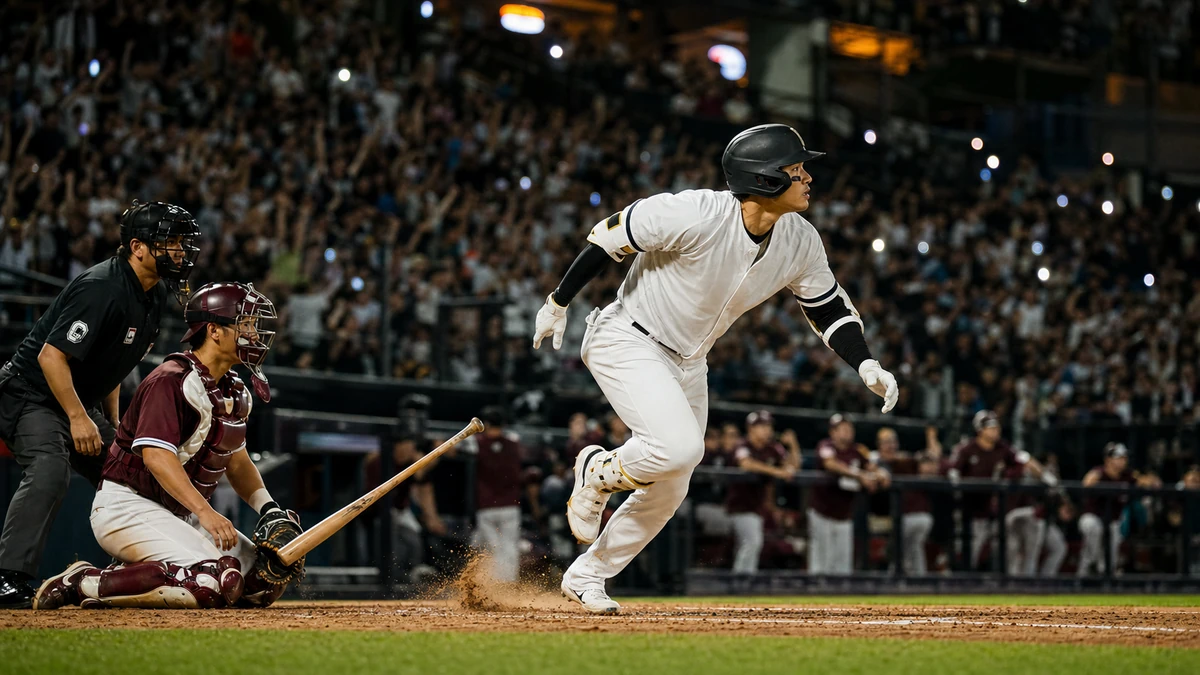
A familiar baseball script plays out in South Korea
Every baseball culture has its favorite story line. In the United States, fans know it as the backup who gets the call when the starter goes down, then turns one unexpected start into something bigger. It is the sort of plot that has powered summer sports pages for generations, whether the setting is Yankee Stadium, Wrigley Field or a minor league park in the middle of nowhere. On Tuesday night in Suwon, just south of Seoul, that same script unfolded in the Korea Baseball Organization, or KBO, when Bae Jeong-dae helped lead the KT Wiz to a 7-3 win over the Kiwoom Heroes.
On the stat sheet, Bae’s line was clean and efficient: 2 for 4, two RBIs and a run scored while starting in center field and batting seventh. In baseball terms, that is the kind of game that can easily get lost over a 144-game season. But numbers alone do not explain why this one mattered. For Bae, it was not simply a good night at the plate. It was a reminder that he still belongs in a pennant race, still has a role on a competitive roster and still can influence games at a moment when his place in the lineup has been anything but secure.
That is why this game resonated beyond the box score. Bae was once a regular presence in KT’s outfield. Then came a difficult season, a slide down the depth chart and, eventually, time in the minors — or, in Korean baseball terms, the second team, the developmental and reserve level below the top-tier first team roster. By the time he reappeared in the starting lineup this week, he was no longer the fixture he once had been. He was the understudy again, waiting for an opening and knowing it might not stay open for long.
For American readers less familiar with Korean baseball, that context is essential. The KBO is not just South Korea’s top professional league; it is one of the country’s biggest shared cultural experiences, a nightly ritual during the warmer months and a major entertainment draw that blends baseball with cheer songs, coordinated fan sections and an atmosphere that can feel closer to a college football Saturday than a conventional MLB weeknight game. In that environment, a player’s fall from everyday starter to fringe option is highly visible, and a bounce-back performance can carry emotional weight far beyond a single evening.
So when Bae came through in KT’s victory, the reaction was not only about two hits. It was about a player reentering the story after spending months on the margins.
Why Bae Jeong-dae’s night meant more than the box score
Bae’s performance mattered because it arrived at a crossroads in his career. According to Korean reports, he endured the worst season of his professional career last year, then lost ground in the competition for playing time this season to the point that he was sent down from the top club. In any league, demotion carries a sting. In the KBO, where roster movement is closely followed and public scrutiny can be intense, it can also become a test of identity.
Bae himself all but said as much after the game. His comments, as reported in Korea, suggested that not being able to help the team had shaken his sense of who he was as a player. That kind of admission stands out in a sport where athletes often speak in clichés about staying ready and helping the club. Bae’s words pointed to something more vulnerable: the psychological toll of watching your role shrink while the season moves on without you.
For American fans, the closest comparison may be a fourth outfielder or utility player who once seemed like a reliable everyday piece, only to become an afterthought after a down year. Baseball’s rhythm can be merciless that way. A player does not have to collapse completely to disappear; sometimes he only has to slump at the wrong time while someone else catches fire. Teams are always balancing performance, health, upside and urgency, especially when standings tighten.
That is what made Bae’s two-RBI game feel bigger than a nice statistical blip. It came in a setting where every opportunity carried extra weight. His hits were not empty. They directly helped produce runs in a game KT needed. His presence in center field mattered, too. Center is one of the most demanding defensive positions on the diamond, and managers do not hand it over lightly. If a player is trusted there, even temporarily, it says something about how the team views his value.
The line between “depth piece” and “important contributor” can be thin in baseball. On Tuesday, Bae stepped back across it, if only for a night. In a long season, one game does not erase months of uncertainty. But it can change the tone of the conversation. It can buy another start, restore some confidence and remind both player and club that the roster still contains more possibilities than the current pecking order suggests.
An injury opened the door, and Bae walked through it
Bae’s chance did not emerge in a vacuum. It came because KT’s starting center fielder, Choi Won-jun, was dealing with a back issue. Choi has been one of the team’s key performers this season and, by Korean accounts, has hit well enough to rank among the league leaders. With his health requiring a lighter defensive load, KT used him as the designated hitter instead of sending him into the outfield. That created an opening in center, and Bae got the nod.
This is one of the most universal dynamics in sports. Opportunity often arrives under less-than-ideal circumstances. Nobody wants to see a starter get hurt or labor through an injury, but contenders survive by having someone ready when the lineup card changes. Managers say it constantly in both Korea and the United States: depth matters. The players at the edge of the everyday rotation are often the ones who determine whether a club can withstand the wear of the season.
For Bae, the timing made the moment even sharper. He had also started the day before, meaning this was not merely a one-inning emergency replacement or a single-game experiment. It was a consecutive opportunity, the kind that allows a player to show he can settle into the job rather than just survive it. On the second night, he delivered tangible offensive production.
That matters in the KBO because roster management is both relentless and visible. The league’s 10 teams play 144 regular-season games, and the grind creates a constant traffic flow between the first team and the lower level. The setup differs from Major League Baseball in structure and terminology, but the underlying logic is familiar: teams must protect key players, cover injuries, preserve matchups and make fast judgments about who gives them the best chance to win right now.
When a backup produces in that environment, it is not simply a feel-good anecdote. It can alter internal decisions. It can influence how often a starter is asked to play through discomfort. It can change late-game defensive plans. It can even affect trade-deadline thinking, though the KBO market operates differently than MLB’s. In other words, a player like Bae is not just filling space. He is part of the machinery that keeps a contender functioning.
Tuesday’s game offered a clear example of that. Choi’s bat stayed in the lineup at designated hitter, Bae handled center field and KT got both offensive support and lineup flexibility. The team’s 7-3 victory was the direct result of more than one player, of course, but Bae’s contribution helped show why competent depth is often one of the least glamorous and most decisive ingredients in a successful season.
The pressure of losing your place in a baseball-mad country
To understand why Korean fans responded so strongly to Bae’s night, it helps to understand how emotionally invested KBO audiences can be. Baseball in South Korea is not a niche obsession. It is mainstream, multigenerational and highly communal. Fans do not simply watch games; they participate in them with organized chants, songs specific to each player and a level of crowd coordination that can surprise first-time visitors from the United States.
That atmosphere can be exhilarating for stars and punishing for players in limbo. When you are in the lineup every day, you are part of the rhythm of the season. Your name is sung, your at-bats are anticipated and your mistakes are quickly replaced by the next chance to contribute. But when you lose that everyday role, the silence can be its own kind of pressure. You are still in uniform, still on the roster bubble, still accountable — yet no longer central to the game’s nightly pulse.
That appears to be the emotional terrain Bae has been navigating. Once a regular, he became a player waiting for a break. In Korea, the phrase “2-gun,” or second team, carries an especially blunt implication. It does not necessarily mean a player’s future is over. Many return. But it is also a clear message that, for now, he is not among the club’s best options at the highest level.
For an athlete, that can be destabilizing in ways fans sometimes underestimate. Baseball players often build their confidence through routine: fielding drills, batting practice, game reps, the certainty of knowing where they fit. When the role disappears, routine goes with it. A player can start to question not only his swing or timing but his larger identity. Am I still a starter? Am I now a bench piece? Am I trusted? Do I still matter here?
That is why Bae’s postgame mood reportedly was not all smiles, even after a strong performance. There was relief in it, but not celebration for celebration’s sake. His comments suggested a player still measuring himself against a standard he feels he has not fully met. That seriousness can resonate with fans because it reads as authentic. He was not pretending two hits had solved everything. He was acknowledging that the work of reclaiming a place is harder than enjoying one good night.
In an era when athlete interviews can sound heavily polished, that kind of honesty tends to stand out. It also helps explain why Bae’s resurgence, however early, has emotional force. Sports fans are not drawn only to stars at their peak. They are drawn to struggle, reinvention and proof that perseverance can still matter in a ruthlessly competitive business.
What this says about KT Wiz and the KBO pennant race
Bae’s story also lands in a larger competitive context. The KBO has been drawing major crowds again, continuing a surge that underscores the league’s place at the center of South Korean sports culture. Korean reports have noted that attendance has reached historic benchmarks at a rapid pace, with the league pushing toward another eight-figure season total. For American readers, that may sound surprising if their exposure to Korean baseball began only during the pandemic, when ESPN broadcasts introduced the KBO to a wider U.S. audience. But inside Korea, this is a deeply established product with enormous local loyalty.
That popularity raises the stakes for every team. KT, based in Suwon, is not just trying to stack ordinary regular-season wins. It is trying to stay in the thick of a league where momentum matters, injuries can reshape a race and the first half of the season often says a great deal about what is coming. Korean baseball analysts regularly cite the importance of first-half position, and for good reason: teams that lead at the break have historically had a strong chance of finishing on top.
In that kind of environment, a 7-3 win in early July is not disposable. Every game feeds the larger math of October positioning. A contender cannot afford to treat lineup gaps casually, especially when its starter at a key defensive position is managing a physical issue. The goal is not merely to survive those games. It is to bank wins without exposing the roster to further strain.
That is where Bae’s performance becomes more than a personal redemption arc. It becomes a practical asset. If KT can get competent or even above-average production from fill-in players while managing Choi’s back, it preserves flexibility for the weeks ahead. It also gives the coaching staff more confidence that the club’s floor remains solid, even when the ideal lineup is unavailable.
That may not sound dramatic compared with walk-off home runs or nine-inning pitching gems, but pennant races are often decided in these quieter moments. A team’s stars draw the headlines. Its depth often determines whether the season stays on track. Tuesday’s game was a small but vivid case study in that principle.
It also illustrated one of the KBO’s appeals to international viewers: the league regularly produces games that feel both deeply local and universally legible. You do not need to speak Korean or know every team’s history to understand the tension of a backup making the most of a sudden opening. Baseball, at its best, is one of the easiest sports in the world to translate emotionally.
Why comeback stories travel across borders
There is a reason fans in any country respond to players like Bae. Dominant stars inspire admiration, but comeback stories invite identification. Most people know what it feels like to lose ground, doubt themselves, wait for another chance and wonder whether they will recognize themselves when it comes. Sports compress those fears into a more public, more dramatic setting, but the emotional mechanics are universal.
Bae’s game against Kiwoom fit that mold perfectly. He was not the biggest name on the field. He was not posting a cartoonish stat line or delivering one of those once-a-month performances that forces every highlight show to pay attention. Instead, he did something quieter and, in many ways, more relatable. He proved useful. He answered the call. He helped his team win after a stretch in which his ability to do exactly that had been in doubt.
That distinction matters. In many sports narratives, redemption is framed as total restoration — the fallen player returns and instantly becomes the star again. Real life is usually less tidy. More often, redemption begins with competence. It begins with holding your position, doing your assignment, making the routine play and delivering when the game asks for something specific. Tuesday looked more like that version. It was not mythmaking. It was professional recovery.
Fans tend to appreciate that because it feels earned. They know one game does not rewrite a career. They also know it can be the first sentence in a new chapter. If Bae continues to produce, he may force KT to keep finding him at-bats even after the roster returns to full strength. If he does not, this game may still remain a vivid reminder that he was ready when his number was called. Either way, the performance had meaning.
For international readers looking for a window into Korean baseball, there is something useful in that. The KBO is often introduced abroad through its atmosphere — the songs, the bat flips, the packed stands, the distinctive fan culture. All of that is real, and all of it is part of the appeal. But just as important are the stories inside the games, stories that feel instantly recognizable to anyone who loves sports. A veteran trying to reclaim relevance. A starter’s injury creating a ripple effect. A team in a long season needing more than its stars. A player confronting not just pitchers, but his own uncertainty.
That was the deeper story in Suwon on Tuesday night. KT beat Kiwoom, 7-3, and Bae Jeong-dae went 2 for 4 with two RBIs. The line will live in the standings and the record books. The significance lives somewhere harder to quantify: in the evidence that one player, after drifting from the center of things, can still step back into the light and matter when his team needs him.
For now, that is enough to make this more than an ordinary July game. It is a reminder of what keeps baseball compelling in Seoul, Suwon and the United States alike. Every season is long enough for doubt to grow. It is also long enough for a player to answer it.
Comments
Post a Comment