Youn Yuh-jung’s Emmy nod signals a bigger shift: Korean actors are no longer visitors in Hollywood’s TV world
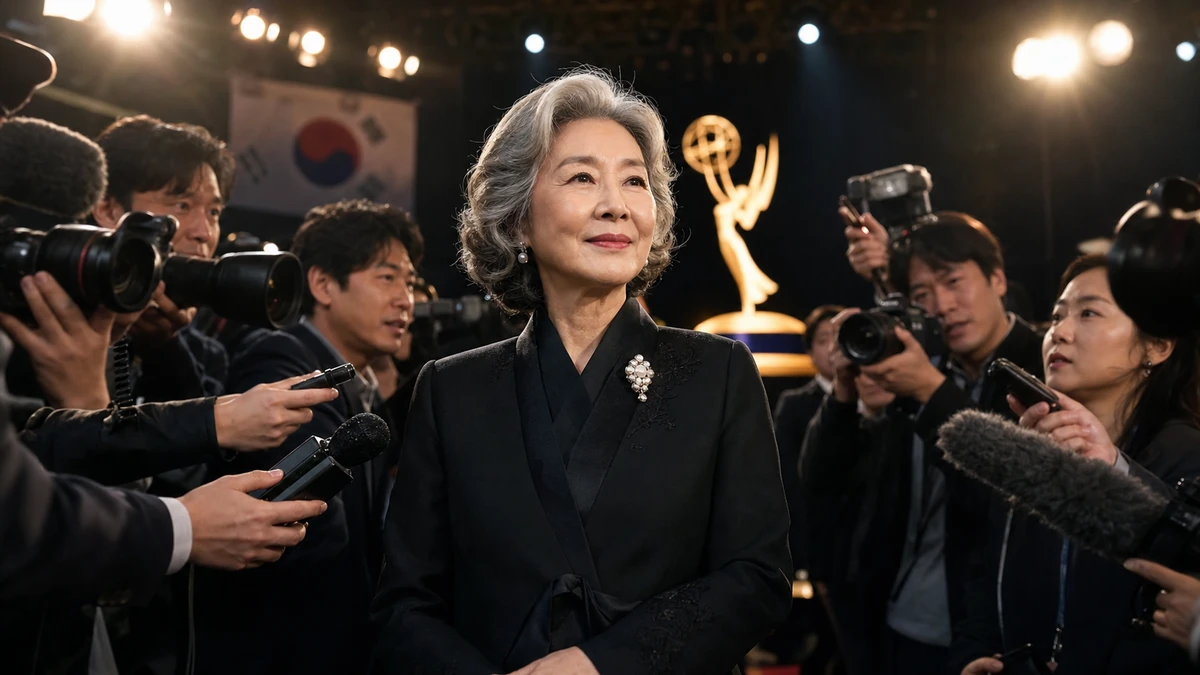
A Korean screen legend returns to the center of the American awards conversation
Youn Yuh-jung, the veteran South Korean actor who made history with her Academy Award win for “Minari,” has now landed in another of American entertainment’s most closely watched races: the Primetime Emmy Awards. According to the Television Academy’s nominations for the 78th Primetime Emmys, Youn was named a contender for supporting actress in a limited or anthology series or movie for her role in Netflix’s “Beef” Season 2.
On paper, a nomination is just that — a place on a shortlist. In practice, this one carries larger cultural and industry weight. For American audiences who first came to know Youn as the sharp-tongued, chain-smoking grandmother in “Minari,” the Emmy recognition is another reminder that her Oscar win was not a one-off crossover moment. It was part of a broader change in how Korean actors are being cast, viewed and rewarded in global entertainment.
That matters because the Emmys are not simply television’s version of the Oscars. In the streaming era, they are one of the clearest indicators of who belongs at the center of the American entertainment business. Prestige TV and streaming dramas now drive the same kind of critical attention and cultural influence that studio films once monopolized. For a Korean actor of Youn’s stature to be recognized here suggests that the pipeline connecting Korean talent to mainstream U.S. storytelling is growing deeper, not narrower.
For years, Korean performers were often introduced to U.S. audiences through imports: Korean films at festivals, Korean dramas on niche streaming menus, or breakout global phenomena like “Parasite” and “Squid Game.” What is changing now is the context. Youn is not being honored for a Korean-language production that traveled outward. She is being recognized for work inside a major global platform’s flagship ecosystem, in a series shaped by Korean, Korean American and American creative influences all at once.
That distinction may sound subtle, but it is significant. It points to a future in which Korean actors are not simply arriving in Hollywood after success at home. They are becoming part of the architecture of global television itself.
Why this nomination matters beyond one performance
Youn’s latest recognition comes with the kind of symbolic force that awards-watchers in the United States understand well. When an actor wins an Oscar, the industry often asks whether the moment will lead to sustained opportunity or remain an isolated milestone. That question has long followed performers from outside Hollywood’s traditional power centers, whether they came from Europe, Latin America or Asia.
In Youn’s case, the Emmy nomination offers a strong answer. Her 2021 Oscar for “Minari” — the first acting Oscar won by a Korean performer — was widely celebrated as historic. But history in Hollywood can be fickle. A barrier breaks, headlines follow, and then the industry sometimes slips back into familiar habits. What makes this Emmy nod important is that it suggests continuity. Youn is not being remembered only as the actor from that one awards-season sensation. She is continuing to work in projects that are central to how American audiences now consume prestige entertainment.
That has broader implications for Korean performers as a group. In the last several years, American audiences have become far more accustomed to subtitles, more curious about Korean storytelling and more open to seeing Korean actors as marquee talent rather than novelty casting. Parasite’s best picture win at the Oscars, the global dominance of BTS in music, the explosive reach of “Squid Game,” and the continued expansion of streaming platforms all helped create that environment. But individual actors still need to turn cultural momentum into durable careers. Youn’s nomination is evidence that such a transition is increasingly possible.
There is also a generational element that makes her story especially striking. Youn is not a newly discovered ingenue being marketed as the face of a trend. She is one of Korea’s most respected veteran actors, with decades of work behind her. That an older Korean woman can command serious attention in the American awards system speaks to a more meaningful kind of global inclusion than simple fad-driven hype. It suggests that talent, screen authority and interpretive depth are crossing borders in ways that matter more than demographics alone.
For American readers, the closest parallel may be the way certain European screen legends eventually became part of the prestige-film canon in the United States, not because they were exotic imports but because the culture made room for them as artists. Youn’s rise in the American imagination increasingly looks like that kind of shift.
Her role in “Beef” Season 2 reflects a new kind of Korean presence on screen
In “Beef” Season 2, Youn plays a wealthy Korean chairwoman who acquires a country club, a setting that American viewers will immediately recognize as a shorthand for class, power and social gatekeeping. In U.S. storytelling, the country club often functions as a stage where status is performed and hierarchies are enforced — less a golf backdrop than a theater of wealth. By placing a Korean billionaire at the center of that space, the series does something revealing. It inserts a distinctly Korean figure into one of the most classically American environments of privilege.
That is part of what makes the role notable. Youn’s character is not there merely to signal international flavor or to satisfy a streaming platform’s diversity checklist. She is positioned as someone who shapes the social world around her, influences the relationships inside the story and carries narrative gravity. In other words, she is not ornamental. She matters.
That might sound obvious, but it marks an evolution in how Korean actors have often been used in Western productions. Too often in the past, actors of Asian descent were cast into narrow roles defined primarily by ethnicity, accent or stereotype. More recent projects have improved that record, but the difference here lies in the combination of specificity and scale. Youn’s character is unmistakably Korean, yet her role also taps into familiar universal themes: money, power, social ambition, family dynamics and human tension within elite spaces.
This balance — being specifically Korean while also fully legible within a broader American dramatic framework — is where many of the most interesting global performances now live. It is one reason Korean actors have found new resonance with English-speaking audiences. They are no longer asked only to represent “Koreanness” in the abstract. They are being given characters whose cultural background informs the role without limiting its dramatic range.
That is a meaningful development in the streaming age. Netflix and similar platforms have trained viewers to accept stories that move across borders, languages and identities with much less friction than traditional network television once allowed. The audience for “Beef” is not neatly divided between domestic and foreign viewers. It is global from the start. A character like Youn’s emerges naturally from that ecosystem.
The pairing of Youn Yuh-jung and Song Kang-ho carries its own cultural charge
Another reason the casting drew attention is the presence of Song Kang-ho, one of South Korea’s most acclaimed actors, in a special appearance as Dr. Kim. For audiences deeply familiar with Korean cinema, the idea of Youn and Song appearing together in a global streaming series is a major event in itself. These are not just recognizable stars. They are pillars of modern Korean screen acting.
To put that in terms American readers might grasp, imagine two performers with the stature, credibility and cultural recognition of top-tier art-house and awards-season veterans suddenly sharing scenes in a buzzy prestige series. The excitement is not only about plot. It is about what the pairing symbolizes: a concentration of screen history and prestige in one production.
The fact that the two appear as a married couple adds another layer of intrigue. Korean audiences, like American ones, often pay close attention to “actor chemistry” and casting combinations. In Korean entertainment coverage, the meeting of beloved or highly respected performers can become part of the story itself. That dynamic is not unique to Korea, but it operates with particular intensity in an industry where star personas, previous roles and generational standing are closely tracked by fans.
For international viewers who may not know the full weight of those names, the takeaway is simpler: “Beef” is not merely using Korean actors incidentally. It is drawing from the upper ranks of Korean screen talent. That says something about how global prestige television now works. Instead of assuming American productions occupy the center and foreign performers orbit around them, series like this increasingly function as meeting points where different national star systems intersect.
There is also an artistic benefit. Actors like Youn and Song bring with them performance traditions shaped by decades of Korean film and television, industries known for tonal agility, emotional precision and a willingness to shift quickly between satire, melodrama and social critique. Those qualities can enrich American series that are already interested in tonal complexity. “Beef,” with its mix of discomfort, class tension and psychological observation, is the kind of show where that sensibility can thrive.
From “Minari” to the Emmys, Youn’s career now maps a wider global route
When Youn won the Oscar for “Minari,” the moment resonated for reasons beyond the award itself. “Minari” was an American film, but it was also a Korean American family story told with a specificity that Hollywood once might have considered too niche for major recognition. Youn’s performance as the grandmother Soon-ja was unforgettable because it overturned easy expectations. She was funny, unruly, unsentimental and deeply human, all at once.
That performance introduced many American viewers to her, but it did not introduce her to the craft. In South Korea, Youn had long been a towering figure, respected for decades of stage and screen work. The Oscar turned her into an international symbol. The Emmy nomination now expands that symbolism from film into television and streaming — a move that reflects how the entertainment business itself has changed.
In earlier eras, movie stardom and television prestige were more sharply divided, especially in the United States. Today, the wall between them has thinned. Limited series, anthology dramas and streaming productions attract filmmakers and actors who once might have reserved themselves for cinema. So when Youn earns Emmy recognition after an Oscar triumph, it is not just a personal accomplishment. It places her squarely within the most consequential storytelling channels of the current moment.
That trajectory also says something about the growing durability of Korean cultural influence. For a while, much of the conversation around the Korean Wave — often called “Hallyu,” the term used to describe the global spread of South Korean popular culture — centered on music and export success. K-pop became the most visible example in the U.S., followed by increasing attention to Korean dramas and films. But Youn’s path shows that the next phase may be less about isolated hits and more about institutional presence. Korean actors are not simply producing breakout moments. They are entering the awards circuits, production networks and casting ecosystems that define long-term cultural authority.
That is why the nomination matters whether she wins or not. Awards can validate, but nominations already tell a story about access, visibility and industry regard. In Hollywood, being invited back into the race is often as revealing as taking home the trophy.
Korean actors are building on earlier Emmy breakthroughs, not starting from scratch
Any discussion of Korean performers at the Emmys inevitably recalls Lee Jung-jae’s 2022 lead actor win for “Squid Game,” a watershed moment that showed a Korean-language series could compete at the heart of America’s television awards machine. That victory helped expand what many U.S. viewers and industry insiders considered possible. It demonstrated that Korean drama was not merely popular overseas or fashionable on streaming charts; it could command the same elite recognition reserved for the center of the American TV industry.
Youn’s nomination belongs to that post-“Squid Game” landscape, but it also broadens it. Lee’s triumph was tied to a distinctly Korean series that traveled globally. Youn’s nod comes through a somewhat different route: a major international streaming production with Korean and Korean American creative DNA, Korean casting and at least some production links to Korea, operating inside a transnational framework. Together, those developments suggest that Korean talent is now moving along multiple tracks at once.
One track is the continued global success of Korean-made content. Another is the growing presence of Korean actors inside multinational productions that are not confined to one national industry. That matters because it reduces the risk that Korean visibility in Hollywood will be treated as a passing craze attached to one mega-hit. Instead, it points toward ecosystem change.
For American audiences, there is an instructive lesson here. The U.S. entertainment industry often discovers international talent in bursts, then narrows its attention to a handful of bankable names. What is happening with Korean actors appears more layered. The emergence of multiple recognized performers across films, dramas and streaming series suggests not a single breakthrough but an expanding bench. Youn, Lee, Song Kang-ho and others are not interchangeable faces of a trend. They represent different generations, styles and entry points into the global market.
That is usually a sign of lasting change rather than a temporary boom. When recognition spreads beyond one breakout title or one star, the culture has started to shift at a structural level.
The real story is what this says about the future of global television
At its core, Youn Yuh-jung’s Emmy nomination is not only about one decorated actor adding another line to a remarkable career. It is about the way global television is being remade. Streaming platforms have accelerated a system in which creators, actors and financiers from different countries collaborate in ways that would have been unusual only a decade ago. A Korean American director can guide a series for a U.S.-based platform, cast Korean screen icons, shoot material connected to Korea and still produce a work intended from the outset for a worldwide audience. That is no longer an exception. It is becoming the grammar of prestige entertainment.
For viewers, this means the most interesting shows may increasingly come from hybrid spaces — not fully American in the old Hollywood sense, not simply imports from abroad, but stories made through layered cultural exchange. For actors, it means national identity can become an asset without functioning as a cage. Youn’s role appears to embody that possibility. Her character’s Koreanness is part of the drama, yet the role also stands on the timeless foundations of conflict, status and human behavior.
There is, of course, a larger question ahead. As Korean actors gain visibility in international productions, will they continue to receive parts with genuine complexity, or will the industry fall back on tokenism once the novelty fades? That remains unresolved. But Youn’s nomination offers one of the more hopeful answers available right now. It suggests that a Korean performer can be recognized not merely for representing a market, but for anchoring a role that matters to the story and lingers with voters.
For American readers who may be only loosely familiar with Korean entertainment beyond a few global hits, Youn’s latest milestone is worth seeing in full context. This is not just another awards-season footnote from the expanding world of K-content. It is evidence that Korean actors are moving from the periphery of U.S. cultural recognition toward a more permanent place inside it.
Whether Youn wins the Emmy or not, her nomination underscores a reality that the American entertainment industry is still learning to articulate: Korean talent is no longer arriving as a guest in Hollywood’s television conversation. It is helping shape the conversation itself.
Comments
Post a Comment