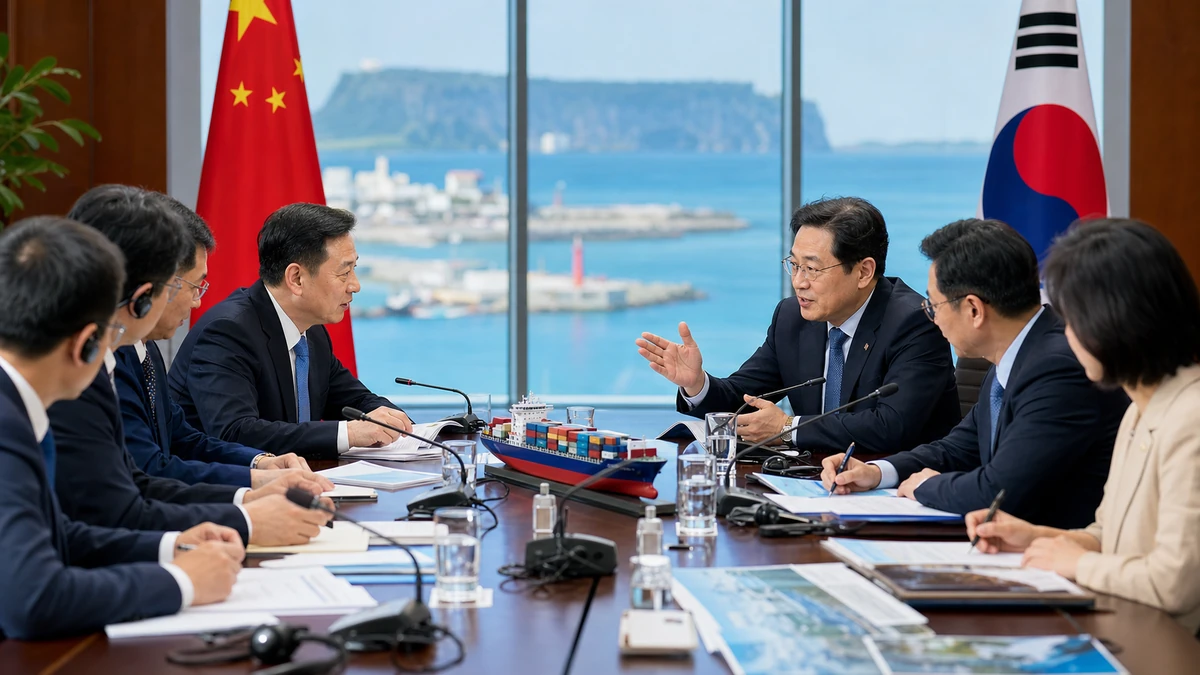
Why a Visit From Qingdao Matters on Jeju Island
A delegation from Qingdao, the major Chinese port city in Shandong province, met this week with Jeju officials to discuss expanding cooperation in the economy, tourism and maritime affairs — a diplomatic-sounding agenda that, on closer look, points to a larger question facing South Korea’s best-known resort island: How should Jeju reconnect with China, and at what cost?
According to South Korean officials and local reporting, the meeting took place during a visit by the Qingdao delegation to Jeju, where the group met with Park Cheon-su, the island’s administrative vice governor. The conversation covered broad areas of exchange, including business ties, tourism and marine cooperation. But the issue drawing the most attention is a proposed international cargo shipping route linking Jeju and Qingdao, a project that has become the first major China-related policy test for Jeju’s new provincial administration.
To American readers, the topic may sound narrow — a freight line between an island in South Korea and a city in eastern China. But on Jeju, logistics is not just a back-office concern. It is inseparable from tourism, trade and the island’s long-term viability. Jeju, often described as South Korea’s answer to Hawaii, is famous for volcanic landscapes, coastal cliffs, citrus farms and honeymoon tourism. Yet like many islands that depend on outside connections, its prosperity hinges not only on how many travelers arrive by plane, but also on how goods move, how ports function and how officials manage relationships with neighboring countries.
That is why a cargo route is being discussed in the same breath as tourism. For Jeju, links to foreign cities are not merely about transporting containers from one port to another. They are part of a wider strategy about how the island positions itself in Northeast Asia — as a leisure destination, a trading hub, a maritime partner and a regional bridge between South Korea and China.
The current debate also comes at a politically sensitive moment. Jeju officials are reviewing whether to keep the project moving under its existing terms, revise the agreement with the Chinese shipping company involved, shore up investment-review procedures or even halt the route altogether. Nothing has been decided, officials say. But even that uncertainty tells an important story: Jeju is weighing the promise of deeper international engagement against the reality of public scrutiny, financial risk and administrative accountability.
The Cargo Route at the Center of the Debate
The Jeju-Qingdao route is, by name and design, a cargo shipping project rather than a passenger ferry service. That distinction matters, but perhaps less than it first appears. In island economies, freight has downstream effects on nearly everything else. Food supplies, hotel goods, restaurant ingredients, consumer products, construction materials and regional specialties all move through logistics networks. So do the less visible building blocks of tourism competitiveness: port infrastructure, supply chain stability and commercial confidence.
If the route functions well, it could strengthen Jeju’s access to a nearby Chinese market and expand commercial channels between the island and one of northern China’s most important coastal cities. Qingdao is not a minor counterpart. It is a strategic port, a manufacturing center and a city with a deep maritime identity. Americans may recognize it as the home of Tsingtao beer, whose older spelling reflects the city’s historic romanization. For Jeju, working with Qingdao means working with a city that has both economic weight and practical relevance in sea-based trade.
Still, the route has not been a straightforward success story. The project has faced controversy over loss-compensation payments and over the investment screening procedures attached to the arrangement. In plain English, that means questions have been raised over how much public money might be needed to cover operating losses, and whether the decision-making process surrounding the project has been handled with sufficient oversight.
Those concerns are not unique to South Korea. American readers have seen versions of the same debate in local infrastructure fights across the United States, whether over regional airports, rail lines, sports stadiums or port expansions: Supporters argue that strategic investments may look expensive in the short term but are necessary for long-term growth. Critics ask whether taxpayers are being asked to subsidize projects with unclear returns or overly optimistic assumptions. Jeju’s shipping debate fits squarely into that familiar pattern.
What makes the issue especially important now is that local officials are not simply deciding whether to keep one business arrangement alive. They are also deciding what kind of engagement with China they want Jeju to pursue after years in which tourism flows, regional politics and post-pandemic recovery efforts have all shifted. The cargo route has become a symbol of a broader choice: maintain the connection, renegotiate it under more sustainable terms or cut losses and move on.
Why Tourism Is Part of a Freight Story
At first glance, tourists do not board cargo ships, so why would a freight route matter to travel? On Jeju, the answer is that tourism is an ecosystem, not just a hotel booking. The island’s appeal depends on beaches, hiking trails, seafood, cafes, museums, resorts and a carefully cultivated image of escape. But beneath that image lies a practical reality. A destination’s quality is shaped by how reliably it can stock its restaurants, support its businesses, export local products and maintain the infrastructure that keeps the economy humming.
That is especially true for Jeju, whose identity is built on both natural beauty and a certain degree of remoteness. Americans might think of the challenge faced by places such as Hawaii, Martha’s Vineyard or Puerto Rico, where paradise depends on supply chains. Visitors may see sunsets and scenic roads; local officials must think about ports, shipping costs and outside market access. Jeju operates under the same logic. Air routes bring in vacationers, but maritime links help sustain the broader economic environment that makes tourism possible.
The fact that Jeju and Qingdao officials discussed tourism alongside economic and maritime cooperation suggests the island is trying to treat the relationship as something larger than a single transport contract. Rather than viewing the route only as a technical shipping matter, Jeju appears to be folding it into a larger framework of regional exchange. That is important because tourism in East Asia often overlaps with diplomacy, commerce and city-to-city partnerships in ways that may be less obvious to Western audiences.
For years, Chinese travelers were a major part of South Korea’s tourism landscape, and Jeju was one of the most visible beneficiaries. The island has long been marketed abroad as an accessible getaway, known for lava tubes, waterfalls, seaside drives and Hallasan, South Korea’s tallest mountain. It is also famous for the haenyeo, the women free divers who harvest seafood without oxygen tanks, a cultural tradition recognized by UNESCO. These are the kinds of experiences that give Jeju global cachet. But keeping an island destination internationally competitive requires more than scenery. It requires dependable connections, policy stability and confidence that public infrastructure decisions will not turn into prolonged political headaches.
That is one reason the Jeju-Qingdao discussion is being watched so closely. The route itself may not carry sightseers, but the success or failure of the project will help signal how Jeju intends to rebuild or redefine its relationship with Chinese counterparts — not only in logistics, but in the wider flow of commerce and visitors.
A New Administration’s First Major China Test
In South Korean local politics, the phrase used in coverage of this issue refers to the first major China-related agenda item for Jeju’s new popularly elected provincial administration. That wording may need a little unpacking for readers outside Korea. South Korea has a robust system of local self-government, and Jeju, formally known as Jeju Special Self-Governing Province, has a degree of administrative distinctiveness within the country. Its leadership must navigate local economic needs while also working within national regulations and broader regional dynamics.
So when officials describe the cargo route as the first major China issue for the new administration, they mean more than a scheduling problem inherited by a new team. They mean that this is an early, high-visibility test of how the current government on Jeju will handle Beijing-adjacent economic engagement, relations with a Chinese city partner and the politically delicate matter of public spending on international projects.
That matters because local governments in South Korea often operate at the intersection of domestic accountability and international ambition. Like governors and mayors in the United States who court foreign investment or promote trade missions, Korean provincial leaders are expected to think globally while answering to local voters. On Jeju, those pressures are even sharper because the island’s economy relies heavily on outside demand, especially tourism, and because its geographic isolation makes transportation policy unusually important.
The visit by the Qingdao delegation therefore served at least two functions. On the surface, it was a routine exchange between regional governments looking to discuss cooperation. At a deeper level, it was a moment in which Jeju had to demonstrate that it remains open to cross-border engagement, even while it reassesses a controversial project. In that sense, the meeting was less about announcing a final decision than about aligning the agenda: identifying areas of mutual interest while buying time to determine what happens next with the cargo route.
Officials have emphasized that no final decision has been made. A Jeju maritime and fisheries official, according to local reporting, said various options remain under review, including continuing operations with procedural adjustments, modifying the agreement with the Chinese shipping side or suspending the route. That may sound bureaucratic, but it is actually the most important fact in the story. There is discussion, there is scrutiny and there is diplomatic contact — but there is not yet a settled outcome.
The Financial and Political Risks Behind the Route
For all the talk of cooperation, the central tension in this story is financial. Jeju officials are reportedly concerned that if the project proceeds under the current agreement, the island could remain on the hook for burdensome operating-loss compensation. That is the kind of phrase that can lose readers quickly, but it boils down to a simple concern: If the route does not make enough money on its own, who pays the difference, and for how long?
This is where public enthusiasm for international exchange can run headlong into taxpayer skepticism. Local governments everywhere love the language of connectivity, revitalization and strategic partnership. But those ideas become politically vulnerable when a project appears dependent on large subsidies, especially if the public is not convinced the benefits are tangible, evenly shared or realistically measured.
There is also the question of process. Reports indicate that investment review procedures tied to the project have themselves become part of the controversy. In democracies, big infrastructure or quasi-commercial public projects often live or die not only on economic merit but on procedural legitimacy. Was proper review conducted? Were forecasts reasonable? Were risks clearly disclosed? Were officials too eager to land a symbolic international project without fully stress-testing the numbers? These are questions familiar to city hall reporters in the United States, and they resonate just as strongly in South Korea.
Jeju’s challenge is that both sides of the equation are real. On one hand, the island needs durable external links if it wants to remain competitive as an international destination and regional economic player. On the other hand, a route that requires ongoing and politically costly support can quickly become a liability rather than an asset. That is why the range of options reportedly under review is so broad. Renegotiation suggests Jeju still sees strategic value in the route but wants terms that reduce exposure. Procedural supplementation suggests officials believe the project may yet be salvageable if governance concerns are addressed. Suspension would signal that the costs or complications have become too great.
None of those outcomes would be trivial. Continuing the route could be read as a vote of confidence in regional integration. Revising it could signal a more cautious, pragmatic approach to China ties. Halting it could be interpreted as an admission that the original framework was unsustainable. In every case, the decision would say something about how Jeju defines success in the balance between global ambition and local fiscal responsibility.
What This Says About Jeju’s Place in Northeast Asia
For international readers, the deeper significance of this story lies in how it reveals the invisible infrastructure behind a world-famous travel destination. Jeju is often consumed in images: canola fields, black volcanic rock, seaside cafes, luxury resorts and newlyweds taking photos against dramatic coastal backdrops. But destinations do not run on imagery alone. They run on governance, transport systems, supply chains and regional relationships that most visitors never see.
The Jeju-Qingdao discussion shows that Jeju is trying to think of itself not only as a scenic island but as a node in a wider Northeast Asian network. That network includes tourism, yes, but also marine industries, trade channels and city-level diplomacy. The fact that Jeju and Qingdao discussed economic, tourism and ocean-related cooperation together suggests a multi-layered approach to regional engagement, one in which a transport route is just one piece of a larger puzzle.
There is also a subtle but important geopolitical undertone. South Korea’s economic ties with China remain significant, even as the broader political environment in the region has become more complicated. For a place like Jeju, local officials do not necessarily control national strategy, but they do feel the practical consequences of regional relationships in their own economies. A shipping route to Qingdao is not foreign policy in the same way a defense agreement is, but it is still part of how interdependence is built, managed and sometimes contested.
That helps explain why this issue has grown beyond the technical realm. The shipping line is now a test of whether Jeju can create or maintain meaningful cross-border connections without overcommitting public resources. It is also a test of whether an island known mainly for leisure can strengthen the less glamorous systems that support that identity. In today’s travel economy, beautiful landscapes remain essential, but connectivity often determines who thrives and who plateaus.
For Americans used to thinking of tourism primarily in terms of direct flights, hotel capacity and advertising campaigns, Jeju offers a useful reminder. The health of a destination can depend just as much on freight, port policy and administrative decisions as on marketing slogans. The beaches and scenic roads may draw visitors in, but the logistics beneath them help decide whether the destination remains resilient.
No Final Decision Yet, but a Clearer Picture of the Stakes
The most important caution in this story is not to confuse discussion with resolution. Jeju officials have not announced that the cargo project will continue, nor have they said it will be abandoned. What they have made clear is that they are reviewing multiple scenarios and that the financial and procedural concerns surrounding the route cannot be ignored.
Even so, the meeting with the Qingdao delegation matters because it sharpens the stakes. It shows that Jeju’s debate is not simply about whether a ship sails from one port to another. It is about how the island manages its next phase of international engagement with China, how it integrates tourism with trade and maritime policy, and how a local government tries to preserve opportunity without losing sight of costs.
That balancing act is especially relevant for Jeju because its brand depends on being both distinct and accessible. It is a place marketed as an escape, but one that must remain deeply connected to thrive. The route to Qingdao, whether ultimately revised, preserved or scrapped, has become a proxy for that larger tension. Connectivity brings opportunity, but also exposure. Regional cooperation offers upside, but only if public officials can prove it is sustainable.
In the end, this is not yet a story about a completed project or a diplomatic breakthrough. It is a story about the mechanics of regional strategy, viewed through the lens of a resort island better known for its cliffs and beaches than for the fine print of shipping agreements. But that fine print matters. It may help determine how Jeju navigates its economic future, how it positions itself in Northeast Asia and how it reconciles its global ambitions with local accountability.
For travelers, that debate may remain largely invisible. For policymakers and businesses, it is front and center. And for anyone trying to understand modern Jeju, it is a reminder that even paradise runs on infrastructure.
Comments
Post a Comment