A Filipino Student Just Earned South Korea’s First Master’s Degree in K-Culture and Entertainment. It Says a Lot About Where K-pop Is Headed.
From fandom to graduate study
South Korea has produced many firsts in pop culture over the past two decades: the first K-pop acts to top U.S. charts, the first Korean-language songs to become global streaming staples, the first Korean films and TV series to dominate mainstream Western conversation. Now the country has marked a different kind of milestone, one that says less about celebrity and more about what happens when a cultural wave becomes an academic field.
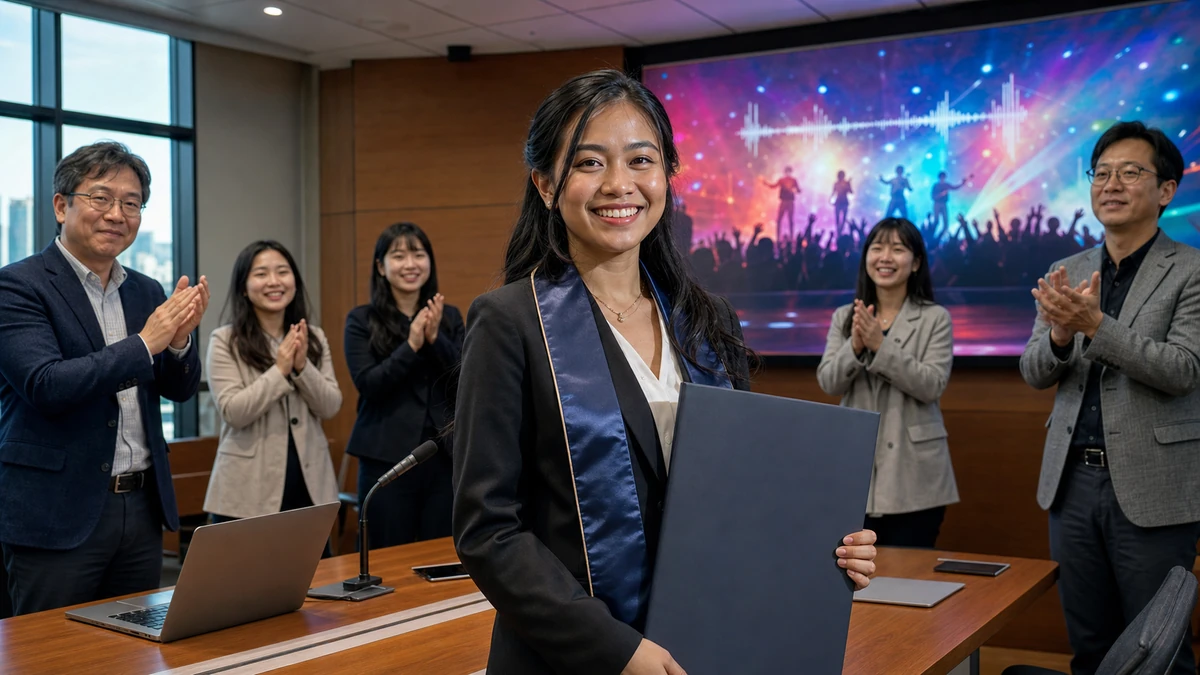
A 29-year-old international student from the Philippines, Abigail Jasmine Lyamo, has become the first person in South Korea to earn a master’s degree explicitly titled in “K-Culture and Entertainment,” according to South Korean reporting. She completed the degree at Sungshin Women’s University in Seoul after passing review of a thesis examining K-pop concert consumption and event planning strategies in South Korea and the Philippines.
That may sound like a narrow academic footnote. It is not. In the same way colleges in the United States long ago stopped treating film, jazz, sports management or digital media as hobbies and began treating them as serious subjects worthy of professional training, South Korea is now signaling that K-pop and the broader machinery around it have moved beyond trend status. They are becoming something that can be systematically studied, taught and professionalized.
What makes this case especially notable is not simply that a student graduated with a thesis related to Korean pop culture. Universities around the world already offer courses on Korean film, soft power, media globalization and fan communities. What is new here is the degree name itself. Rather than placing the work inside a broader and more traditional category like arts management, media studies or cultural industries, the program puts “K-Culture and Entertainment” front and center. That naming matters. It reflects an industry and a society increasingly comfortable saying that Korean popular culture is not just an offshoot of something else. It is now substantial enough to stand on its own.
For American readers, it may help to think of this as the point when an entertainment phenomenon crosses over from fandom into institution-building. It is similar to the way universities eventually created formal programs in hip-hop studies, sports business or game design after years of treating them as extracurricular interests or niche specializations. Once a field generates jobs, international influence, research questions and a steady stream of students, academia eventually follows.
Lyamo’s journey also highlights another reality of the Korean Wave, or “Hallyu,” the term used to describe the global spread of South Korean entertainment and culture. Hallyu is no longer just about exports from Seoul to the rest of the world. It is also about what those exports inspire abroad: language study, tourism, local music scenes, fan communities, new career paths and, increasingly, research produced by people outside Korea who want to work inside the industry rather than simply consume it.
A generation shaped by K-pop’s global rise
Lyamo told South Korean media that she became a K-pop fan around 2010 through SHINee, one of the defining boy bands of what many fans think of as K-pop’s second generation. Later, she followed groups including EXO, NCT DREAM and SEVENTEEN, effectively tracing the genre’s evolution across multiple eras. For longtime international fans, that kind of artist list is more than a playlist. It maps onto how K-pop grew from a passionate but still somewhat specialized global interest into a highly organized and commercially sophisticated transnational industry.
In the United States, people often talk about K-pop through the lens of viral moments: a song that blows up on TikTok, a stadium tour stop in Los Angeles, a Coachella performance, a chart record, a late-night TV appearance. But for many fans in Asia, Latin America and beyond, K-pop has been part of daily youth culture for well over a decade. Fans did not simply stumble onto the genre through algorithmic recommendation. They followed it through message boards, fan-subtitled videos, online communities, album group orders and concert circuits that were already global long before U.S. cultural institutions fully caught up.
Lyamo’s story reflects that deeper timeline. She did not arrive at Korean culture through a sudden trend cycle. She followed K-pop over years, learned the language during the COVID-19 pandemic and eventually enrolled as the first student in a graduate concentration in K-Culture and Entertainment launched in 2024. The path from fan to language learner to researcher to aspiring industry professional shows how K-pop’s reach has matured. It is no longer unusual for international fans to know enough about Korean language, performance norms and fan culture to navigate spaces that once belonged mostly to domestic audiences.
In that sense, her trajectory resembles something familiar to Americans who have seen passions turn into professions. A teenager obsessed with sports becomes a data analyst. A comic-book fan becomes an editor. A gamer studies software design. The important shift is not the fandom itself; it is the infrastructure around it that makes professional entry seem realistic. K-pop now has that infrastructure. It has major agencies, touring companies, merchandising operations, fan platforms, global licensing pipelines, scholarship opportunities and increasingly formal educational channels.
Lyamo has said she hopes to gain practical experience in K-pop concert work in South Korea after graduation and eventually become a concert director. That ambition is revealing. It suggests that K-pop does not only generate consumers abroad; it generates skilled aspirants who want to help produce the spectacle. For an industry that depends heavily on live events, international expansion and increasingly localized audience strategies, that matters.
Why concerts are the right place to study K-pop
Lyamo’s thesis focused on an area that industry executives, promoters and fans alike understand is central to K-pop’s business model: concerts. Her study compared K-pop fan concert consumption in South Korea and the Philippines while also examining planning strategies used by event organizers. Even without reading the full paper, the framing alone points to one of the most important truths about modern pop music. The concert is not just the afterthought that follows the album release. It is where brand identity, fan loyalty, commerce and performance aesthetics converge.
K-pop concerts are especially rich sites for research because they are built around more than music. Buying a ticket is only one part of the experience. Fans often coordinate travel, outfits, unofficial freebies, fan projects, synchronized chants and merchandise purchases. There are light sticks designed for specific artists, fan-made banners, rules of etiquette and carefully choreographed moments of audience participation. In the K-pop world, the concert arena can function almost like a temporary city built around belonging.
For readers less familiar with the culture, one useful comparison is the way major fandom events in the United States combine entertainment, identity and ritual. Think of the atmosphere around a Taylor Swift stadium show, Comic-Con or a major college football game: the pilgrimage, the merchandise, the inside language, the social media performance, the sense that attendance itself becomes part of personal history. K-pop concerts often carry that same intensity, but with a particularly structured relationship between artist and fandom, sharpened by years of training, visual design and fan engagement strategies.
That is why comparing South Korea and the Philippines makes sense. A concert is never just the same product dropped into different countries. Local infrastructure matters. Ticket pricing matters. Venue access matters. Public transit, weather, scheduling, fan expectations, language comfort and organizer reputation all shape how audiences experience a show. So do local norms of enthusiasm and participation. A performance that reads as polished and intimate in Seoul may land differently in Manila, where audience energy, venue realities and fan community habits may create another kind of atmosphere.
The Philippines is a particularly meaningful case. With a population of more than 100 million, it is one of Southeast Asia’s major K-pop markets. Korean acts draw substantial interest there, and local pop groups have also emerged in ways influenced by the K-pop training-and-performance model. In other words, the Philippines is not merely a passive destination for Korean cultural exports. It is part of a larger regional ecosystem in which K-pop is consumed, reinterpreted and woven into local entertainment industries.
By focusing on both “concert consumption” and “planning strategies,” the thesis appears to bridge two perspectives that are often kept apart: the fan’s experience and the organizer’s decision-making. That matters because K-pop’s global success depends on the meeting point between the two. Fans decide whether a show feels worth the money, the travel and the emotional investment. Promoters decide how to package, market and stage that experience in ways that make commercial sense. Research that takes both sides seriously is exactly the kind of work a maturing entertainment industry needs.
What it means to put “K-Culture” on the diploma
South Korea has long taught subjects that overlap with the business of entertainment: arts administration, media production, communications, cultural policy and business management. What makes this development stand out is the degree label itself. “K-Culture and Entertainment” is not a neutral, old-fashioned academic term. It is contemporary, market-aware and intentionally specific.
That can sound odd to American ears at first. Universities in the U.S. have traditionally preferred broader, more durable names for majors and graduate programs. Academia often moves slowly, while entertainment trends move fast. There is always a risk that a field tied too closely to a current phenomenon can seem promotional or temporary. But those concerns become less persuasive when the phenomenon has already lasted decades, supports major export revenue, influences fashion and beauty markets, shapes tourism and language study, and generates durable global communities.
K-pop is now well past the point where it can be dismissed as a fad. Neither can the broader category of “K-culture,” which for many international audiences encompasses television dramas, film, beauty products, food, fashion, online platforms and lifestyle branding. In Washington policy circles, analysts discuss South Korea’s cultural reach as an element of soft power, the ability of a country to shape international perceptions through attraction rather than force. In boardrooms, executives look at it as a commercial engine. In universities, it is increasingly a subject that invites study across sociology, business, communications and cultural theory. A degree title that names K-culture directly is a sign those worlds are converging.
Still, it is important not to exaggerate the milestone. One graduate does not automatically mean a transformed higher-education system or a wholly new academic discipline. Firsts are symbolic by nature. Their value lies less in scale than in precedent. Someone has to be the first person to make the case that a field deserves its own vocabulary, curriculum and professional pipeline. After that, institutions, employers and future students have something concrete to point to.
The fact that the first graduate is an international student is significant in its own right. It underscores that K-pop scholarship is not confined to Korean researchers studying domestic culture from within. The audiences, consumers and future professionals shaped by the Korean Wave are increasingly global. That means the study of Korean entertainment is also becoming global, not as an abstract matter of foreign interest but as a field informed by people who bring different markets, fan practices and cultural assumptions into the conversation.
The Philippines and South Korea in a shared pop ecosystem
There is a tendency in some coverage of K-pop to describe global markets as if they were simply destinations on a map: places where Korean agencies sell albums, stream videos and schedule arena dates. That framing misses the more complicated reality. Countries like the Philippines are not just endpoints for Korean content. They are places where audiences actively reshape what that content means.
The Philippines has long been one of the most enthusiastic overseas audiences for Korean entertainment. Korean dramas have been widely watched there, K-pop groups command intense fan loyalty, and Korean beauty and fashion trends have had broad visibility. At the same time, Filipino music and entertainment industries have not stood still. Local performers and management systems have adapted some of the polished, idol-centered techniques associated with K-pop while filtering them through local languages, tastes and performance traditions.
That interplay is one reason Lyamo’s perspective matters. As a Filipino researcher and fan studying Korean concerts, she is positioned to see both the attraction of the original product and the differences that emerge when it travels. Those differences can be subtle but commercially important. What do fans in Manila expect from an event package? How do they weigh price against prestige? What makes a concert feel authentically “K-pop” without making it feel culturally distant or inaccessible? These are not abstract questions. They affect ticket sales, fan satisfaction, promoter trust and an artist’s long-term standing in a given market.
For Americans, a rough parallel might be the way Latin music or British pop has moved through the U.S. market over time. Success rarely comes from exporting a product unchanged and assuming audiences will adapt. It comes from a conversation between origin and destination, between a genre’s core identity and the expectations of local listeners. K-pop’s challenge is especially delicate because part of its appeal lies precisely in its Koreanness, the sense that it offers something distinct from mainstream Western pop, even as it borrows freely from global musical traditions.
That tension appears in one of the most intriguing ideas connected to Lyamo’s story: the suggestion that overseas fans want K-pop to preserve its “Korean elements” even as it expands globally. That message pushes against an assumption sometimes heard in entertainment circles, namely that worldwide success requires flattening cultural specificity in favor of a more generic international style. Fans often say the opposite. They are drawn to K-pop because it feels like it comes from somewhere.
Global success, local identity
The question hanging over much of K-pop’s future is not whether it can go global. It already has. The question is how far it can globalize without losing the qualities that made it compelling in the first place.
That concern is familiar in American culture too. Hollywood, country music, regional food traditions and even college sports all face versions of the same debate: how do you scale up without sanding off what makes the thing distinctive? For K-pop, the issue can involve language choices, training systems, visual aesthetics, fan communication styles, storytelling formats and the structure of live performance itself.
When international fans say they hope K-pop retains Korean elements, they are not necessarily asking for purity or isolation. K-pop has always been hybrid. It draws from American R&B, hip-hop, EDM, Japanese idol systems, global fashion and digital culture. But fans often recognize a specifically Korean mode of packaging and performance: tightly coordinated group identity, rigorous choreography, multi-format fan engagement, intensive trainee development, serialized comeback cycles and a concert culture that treats the live show as a carefully engineered emotional event.
As Korean entertainment companies increasingly build multinational groups and court mainstream Western audiences, the pressure to adapt will grow. Some of that adaptation is smart business. Some of it is inevitable in a transnational media economy. But Lyamo’s viewpoint, as described in Korean reporting, is a reminder that fans abroad do not necessarily want K-pop to become indistinguishable from the pop industries they already have. Its difference is part of its value.
That insight could matter far beyond theory. Promoters and agencies planning concerts in Southeast Asia, North America or Europe have to make choices about language, stage design, fan interaction, set lists, pricing and local partnerships. Research grounded in actual fan behavior can help them understand which parts of the experience should travel intact and which parts can be adapted to local conditions without breaking the bond fans feel to the genre.
When fans become researchers — and then industry insiders
Perhaps the most striking thing about this milestone is what it reveals about the changing role of the fan. In older models of entertainment, fans were typically treated as consumers: they bought records, went to shows and joined clubs, but they remained outside the machinery. In the digital age, especially in K-pop, fans have become much more than that. They organize streaming campaigns, coordinate social-media promotion, translate content, collect data, finance ads, mobilize for charity and build communities that can influence industry decisions.
Now, increasingly, they are also becoming researchers and professionals. Lyamo’s case captures that shift neatly. She is not simply someone who enjoys the music. She has turned personal enthusiasm into language acquisition, graduate training and a proposed career in live entertainment. In effect, the fandom pipeline now stretches from the audience to the classroom to the control room.
That has implications for South Korea’s universities and entertainment companies alike. Schools training students in K-culture fields will likely attract more international applicants who arrive not as blank slates but as highly informed participants in global fan culture. Employers may also find value in workers who understand both Korean production systems and overseas audience behavior from lived experience. In an industry where success increasingly depends on reading cultural nuance across borders, that combination can be an asset.
There is also a broader symbolic takeaway. South Korea’s cultural ascent is often told through blockbuster achievements: Oscars, Emmys, Billboard rankings, sold-out stadiums. Those milestones matter, but they can obscure quieter signs of staying power. One of the clearest indicators that a cultural movement has become durable is when it begins producing institutions — degree programs, research agendas, professional credentials and transnational career pathways.
That is what this first master’s degree represents. It is not merely a ceremonial accolade for one student, though it is certainly that. It is evidence that the Korean Wave has entered another phase, one where global admiration is being converted into expertise, and where expertise may, in turn, shape the next generation of concerts, platforms and cultural exchange.
For American readers used to seeing K-pop as a chart phenomenon or a social-media force, this may be the more important story. The Korean Wave is no longer only about what the world watches, streams or sings along to. It is also about who studies it, who builds careers around it and who gets to help decide what it becomes next.
Comments
Post a Comment