South Korea’s U-18 Women’s Volleyball Team Falls to China in Asian Final, but a Runner-Up Finish Signals a Promising Future
A loss in the final, and a bigger story beneath it
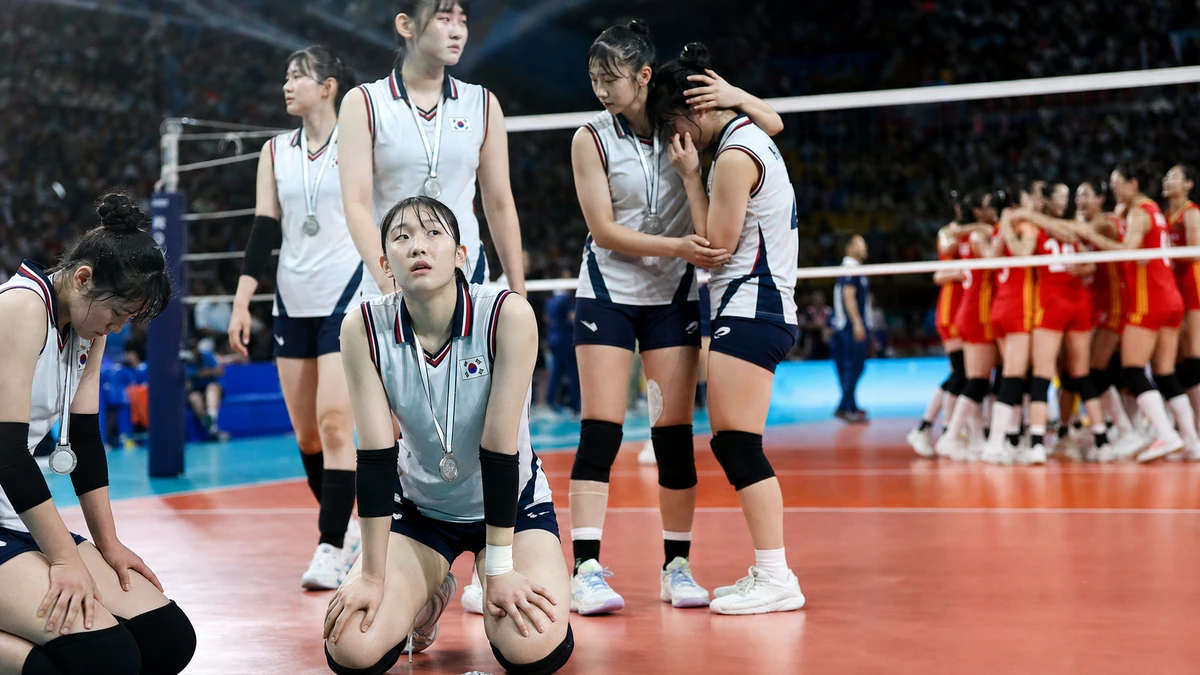
South Korea’s under-18 women’s volleyball team lost 3-0 to China in the final of the 2026 Asian Women’s U-18 Volleyball Championship on Monday in Nakhon Ratchasima, Thailand, a result that on paper looks straightforward: 25-23, 25-16, 25-16. But in South Korea, where fans have spent years wondering when the country’s once-formidable women’s volleyball pipeline might show signs of revival, the match landed as something more complicated than a championship defeat.
The reason is simple and significant. South Korea had not reached the final of this tournament in 19 years. For a generation of young Korean volleyball fans, a title match appearance at this level was not a routine benchmark. It was a breakthrough.
That context matters for readers outside Asia, where youth tournaments can be easy to dismiss as minor events far removed from the global spotlight of the Olympics or the NCAA Final Four. In countries such as South Korea, China and Japan, however, age-group national teams are treated as an early glimpse of the future. These tournaments are where federations measure not just results, but depth, coaching, technical discipline and whether a country’s next wave of players can keep pace with regional powers.
So while the final score reflected China’s control over the last two sets, the broader takeaway in South Korea was not simply that a young team came up short. It was that Korean women’s volleyball, which has been searching for fresh momentum after years of uneven results at the senior level, may have found evidence that its next generation can compete again on one of Asia’s biggest development stages.
That does not erase the sting of losing a final. It does, however, reshape the meaning of the loss. In American sports terms, this was less a story of a team collapsing on the biggest stage than of a program announcing itself earlier than many expected, even if the final step proved too steep.
The first set showed why this team drew attention
If there was one stretch of volleyball that captured why South Korea’s runner-up finish resonated back home, it came in the opening set. Trailing 20-16 against a Chinese team that had the size, rhythm and composure of a favorite, South Korea reeled off five straight points to take a 21-20 lead.
Anyone familiar with volleyball knows a scoring run is never just a scoring run. It usually means several systems are working at once: the serve puts pressure on the opponent, the reception holds up, the setter makes clean decisions, the attack finds a seam, the block gets organized and the back-row defense stays sharp enough to extend rallies. For a youth team in a continental final, doing all of that while trailing by four late in a set says something about nerve and team structure.
It was the kind of sequence coaches remember even when the result goes the other way. South Korea looked rattled early, then suddenly looked fearless. Instead of retreating from China’s physical edge, the Koreans turned the set into a real contest, the kind of tense exchange that gives a championship match its pulse.
In the end, though, that surge did not produce the set. Ahead 23-22 and within reach of a crucial early advantage, South Korea gave up the final three points and lost 25-23. In volleyball, especially at the youth level, those moments near the finish line can swing more than a scoreboard. One mistimed attack, one defensive misread, one serve-receive breakdown can alter a set, and with it the emotional balance of the match.
That appears to be what happened here. South Korea proved it could stand toe-to-toe with China in stretches, but it could not finish the most important stretch of the night. For observers in Korea, that closing sequence was frustrating precisely because it revealed both the team’s promise and its inexperience at the same time.
Still, the first set is likely to endure as the defining memory of the final from a Korean perspective. The comeback from 20-16 down to 21-20 up was the clearest sign that this team belonged on the floor in a championship match, even if it did not leave with the trophy.
China’s control exposed the gap South Korea still must close
After the opening set slipped away, the match turned harder for South Korea to manage. China opened the second set with authority, building a 9-1 lead and forcing the Koreans into a chase almost immediately. That is a dangerous script in volleyball at any level, but particularly in a final, where urgency can easily turn into pressing, and pressing often becomes mistakes.
South Korea did respond. The team cut the deficit to 20-15, another sign that it did not mentally fold after losing the first set. That mattered. Youth sports often reveal themselves not just in a team’s peak moments, but in how it behaves once momentum swings the other way. By clawing back into the second set, even briefly, South Korea showed concentration and resilience that coaches and national-team officials will likely value as much as any single scoreline.
But China never truly lost its grip. The rally stopped there, and South Korea dropped the set 25-16. The third set followed a similar pattern. The Koreans stayed within range at 16-12, then surrendered five straight points, a run that effectively settled the championship. The final set also ended 25-16.
From a distance, those numbers suggest a one-sided match. That is not entirely inaccurate. China was stronger overall, and its advantage became clearer as the match went on. But there is a difference between being outclassed from the opening whistle and being a young team that briefly threatens, then struggles to sustain that level once the pressure compounds. South Korea fell into the second category.
That distinction may sound subtle, but it is important in evaluating a developmental team. The Koreans did not look incapable of competing. They looked unfinished.
And that, in many ways, is exactly what an under-18 team is supposed to be: talented, inconsistent, emotionally tested and still learning how to reset after a devastating point or a lost set. The lessons here are clear. South Korea needs better starts, more steadiness after momentum swings and more polish in high-leverage situations. But those are the kinds of weaknesses coaches often believe can be improved with experience, repetition and time.
China, by contrast, looked like a team further along in that process. It handled key points with more certainty, absorbed South Korea’s first-set push and took command before the Korean side could recover. That is what elite youth programs do. They do not just win rallies; they manage the emotional architecture of a match.
Why this runner-up finish matters in South Korea
To understand why a second-place finish is being treated in South Korea as a meaningful step rather than a mere consolation, it helps to understand the place women’s volleyball holds in the country’s sports culture.
Volleyball is not South Korea’s biggest spectator sport; baseball and soccer carry broader mainstream reach, and in recent years global soccer stars and Major League Baseball exports have often dominated headlines. But women’s volleyball has a loyal following, a recognizable domestic league and a history of producing athletes who became national fixtures. For many Korean fans, the sport’s modern peak remains the women’s national team’s memorable run at the Tokyo Olympics, where its gritty performances captured attention beyond regular volleyball audiences.
That run also raised expectations. Since then, South Korean women’s volleyball has been judged against both its history and its recent struggles. Questions have lingered about whether the pipeline was deep enough, whether the next wave of players could restore competitiveness against Asia’s strongest programs and whether the country could produce technically sound players capable of handling international pace and power.
This is why a 19-year return to the U-18 Asian final matters. It is not simply a statistic tucked into a tournament recap. It is a symbolic marker. In a sports culture that tracks long droughts and delayed breakthroughs closely, nearly two decades between final appearances tells a story of how difficult it has been for South Korea to reassert itself at this level.
For American readers, one rough comparison might be the way fans in the United States watch the U.S. under-20 soccer pipeline or top AAU basketball prospects, looking for signs of what the senior national team or future college stars might become. The details differ, but the instinct is similar: youth competition serves as an early forecast. It does not guarantee anything, but it can shift the mood around a program.
In South Korea, the mood shift is part of the story. This was a reminder that the country still has young players capable of reaching a continental final, still has enough structure to compete deep into a tournament and still has reason to believe its women’s volleyball future is not defined only by recent disappointments.
That perspective does not require romanticizing the loss. It requires recognizing that development in international sports is rarely linear. Sometimes a program’s most important step is not a championship. It is getting back into a position where a championship is within sight.
Two individual awards offered a glimpse of the next generation
South Korea left the tournament without the team title, but not without individual recognition. Park Seo-yoon was named best middle blocker, and Jo Ra-bin was selected best libero, according to South Korean reporting. Both players were identified as students at Jungang Girls’ High School, a detail that carries cultural weight in Korea’s school-based sports system.
For readers unfamiliar with how Korean athletics often develop, school teams can play an outsized role in identifying and shaping elite talent. High school sports in South Korea do not mirror the sprawling commercial ecosystem of American high school football or basketball, but they remain an important pipeline, especially in sports such as volleyball. A player’s school affiliation is not just a biographical footnote. It is part of how fans and coaches understand where talent is coming from and which programs are doing the work of development.
Park’s award as best middle blocker suggests South Korea was not merely surviving in the tournament through scrappy defense or emotional momentum. Middle blockers are central to the geometry of volleyball. They influence the net defensively, challenge attackers, quicken transition plays and often reveal how organized a team is in its front-court system. For a Korean player to be recognized in that role against the region’s best youth competition is a meaningful sign of quality.
Jo’s award as best libero may be even more culturally resonant for Korean volleyball followers. The libero, easily explained to new American readers as a defense-first specialist in a contrasting jersey, does much of the unseen work that stabilizes a team: serve receive, floor defense, coverage and the kind of calm ball control that keeps rallies alive. South Korea has long valued technical cleanliness and defensive discipline in volleyball, especially when facing taller, more powerful opponents. An award at libero fits that tradition.
Together, those honors deepen the meaning of the runner-up finish. They suggest South Korea did not simply have a lucky tournament bracket or one dramatic comeback sequence. It had players who stood out individually in roles that matter to winning volleyball. That is the sort of evidence coaches and fans use when trying to determine whether a youth team’s success was fleeting or foundational.
It also gives the public names to follow. In any sports culture, hope becomes more tangible when it is attached to actual athletes rather than abstract talk about “the future.” Park and Jo are now part of that conversation in Korea, symbols of a team that lost the final but may have introduced the country to two of its next important players.
The cultural meaning of finishing second
American sports audiences are accustomed to a hard-edged view of runner-up finishes. In the United States, championship culture often leaves little room for nuance. If you lose the title game, the assumption can be that the night ended in failure, full stop.
South Korean sports culture can be just as demanding, and sometimes harsher, especially in a media environment that closely scrutinizes national teams. But there is also a strong appreciation for endurance, collective effort and visible progress, particularly when young athletes are involved. That helps explain why this result is being discussed as a meaningful achievement despite the lopsided score in the final two sets.
The phrase “19 years” carries emotional force. It compresses nearly two decades of waiting, turnover, coaching changes and unrealized promise into one number. Reaching the final broke that cycle, at least for one tournament. The loss to China does not erase that.
There is also a practical reason for caution in judging the team too harshly. These are under-18 players, not finished professionals. Their value lies not only in what they produced this week, but in what the experience of a final against China may mean two or four years from now. International youth tournaments can speed up player growth by exposing athletes to different tempos, body types and tactical demands. A tough loss in a final can become part of a player’s education, much the way an NCAA tournament defeat can harden a college team for a future run.
That is why the most revealing moments in this match may not be the final point or even the medal ceremony. They may be the pressure points South Korea failed to handle: losing three straight points after leading 23-22 in the first set, falling behind 9-1 in the second, giving up five straight in the third from a manageable deficit. Those are the snapshots that define what needs work.
At the same time, they should not overshadow the moments that showed growth: the first-set comeback, the refusal to quit in the second, the individual awards, the simple fact of standing in a final for the first time since many of the players were not yet born.
What international readers should take from this result
For readers outside South Korea, especially those who follow volleyball only during the Olympics or through college and professional leagues, this tournament result may seem small. In truth, it offers a revealing look at how sports power is renewed in Asia.
The Asian U-18 championship is not just a youth event. It is a testing ground for the next competitive cycle. Countries use it to assess depth, identify leaders and measure whether their technical standards hold up under pressure. When South Korea reaches the final after 19 years, it signals that something in its developmental picture may be improving.
That does not mean South Korea is suddenly ready to overtake Asia’s established powers. China remains a benchmark, and the final made clear that South Korea still has a gap to close in consistency, composure and sustained execution. But sports stories are often most interesting not when a power wins exactly as expected, but when a challenger shows it may not be far from relevance.
For American readers, there is a familiar shape to this story. It is the story of a proud program in search of renewal. It is the story of teenagers performing under the weight of expectations they did not create. And it is the story of a championship loss that still leaves a fan base feeling that something valuable was discovered.
South Korea’s U-18 women did not win the title in Thailand. China was better, and the scoreboard reflected it. But the Korean team gave its supporters something they had not had in a long time at this level: proof that the future may be arriving sooner than expected.
That may be the most important result of all. In sports, as in culture, momentum often begins before the trophies do. South Korea’s young women did not leave with the gold medal. They left with a silver medal, two individual awards and a renewed sense that Korean women’s volleyball has a next chapter worth watching.
Comments
Post a Comment