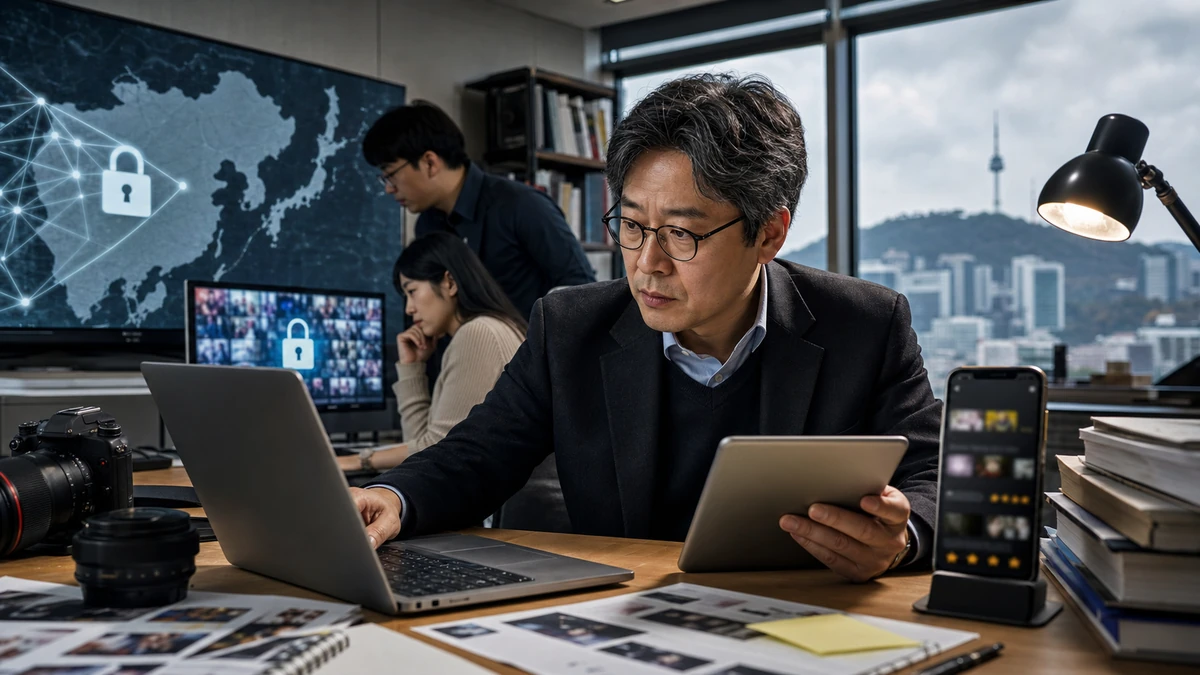
A K-drama paradox with global implications
A new controversy surrounding the Korean Netflix series “True Education” is drawing attention to a familiar problem in global entertainment: What happens when a show becomes wildly popular in a market where the platform carrying it is not officially available?
That question is now at the center of a debate involving China, South Korea and one of the most powerful forces in global pop culture — the Korean Wave, often called “Hallyu.” According to South Korean reports, professor Seo Kyoung-duk, a well-known public advocate for Korean culture, accused some Chinese internet users of watching the series illegally and then openly discussing it online as if it were readily available through normal channels.
The apparent contradiction is hard to miss. Netflix does not officially operate in mainland China. Yet “True Education,” a high-profile Korean series distributed by Netflix, has reportedly built substantial buzz there. On Douban, a major Chinese platform where users rate and review films and TV shows, the series is said to hold an 8.7 out of 10 rating, with about 140,000 users participating in star ratings and roughly 50,000 reviews posted.
For American readers, the easiest comparison might be this: Imagine a Hulu or HBO exclusive becoming a huge online sensation in a country where neither service legally exists, with tens of thousands of public reviews and little mystery about how people found it. The show’s popularity would be obvious. So would the copyright problem.
In that sense, the debate over “True Education” is bigger than one Korean drama or one viral moment. It highlights a growing tension in the streaming era: Content now crosses borders faster than licensing agreements, government restrictions and copyright enforcement can keep up. And for South Korea’s entertainment industry — which has become one of the world’s most influential cultural exporters — that gap carries both opportunity and cost.
Why this matters beyond one show
“True Education” is not just another imported series with a niche following. It has been described in Korean coverage as a globally watched Netflix title, one that has attracted attention well beyond South Korea. That matters because K-dramas are no longer treated as a subcultural interest reserved for devoted fans. In the United States, Korean series have become mainstream viewing, helped by the global success of shows like “Squid Game,” “The Glory” and “Extraordinary Attorney Woo.”
Over the past decade, Korean entertainment has expanded from cult favorite to central player in international media. K-pop groups sell out U.S. stadiums. Korean films have won Oscars. Korean beauty products fill American store shelves. And Korean TV dramas have become appointment viewing for audiences from Los Angeles to London to Latin America.
That broad appeal is precisely why piracy remains such a persistent problem. When a piece of entertainment generates intense demand in places where legal access is limited or blocked, audiences often turn to informal networks: fan-uploaded streams, unauthorized download links, subtitle-sharing communities and mirror sites that spread content almost immediately after release.
In many countries, that pattern is not unique to Korean programming. American audiences saw versions of it for years before streaming became more widespread and convenient. In the 2000s and early 2010s, U.S. viewers often pirated British shows before they aired domestically, or searched for workarounds when certain sports events or specialty channels were unavailable. The difference now is scale. With K-content, the demand is global, immediate and often amplified by online fandoms that operate across languages and platforms.
So when a Korean series trends in a place where it cannot legally be streamed, it sends two messages at once. First, the show has real international pull. Second, the business model around distribution may be failing to capture that interest in a lawful, sustainable way.
The criticism from Seoul
Seo Kyoung-duk, the South Korean professor who raised the issue, is a familiar public figure in Korea. He is known for advocacy related to Korean history, culture and national image overseas, and he frequently comments on how Korean culture is represented or misrepresented abroad. In this case, he argued on social media that some Chinese viewers were essentially “stealing” the show by watching it through illegal means.
His point, according to Korean reports, was not merely that piracy exists — few people in the entertainment business would dispute that. It was that the scale and openness of the response in China seemed to expose an uncomfortable truth. If a Netflix-exclusive series can accumulate tens of thousands of reviews on Chinese platforms despite Netflix’s absence there, then unauthorized distribution is not a fringe issue. It is operating in plain sight.
Seo reportedly said that a search for “True Education” on Baidu, China’s dominant search engine, easily led users to free viewing sites. That detail, if accurate, underscores why South Korean critics see the problem as routine rather than exceptional. Their concern is not just that a few viewers found bootleg copies; it is that informal access appears easy, normalized and large-scale.
He also framed the incident as part of a broader pattern. Other Korean hits, including “Squid Game,” “The Glory,” “Culinary Class Wars” and the animated-feature-related phenomenon “KPop Demon Hunters,” have also faced unauthorized circulation in China, according to Korean commentary on the issue. The titles vary in genre — thriller, revenge drama, reality or competition-based entertainment, music-driven content — but the underlying problem remains the same. The more globally visible Korean content becomes, the more likely it is to leak into markets where rights are restricted, fragmented or politically complicated.
For South Korea’s content industry, that creates a frustrating paradox. International buzz is essential. It builds stars, increases export power and enhances the country’s broader soft power. But when that buzz does not translate into legal viewing, subscription revenue or licensed syndication, producers may gain prestige without receiving the full economic benefit.
The China factor: strong demand, restricted access
Any discussion of Korean entertainment in China requires some political and industry context. China is one of the world’s biggest audiences for film, television and digital media, but it is also a tightly controlled market. Foreign platforms face major regulatory hurdles, and global streaming services that Americans take for granted — including Netflix — are not simply able to launch there in the way they do in the United States or much of Europe.
That means Chinese viewers often live in a split-screen media environment. Officially available content is governed by domestic regulations, licensing rules and censorship standards. At the same time, public curiosity about foreign entertainment remains strong, especially for buzzy international titles that dominate social media elsewhere.
Korean entertainment occupies a particularly complicated place in that environment. Even during periods of political tension between Seoul and Beijing, Chinese audience interest in Korean stars, music and drama has not disappeared. If anything, informal fan networks often help sustain that interest when official distribution channels narrow.
Douban, where “True Education” has reportedly drawn especially strong engagement, is an important indicator of that interest. For readers unfamiliar with it, Douban is something like a mix of Letterboxd, Goodreads, Rotten Tomatoes-style user culture and older online forum communities. It has long served as a place where Chinese users discuss books, films, television and music with a level of seriousness that often goes beyond quick social media reactions. High ratings and large review totals there can signal genuine cultural relevance.
That is why the numbers attached to “True Education” stand out. A rating of 8.7 with roughly 140,000 star participants and around 50,000 reviews suggests that the series is not merely known in China. It is being actively consumed, discussed and judged at scale. For any entertainment executive, those are the kinds of metrics that normally point to a strong market opportunity. But if the underlying viewing is unauthorized, those same metrics also become evidence of a system not functioning as intended.
In a purely commercial sense, it is like discovering that a sold-out crowd is cheering outside the stadium because they found a way to watch from the parking lot without buying tickets.
What piracy costs creators — and what fans often overlook
To viewers, especially younger audiences raised in the internet era, unauthorized streaming can seem abstract or even victimless. If a giant platform like Netflix or a successful studio is involved, some fans assume little real harm is done. But entertainment professionals argue that the losses do not stop at one corporation’s balance sheet.
Television production is an ecosystem. Revenue supports writers, directors, actors, editors, costume designers, visual effects teams, location crews, soundtrack composers and production staff whose names most viewers never learn. In the case of high-end Korean dramas, budgets have climbed as global demand has grown. Production values are higher, marketing is broader and expectations are steeper. That also means the financial stakes are greater.
When a show is widely consumed outside authorized channels, the damage is not always easy to measure title by title, but the effects accumulate. Distributors have a harder time valuing rights. Producers lose leverage in future negotiations. Investors face more uncertainty. And the case for funding ambitious follow-up projects can weaken if global visibility does not reliably convert into revenue.
This is not just a Korean issue. Hollywood has wrestled with similar problems for years, especially in regions where release windows used to lag behind the U.S. market. One reason streaming transformed media so dramatically in America was convenience: It became easier to pay for legal access than to hunt down bootlegs. But that logic only works when legal access actually exists.
That is what makes the “True Education” case so thorny. Some observers may argue that fans are filling a vacuum created by platform unavailability. Others will say that restricted access does not excuse piracy. Both can be true at once. Viewers may have genuine interest and few legal options, but creators still lose control over how their work is distributed.
For fans who see themselves as supporting Korean culture, this is the uncomfortable part. Enthusiasm alone does not sustain an industry. If affection for K-dramas is routed mainly through piracy, the long-term benefits to the people making that culture are much smaller than the online excitement would suggest.
The bigger challenge for the Korean Wave
The Korean Wave has entered a new phase. In its earlier years, success abroad could still be described as surprising or breakout-driven. Now it is structural. Korean content is expected to travel. Streaming services buy it aggressively. U.S. critics review it seriously. American viewers recommend Korean series to friends who, a decade ago, might never have considered watching subtitled television on a weeknight.
That maturity brings new responsibilities and new vulnerabilities. One is protecting intellectual property in a digital environment where demand is instantaneous and geography matters less to viewers than to corporate licensing departments. Another is ensuring that legitimate access keeps pace with international interest.
The situation around “True Education” illustrates how the global entertainment map remains uneven. A show can be promoted as a worldwide phenomenon and still be effectively inaccessible in one of the world’s largest audience markets through normal legal channels. In that gap, piracy thrives.
For South Korea, the stakes go beyond one season of one show. Cultural exports are a meaningful part of the country’s global brand and economic strategy. K-dramas, K-pop, films and digital entertainment all contribute to South Korea’s image as a creative powerhouse. That brand has real value, from tourism to consumer products to diplomatic soft power.
But soft power can create illusions of success if not paired with solid market infrastructure. A trending show, glowing online reviews and viral fan edits may signal influence. They do not automatically signal that the business behind the influence is being protected. If piracy becomes a default pathway in major markets, then popularity risks outpacing profitability.
That is one reason Korean commentators increasingly describe copyright protection not as a technical legal issue but as a strategic one. If Korea wants to maintain its place as one of the world’s premier content exporters, it must think not only about producing compelling stories but about how those stories reach audiences lawfully and efficiently.
What comes next
There is no easy solution here. Stronger enforcement against illegal streaming sites is one obvious response, and rights holders will almost certainly continue pushing in that direction. Public criticism, such as Seo’s intervention, can also serve a purpose by making the issue harder to ignore.
But enforcement alone rarely solves global piracy. The modern history of media suggests that when legal access is too limited, too delayed or too fragmented, unauthorized distribution finds a way. That is especially true for fan-driven entertainment that depends on real-time conversation. In the age of algorithms, spoilers, memes and social media discourse, viewers do not want to wait months — or forever — for a show everyone else is already discussing.
That leaves a broader strategic question for platforms and content companies: How can they reduce the gaps that make piracy attractive in the first place? In some markets, that may mean pursuing more flexible licensing arrangements. In others, political and regulatory barriers may make that impossible. China, with its unique rules and digital ecosystem, presents a particularly difficult case.
Still, the “True Education” controversy offers a clear lesson. Interest in Korean content remains powerful, even where official channels are blocked or absent. That is a testament to the reach of Korean storytelling. It is also a warning sign. If one of the world’s most dynamic entertainment industries cannot convert global fascination into legal, sustainable access, then its biggest successes may continue to come with invisible losses.
For American audiences, the story is a reminder that the streaming wars were never just about which app sits on your smart TV. They are also about who gets to watch what, where and under what rules. K-dramas have become part of that global battle, not because they are niche, but because they are now central to the international entertainment economy.
And in that economy, a hit series being widely watched in a place where it is not officially available is not just a curiosity. It is evidence of how deeply globalized fandom has become — and how far copyright systems still have to go to catch up.
Comments
Post a Comment