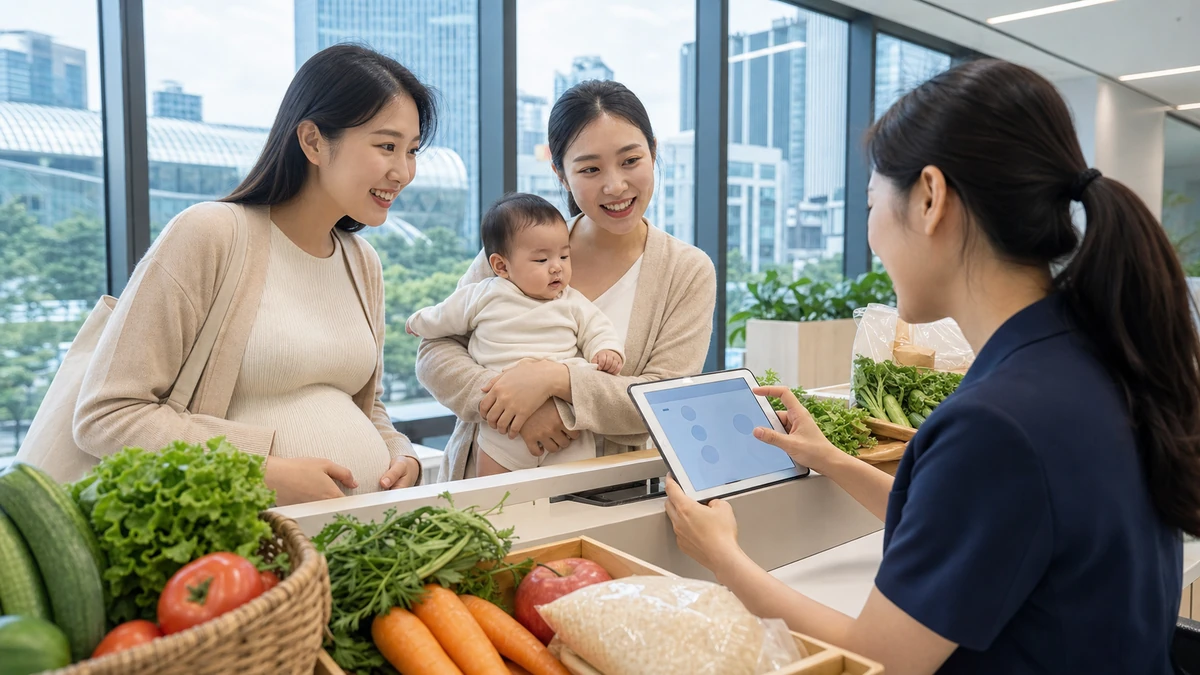
A city health policy that starts in the kitchen
Seoul, the capital of South Korea, is opening applications July 13 for a program that will provide environmentally friendly agricultural products to pregnant women and new mothers, according to an announcement from the city government. On its face, the plan may sound modest: a municipal benefit aimed at helping eligible residents bring more fresh food to the table. But in a country where public policy around pregnancy often centers on clinics, prenatal exams and childbirth costs, Seoul’s decision to focus on groceries offers a revealing window into how the city is thinking about health, family life and food access.
The program, formally described as Seoul’s 2026 support project for eco-friendly agricultural products for pregnant women, is designed for residents who are currently pregnant or who have given birth since Jan. 1 of last year. Applicants must be registered as living in Seoul as of the application date. In South Korea, that residency standard is tied to the country’s resident registration system, a core administrative framework used to verify where a person officially lives and which local government is responsible for providing certain public services.
For American readers, the closest comparison may be a city-backed nutrition benefit with both public health and local agriculture goals, something that sits somewhere between maternal health support and a farm-to-family program. It is not medical treatment. It is not an insurance subsidy. Instead, it reflects a broader idea: that healthy pregnancies and postpartum recovery are shaped not only by doctor visits, but also by what people can realistically buy, cook and eat each day.
That distinction matters. In the United States, discussions about maternal health often revolve around mortality rates, hospital access, paid leave, insurance gaps and racial disparities in care. Those issues remain urgent and foundational. Seoul’s announcement does not attempt to solve all of that. What it does show is how a major global city is trying to intervene at a more ordinary level of life, where nutrition, household stress and food costs all intersect.
The timing of the announcement also gives the policy a practical immediacy. Seoul disclosed the plan on July 9 and said applications would begin just days later, on July 13. That short runway underscores that, for many families, even relatively small public benefits can matter only if people hear about them in time and understand whether they qualify.
Who qualifies, and why the eligibility rules matter
Based on the city’s announcement, the eligible group includes pregnant residents of Seoul and mothers who have given birth since Jan. 1 of last year. That may seem like a straightforward administrative detail, but it reflects an important policy choice. Seoul is treating pregnancy and the months after childbirth not as separate bureaucratic moments, but as part of a continuous period of health management and recovery.
That framing may resonate with parents anywhere. In the United States, postpartum care has increasingly become part of mainstream public conversation, especially as doctors and advocates have pushed back against the long-standing tendency to focus intensely on pregnancy and delivery, then offer limited support once a baby is born. The physical demands of recovery, infant feeding, sleep disruption and the overall adjustment to a new household routine do not end at the hospital door. Nutrition remains important well beyond delivery.
Seoul’s rules appear to recognize that reality. By including mothers who recently gave birth, the city is acknowledging that the postpartum period carries its own pressures. New parents may have less time to shop, cook and compare food options. Their budgets may be tighter. Their need for reliable, easy access to produce may be greater, not less.
There is also a distinctly Korean administrative element here that may be unfamiliar to foreign audiences. Local benefits in South Korea are often tied closely to registered residence, because municipal governments administer a wide range of social services. In practical terms, that means Seoul is limiting the benefit to people whose official address is within the city. That is not unusual in Korea, where local governments routinely operate programs targeted to their own residents, from child care support to transportation discounts to senior welfare services.
The announcement did not, at least in the summary provided, spell out every procedural detail, including the exact support amount or the full application method. But the essentials are clear enough to understand the policy’s architecture: the city is targeting a defined group of residents during a nutritionally sensitive period of life, and it is using food support rather than a purely clinical intervention to do it.
What “eco-friendly” means in the Korean context
The phrase eco-friendly agricultural products can sound vague in English, especially in an American media landscape where labels like organic, natural, sustainable and non-GMO often blur together in both marketing and public debate. In South Korea, however, eco-friendly farm products usually refer to goods produced under specific certification standards that emphasize reduced pesticide and chemical use, environmental protection and, in some cases, organic methods.
That means Seoul’s project is doing two things at once. It is trying to support healthier eating for pregnant people and new mothers, and it is trying to stimulate consumer demand for a category of agricultural goods that the government wants to promote. The city explicitly said the program is intended both to help support a healthy diet and to encourage the consumption of eco-friendly farm products.
This dual purpose is worth paying attention to. In the United States, food benefits are often discussed in terms of personal nutrition or anti-hunger policy. Here, Seoul is presenting food support as part of a broader chain that links maternal health, household consumption and agricultural markets. The shopping basket becomes a policy tool. Every box of produce or every subsidized purchase does not just affect one family’s menu. It also sends a signal through the local and regional food economy.
That logic is familiar in other settings. American farmers markets that accept nutrition assistance benefits, for example, often serve two goals at once: expanding access to fresh food while helping smaller-scale producers find stable customers. Seoul’s initiative appears to operate within a similar policy imagination, though adapted to the Korean context, where dense urban life and strong local-government administration often shape how benefits are delivered.
There is also a social message embedded in the city’s language. By emphasizing healthy eating rather than miracle foods or highly specific nutritional claims, the program avoids some of the hype that can surround pregnancy wellness. Anyone who has spent time online has seen the modern flood of advice aimed at expecting parents: what superfood to eat, what supplement to buy, what ingredient to avoid, what trend to follow. Seoul’s approach, at least from the information released so far, looks less glamorous and more practical. It focuses on the basic building blocks of everyday meals.
Why this matters in a country wrestling with low birthrates
No contemporary story about family policy in South Korea exists in a vacuum. The country has one of the world’s lowest birthrates, a demographic crisis that has prompted years of policy experimentation and mounting public concern. National and local governments have rolled out incentives, cash support, child care measures and housing-related programs aimed at easing the burdens associated with marriage, pregnancy and parenting.
Against that backdrop, even a produce support initiative carries significance beyond its immediate nutritional value. It speaks to a larger political and social question: What kinds of public support actually make life easier for people considering parenthood, or already navigating it? Big demographic problems do not yield to one produce box or one subsidy. But the day-to-day burdens of family life are real, and governments increasingly understand that people judge public support not only by headline spending totals, but also by whether assistance shows up in tangible, usable ways.
That helps explain why local readers in Korea might view Seoul’s announcement as more than a routine administrative notice. It fits into a broader evolution in family policy, one that is moving beyond the hospital-centered model of maternal support. Prenatal checkups and delivery care remain essential, of course, but they are only part of the lived experience of pregnancy and early parenthood. The diet in the refrigerator, the time it takes to prepare meals, and the affordability of fresh produce can all influence how supported a household feels.
For American readers, there is a useful parallel in the way U.S. experts increasingly talk about the social determinants of health. Those are the conditions beyond the clinic that affect health outcomes, including income, housing, transportation, nutrition and access to community resources. Seoul’s program is not framed in exactly those words, but it clearly operates on a similar insight: health is not managed only in exam rooms.
There is another Korean dimension here as well. In a fast-paced urban society where long work hours and high living costs can put pressure on families, convenience matters. Policies that sound small on paper may carry greater weight in practice if they reduce one recurring source of stress. Fresh produce support is not a cure-all, but it may lower the friction involved in feeding a household during pregnancy or postpartum recovery.
From prenatal vitamins to public produce: a broader view of maternal health
One of the most notable aspects of Seoul’s announcement is its underlying philosophy. Rather than presenting maternal health as a narrow matter of medical supervision, the city is using food support as a point of intervention. That suggests a broader understanding of what it takes to sustain health during pregnancy and after childbirth.
In the United States, pregnancy-related guidance often arrives in the form of clinical advice: take prenatal vitamins, monitor blood pressure, attend appointments, follow screening schedules, watch for warning signs after birth. All of that is vital. But families also face a simpler, more relentless question every day: What are we eating, and how easy is it to get the food we want to eat?
Seoul’s program does not replace medical care, nor does it claim to. Instead, it sits alongside formal health care as a form of practical support. That can be especially meaningful in a time when health information is abundant but often overwhelming. Pregnant people and new parents are bombarded with advice from doctors, relatives, parenting forums, social media influencers and advertisers. In that environment, a public program built around produce may feel refreshingly concrete. It does not ask families to decode a wellness trend. It helps them access ingredients.
That practicality is one reason the story belongs in the health conversation, even though it is not about a new treatment or a breakthrough drug. Public health is often built through mundane systems: clean water, school lunches, food inspections, vaccination schedules, maternal checkups and, sometimes, support for healthier groceries. Policies become powerful not only when they are dramatic, but when they are repeatable and woven into ordinary life.
The announcement also invites a wider question relevant far beyond Korea: If governments are serious about maternal and infant well-being, should food support become a more standard part of the policy mix? In the United States, programs such as the Special Supplemental Nutrition Program for Women, Infants, and Children, or WIC, already reflect that logic at the federal level by helping eligible families obtain nutritious foods. Seoul’s initiative differs in structure and scale, but the comparison is instructive. Both rest on the premise that nutrition support is not peripheral to maternal health; it is part of it.
What remains unknown, and what to watch next
For all the policy symbolism attached to the announcement, the practical effectiveness of Seoul’s program will depend on details that were not fully included in the summary released so far. How large is the benefit? Is it delivered through vouchers, direct shipments or a purchasing platform? How easy is the application process for people juggling pregnancy, work, child care and medical appointments? Which products qualify, and how broadly are they available across the city?
Those questions matter because public benefits can fail or succeed on implementation. A well-intentioned program that is difficult to access, poorly publicized or administratively cumbersome may reach fewer people than expected. Conversely, even a relatively limited subsidy can have outsized value if it is easy to use and arrives at the right moment.
There is also the matter of measuring results. The city has made its goals clear: support healthy eating for pregnant residents and encourage eco-friendly agricultural consumption. But translating goals into evidence will require follow-up. Did participants actually change what they bought or ate? Did they report reduced stress around meal planning? Did demand for eco-friendly farm products rise in measurable ways? Those are the kinds of outcomes that would determine whether the policy becomes a model, remains a niche benefit or eventually expands.
Still, even before those answers emerge, the announcement says something meaningful about the direction of urban health policy. Seoul, a city often associated abroad with K-pop, cutting-edge tech and high-speed modernity, is also a place where local government experiments increasingly touch the intimate routines of household life. Supporting a pregnancy, in this vision, is not just about the delivery room. It is also about the dinner table.
That makes the story legible well beyond South Korea. Cities around the world are grappling with the same fundamental challenge: how to design public support that feels useful in daily life, especially for families navigating vulnerable transitions. The scale may vary. The delivery systems may differ. The cultural assumptions around pregnancy and family may not be the same. But the question is widely shared.
Seoul’s produce support initiative will not solve the many structural issues surrounding maternal health, affordability or demographic decline. It is not that kind of policy. What it does offer is a clear example of a government trying to meet families in the realm of ordinary habits, where health is shaped meal by meal. In an era of information overload, that kind of grounded, practical intervention may be one of the most persuasive messages a city can send: caring for parents and babies begins not only with medicine, but with food.
A local policy with global resonance
It is easy to dismiss a municipal food-support program as small-bore governance, the kind of item that would normally sit deep inside a metro section. But that would miss what makes this story travel. The Seoul announcement captures a growing truth in public policy: some of the most consequential health decisions happen far away from hospitals, in shopping decisions, kitchen routines and the availability of fresh ingredients.
For English-speaking readers who may know Seoul mainly through its cultural exports, the policy is also a reminder that South Korea’s global influence does not stop at music, film and beauty trends. It extends to how one of Asia’s largest and most sophisticated cities experiments with social policy. In this case, the experiment is not flashy. It is about produce, pregnancy and the politics of everyday care.
Whether the program proves highly effective will depend on the mechanics still to come. But the city’s message is already plain enough. Supporting pregnant residents means more than covering doctor visits or urging healthy choices. It can also mean helping make those choices easier to act on. That is a lesson American policymakers, too, may recognize: for many families, health policy becomes real only when it shows up at home.
Comments
Post a Comment