
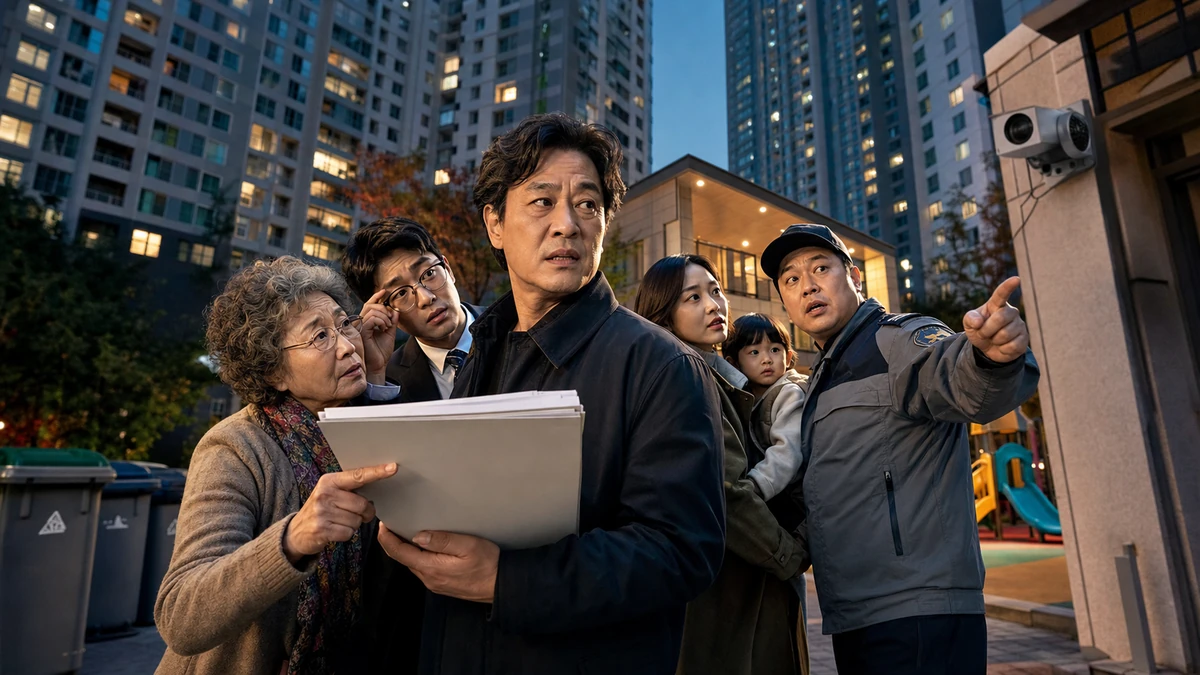
A familiar Korean setting gets a starring role
South Korean actor Ji Sung is set to lead a new JTBC weekend drama called “Apartment,” premiering July 11, 2026, in a series that takes one of the most ordinary features of modern Korean life and turns it into the engine of a comic corruption caper. On paper, the premise sounds almost absurd in the best way: a former gang boss moves into a large apartment complex under false pretenses, hoping to get his hands on roughly 17.8 billion won — about $13 million to $14 million, depending on exchange rates — sitting in the complex’s long-term maintenance reserve fund. Instead of simply pulling off a scheme, he ends up entangled with residents and drawn into exposing corruption inside the community itself.
For many American viewers, the idea that an apartment building could sustain a full drama about money, power, elections, fake family ties and neighborhood solidarity may sound unusual. In South Korea, it makes immediate sense. High-rise apartment complexes are not just places to live. They are often self-contained micro-societies, especially in major cities and newly built suburban districts, where thousands of people can share the same development, management system, playgrounds, parking structures, security gates and resident committees. If U.S. audiences think of a homeowners association, a condo board and a suburban neighborhood all compressed vertically into one giant residential compound, they are getting close.
That is what appears to have attracted Ji Sung to the project. During an online production presentation, the actor said he was drawn to the script because so many incidents unfold in the highly recognizable setting of a large apartment complex. The appeal, he suggested, lay in seeing a space that feels entirely ordinary through a strange and unexpected lens. It is a smart hook for television in an era when audiences often respond to stories that expose the hidden tensions inside seemingly mundane institutions, whether that is an office, a school district, a church or, in this case, a residential development.
The result could make “Apartment” one of the more culturally accessible Korean dramas of its season. It is rooted in a specifically Korean housing reality, but it is built on universal themes: greed, image management, local politics, neighborly suspicion and the possibility that people who share a space might, under pressure, become a real community.
The scam at the center of the story
Ji Sung plays Park Hae-gang, a former boss of the fictional Oasis gang who enters the apartment complex with no noble mission whatsoever. He is not introduced as a crusader, reformer or avenging antihero. He is after the money. Specifically, he wants control over the building complex’s long-term repair reserve fund, a pool of money collected over time for large-scale maintenance and infrastructure work. In practical terms, that could include major repairs to elevators, exterior walls, plumbing systems, roofs, parking facilities or mechanical equipment. In dramatic terms, it is a jackpot hidden in plain sight.
That fund is one of the cleverest parts of the premise because it takes a deeply ordinary administrative reality and reframes it as the prize in a crime story. American viewers may not immediately recognize the Korean term behind it, but the concept itself is not foreign. Condo associations, co-op boards and homeowner communities in the United States also collect reserve funds for future capital repairs. What “Apartment” does is ask a deliciously cynical question: What if someone saw that pooled community money not as responsible budgeting, but as a vault to be cracked?
To get close to that money, Park reportedly constructs a fake family and moves into the complex. That setup alone gives the show a strong comic engine. Fake-family stories have long been a reliable formula in television because they force characters into constant performance. Every neighbor becomes a potential witness. Every hallway encounter can become a test. Every community event becomes a stage where identities must be maintained. Add in the fact that Park is not merely trying to blend in, but is also planning to run for president of the apartment residents’ representative council, and the series gains another layer: public respectability as cover for private ambition.
That residents’ council election is a detail likely to resonate strongly with Korean audiences while requiring some explanation for foreign viewers. In many large Korean apartment complexes, resident governance matters. These bodies can influence building management decisions, spending priorities and community disputes. In a country where apartment living is a central part of middle-class life, the politics of shared space can become surprisingly consequential. In other words, imagine a local condo board race, then raise the stakes, multiply the number of residents and add a hidden fortune. That appears to be the arena in which “Apartment” wants to play.
Why apartments matter so much in South Korea
To understand why this drama could hit home in South Korea, it helps to understand what apartments mean there. In the United States, “apartment” can suggest a wide range of living situations, from urban rentals to luxury towers to modest suburban complexes. In South Korea, the word often carries a more specific social and cultural weight. Large apartment developments are a defining feature of modern urban life, especially in and around Seoul, Incheon and other major metropolitan areas. They are central to family life, status, investment, education planning and daily routines.
For decades, apartment construction has helped shape the Korean urban landscape, and living in a particular complex or neighborhood can carry implications about class, convenience and aspiration. These compounds often come with branded identities, controlled entry points, landscaped common spaces, playgrounds, gyms, daycare access and tightly managed resident services. Children grow up together. Parents compare schools and tutoring options. Elderly residents take walks on the same internal paths. Delivery workers, management staff and security guards become part of the social ecosystem. Conflicts can be petty, structural, emotional or financial, but they are rarely distant.
That is why the creators’ decision to place “Apartment” entirely within such a space is more meaningful than a title gimmick. The apartment complex is not just a background location. It is the story’s social organism. Money, influence, reputation and relationships all circulate inside it. The same people pass each other in elevators, parking garages, playgrounds and meeting rooms. The boundaries are tight, which makes misunderstandings funnier, secrets riskier and alliances more consequential.
There is also a broader television trend at work here. Some of the most effective Korean dramas use highly specific institutions or social spaces to tell stories that feel both local and universal. A hospital, a law firm, a wealthy household, a school or a village can function as a miniature model of Korean society. “Apartment” seems poised to do the same with a residential complex, treating it not as a sterile building but as a compressed social world where every resident has a stake and everyone’s business is potentially everybody else’s problem.
Ji Sung’s role and the appeal of moral pivot stories
Ji Sung’s casting is likely to be a significant draw. The veteran actor is well known in South Korea for combining emotional intelligence with broad range, moving between melodrama, psychological tension and more playful performances over the course of his career. He has the kind of screen persona that can make a dubious character watchable without sanding away the character’s flaws. That matters here because Park Hae-gang begins the story as an opportunist, not a misunderstood saint.
One of the most intriguing aspects of the show, based on the production presentation, is that Park does not remain a simple predator. As the plot unfolds, he begins working with residents to uncover wrongdoing within the complex. That shift appears to be central to the series’ emotional and comic structure. The man who entered the community intending to exploit it may find himself defending it, or at least defending the people in it. If handled well, that arc can be deeply satisfying. American audiences know the appeal of stories in which a self-interested outsider gets absorbed into a collective cause, from neighborhood comedies to crime capers to sports movies where cynical recruits slowly become believers.
What makes this version especially promising is the tension between Park’s original scheme and his emerging relationships. If he is pretending to belong, when does pretense become attachment? If he is manufacturing a family, what happens when staged intimacy produces real feeling or responsibility? If he campaigns for a leadership role as cover, what happens when residents actually place their trust in him? These are classical dramatic questions, but they are sharpened by the highly social, highly visible environment of a Korean apartment complex.
Ji Sung said he came away from the project seeing apartments differently, describing them as a kind of world unto themselves. That observation sounds simple, but it helps explain why the role may suit him. Park’s transformation is apparently not just about switching sides in a corruption case. It is about learning to see the people around him not as obstacles or targets, but as neighbors. The actor’s own comments suggest the drama wants to make that discovery feel sincere rather than merely strategic.
Comedy, corruption and the politics of everyday life
The show’s tonal balance may ultimately determine whether it becomes a standout hit. “Apartment” is described as a comedy, but its central ingredients include embezzlement, local corruption, gangland history and organized deception. That blend is not unusual in Korean television, which often moves fluidly between slapstick, social satire and emotional sincerity in ways that can surprise first-time viewers. A scene can pivot from absurd to heartfelt within minutes, and successful dramas make that elasticity feel like a strength rather than a tonal mismatch.
Here, the comedy appears to arise less from broad parody than from the collision between public process and private motives. Park Hae-gang wants money, but to pursue it he must perform domestic normalcy, participate in resident politics and persuade ordinary people to accept him. There is built-in irony every step of the way. The apartment council election, for example, turns a seemingly minor civic mechanism into a battleground over access, influence and hidden funds. Americans used to stories about school board fights, PTA controversies or feuding homeowner associations will recognize the satirical potential. The details are Korean, but the instinct behind the storytelling is broadly familiar: local governance becomes unexpectedly dramatic when money and ego enter the picture.
The corruption angle also gives the series a sharper edge. Korean dramas have long found fertile ground in exposing institutional rot, whether in business conglomerates, prosecutors’ offices, police agencies or real estate systems. “Apartment” appears to scale that impulse down to the level of daily life. Instead of a presidential scandal or corporate cover-up, the arena is an apartment complex. But that smaller scale may be part of the point. For most people, corruption is not experienced as an abstraction. It is experienced in the places where they live, work and rely on others to do their jobs honestly.
If the series succeeds, it could offer the pleasure of a mystery, the rhythm of a neighborhood comedy and the emotional payoff of a found-community story. That combination helps explain why the production team is emphasizing both the exhilarating chase for hidden wrongdoing and the warmth of the world the characters inhabit.
Songdo as a real-world backdrop
Ji Sung also said his perspective changed while observing residents in Songdo, the Incheon district where the drama was filmed. That detail matters. Songdo is one of South Korea’s best-known master-planned urban developments, often described to foreign audiences as a “smart city” filled with gleaming towers, wide roads and modern residential zones. Located west of Seoul in Incheon, it represents a particular version of contemporary Korean urban ambition: polished, dense, highly designed and globally oriented.
For an American reader, Songdo might evoke the feel of a newly built waterfront district or a carefully planned suburb-city hybrid designed around efficiency, technology and upscale apartment living. It is the kind of place where the architecture itself can reinforce the sense that apartment life is not merely housing, but a system. Choosing such a location for “Apartment” adds another layer to the show’s themes. Behind the neat surfaces and controlled infrastructure lies a messier human reality of desire, fear, ambition and connection.
Ji Sung’s remarks about warmth are especially notable in that context. He said he wanted viewers to feel that the world we live in can be this warm. That statement suggests the series does not want to remain trapped in cynicism, even though cynicism powers its plot. It begins with an ex-mobster chasing communal funds, but it appears to be reaching for something more humane: the idea that ordinary residents, often dismissed as passive bystanders, can become a force of solidarity.
That may be one reason the apartment setting is so effective. It naturally gathers people who would not otherwise choose one another. They differ in age, class background, temperament and personal goals, but they share walls, budgets, safety concerns and daily routines. In narrative terms, that creates friction. In emotional terms, it creates the possibility of unexpected care. The drama’s challenge will be making those bonds feel earned rather than sentimental.
Why this could connect with global audiences
For international viewers, especially in the United States, “Apartment” may offer one of the more legible entry points into a distinctly Korean social world. Korean dramas often travel best when they pair a culture-specific setting with instantly understandable motivations. That is exactly what this premise does. You do not need prior knowledge of Korean housing policy to understand a man trying to infiltrate a community for money. You do not need to know the mechanics of resident councils to appreciate the comic tension of a scammer running for local office. And you do not need to live in Seoul to understand how people forced into proximity can become each other’s problem — and, sometimes, each other’s support system.
The title alone carries symbolic weight. “Apartment” reduces the premise to a single everyday noun, betting that the ordinary can hold extraordinary drama. That is a very Korean storytelling move, but it also mirrors a broader trend in prestige and popular television alike: take a familiar institution, then reveal the hidden systems beneath it. American audiences have seen versions of that in workplace satires, suburban mysteries and class dramas set in condos, gated communities and luxury towers. “Apartment” seems ready to offer a Korean variation with its own social textures and comic rhythm.
There is also growing appetite for Korean series that go beyond palace dramas, zombie thrillers or elite romance and instead open windows into how contemporary life is organized. Apartment complexes in South Korea are among the most visible structures of that daily life. They are where children are raised, retirees age, property wealth accumulates, gossip spreads, elections matter and community tensions simmer. By centering that reality, the series may give overseas viewers something more valuable than novelty: a vivid sense of how ordinary Korean urban life can become compelling television.
When the show premieres, one of the first things viewers will likely be watching for is how Park Hae-gang gets into the complex and how his fake-family strategy intersects with his political maneuvering. But the larger question may be whether “Apartment” can sustain the balance its star has highlighted: a story that is funnier and sharper because it deals in greed and corruption, yet more memorable because it insists there is warmth inside the machinery of communal life. That is a difficult combination to pull off. If it works, “Apartment” could become more than a clever premise. It could become one of those Korean dramas that translates not by simplifying its world for outsiders, but by trusting that the everyday pressures of living together are universal enough to speak for themselves.


0 Comments