ENHYPEN heads to Comic-Con, bringing K-pop’s vampire universe to America’s biggest pop culture stage
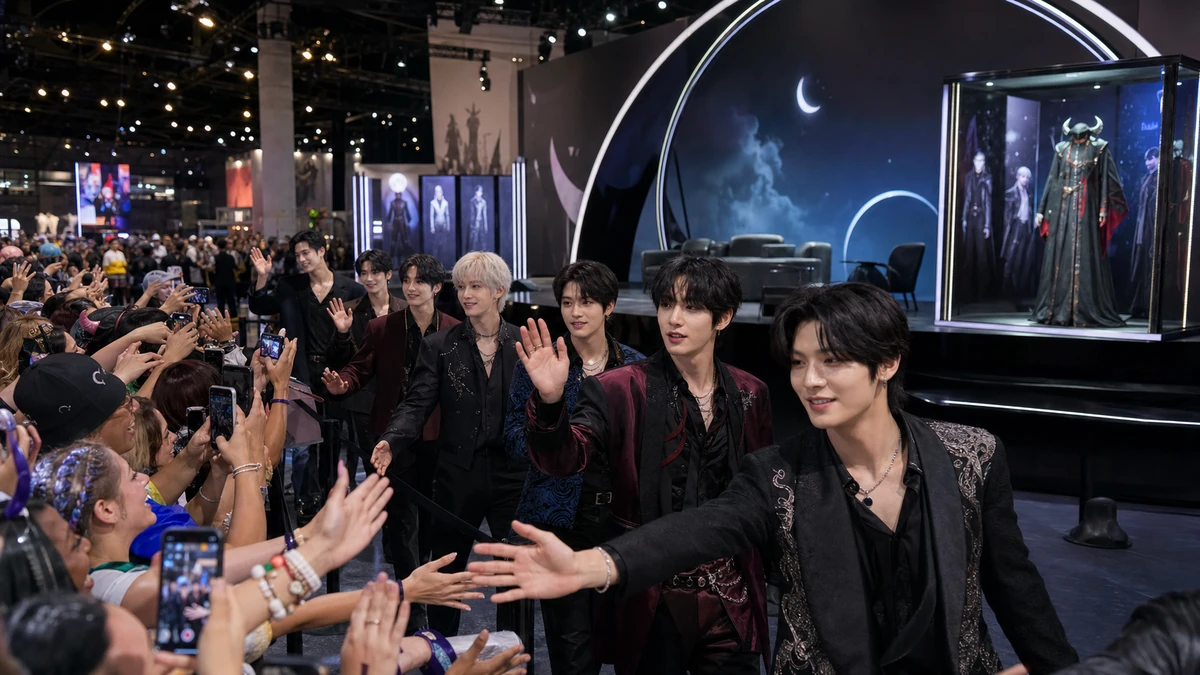
K-pop arrives at Comic-Con as more than a concert act
ENHYPEN, the seven-member K-pop group that has built a fast-growing international following, is set to take part in San Diego Comic-Con 2026, a move that says as much about where the global entertainment business is headed as it does about the group itself.
According to plans announced by its agency, BELIFT LAB, ENHYPEN will appear at the annual pop culture convention from July 23 to July 26 at the San Diego Convention Center. But this is not a simple celebrity stopover or a quick cameo designed to stir social media. The group is expected to take part in a dedicated booth tied to its story franchise “DARK MOON,” join a large panel discussion and stage its own performance. In other words, ENHYPEN is not just showing up as a musical guest. It is arriving as part of a broader fictional universe.
That distinction matters. For decades, Comic-Con has been a place where Hollywood studios preview superhero films, TV networks launch genre series and publishers introduce comic-book worlds to devoted fan communities. In recent years, it has also become a barometer for what counts as mainstream fandom in America. When an act like ENHYPEN participates not only with music but with a narrative property built around characters, mythology and online storytelling, it suggests K-pop is continuing to evolve in the United States from a niche import into a fully integrated pop culture force.
For American audiences who may know K-pop primarily through music videos, arena tours and polished choreography, ENHYPEN’s Comic-Con appearance offers a clearer view of how the Korean entertainment industry increasingly works. K-pop groups are no longer just releasing singles and albums. They are often at the center of elaborate multimedia ecosystems that can include webtoons, fictional lore, character franchises, merchandise, mobile content and serialized storytelling. The artist becomes part musician, part actor in an ongoing myth, part ambassador for a story world that fans can enter through multiple doors.
That strategy is especially visible in ENHYPEN’s case. The group’s upcoming Comic-Con schedule points to a larger shift now reshaping global fan culture: the merging of pop music with world-building usually associated with comic books, fantasy franchises and cinematic universes. For fans in Southern California, the timing is even more notable because ENHYPEN is also scheduled to perform a world tour concert at Snapdragon Stadium in San Diego on July 21, just days before the convention begins. The result is a week in which the group’s live music identity and its fictional identity will play out in the same city, back to back.
What “DARK MOON” means in the K-pop universe
At the center of ENHYPEN’s Comic-Con appearance is “DARK MOON,” an original story franchise developed by HYBE, the Korean entertainment company behind several major K-pop acts. If that sounds unfamiliar to American readers, it may help to think of “DARK MOON” less as a side project and more as a cross-platform intellectual property strategy — something closer in spirit to how Marvel, “Star Wars” or “The Hunger Games” can live across films, books, merchandise and fan communities, even if the scale and format are different.
In ENHYPEN’s case, “DARK MOON” includes titles such as “DARK MOON: THE BLOOD ALTAR,” “DARK MOON: TWO MOONS” and “Children of Vamfield by DARK MOON.” These works are tied together by a dark fantasy framework centered on vampires, a motif that has become one of ENHYPEN’s most recognizable thematic signatures. The stories are designed to complement the group’s music rather than exist separately from it. Images, symbols and recurring ideas flow between songs, performances and story content, allowing fans to piece together a larger narrative over time.
This is one of the more distinctive features of contemporary K-pop fandom, and it can be easy to miss from the outside. American pop stars often cultivate visual brands or recurring aesthetics from one album cycle to the next. K-pop companies, by contrast, frequently develop what fans call a “worldview” or “universe” — a sustained fictional framework that can deepen audience engagement far beyond the music itself. The practice turns listening into a form of participation. Fans do not simply hear a song; they decode clues, discuss symbolism and connect new releases to an evolving storyline.
That helps explain why ENHYPEN’s Comic-Con presence is significant. The group is not bringing an unrelated merchandising concept into the convention hall. It is bringing the narrative architecture that has helped define its artistic identity. A dedicated “DARK MOON” booth suggests the property can stand on its own as a story brand, not merely as decorative packaging for a music act. The panel discussion and performance then show how that world translates back into the group’s public persona and stagecraft.
For newcomers, the vampire element may seem like a stylized gimmick. But in practice, it functions as a bridge between multiple fandoms. A listener who first encounters ENHYPEN through music can move outward into fantasy storytelling. A Comic-Con attendee drawn to supernatural lore may discover the group through character and plot before ever streaming a song. That kind of cross-pollination is precisely what media companies increasingly want: audiences that circulate across formats rather than staying confined to one platform.
Why the vampire panel could resonate with American fans
One of the most intriguing events on ENHYPEN’s schedule is a July 23 conversation built around vampires, a theme that links the group’s “DARK MOON” universe to one of the most recognizable supernatural crazes in modern American pop culture. ENHYPEN members are slated to appear alongside Catherine Hardwicke, the director of the first “Twilight” film, as well as actors Peter Facinelli and Ashley Greene. Critic Demihan Holbrook is also expected to join the conversation.
That panel has the potential to be more than a novelty booking. In the United States, “Twilight” remains a defining cultural reference point for mainstream vampire storytelling in the 21st century. The franchise helped introduce a generation of young viewers to a highly romanticized, emotionally charged version of vampire mythology, one that blended teen angst, forbidden desire and fantasy danger into a global phenomenon. For many Americans, especially millennials, “Twilight” is shorthand for a specific era of fandom — midnight premieres, Team Edward versus Team Jacob debates and the rise of online fan communities that helped shape today’s social media-driven entertainment culture.
By putting ENHYPEN in conversation with figures associated with “Twilight,” Comic-Con is effectively inviting a cross-cultural discussion about how vampire stories travel and evolve. The source material is shared — immortality, seduction, danger, outsider identity — but the expression is different. “Twilight” came to American audiences primarily through novels and film. ENHYPEN’s take emerges through music, performance and web-based serialized storytelling. One belongs to the grammar of young adult publishing and Hollywood adaptation; the other belongs to the highly systematized, transmedia logic of the Korean idol industry.
That makes the panel symbolically rich, even if the final discussion turns out to be fan-friendly and light on academic analysis. It places a K-pop group’s fictional mythology on the same stage as a franchise that once dominated the American cultural conversation. It also reflects how Comic-Con now functions as a meeting ground not just for comics and movies, but for overlapping forms of storytelling that include streaming entertainment, celebrity fandom and internationally produced media ecosystems.
For ENHYPEN, the benefit is obvious. The group gets to frame its dark fantasy identity in language American audiences already recognize. For Comic-Con, the panel broadens the convention’s reach by showing that the future of pop culture storytelling is increasingly global, multilingual and platform-fluid. And for fans, it offers a chance to hear how artists working in different industries think about the same enduring myth.
From stage performance to story franchise
ENHYPEN’s participation in San Diego also underscores a broader transformation in what it means to be a K-pop act in the American market. Not long ago, success in the United States largely meant landing on Billboard, selling out a tour or appearing on late-night television. Those milestones still matter, but they are no longer the only markers of influence. Increasingly, the question is whether a group can build durable cultural presence across entertainment categories.
That is what makes the Comic-Con booking especially notable. ENHYPEN is expected to engage with visitors in at least three different ways: through a booth experience, through conversation and through live performance. Each serves a different purpose. The booth offers visual immersion, something akin to a museum-style or experiential brand activation where fans can encounter the fictional world directly. The panel creates interpretation, giving the group a forum to discuss themes and ideas rather than simply perform them. The concert component delivers the most familiar appeal: music, choreography and the kinetic energy that helped build the fandom in the first place.
Taken together, the structure resembles a layered media strategy more common to franchise entertainment than to conventional pop promotion. It suggests ENHYPEN is being positioned not only as a recording act but as a central access point into a larger entertainment property. In the streaming era, where attention is fragmented and fan loyalty is increasingly built through constant interaction, that kind of multidimensional presence can be more valuable than a one-off chart hit.
For Americans who have watched the explosion of cinematic universes, spin-offs and franchise branding over the last two decades, the logic is familiar. Hollywood learned that audiences often want not just a story but a world. K-pop companies have drawn a similar lesson, though they apply it with their own industry tools: rigorous idol training systems, highly coordinated visual rollouts, digital-first fan engagement and a willingness to develop narrative IP alongside music releases. ENHYPEN’s San Diego plans bring that model into one of the most recognizable fan spaces in the United States.
The group’s timing in San Diego sharpens that point. A stadium concert on July 21 highlights ENHYPEN in its most traditional role: pop performers meeting fans through songs and spectacle. The Comic-Con events that follow recast the members as participants in a narrative system, discussing and embodying a fictional universe attached to their work. The same audience, or at least overlapping parts of it, can experience both versions of the group within days.
What this says about HYBE and the business of fandom
Behind ENHYPEN’s Comic-Con appearance is a larger business story about how Korean entertainment companies are thinking globally. HYBE, like other major firms in the K-pop industry, has spent years expanding beyond music production into broader fan-platform, storytelling and IP development. That strategy is partly economic and partly cultural. Music alone can be unpredictable, especially in an industry where trends move fast and fan attention is highly competitive. Story worlds, by contrast, can generate long-term value across merchandise, publishing, digital content and live events.
In the United States, fans may be used to entertainment conglomerates that stretch brands across multiple sectors. Disney has long been the gold standard of that model, turning characters and stories into theme-park attractions, streaming content, consumer products and repeat theatrical events. HYBE is not Disney, and the comparison has limits. But the underlying ambition — to create entertainment ecosystems rather than isolated products — is increasingly visible.
With ENHYPEN, that ambition takes a particularly youth-oriented and internet-savvy form. “DARK MOON” does not replace the music; it amplifies the emotional framework around it. It gives fans another reason to stay engaged between releases, another set of details to analyze online and another pathway into the group’s identity. That is especially important in K-pop, where fandom is often organized, participatory and deeply communal. Fans stream songs, attend concerts, trade theories, create reaction content and treat each release as part of a continuing conversation.
Comic-Con is an ideal venue for that strategy because the convention already operates on a similar logic. It gathers communities that enjoy deep knowledge, character attachment, lore-building and shared enthusiasm for fictional worlds. ENHYPEN’s appearance effectively translates K-pop fandom into a language Comic-Con understands. The vampire lore, the dedicated booth, the panel conversation and the emphasis on story IP all make the group legible to attendees who may not closely follow Korean music but know exactly how to engage with a franchise.
There is also a soft-power dimension here. South Korea has spent the last two decades becoming one of the world’s most influential cultural exporters, thanks to a wave that includes K-pop, Korean dramas, film, beauty products and digital storytelling formats such as webtoons. American audiences may have first encountered that wave through acts like BTS or films like “Parasite,” then continued through streaming hits such as “Squid Game.” ENHYPEN’s Comic-Con moment fits within that larger arc. It reflects a Korea that is not just exporting songs or shows, but increasingly exporting storytelling systems and fan-engagement models.
Why San Diego matters this summer
There is a reason this news stands out even in a crowded global entertainment calendar: location matters. San Diego Comic-Con is not just another fan gathering. In the American imagination, it is the place where studios, creators and brands go when they want to make a statement about relevance in genre culture. To appear there with a dedicated franchise identity is, in effect, to claim a seat at the table of mainstream fandom.
For local fans in Southern California, ENHYPEN’s back-to-back scheduling creates a rare opportunity. A stadium show and Comic-Con appearance in the same city allow audiences to experience the group in two different registers — first as performers, then as world-builders. Someone who comes for the concert may decide to explore “DARK MOON.” Someone who encounters the booth or panel at Comic-Con may walk away curious about the music. The formats reinforce one another rather than compete.
That dynamic reflects one of the core strengths of K-pop’s global expansion: its ability to treat entertainment not as a single lane but as a network. Music, fashion, social media, lore and live events all feed the same engine. American pop culture has increasingly moved in that direction too, especially among younger audiences who jump seamlessly from TikTok clips to streaming playlists to fan theories on Reddit. ENHYPEN’s San Diego week feels well suited to that reality.
It may also mark a broader shift in how K-pop is framed in the United States. For years, coverage often focused on spectacle: synchronized dancing, passionate fandoms and impressive sales numbers. Those features remain true, but they tell only part of the story. The more revealing question now may be how K-pop acts participate in the architecture of global entertainment itself. ENHYPEN’s Comic-Con appearance provides one answer. The group is not simply entering American pop culture as a guest. It is contributing to one of its defining habits: the creation of immersive, expandable universes that keep fans invested across time and format.
That is why this is more than another international booking announcement. It is a case study in how music, mythology and fandom are increasingly fused. It is also a reminder that the Korean Wave — often discussed in terms of catchy choruses and addictive dramas — has matured into something broader and more structurally ambitious. If ENHYPEN’s San Diego plans play out as expected, the group will not just perform for Comic-Con. It will demonstrate how a K-pop act can function like a modern franchise, one capable of moving between concert stage, convention floor and fictional canon without losing its audience along the way.
For American fans, that makes ENHYPEN worth watching this summer whether or not they already know the group’s discography. Comic-Con has long rewarded curiosity, and ENHYPEN is arriving with a format built for exactly that instinct: come for the spectacle, stay for the lore.
Comments
Post a Comment