A South Korean City Expands Home-Based Elder Care, Offering a Glimpse of How Aging in Place Is Taking Shape in Korea
A local agreement with national implications
In a city hall meeting room in Iksan, a midsize city in South Korea’s southwestern North Jeolla province, local officials this month signed what might sound like a routine administrative agreement. But the deal points to something much bigger: how one of the world’s fastest-aging countries is trying to help older adults receive medical care without leaving home.
According to the city, Iksan on July 8, 2026, signed a business agreement with Gim Jehyeong Internal Medicine Clinic to join a pilot program known as a long-term care home medical center project. The purpose is straightforward but significant. Older adults and other long-term care beneficiaries with limited mobility will be able to receive visiting medical treatment, health management and linked long-term care services in their own homes rather than having to rely entirely on clinic visits or residential facilities.
For American readers, the broad idea may sound familiar. In the United States, policymakers, hospitals and elder-care advocates often use the phrase “aging in place” to describe efforts to help seniors remain in their homes and communities instead of moving prematurely into institutions. South Korea is now grappling with many of the same pressures that have shaped those debates in the U.S.: a rapidly growing elderly population, chronic disease, caregiver strain and rising concern over how to coordinate fragmented medical and support services.
What makes the Iksan agreement notable is not that it announces a sweeping national overhaul. It does not. The confirmed facts are narrower and more local: Iksan has added a new participating medical provider to an existing pilot program, strengthening its ability to offer care at home. But within that local move is a revealing picture of where Korean elder care is headed. The home is increasingly being treated not just as a place where an older person lives, but as a place where treatment, monitoring and daily support can be delivered together.
That shift matters in a society where older adults have often had to navigate care through separate lanes: one system for medical treatment, another for long-term assistance and still another for welfare support. By linking those pieces more closely, Iksan is attempting a practical, on-the-ground version of what many governments promise but struggle to build: coordinated community care.
Why home care is becoming a bigger issue in South Korea
South Korea’s aging story has unfolded with unusual speed. The country transformed in just a few generations from a war-scarred, lower-income nation into one of the world’s most advanced industrial economies. But that rapid rise has been accompanied by a demographic crunch. Korea has one of the world’s lowest birth rates and a growing share of older adults, creating mounting pressure on pensions, health systems and family caregiving structures.
In the past, elder care in Korea often depended heavily on family, especially adult children. Confucian traditions emphasizing filial duty still shape expectations around caring for parents and grandparents. But as in the United States, social realities have changed. Families are smaller. More women, who have historically shouldered much of caregiving, work outside the home. Younger relatives may live far away for jobs. And more seniors live with chronic conditions that require regular management rather than occasional treatment.
That has exposed the limits of a model built around either family care or repeated trips to hospitals and clinics. For seniors who have trouble walking, use wheelchairs, live with dementia or manage multiple illnesses, getting to a medical office can be exhausting and sometimes impossible without significant help. Transportation itself becomes a barrier to care. A doctor’s appointment is no longer just a visit; it can become an all-day logistical challenge involving relatives, taxis, ambulances or private transportation costs.
The Iksan pilot responds directly to that problem. The beneficiaries in question are long-term care recipients, meaning people who have been recognized as needing assistance because they have difficulty carrying out daily activities on their own. In practical terms, these are often older adults who need regular support with mobility, health management or personal care. Bringing services to them is not simply a matter of convenience. It can determine whether they receive care consistently at all.
For U.S. readers, it may help to think of this less as a luxury add-on and more as a local effort to bridge the gap between home health care, primary care and elder services. Korea’s system is organized differently from America’s Medicare-Medicaid landscape, but the underlying challenge is recognizable: What happens when a patient’s needs do not fit neatly into one silo?
The answer in Iksan is still experimental. This is a pilot project, not a final template. But even pilot programs can signal policy direction. And in this case, the direction is clear. Korean local governments are looking for ways to make care delivery more community-based, more coordinated and less dependent on institutional settings.
What changed in Iksan, and why the new clinic matters
Before this latest agreement, Iksan had already been operating the home medical service project in cooperation with two Korean medicine clinics: Seodong Korean Medicine Clinic and Somang Korean Medicine Clinic. Korean medicine, often referred to abroad as traditional Korean medicine, includes treatments such as acupuncture, moxibustion, herbal prescriptions and pain-focused supportive care. In Korea, it exists alongside Western-style medicine as part of a dual medical system that many outsiders find unfamiliar.
That context is important. For American audiences, the addition of Gim Jehyeong Internal Medicine Clinic means the pilot is no longer centered only on Korean medicine providers. It now includes an internal medicine practice, broadening the kinds of care that can be offered to homebound elderly patients.
Why does that matter? Because many long-term care recipients are not dealing with a single issue such as pain or mobility. They may have diabetes, high blood pressure, heart disease, frailty, respiratory problems or multiple chronic conditions at once. Internal medicine is especially relevant for managing those overlapping health concerns, reviewing medications, monitoring overall physical condition and addressing illnesses that require ongoing clinical oversight.
In that sense, the new agreement is more than an administrative expansion by one institution. It reflects a shift in the service mix. The city is moving from a narrower home-care arrangement toward a broader one that can respond to a wider range of medical needs. Officials described the change as a strengthening of the city’s service foundation, and that appears to be an accurate reading of the facts available.
Local governments often make progress in elder care through such incremental steps rather than dramatic launches. A city adds one clinic, deepens one partnership or improves one referral system. Those changes can sound modest. But for a homebound senior, the difference between having access only to limited supportive care and having access to broader medical evaluation may be the difference between catching a problem early and ending up in the emergency room later.
That may be one reason this case is worth watching. It shows how local Korean officials are trying to build layered care networks from the ground up, using the medical institutions already present in the community. Instead of expecting frail patients to fit the system, the system is being adjusted, at least in part, to reach patients where they live.
The idea of “integrated community care,” explained for a global audience
One phrase that appears central to the Iksan initiative is “integrated community care.” For readers outside Korea, that language can sound bureaucratic, but the underlying concept is simple. It means linking medical care, long-term care and daily living support so that older adults and others with care needs can continue living in familiar surroundings for as long as possible.
In Korea, this idea has gained traction as policymakers confront the reality that older adults do not experience their needs in separate categories. A person may need blood pressure monitoring, help bathing, medication management, meal support and occasional rehabilitation. If each service operates separately, the burden falls back on the patient and family to coordinate everything. That fragmentation often leads to missed care, duplicated effort and preventable decline.
Iksan’s elderly welfare chief, Lee Haeng-hee, said the city would use the new agreement to further strengthen a community-based integrated care system linking medical treatment, nursing care and caregiving. That statement captures the project’s central goal. This is not only about adding doctor house calls. It is about trying to connect the medical and nonmedical parts of care so that elderly residents can keep living where they have built their lives.
Americans will recognize the ambition even if the institutional details differ. In the U.S., similar goals appear in efforts to expand home- and community-based services, reduce unnecessary nursing home placement and improve coordination between hospitals, primary care doctors and social services. Programs like PACE, short for Program of All-Inclusive Care for the Elderly, or hospital-at-home experiments reflect some of the same instincts, though they operate in very different legal and insurance frameworks.
The Korean version also reflects a distinctive social concern: how to preserve ordinary daily life for elders in a country where neighborhood ties, familiar routines and a sense of place still carry deep meaning. To remain in one’s own home is not just a matter of personal preference. It is often tied to dignity, continuity and social belonging.
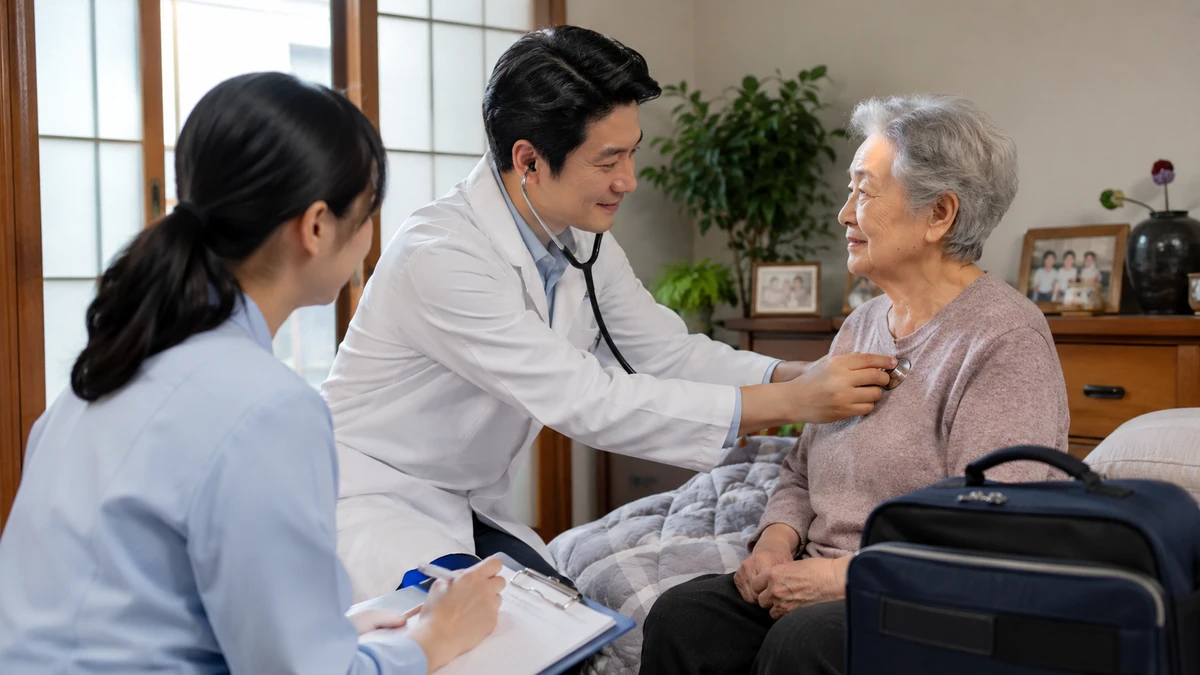
That is why the image at the center of this policy shift matters. In the traditional institutional model, care happens somewhere else: the hospital, the nursing facility, the clinic. In the community-care model, care is brought into the living space of the person who needs it. The home becomes the meeting point between medicine and support services. For a country under mounting demographic strain, that redefinition may prove increasingly important.
How Korean cultural context shapes the story
To understand why this kind of pilot draws attention in South Korea, it helps to look beyond policy language and consider the country’s social evolution. Korea still carries strong cultural expectations around respect for elders and responsibility toward aging parents. But those expectations now coexist with modern realities that make at-home family caregiving much harder to sustain on its own.
Many older Koreans want to remain in the neighborhoods where they spent decades raising children, shopping at local markets and building routines. In that sense, the aspiration behind Iksan’s program is universal. Most Americans, if asked where they would prefer to spend later life, would probably say somewhere familiar, close to their possessions, community and memories. Korea’s elderly population is no different.
Yet there is also a specifically Korean dimension. Korea’s health system is generally accessible and hospital-centered, and the country has a dense network of medical institutions compared with many rural parts of the U.S. Even so, physical access is not the same as practical access. A clinic may be nearby on a map, but if an 85-year-old person cannot easily leave home, the distance might as well be much greater.
The presence of Korean medicine clinics in the project also reflects a feature of Korean health culture that international readers may not immediately grasp. Many older Koreans are comfortable receiving both conventional medical treatment and Korean medicine, especially for pain management, musculoskeletal issues and general wellness support. By adding an internal medicine clinic rather than replacing Korean medicine providers, Iksan appears to be broadening its model rather than forcing a choice between medical traditions.
That kind of blended approach may be particularly appealing for elderly patients with complex needs. A senior living with arthritis, hypertension and reduced mobility might benefit from different kinds of intervention at different times. The important point in this story is not to debate medical philosophies, but to recognize that Iksan is trying to expand what is available within the home-care setting.
For global readers who tend to associate the Korean Wave, or Hallyu, with K-pop, hit dramas and beauty trends, this story offers another side of contemporary Korea: an aging society trying to redesign everyday care. It is a reminder that behind the export power of Korean culture is a country facing many of the same demographic and social challenges confronting the developed world.
What this means for families, patients and other countries watching
The practical value of home-based medical care is often easiest to understand at the family level. When an older adult has trouble leaving home, every medical visit can require a child to take time off work, a caregiver to arrange transportation or a patient to endure stress that worsens fatigue and confusion. Home visits can ease those pressures while also allowing providers to see the patient’s living conditions directly — something that office-based medicine often misses.
That can matter in subtle but important ways. A clinician visiting the home may notice fall hazards, poor nutrition, medication confusion or caregiver exhaustion. Those observations can shape care in a way that a brief clinic appointment cannot. For long-term care recipients, whose needs often stretch across health and daily function, that fuller picture is especially valuable.
Still, it is important not to overstate what the Iksan agreement does. There is no indication in the available facts that this local agreement by itself transforms Korea’s national system or guarantees rapid expansion elsewhere. The most accurate reading is that Iksan is reinforcing a pilot project at the city level by bringing in a new internal medicine provider and increasing the range of services available to elderly residents who qualify.
Even within those limits, the case speaks to a broader international question: how societies can care for aging populations without relying solely on hospitals and institutions. Japan, much of Europe and the United States are all wrestling with variations of that issue. Costs are high. Families are stretched. The supply of caregivers is limited. And most older adults prefer to remain at home if support can be made safe and reliable.
That is why small municipal agreements can be more revealing than they first appear. They show how policy becomes real — not in abstract white papers, but in local partnerships, provider networks and service arrangements that determine whether a frail person can see a doctor next week.
Lee, the Iksan official, said the city aims to help seniors continue healthy lives in the places where they have long lived. That may be the clearest summary of the project’s purpose. Not simply longer life, and not merely treatment, but the chance to remain rooted in familiar surroundings while receiving a more connected package of care.
For an American audience, the lesson from Iksan is easy to recognize. The future of elder care may depend less on building ever more centralized systems and more on bringing medicine, support and dignity to the front door. South Korea is still testing what that looks like in practice. In one provincial city, at least, the experiment is moving forward — one clinic, one agreement and one home at a time.
Comments
Post a Comment