South Korea Takes Its Rail Dispute to the People as Residents Near a Coastal Construction Zone Voice Noise and Business Loss Concerns
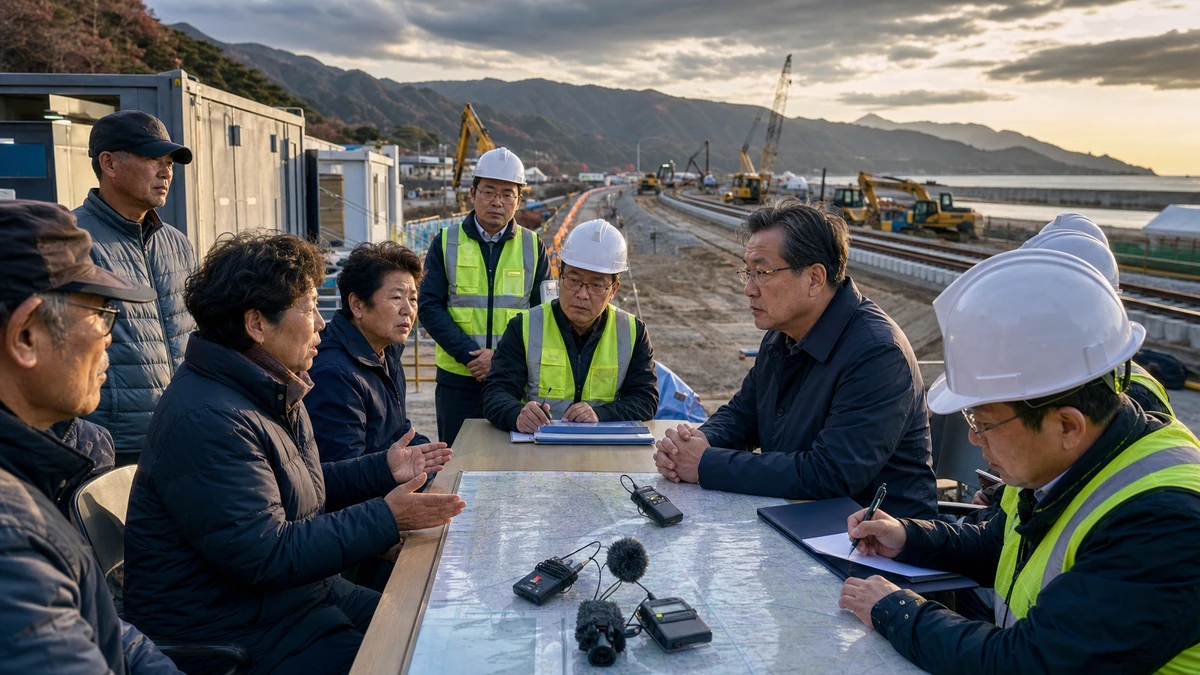
A government complaints office goes on the road
In the United States, people tend to think of government complaint systems as websites, hotlines or the occasional town hall. In South Korea, officials sometimes do something more visible: They physically take the complaints office to the people. That is what happened this week in Yangyang, a county on South Korea’s northeast coast, where the national government sent a mobile civil petition team to hear from residents affected by the construction of the Gangneung-to-Jejin railway.
The visit, organized by South Korea’s Anti-Corruption and Civil Rights Commission, was not a ribbon-cutting or a celebratory infrastructure event. It was a listening session centered on disruption: construction noise, business losses and the everyday strain that often comes when major public works arrive in smaller communities. According to the South Korean news agency Yonhap, Vice Chairperson and Secretary-General Han Sam-seok joined the field visit, met with project officials and listened directly to residents who said the railway construction had caused damage to their lives and livelihoods.
For readers outside Korea, the commission’s role may require some explanation. The Anti-Corruption and Civil Rights Commission is a national body that, among other things, handles public grievances and tries to mediate disputes between citizens and government agencies. It is not a direct equivalent to any single U.S. institution, but Americans might think of it as part ombudsman, part administrative watchdog and part mediator between the public and the bureaucracy. Its mobile outreach program, known in Korean as the “Running National Petition Office,” sends officials into communities to hear complaints on-site rather than requiring residents to navigate the process from afar.
That is a revealing detail in itself. South Korea is often presented abroad through the lenses of K-pop, blockbuster technology companies and Seoul’s fast-moving urban life. But this case in Gangwon Province, a region better known to many travelers for mountains, beaches and scenic rail trips, highlights another side of the country: the friction that can emerge when national development projects meet the rhythms of local life.
The railway project at the center of the dispute links Gangneung and Jejin, both on the country’s eastern side. The government session in Yangyang did not announce a final settlement, compensation package or construction change. The point, based on the information available, was more basic and perhaps more important in democratic terms: to hear residents out, document the problems and begin discussing possible remedies.
Why rail projects can symbolize progress and disruption at the same time
Large rail projects almost always come wrapped in the language of the future. They promise better mobility, stronger regional connections and the kind of infrastructure that can support tourism, commerce and long-term development. That framing is not unique to South Korea. Americans have seen similar debates play out around highway expansions, airport projects, new transit lines and high-speed rail proposals. Supporters emphasize what a project will deliver years from now. Critics, or simply those living closest to the construction, often measure the costs in immediate terms: traffic, dust, noise, lost parking, reduced foot traffic and business uncertainty.
The same split is evident in Yangyang. A railway can sound like modernization at the level of national planning. But at street level, it may feel like excavation, truck movements, blocked approaches and a dull daily stress that does not show up neatly in progress reports. Residents near the project reportedly raised two central complaints: noise and business losses. Those may sound like standard side effects of construction, but for the people dealing with them, they can shape everything from sleep quality to whether customers decide to stop by a store.
Noise is especially easy for governments and contractors to underestimate because it can be hard to communicate in paperwork. A resident who says a site is “too loud” is often describing more than a decibel reading. They may be talking about interrupted mornings, shaken windows, anxiety, children trying to study or the inability to rest during hours that used to be quiet. Business losses can be even harder to pin down. A shop owner may see fewer customers because roads feel inconvenient, because the area looks unwelcoming during construction or because regulars decide, even temporarily, that it is easier to go elsewhere.
In many countries, the politics of infrastructure turns on that divide between diffuse future benefits and concentrated present burdens. Everyone may eventually benefit from smoother transportation or stronger regional links. But only a smaller number of people absorb the direct pain while construction is underway. That imbalance does not necessarily mean a project should stop. It does mean governments have to show that they recognize the burden is not being shared equally.
That is what makes a field hearing like the one in Yangyang more than symbolic. If officials want public trust, they cannot treat the hardship of nearby residents as an unfortunate but private matter. They have to acknowledge that a project carried out in the public interest still creates private costs, and those costs need a public response.
What the Korean complaints process says about the state-citizen relationship
South Korea’s “Running National Petition Office” may sound unusual to English-speaking readers, but it reflects a broader expectation in Korean public life that government should be accessible, responsive and visibly present. The Korean term “Sinmungo,” often translated as a petition or grievance channel, carries historical echoes. In modern administrative use, it refers to a formal way for citizens to raise concerns with the state. The “running” version adds a practical twist: instead of waiting for complaints to move through digital portals and paperwork, the state comes directly to the affected site.
That matters in part because not all grievances are legible on paper. Officials can read a complaint about construction noise in an office hundreds of miles away, but they may not understand the emotional or economic texture of that complaint without visiting. How close are homes to the work zone? What does a commercial street look like when construction equipment moves in? How do residents, business owners and contractors describe the same stretch of road differently? Those are questions that become clearer when decision-makers stand in the place where the conflict is happening.
Han’s presence at the site underscored that point. When a senior official appears in person, the visit signals that the complaint process is not being treated as routine administrative traffic. It also creates a moment in which residents can see that their concerns have at least reached someone high enough in the system to elevate them. That does not guarantee results, and it should not be mistaken for a policy solution in itself. But in public administration, procedure often shapes legitimacy. People are more likely to accept difficult trade-offs if they believe they were heard in a serious way.
For American readers, the closest analogy might be a federal or state agency sending senior staff to a community forum near a major infrastructure project after residents complained about quality-of-life harm. The difference is that South Korea has institutionalized this in a recognizable traveling format. The mobile complaints office turns listening into an event and, in doing so, gives public visibility to grievances that might otherwise remain trapped in forms, local rumor or private frustration.
It also says something important about the Korean state. South Korea is a highly wired, highly centralized country with a reputation for speed and efficiency. Yet even there, governments still need face-to-face processes to manage the political and social costs of development. Technology can receive a complaint. It cannot, on its own, rebuild confidence when residents believe they are bearing too much of the burden.
Gangwon’s image versus the realities of living through development
Yangyang occupies a particular place in the imagination of modern South Korea. To many Koreans, and increasingly to foreign visitors, Gangwon Province evokes beaches, mountain scenery and a pace of life that feels far removed from the crush of Seoul. Yangyang itself has also drawn attention in recent years as a surf destination and an east coast getaway. But the tourism image of a place can conceal the everyday policy questions that shape how people actually live there.
That gap between image and reality is not unique to Korea. Americans know it from resort towns, coastal communities and scenic mountain regions where vacation marketing often obscures the basic pressures locals face, from housing and traffic to seasonal economies and infrastructure strain. In Yangyang, the issue now is not branding or tourism campaigns but what it means to build a large public project in a place where residents and small businesses are living through the disruption in real time.
One reason this story deserves attention beyond Korea is that it complicates a familiar global narrative. South Korea is often admired for its efficient transit systems and aggressive infrastructure planning. Those reputations are earned. But infrastructure does not simply materialize because planners decide it should. It has to be built in places where people already live, work, sleep and run businesses. The clean final image of a new rail connection usually omits the messier political and human process that precedes it.
The Yangyang hearing offers a glimpse of that process. The government’s acknowledgment of business losses is especially significant. Public debate around infrastructure often focuses on engineering and timelines, but small businesses tend to experience construction in immediate survival terms. A café, restaurant, convenience store or family-run shop may not be able to absorb a prolonged dip in customer traffic the way a larger company can. Even if compensation or mitigation is eventually considered, the period of uncertainty can be its own form of damage.
That is why local residents’ voices matter not only as a democratic formality but as a practical source of information. People who live near the site can identify problems that planners may have discounted or failed to anticipate. They can describe when noise is worst, when access becomes difficult and how commercial patterns have changed. In other words, they know where a project collides with daily life.
The limits of what is known and why caution matters
One of the most important facts in this case is what has not yet been announced. Based on the available reporting, the commission’s visit did not produce a definitive resolution. There was no public statement, at least in the source material summarized here, promising specific compensation standards, redesigns, schedule changes or mandated mitigation measures. The government’s position was that it had come to listen, to consult and to look for solutions.
That distinction matters. Too often, public coverage of grievance hearings implies that the act of listening is equivalent to solving the problem. It is not. Residents in Yangyang raised complaints about noise and business losses, and senior officials met them on-site. That is a meaningful administrative step. But it is still only a step. The test comes later, when agencies decide what evidence to accept, which harms are compensable, whether contractors must change their practices and how quickly any relief can be delivered.
Journalistically, this is where restraint is necessary. There is no basis, from the information at hand, to claim that relief is imminent or that the dispute is close to resolution. Nor is there enough evidence to quantify how widespread the hardship is, how many businesses have been affected or whether the construction plan itself will be altered. The most accurate reading is also the most modest one: the state has officially heard the complaints and opened a channel for direct discussion.
Still, even modest steps can be revealing. In democracies, public trust is often won or lost in the interval between complaint and response. If residents believe the visit was merely procedural theater, the hearing could deepen cynicism rather than reduce it. If they see evidence that officials gathered facts seriously and followed up with concrete adjustments, the meeting could become a model for how governments manage the unavoidable frictions of infrastructure work.
That is part of why stories like this matter. They may appear small compared with geopolitical headlines or sweeping policy announcements, but they show how states function at ground level. The quality of a government is not measured only by what it plans, but by how it handles the people who bear the costs of those plans.
A broader portrait of contemporary Korea beyond K-pop and headline politics
The Yangyang hearing also sits alongside other local stories that paint a broader picture of civic life in South Korea. Yonhap reported separately that Kim Hee-su, speaker of the Jeonbuk State Council, donated about 150 congratulatory flower arrangements from his inauguration to Beautiful Store, a social enterprise that plans to sell them and donate the proceeds to neighbors in need. In another local development, KT HCN and nine welfare institutions in Busan’s Dongnae and Yeonje districts launched a consultative body aimed at promoting welfare issues through media content and joint support efforts for vulnerable residents.
These are not the same story, and they should not be forced into one narrative. But they share a theme that often receives less international attention than South Korea’s entertainment exports or security concerns: the routine work of local governance, civil society and institutional response. In one case, it is a grievance process tied to construction. In another, a gesture of civic donation linked to social welfare. In yet another, a partnership between a company and welfare agencies to raise awareness of community needs.
Taken together, they suggest a Korea that is not only technologically sophisticated and culturally influential, but also deeply invested in everyday administration. That may sound unglamorous. It is also essential. A society’s resilience is built not only through economic growth or global visibility but through the mechanisms it uses to process complaints, redistribute resources and respond to local stress points.
For foreign audiences, especially those whose view of South Korea is shaped by Seoul skyscrapers, streaming hits and global brand names, stories like the one in Yangyang offer necessary texture. They show that modern Korea is not just a site of innovation and soft power. It is also a country where local residents challenge the side effects of state-led development, where public officials are expected to show up in person and where administrative legitimacy depends on being seen to listen.
That does not make South Korea unique. It makes it legible. Americans, too, know the tensions between growth and disruption, between public works and neighborhood burdens, between grand plans and street-level impacts. In that sense, the Yangyang case is highly specific to Korea yet broadly recognizable across democracies.
What comes next for residents, officials and the project itself
The next phase will determine whether this story remains a footnote in local administration or becomes a more consequential test of public accountability. Residents have now voiced their concerns through an official channel backed by a national commission. Project officials have been placed in direct conversation with those complaints. The question is whether that exchange produces measurable follow-through.
That could take several forms, though none were confirmed in the source material: closer review of business impacts, efforts to reduce or better schedule construction noise, improved communication with affected residents or additional consultations if disputes continue. In many infrastructure conflicts, the most valuable change is not always dramatic. Sometimes it is consistent information, predictable hours, clearer access routes or a transparent standard for evaluating damages. Sometimes, too, the most meaningful outcome is simply that residents no longer feel ignored.
But the burden is now on the government and relevant agencies to show that the mobile petition process leads somewhere tangible. A listening session without follow-up can harden frustration. A listening session with even partial, visible responses can help restore faith that the state does not regard local hardship as collateral damage beneath notice.
For English-speaking readers trying to understand why this matters, the simplest answer is this: infrastructure is never just concrete, steel and maps. It is a social contract. Governments ask communities to endure disruption today in exchange for promised public benefits tomorrow. That bargain only holds if people believe the state sees them not as obstacles, but as citizens whose losses and discomfort count.
In Yangyang, South Korea’s government made a point of showing up. That alone does not settle the tensions surrounding the Gangneung-to-Jejin railway construction. But it does make visible the administrative work required to keep ambitious public projects connected to democratic consent. Behind every rail line that eventually carries passengers smoothly from one city to another is a less glamorous reality: meetings, complaints, negotiations and the people living closest to the noise.
That reality is easy to miss from the outside. It is also where the meaning of modern governance is often found.
Comments
Post a Comment